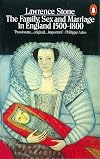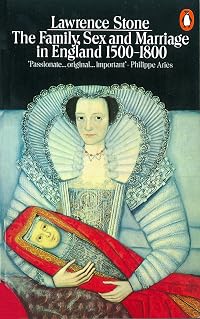
The Family, Sex and Marriage in England, 1500-1800
by Lawrence Stone
On This Page
Description
This book studies the evolution of the family from the sixteenth to the eighteenth century and how the process radically influenced child-rearing, education, contraception, sexual behaviour and marriage.Tags
Recommendations














Member Reviews
During the period 1500-1800, there were massive changes in world social and cultural systems, and the family unit as we recognize it today came into being. The emphasis on the individual, the right to personal freedoms and the desire for privacy developed during this period and were symptomatic of world wide shifts in attitude that also affected religion and politics. This text is a study of the evolution of the family, from the impersonal, economically-bonded and precarious extended family-group of the 16th century to the smaller, affectively-bonded nuclear unit that had appeared by the end of the 18th century, and shows how this process radically influenced child rearing, education contraception, sexual behaviour and marriage.
Ratings
Members
- Recently Added By
Published Reviews
ThingScore 75
The most critical change in world view and values ""possibly in the last thousand years of Western history"" is the shift from ""distance, deference and patriarchy"" to what Stone (best known for work in early modern English history) calls ""Affective Individualism."" In this massive, aptly illustrated book, he explains and analyzes the change, taking as example the development of the modern show more family. The 16th-century ""Open Lineage Family""--a cool economic and political calculation for the good of kin, community, and the male line--is replaced by the ""Restricted Patriarchal Nuclear Family"" (1550-1700), under pressure of an authoritarian state, patriarchal protestant theology, and Reformation upheaval to become a sterner agent of social control. In ""the great age of the whip"" children are ""broken"" for the good of their souls, wives for the pleasure of their husbands. Counter-trends toward greater freedom and equality (the recognition that coercion has limits) yield the ""Closed Domesticated Nuclear Family"" (1640-1800), increasingly egalitarian and affectionate, increasingly withdrawn from interests of kin and community. Husband, wife, and kids like one another better and the world less...[click on Kirkus Reviews for the rest of the review] show less
added by MsMixte
Lists

Books referenced in History by Numbers by Pat Hudson
88 works; 1 member

Books in the Bibliography of Contested Continent by Peter Mancall
495 works; 1 member
Author Information

29+ Works 1,370 Members
Stone teaches history at Princeton University. With his semi-Marxist perspective, he examines class relationships and ambitions as explanatory factors in sixteenth- and seventeenth-century English history. (Bowker Author Biography)
Awards and Honors
Notable Lists
Series
Belongs to Publisher Series
Work Relationships
Common Knowledge
- Original publication date
- 1977
- First words
- The subject of this book can be stated fairly simply.
- Last words
- (Click to show. Warning: May contain spoilers.)It is geographically, chronologically and socially a most restricted and unusual phenomenon, and there is as little reason to have any more confidence in its survival and spread in the future as there is in that of democracy itself.
Classifications
- Genres
- History, Nonfiction, General Nonfiction, Sexuality and Gender Studies
- DDC/MDS
- 306.8 — Society, government, & culture Social sciences, sociology & anthropology Social Behavior - Dating, Marriage, Divorce Marriage, partnerships, unions; family
- LCC
- HQ615 .S76 — Social sciences The family. Marriage, Women and Sexuality The Family. Marriage. Women The family. Marriage. Home
- BISAC
Statistics
- Members
- 273
- Popularity
- 118,317
- Reviews
- 1
- Rating
- (4.29)
- Languages
- English, Italian
- Media
- Paper
- ISBNs
- 7
- ASINs
- 6