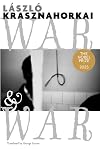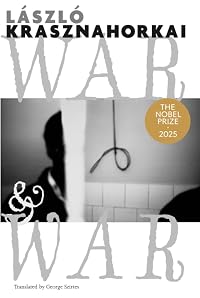
War and War
by Laszlo Krasznahorkai
On This Page
Description
"War & War, Laszlo Krasznahorkai's second novel in English from New Directions, begins at a point of danger: on a dark train platform Korim is on the verge of being attacked by thuggish teenagers and robbed; and from here, we are carried along by the insistent voice of this nervous clerk. Desperate, at times almost mad, but also keenly empathic, Korim has discovered in a small Hungarian town's archives an antique manuscript of startling beauty: it narrates the epic tale of brothers-in-arms show more struggling to return home from a disastrous war. Korim is determined to do away with himself, but before he can commit suicide, he feels he must escape to New York with the precious manuscript and commit it to eternity by typing it all on the world-wide web. Following Korim with obsessive realism through the streets of New York (from his landing in a Bowery flophouse to his moving far uptown with a mad interpreter), War and War relates his encounters with a fascinating range of humanity, a world torn between viciousness and mysterious beauty. Following the eight chapters of War and War is a short "prequel acting as a sequel," "Isaiah," which brings us to a dark bar, years before in Hungary, where Korim rants against the world and threatens suicide."--Publisher's website. show lessTags
Recommendations







Member Reviews
There aren't many works of fiction I've read--not since childhood, anyway--that left me feeling that the characters, settings,and events were real. This one did, which is probably why I can't get its details out of my head nor altogether shrug off the sadness it aroused. You'd think that the device of using sometimes very long sentences (which are so beautifully constructed that even if you stop reading in the middle of one, you'll very easily find your place again) with innumerable clauses would distance the reader from the stoty, but that's not at all the case here. I'm not sure how Krasznahorkai imparts so strong a sense of realness to his writing; he certainly doesn't take the obvious options like using description or dialogue to do show more so. Part of the effect might be due to the personalities of the main characters being displayed bit by bit and layer by layer: Korin, for example, is at first shown only as garrulous and obssessive, then quite pitiable and, gradually, becomes a learned and rather canny man who is in the end sympathetic rather than pathetic. And, in the end, the only thing that saved the book from being heart-breaking was the introduction of a few characters who also find Korin sympathetic enough to listen to.
There's a sort of epilogue, a closing section, to the book that I've a qualm or two about. Whilst its setting and happenings are wonderfully atmospheric, the tone and the content feel markedly different to what's gone before. The discrepancy doesn't exactly jar, but for me it momentarily blunted the impact of what preceded it. If I could somehow read War and War for the first time again knowing what I do now, I'd read the closing section before reading the rest of the book. And I most emphatically wouldn't have looked up the website mentioned until I'd reached the appropriate page.
Edit: I copied over this review fr. amazon where a poster told me that the epilogue was originally the beginning of the novel. Hope so. show less
There's a sort of epilogue, a closing section, to the book that I've a qualm or two about. Whilst its setting and happenings are wonderfully atmospheric, the tone and the content feel markedly different to what's gone before. The discrepancy doesn't exactly jar, but for me it momentarily blunted the impact of what preceded it. If I could somehow read War and War for the first time again knowing what I do now, I'd read the closing section before reading the rest of the book. And I most emphatically wouldn't have looked up the website mentioned until I'd reached the appropriate page.
Edit: I copied over this review fr. amazon where a poster told me that the epilogue was originally the beginning of the novel. Hope so. show less
OK, trying to collect some thoughts on War and War.
The weird thing is, as much as I was blown away by it, there are some things about it that annoy me. For one thing, there's the same issue (if for a slightly different reason) that I had with Pale Fire: that feeling that there's no firm ground to stand on in the novel - it's all related through the eyes of someone who's not entirely reliable even to himself. There are times when I wonder if that's not a cop-out on behalf of the writer - if there's any part that doesn't quite work, you can always claim that he meant for it to not work since Korin's a bit of a nut even when he's at his most relatable and, well, US. This is especially obvious in the coda, where Korin sounds at times like a show more caricature of a reactionary conspiracy theorist (noble and transcendant and transcendant and noble and...)
Thing is, though, it does work. I'm still not sure the coda is strictly necessary, but it does cast the novel into a starker light, separates the shadows from the open spaces like an old expressionist movie, brings out the themes that were lurking just under the surface. There's the prose, those huge labyrintine sentences that take me days to even get a hang of (once I do, I zoom through the novel in a few marathon sessions); sentences that are cast into the general mess of life like fishing lines with hundreds of hooks, dragging anything they catch up to the surface. Bob Dylan once said that he wrote "A Hard Rain's A-Gonna Fall" because he didn't think he'd have time to write all the songs he wanted to, so he just let every idea he had form one line, one line that could be spun off into an entire story, and turned them all into one song; Krasznahorkai does something similar here, though possibly in reverse.
The underlying theme of transcendance is a tricky one; on the one hand, with the coda in mind, you have Korin answering his own question - what's left in the world - not by finding the story (if that were the point, we'd get to read the story ourselves) but by telling it, finding someone who'll listen to him as he tells it to himself and tries to imbue it with himself. Of course, it also means he withdraws from society, and ironically fails to save the person who's become his one and only audience... or himself, of course. Unless that's what he does. I mean, at least I'll never forget him.
...which, of course, accompanies the theme of all the various timeskips; all the great peace efforts built on methods that require war, all the great churches built on power, all the great discoveries leading to oppression... Yeah, the road to hell is paved with good intentions, that's not news, but I've rarely seen it explored this insidiously; that there is, to nod to Pynchon, an inherent vice in all of humanity. (There's a horror novel lurking under the surface here someplace, an almost Lovecraftian one... that'd make Korin the mad Arab, I guess, but I digress.)
And then there's the sheer beauty of it. I keep going back to Part VI, chapter 1, the scene where movers come and empty the flat and then fill it again whie Korin and Maria just watch in confusion. All according to some plan.
..until, about four o'clock, the men departed and suddenly there was silence in the apartment, at which point, seeking an explanation, they began tentatively to open the boxes.
It's not a perfect novel. It'd be a crime to inflict a perfect novel on an imperfect world. It is a great novel, though.
That's all I got right now. And I'm not sure about any of it, but at least I'm sure about that. show less
The weird thing is, as much as I was blown away by it, there are some things about it that annoy me. For one thing, there's the same issue (if for a slightly different reason) that I had with Pale Fire: that feeling that there's no firm ground to stand on in the novel - it's all related through the eyes of someone who's not entirely reliable even to himself. There are times when I wonder if that's not a cop-out on behalf of the writer - if there's any part that doesn't quite work, you can always claim that he meant for it to not work since Korin's a bit of a nut even when he's at his most relatable and, well, US. This is especially obvious in the coda, where Korin sounds at times like a show more caricature of a reactionary conspiracy theorist (noble and transcendant and transcendant and noble and...)
Thing is, though, it does work. I'm still not sure the coda is strictly necessary, but it does cast the novel into a starker light, separates the shadows from the open spaces like an old expressionist movie, brings out the themes that were lurking just under the surface. There's the prose, those huge labyrintine sentences that take me days to even get a hang of (once I do, I zoom through the novel in a few marathon sessions); sentences that are cast into the general mess of life like fishing lines with hundreds of hooks, dragging anything they catch up to the surface. Bob Dylan once said that he wrote "A Hard Rain's A-Gonna Fall" because he didn't think he'd have time to write all the songs he wanted to, so he just let every idea he had form one line, one line that could be spun off into an entire story, and turned them all into one song; Krasznahorkai does something similar here, though possibly in reverse.
The underlying theme of transcendance is a tricky one; on the one hand, with the coda in mind, you have Korin answering his own question - what's left in the world - not by finding the story (if that were the point, we'd get to read the story ourselves) but by telling it, finding someone who'll listen to him as he tells it to himself and tries to imbue it with himself. Of course, it also means he withdraws from society, and ironically fails to save the person who's become his one and only audience... or himself, of course. Unless that's what he does. I mean, at least I'll never forget him.
...which, of course, accompanies the theme of all the various timeskips; all the great peace efforts built on methods that require war, all the great churches built on power, all the great discoveries leading to oppression... Yeah, the road to hell is paved with good intentions, that's not news, but I've rarely seen it explored this insidiously; that there is, to nod to Pynchon, an inherent vice in all of humanity. (There's a horror novel lurking under the surface here someplace, an almost Lovecraftian one... that'd make Korin the mad Arab, I guess, but I digress.)
And then there's the sheer beauty of it. I keep going back to Part VI, chapter 1, the scene where movers come and empty the flat and then fill it again whie Korin and Maria just watch in confusion. All according to some plan.
..until, about four o'clock, the men departed and suddenly there was silence in the apartment, at which point, seeking an explanation, they began tentatively to open the boxes.
It's not a perfect novel. It'd be a crime to inflict a perfect novel on an imperfect world. It is a great novel, though.
That's all I got right now. And I'm not sure about any of it, but at least I'm sure about that. show less
A tale of monomania?
War & War is a book within a book. For the most part it's the story of Korin the archivist, a somewhat unhinged free spirit, who unearths a manuscript of startling truth and beauty. Korin wants to publish his find on the internet (to make it "eternal"), and so he travels to New York, which for him is "the centre of the world".
Throughout the novel Korin reveals the contents of the manuscript as he talks endlessly to whoever will listen. The manuscript itself - the book within the novel - tells of the world-hopping exploits of four time-travellers and a mysterious other named Mastermann.
I enjoyed the writing style (i.e. the author's use of long sentences): it captures Korin's enlightened but overloaded mind. - What's show more it about? The search for lasting meaning, perhaps? A futile attempt to secure immortality? The melancholy that results from realising that man (no matter how much he wants it) cannot go beyond conflict?...
All in all I'd define it as a pessimistic novel about the final days of a homeless soul whose chance discovery and obsession with a unique manuscript dooms him. Difficult and frustrating at times, though enjoyable because of the protagonist's spirited innocence. show less
War & War is a book within a book. For the most part it's the story of Korin the archivist, a somewhat unhinged free spirit, who unearths a manuscript of startling truth and beauty. Korin wants to publish his find on the internet (to make it "eternal"), and so he travels to New York, which for him is "the centre of the world".
Throughout the novel Korin reveals the contents of the manuscript as he talks endlessly to whoever will listen. The manuscript itself - the book within the novel - tells of the world-hopping exploits of four time-travellers and a mysterious other named Mastermann.
I enjoyed the writing style (i.e. the author's use of long sentences): it captures Korin's enlightened but overloaded mind. - What's show more it about? The search for lasting meaning, perhaps? A futile attempt to secure immortality? The melancholy that results from realising that man (no matter how much he wants it) cannot go beyond conflict?...
All in all I'd define it as a pessimistic novel about the final days of a homeless soul whose chance discovery and obsession with a unique manuscript dooms him. Difficult and frustrating at times, though enjoyable because of the protagonist's spirited innocence. show less
This is an amazing novel, and unlike anything else I have ever read. It is amazing in its layers of story, its ideas, and its writing style, which consists of sections, often several pages long, each containing only one long sentence.
Korin, through whose mind we see most of the novel, is a former archivist in a town outside Budapest who, for reasons we don't know at first, has come to Budapest as the first leg of a journey to New York City, which he views as the center of the world. He is a man at the very least obsessed -- obsessed with his discovery in the midst of the archives of a manuscript that he believes will change the world, as well as with his own thoughts -- but also possibly quite deranged. His goal, once he gets to New show more York, is to type the entire manuscript and upload it to the internet so it will live forever, and then kill himself. But that is only the scaffolding on which this novel is hung.
Through Kraznahorkai's writing style, the reader gets inside Korin's mind, as well as the mind of the various other characters he encounters, from a gang of preteen criminals to a former beauty queen flight attendant to a security guard and an interpreter at JFK airport, and more. Mostly, though it is Korin's mind, and the thoughts and ideas just pour out of him in the form of seemingly endless sentences. Much of what he thinks about, and talks about, is the content of the manuscript, chapter by chapter.
And what is this manuscript about? On the surface, it is the story of four companions (Kasser, Bengazza, Falke, and Toót), possibly spies, possibly soldiers, definitely experts in defensive strategies, who appear and reappear in different historical times and places, from Crete on the eve of the volcanic eruption that destroyed Minoan civilization, to Cologne in the late 1800s, on the verge of a war with France, when the building of the cathedral was nearing completion (after having been left unfinished for centuries), to Venice, to Hadrian's Wall at the edges of the Roman empire in Britain (and apparently simultaneously in Portugal in 1493, awaiting the return of Columbus), and more. At each place, a mysterious man named Mastemann appears, and then disappears, seemingly involved in some imminent catastrophe. As I was struggling to figure out what this was all about, I reached this same questioning in Korin's narrative:
and beside that, why, in any case -- Korin's agitation was evident in his expression -- does he describe four characters with such extraordinary clarity then insert them at certain historical moments, and why precisely one moment rather than another, why precisely these four and not some other people; and what is this fog, this miasma, out of which he leads them time after time; and what is the fog into which he drives them; and why the constant repetition; and how does Kasser disappear at the end; and what is this perpetual, continuous secrecy about, and the ever more nagging impatience, increasing chapter on chapter, to discover who Mastemann is, and why each episode concerning him follows the same pattern, as does the narrative too; and, most important of all, why does the writer go completely mad, whoever he is . . ." p.202
As the novel progresses, Kraznohorkai provides a little more, a very little more, of Korin's background, which explains perhaps, his knowledge of history (I, on the other hand, was driven to Wikipedia and Google Translate many times throughout Korin's retelling of the manuscript). It seems that Korin is obsessed by the idea of borders between "civilization" and "barbarians," by the ends of certain phases of history and lost cultures, by the idea of someone evil (the devil?) pulling the strings without being seen, by art as the antidote to money, and by the dangerous idea of money representing goods instead of the goods themselves. But what this all means is as much a mystery to me as it apparently is to Korin.
In Korin's "real" life, as opposed to the fantasy world of the "manuscript" (which comes to seem to be a creation of Korin's imagination), he encounters people who help him (such as the flight attendant in Budapest), but a lot more people who are up to no good, including his mercurial and violent (to his girlfriend) Hungarian landlord; life in the modern world is brutal. He also constantly and endlessly tells otherl people what he is thinking about and what is going on in the manuscript, despite the fact that they completely ignore him (either because they don't understand Hungarian, like the landlord's Puerto Rican girlfriend) or because he appears mad.
Nonetheless, despite all this, Korin is a sympathetic character; he is clearly suffering, as well as mad. When he begins to get some sense of what the "manuscript" is all about, he thinks:
he, in his dense, stupid, unhealthy way had managed to grasp nothing, but nothing of it in the last few days, and the mysterious, cloudy, origins of the text, its powerful poetic energy, and the way it turned its back in the most decided manner on normal literary conventions governing such works, had deafened and blinded him, in fact as good as blasted him out of existence, like having a cannon fired at you, he said and shook his head, although the answer was right there in front of him all the time and he should have seen it, did in fact see it, and, furthermore, admired it, but had failed to understand it, failed to understand what he was looking at and admiring, meaning that the manuscript was interested in one thing only, and that was reality explored to the point of madness, and the experience of all those intense mad details, the engraving by sheer manic repetition into the imagination was, and he meant this literally, Korin explained, as if the writer had written the text not with pen and words but with his nails, scratching the text into the paper and into the mind, all the details, repetitions and intensifications making the process of reading more difficult, while the details it gave, the lists it repeated and the material it intensified was etched into the brain forever . . ." p. 174
Of course, if a book is entitled War and War, one thinks immediately of War and Peace. At first I found this puzzling, because at first there seemed to be no war in this book. But it becomes clearer that Korin perceives the world to be in a state of endless war, although peace is described as "the greatest, the highest, the supreme achievement of man," with the world of beauty represented here and there in the "manuscript" gone forever. In fact, there was a lot of beauty in some of the descriptions. I've only scratched the surface of this remarkable book, and I feel there was a lot that went by me as I read it. It is a challenging book to read, but well worth it.
As a final note, there were a few minor points that annoyed me because they were errors about New York City. For example, nobody arriving at JFK Airport in 1997 had to leave the plane by stairs and take a bus to the terminal as Korin does; the street in upper Manhattan is Fort Washington Avenue, not Washington Avenue; and Puerto Ricans are US citizens and do not have to cross illegally into the US without ID. But these, as I say, are small in the context of the whole. show less
Korin, through whose mind we see most of the novel, is a former archivist in a town outside Budapest who, for reasons we don't know at first, has come to Budapest as the first leg of a journey to New York City, which he views as the center of the world. He is a man at the very least obsessed -- obsessed with his discovery in the midst of the archives of a manuscript that he believes will change the world, as well as with his own thoughts -- but also possibly quite deranged. His goal, once he gets to New show more York, is to type the entire manuscript and upload it to the internet so it will live forever, and then kill himself. But that is only the scaffolding on which this novel is hung.
Through Kraznahorkai's writing style, the reader gets inside Korin's mind, as well as the mind of the various other characters he encounters, from a gang of preteen criminals to a former beauty queen flight attendant to a security guard and an interpreter at JFK airport, and more. Mostly, though it is Korin's mind, and the thoughts and ideas just pour out of him in the form of seemingly endless sentences. Much of what he thinks about, and talks about, is the content of the manuscript, chapter by chapter.
And what is this manuscript about? On the surface, it is the story of four companions (Kasser, Bengazza, Falke, and Toót), possibly spies, possibly soldiers, definitely experts in defensive strategies, who appear and reappear in different historical times and places, from Crete on the eve of the volcanic eruption that destroyed Minoan civilization, to Cologne in the late 1800s, on the verge of a war with France, when the building of the cathedral was nearing completion (after having been left unfinished for centuries), to Venice, to Hadrian's Wall at the edges of the Roman empire in Britain (and apparently simultaneously in Portugal in 1493, awaiting the return of Columbus), and more. At each place, a mysterious man named Mastemann appears, and then disappears, seemingly involved in some imminent catastrophe. As I was struggling to figure out what this was all about, I reached this same questioning in Korin's narrative:
and beside that, why, in any case -- Korin's agitation was evident in his expression -- does he describe four characters with such extraordinary clarity then insert them at certain historical moments, and why precisely one moment rather than another, why precisely these four and not some other people; and what is this fog, this miasma, out of which he leads them time after time; and what is the fog into which he drives them; and why the constant repetition; and how does Kasser disappear at the end; and what is this perpetual, continuous secrecy about, and the ever more nagging impatience, increasing chapter on chapter, to discover who Mastemann is, and why each episode concerning him follows the same pattern, as does the narrative too; and, most important of all, why does the writer go completely mad, whoever he is . . ." p.202
As the novel progresses, Kraznohorkai provides a little more, a very little more, of Korin's background, which explains perhaps, his knowledge of history (I, on the other hand, was driven to Wikipedia and Google Translate many times throughout Korin's retelling of the manuscript). It seems that Korin is obsessed by the idea of borders between "civilization" and "barbarians," by the ends of certain phases of history and lost cultures, by the idea of someone evil (the devil?) pulling the strings without being seen, by art as the antidote to money, and by the dangerous idea of money representing goods instead of the goods themselves. But what this all means is as much a mystery to me as it apparently is to Korin.
In Korin's "real" life, as opposed to the fantasy world of the "manuscript" (which comes to seem to be a creation of Korin's imagination), he encounters people who help him (such as the flight attendant in Budapest), but a lot more people who are up to no good, including his mercurial and violent (to his girlfriend) Hungarian landlord; life in the modern world is brutal. He also constantly and endlessly tells otherl people what he is thinking about and what is going on in the manuscript, despite the fact that they completely ignore him (either because they don't understand Hungarian, like the landlord's Puerto Rican girlfriend) or because he appears mad.
Nonetheless, despite all this, Korin is a sympathetic character; he is clearly suffering, as well as mad. When he begins to get some sense of what the "manuscript" is all about, he thinks:
he, in his dense, stupid, unhealthy way had managed to grasp nothing, but nothing of it in the last few days, and the mysterious, cloudy, origins of the text, its powerful poetic energy, and the way it turned its back in the most decided manner on normal literary conventions governing such works, had deafened and blinded him, in fact as good as blasted him out of existence, like having a cannon fired at you, he said and shook his head, although the answer was right there in front of him all the time and he should have seen it, did in fact see it, and, furthermore, admired it, but had failed to understand it, failed to understand what he was looking at and admiring, meaning that the manuscript was interested in one thing only, and that was reality explored to the point of madness, and the experience of all those intense mad details, the engraving by sheer manic repetition into the imagination was, and he meant this literally, Korin explained, as if the writer had written the text not with pen and words but with his nails, scratching the text into the paper and into the mind, all the details, repetitions and intensifications making the process of reading more difficult, while the details it gave, the lists it repeated and the material it intensified was etched into the brain forever . . ." p. 174
Of course, if a book is entitled War and War, one thinks immediately of War and Peace. At first I found this puzzling, because at first there seemed to be no war in this book. But it becomes clearer that Korin perceives the world to be in a state of endless war, although peace is described as "the greatest, the highest, the supreme achievement of man," with the world of beauty represented here and there in the "manuscript" gone forever. In fact, there was a lot of beauty in some of the descriptions. I've only scratched the surface of this remarkable book, and I feel there was a lot that went by me as I read it. It is a challenging book to read, but well worth it.
As a final note, there were a few minor points that annoyed me because they were errors about New York City. For example, nobody arriving at JFK Airport in 1997 had to leave the plane by stairs and take a bus to the terminal as Korin does; the street in upper Manhattan is Fort Washington Avenue, not Washington Avenue; and Puerto Ricans are US citizens and do not have to cross illegally into the US without ID. But these, as I say, are small in the context of the whole. show less
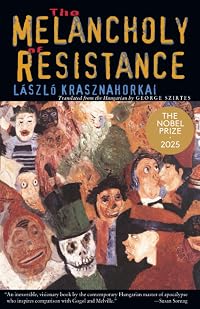
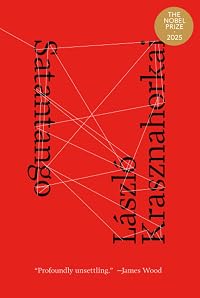
I usually don't like books with gimmicks: to me a book is good based on its writing, characters, plot, and what it has to say, and gimmicks usually don't add to those things- or at least don't add enough to justify themselves. War and War is a book with several gimmicks, and it's a testament to Krasznahorkai's skill as an author that the gimmicks have a point and add to the book. At the same time, they caused their own frustrations, and ultimately I didn't find this work as satisfying as The Melancholy of Resistance or Satantango.
The gimmick you'll notice first is that War and War is written in the form of extremely long sentences, some of which can go on for pages. I took this as a reflection of the main character's mental state, as show more he's none too stable, and more than a bit obsessed and confused. The run-on-sentences therefore mimics the breathless manic thoughts of the protagonist. This gimmick got old for me before even a third of the book was done, but because Krasznahorkai can continue each sentence indefinitely by just putting ", and" where a period would be, it doesn't detract much from the book (unlike, say, Perec's avoidance of the letter "e" in A Void, which forced him into writing a mess of a book). Even with these long run-on sentences the book is filled with striking images, though noticeably more in the early chapters of the book than later on.
The second gimmick is that the middle section of the book deals with a manuscript that the main character is typing up, but instead of ever reading any of this manuscript, Krasznahorkai gives us only the protagonist's descriptions of it, in the sentence style already discussed. This is the section where the book underwhelms, and unfortunately it's the section that needs to impress. The manuscript is supposed to be so impactful that it makes the main character abandon his entire life, sell all that he owns, and travel to the United States out of a belief that putting this manuscript on the internet will be a single action of value in an otherwise pointless life, and that after having fulfilled his purpose by transcribing the manuscript he will welcome death. Even if the character isn't mentally stable, the manuscript needs to be striking to make this believable. Instead, the main character's descriptions of the manuscript are mediocre. The four manuscript characters never feel distinct, the long sentence style of the book seems out of place when the manuscript is being described, and in general it was never as interesting as it needed to be. The middle segment where the manuscript is described is the weakest section of the book, and unfortunately it's also the longest.
The final gimmick reveals itself at the end of the book, whena website is given that appears to be the one containing the transcribed manuscript, and a plaque is revealed that indicates that the main character committed suicide. When you check out the website, however, you arrive at a mostly blank page saying that the information on the website has been erased for lack of payment. Again, I know what Krasznahorkai was doing with this, showing the fallacy of the main character's idea that something being on the internet makes it immortal, and rendering the actions of the main character even more tragic, but I didn't think that this gimmick added much either. One of the characters could have checked the website and found it erased, I don't think having the reader do it instead adds much.
Overall the early segments of War and War were the ones I liked the best, as they had some striking imagery and happened before the sentence gimmick started grating. Once the manuscript began getting described though, the book became far more of a slog. This is where the book should have really taken off and impressed. Unfortunately it did not, making this my least favorite Krasznahorkai book, below both Satantango and The Melancholy of Resistance. Still, being Krasznahorkai it was far more interesting than most books, and may be well worth your time, I just wish some aspects of the execution were better. show less
The gimmick you'll notice first is that War and War is written in the form of extremely long sentences, some of which can go on for pages. I took this as a reflection of the main character's mental state, as show more he's none too stable, and more than a bit obsessed and confused. The run-on-sentences therefore mimics the breathless manic thoughts of the protagonist. This gimmick got old for me before even a third of the book was done, but because Krasznahorkai can continue each sentence indefinitely by just putting ", and" where a period would be, it doesn't detract much from the book (unlike, say, Perec's avoidance of the letter "e" in A Void, which forced him into writing a mess of a book). Even with these long run-on sentences the book is filled with striking images, though noticeably more in the early chapters of the book than later on.
The second gimmick is that the middle section of the book deals with a manuscript that the main character is typing up, but instead of ever reading any of this manuscript, Krasznahorkai gives us only the protagonist's descriptions of it, in the sentence style already discussed. This is the section where the book underwhelms, and unfortunately it's the section that needs to impress. The manuscript is supposed to be so impactful that it makes the main character abandon his entire life, sell all that he owns, and travel to the United States out of a belief that putting this manuscript on the internet will be a single action of value in an otherwise pointless life, and that after having fulfilled his purpose by transcribing the manuscript he will welcome death. Even if the character isn't mentally stable, the manuscript needs to be striking to make this believable. Instead, the main character's descriptions of the manuscript are mediocre. The four manuscript characters never feel distinct, the long sentence style of the book seems out of place when the manuscript is being described, and in general it was never as interesting as it needed to be. The middle segment where the manuscript is described is the weakest section of the book, and unfortunately it's also the longest.
The final gimmick reveals itself at the end of the book, when
Overall the early segments of War and War were the ones I liked the best, as they had some striking imagery and happened before the sentence gimmick started grating. Once the manuscript began getting described though, the book became far more of a slog. This is where the book should have really taken off and impressed. Unfortunately it did not, making this my least favorite Krasznahorkai book, below both Satantango and The Melancholy of Resistance. Still, being Krasznahorkai it was far more interesting than most books, and may be well worth your time, I just wish some aspects of the execution were better. show less
War & War was less gripping, I thought, than Melancholy of Resistance, though that might just be about me: this one leaned a little too far towards self-obsessed-writer territory, which certainly can't be said about any of the other Krasznahorkai I've read. Here, a clerk reads a manuscript and decides it's so good that it must be put on the internet for all to read. We get the story of his going to New York, which he considers the center of the world, and also indirect description of the manuscript. I can't help thinking that the book was originally just the manuscript itself, and that Krasznahorkai ultimately decided that it needed a frame. He was probably right, though it is also enjoyable enough in its own right, with a typical show more Krasznahorkaian demonic type, and three more or less innocents, who keep bumping into each other at historically important moments: the end of the (I think) Minoan civilization; the discovery of the New World; Hadrianic Rome; and so on. He needed the frame to give these chapters a more definite shape.
As ever, the language is the main point, but the formal constraint (one sentence per section) really does work against the book. Whereas the long sentences in his earlier work are unintrusive, here you're constantly reminded that Krasznahorkai is a writer of long sentences. And the long sentences are too often too obviously just quite long sentence joined together with commas and conjunctions.
But the ideas are a little clearer here, in large part because the innocents in the MS are philosophically minded:
"...until Kasser picked up on the subject of pure love, that wholly pure love, the clear love, said Korin,a nd what was more, he added, the wholly pure love of which he spoke being resistence, the deepest and perhaps only noble form of revolt..."
And thanks to the frame-narrative structure, Krasznahorkai gets to have people comment on the MS with an obvious sense that they are also commenting on his own work:
"... the answer was right there in front of him all the time and he should have seen it, did in fact see it, and, furthermore, admired it, but had failed to understand it, failed to understand what he was looking at and admiring, meaning that the manuscript was interested in one thing only, and that was reality examined to the point of madness, and the experience of all those intense mad details, the engraving by sheer manic repetition of the matter into the imagination..."
"... once a sentence begin it doesn't want to stop, not because--let's put it this way--because it is about to fall off the edge of the world, not in other words as a result of incompetence, but because it is driven by some crazy form of rigor, as if its antithesis--the short sentence--led straight to hell..."
I do appreciate the characters-interpreting-texts bits, too. Nothing wrong with being explicit about what you're trying to do.
This edition also contains a short story, 'Isaiah has Come,' a kind of prequel to the novel. This is fine, but nowhere near as interesting as the novel itself, and, for some incomprehensible reason, has been typeset in a sans serif font that would make users of comic sans wince with embarrassment. show less
As ever, the language is the main point, but the formal constraint (one sentence per section) really does work against the book. Whereas the long sentences in his earlier work are unintrusive, here you're constantly reminded that Krasznahorkai is a writer of long sentences. And the long sentences are too often too obviously just quite long sentence joined together with commas and conjunctions.
But the ideas are a little clearer here, in large part because the innocents in the MS are philosophically minded:
"...until Kasser picked up on the subject of pure love, that wholly pure love, the clear love, said Korin,a nd what was more, he added, the wholly pure love of which he spoke being resistence, the deepest and perhaps only noble form of revolt..."
And thanks to the frame-narrative structure, Krasznahorkai gets to have people comment on the MS with an obvious sense that they are also commenting on his own work:
"... the answer was right there in front of him all the time and he should have seen it, did in fact see it, and, furthermore, admired it, but had failed to understand it, failed to understand what he was looking at and admiring, meaning that the manuscript was interested in one thing only, and that was reality examined to the point of madness, and the experience of all those intense mad details, the engraving by sheer manic repetition of the matter into the imagination..."
"... once a sentence begin it doesn't want to stop, not because--let's put it this way--because it is about to fall off the edge of the world, not in other words as a result of incompetence, but because it is driven by some crazy form of rigor, as if its antithesis--the short sentence--led straight to hell..."
I do appreciate the characters-interpreting-texts bits, too. Nothing wrong with being explicit about what you're trying to do.
This edition also contains a short story, 'Isaiah has Come,' a kind of prequel to the novel. This is fine, but nowhere near as interesting as the novel itself, and, for some incomprehensible reason, has been typeset in a sans serif font that would make users of comic sans wince with embarrassment. show less
Raczej nie. Pierwszy rozdział jeszcze się podobał, ale potem było źle, bardzo źle, coraz gorzej.
Members
- Recently Added By
Lists

Best Contemporary Literary Fiction (Around the Last 30 Years)
400 works; 124 members
Author Information

44+ Works 6,723 Members
László Krasznahorkai is an Hungarian Author who has won the 2015 Man Booker International Prize. The $117,600 biennial prize is awarded to a living author, whose body of work is available in English or English translation, in recognition of his or her contribution to fiction 'on the world stage'. (Bowker Author Biography)
Some Editions
Awards and Honors
Awards
Notable Lists
Work Relationships
Common Knowledge
- Canonical title
- War and War
- Original title
- Háború és háború
- Original publication date
- 1999
- People/Characters*
- György Korim
- Important places
- Hungary
- Original language*
- Hongaars
*Some information comes from Common Knowledge in other languages. Click "Edit" for more information.
Classifications
- Genres
- Fiction and Literature, General Fiction
- DDC/MDS
- 894.51134 — Literature & rhetoric Literatures of other languages Literatures of Altaic, Uralic, Hyperborean, Dravidian languages; literatures of miscellaneous languages of south Asia Finno-Ugric languages Ugric languages Hungarian Hungarian fiction 2000–
- LCC
- PH3281 .K8866 .H3313 — Language and Literature Uralic languages. Basque language Uralic. Basque Hungarian
- BISAC
Statistics
- Members
- 609
- Popularity
- 48,190
- Reviews
- 9
- Rating
- (4.02)
- Languages
- 11 — Dutch, English, French, German, Greek, Hebrew, Hungarian, Italian, Polish, Spanish, Turkish
- Media
- Paper, Ebook
- ISBNs
- 21
- ASINs
- 2