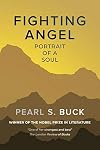
Fighting Angel
by Pearl S. Buck
On This Page
Description
Biography of the author's father.Tags
Recommendations

















Member Reviews
This is a biography of Buck's father who went to China as a missionary in the late 1800's--soon after the US Civil War-- and spent over fifty years there. This biography was specifically mentioned in the contributing works when Buck won her Nobel prize.
As always, Buck's descriptions of China, Chinese history, the Chinese people, and in this case, Buck's father are wonderfully evocative.
But the man himself, Andrew, was so on fire for his somewhat narrow religious doctrine that it burned out any room for anything else in his life. In his seventies, he wrote a short 25 page autobiography. He failed to mention his marriage, or any of his children; either those that lived or those that died.
He may have accomplished great things as a show more missionary, and was beloved by the Chinese people, but he was completely detached emotionally from his family.
As Buck says: "Andrew was somebody in a dream, a soul possessed, to whom life and the human heart had no importance. He never lived on earth. ....She (Buck wrote about herself in the third person in this book) did not blame Andrew, not really--but she felt herself fatherless. In after years she grew closer to him, as close as any human could, and came to understand and value him, to know why he was as he was, both great and small. But all that later knowlege cannot quite wipe away the bereavement of that hour. For Andrew's children were bereaved in what they never had, in what he could not give them, because he had given everything in him to God." (p135). show less
As always, Buck's descriptions of China, Chinese history, the Chinese people, and in this case, Buck's father are wonderfully evocative.
But the man himself, Andrew, was so on fire for his somewhat narrow religious doctrine that it burned out any room for anything else in his life. In his seventies, he wrote a short 25 page autobiography. He failed to mention his marriage, or any of his children; either those that lived or those that died.
He may have accomplished great things as a show more missionary, and was beloved by the Chinese people, but he was completely detached emotionally from his family.
As Buck says: "Andrew was somebody in a dream, a soul possessed, to whom life and the human heart had no importance. He never lived on earth. ....She (Buck wrote about herself in the third person in this book) did not blame Andrew, not really--but she felt herself fatherless. In after years she grew closer to him, as close as any human could, and came to understand and value him, to know why he was as he was, both great and small. But all that later knowlege cannot quite wipe away the bereavement of that hour. For Andrew's children were bereaved in what they never had, in what he could not give them, because he had given everything in him to God." (p135). show less
I really enjoyed this short biography of Pearl S. Buck's father, who worked as a missionary in China most of his life. It was a little strange because it was written extremely objectively, as if the author needed to put a lot of distance between herself and her subject. She refers to herself only as "Carie's daughter" although sometimes the pronoun "I' sneaks in as well.
The missionary's family lived in a remote part of China during famines, floods, and wars, including the Boxer rebellion and both revolutions. The picture of what China and the Chinese people were like at that time is clear and lovely, tinged with not a little nostalgia.
Andrew, the missionary, travels the countryside, converting the Chinese and setting up churches. He is show more absolutely certain that this is the right thing to do and he never questions his calling or that the Chinese may not wish to be converted. After many years of working with them, he becomes a respected elder and they call him "Old Teacher." This is a fascinating portrait of a man with many faults who never wavers from what he believes is right. show less
The missionary's family lived in a remote part of China during famines, floods, and wars, including the Boxer rebellion and both revolutions. The picture of what China and the Chinese people were like at that time is clear and lovely, tinged with not a little nostalgia.
Andrew, the missionary, travels the countryside, converting the Chinese and setting up churches. He is show more absolutely certain that this is the right thing to do and he never questions his calling or that the Chinese may not wish to be converted. After many years of working with them, he becomes a respected elder and they call him "Old Teacher." This is a fascinating portrait of a man with many faults who never wavers from what he believes is right. show less
FIGHTING ANGEL, The biography of the author's father, is a companion volume to THE EXILE, which is a biography of her mother. Together they form a work to be titled THE SPIRIT AND THE FLESH.
Romanian version, translated by Mircea Eliade
B
Feb 1, 2017Catalan
Ratings
Members
- Recently Added By
Author Information

433+ Works 37,132 Members
Pearl S. Buck, June 26, 1892 - March 6, 1973 Pearl Sydenstricker Buck was an American author, best know for her novels about China. Buck was born on June 26, 1892, in Hillsboro, West Virginia, but as the daughter of Presbyterian missionaries she was taken to China in infancy. She received her early education in Shanghai, but returned to the United show more States to attend college, and graduated from Randolph-Macon Woman's College in Virginia in 1914. Buck became a university teacher there and married John Lossing Buck, an agricultural economist, in 1917. Buck and her husband both taught in China, and she published magazine articles about life there. Her first novel East Wind, West Wind was published in 1930. Buck achieved international success with The Good Earth, which won the Pulitzer Prize in 1932. This story of a Chinese peasant family's struggle for survival was later made into a MGM film. Buck resigned from the Presbyterian Board of Foreign Missions after publishing an article that was critical of missionaries. She returned to the United States because of political unrest in China. Buck's novels during this period include Sons, A House Divided, and The Mother. She also wrote biographies of her father (Fighting Angel) and her mother (The Exile). She won the Nobel Prize for Literature in 1938. During her career, Buck published over 70 books: novels, nonfiction, story collections, children's books, and translations from the Chinese. She also wrote under the pseudonym John Sedges. In the United States, Buck was active in the civil rights and women's rights movements. In 1942 she founded the East and West Association to promote understanding between Asia and the West. In 1949, Buck established Welcome House, the first international interracial adoption agency. In 1964, she established the Pearl S. Buck foundation to sponsor support for Amerasian children who were not considered adoptable. Pearl Buck died in Danbury, Vermont, on March 6, 1973. (Bowker Author Biography) show less
Some Editions
Work Relationships
Common Knowledge
- Canonical title
- Fighting Angel
- Original title
- Fighting Angel
- Original publication date
- 1936
Classifications
- Genres
- Biography & Memoir, Fiction and Literature
- DDC/MDS
- 813.52 — Literature & rhetoric American literature in English American fiction in English 1900-1999 1900-1945
- LCC
- BV3427 .S85 .B8 — Philosophy, Psychology and Religion Practical Theology Practical Theology Missions Missions in individual countries
- BISAC
Statistics
- Members
- 229
- Popularity
- 141,700
- Reviews
- 5
- Rating
- (3.67)
- Languages
- 10 — Danish, Dutch, English, Finnish, French, German, Italian, Norwegian (Bokmål), Norwegian, Spanish
- Media
- Paper, Ebook
- ISBNs
- 23
- ASINs
- 27