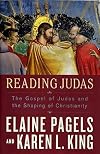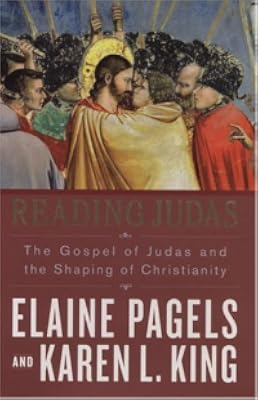
Reading Judas: The Gospel of Judas and the Shaping of Christianity
by Elaine Pagels, Karen L. King
On This Page
Description
Evaluates the meaning of the controversial newly-discovered Gospel of Judas, illustrating how the text offers an understanding of Judas's betrayal, the apostles' understanding of Jesus's death, and God's role in the crucifixion.Tags
Recommendations







Member Reviews
The Gospel of Judas presents, for most modern readers, an unfamiliar and uncomfortable portrait of the relationship between Jesus and Judas Iscariot. Perhaps Judas was not betraying Jesus, but instead was the only enlightened disciple, who understood that all evils all lay in the material world, and the true believers would transcend it to a higher spiritual realm once they realized that. Therefore the crucifixion would have meant very little - the true spiritual Jesus merely 'shedding' his vulgar skin - and Judas played an integral part in this plot.
Such Christian Gnosticism had been condemned as heretical in the proto-orthodox early church, but was popular among many Christians, especially persecuted ones. It's easy to see its show more popularity: suffering is temporary, as long as the spiritual self remains unblemished, spiritual salvation is all that matters. On the other hand, the ones doing the persecution at present will be damned to their own material and evil world. This seems to have been the society in which the Gospel of Judas was written, due to its condemnation of the 'other' apostles and support of Judas.
Reading Judas includes the full text of the Gospel, a verse-by-verse commentary, and several chapters detailing the situation and conflicts of the early Christian church. Even though the gospel is placed somewhat near the end of the book, readers should read it first to have a better sense of what's going on in the other chapters. It's a very clear and concise look at this alternate Christianity in the first few centuries of the church - a testament that the religion was hardly a harmonious movement but rather many people with many theologies adjusted to their own social climate. show less
Such Christian Gnosticism had been condemned as heretical in the proto-orthodox early church, but was popular among many Christians, especially persecuted ones. It's easy to see its show more popularity: suffering is temporary, as long as the spiritual self remains unblemished, spiritual salvation is all that matters. On the other hand, the ones doing the persecution at present will be damned to their own material and evil world. This seems to have been the society in which the Gospel of Judas was written, due to its condemnation of the 'other' apostles and support of Judas.
Reading Judas includes the full text of the Gospel, a verse-by-verse commentary, and several chapters detailing the situation and conflicts of the early Christian church. Even though the gospel is placed somewhat near the end of the book, readers should read it first to have a better sense of what's going on in the other chapters. It's a very clear and concise look at this alternate Christianity in the first few centuries of the church - a testament that the religion was hardly a harmonious movement but rather many people with many theologies adjusted to their own social climate. show less
This one was a bit odd in its quality. The first half of the book is text co-authored by Pagels and King, and there I would give it at best 3½***. Not bad, but this textual discussion of this heterodox second-century scripture is a bit light-weight. It's not really so much an analysis of the scripture text as it is a multi-chapter general introduction running roughly a hundred pages.
What's really excellent, though, is the second portion of the book, consisting of King's translation of Judas accompanied by a fairly comprehensive end-note commentary on the text by King (substantially longer than the scriptural text itself), and here I'd give it at least 4½**** or even 5*****
Judas would have been written in the mid-second century. It show more couldn't have been later because it is one of the heterodox scriptures condemned by St Irenaeus of Lyon in Against Heresies {Wikipedia}, which itself was written around 180CE, Irenaeus dying a martyr just about the turn of the century; and it definitely postdates the canonical gospels (Mark, Matthew, Luke, and John) because it was written in response to and criticism of these canonical gospels.
There seems to be some expectation that Judas could be an antidote to the sometime anti-Semitism of the canonical gospels (especially John), but that's not the case. In fact, there's no reference in Judas to a Roman execution of Jesus – the Jewish leadership alone is implicated. Judas also might prove offensive to current-day readers for its snide references to homosexuality.
The significance of Judas is that it condemns orthodoxy's glorification of martyrdom, equating this to "blood sacrifice"; rejects atonement theology (Jesus died for the sins of the world), seeing this as a hideous "child sacrifice" theology; and denies a physical, bodily resurrection of the dead. Instead, resurrection is a spiritual resurrection (which isn't necessarily entirely contrary to the resurrection theology of the genuine Pauline letters) – but this isn't docetism {Wikipedia}, which denies the humanity of Jesus or of the suffering of his human body.
It would be too lengthy and complicated a discussion to completely summarize King's treatment of Judas. Suffice it to say that this heterodox scripture treats the "traitor" apostle as the only one who really "got it right" – he "betrays" Jesus at Jesus's own direction in order that Jesus can fulfill his destiny of dying to give an example of exactly how a spiritual resurrection will occur. Those who truly understand this message and live a life consistent with it will themselves be spiritually resurrected while the rest of humanity will simply die (i.e., no eternal lake of hellish fire, or whatever).
Judas, though, seems not to reject martyrdom entirely. Yes, die if need be as a result of your spreading the message of Jesus (Judas himself is finally stoned by the other apostles); but don't expect it to be an "express ticket" to heaven or to any bodily resurrection, don't claim that "the blood of martyrs is the seed of the church," and reject atonement theology. show less
What's really excellent, though, is the second portion of the book, consisting of King's translation of Judas accompanied by a fairly comprehensive end-note commentary on the text by King (substantially longer than the scriptural text itself), and here I'd give it at least 4½**** or even 5*****
Judas would have been written in the mid-second century. It show more couldn't have been later because it is one of the heterodox scriptures condemned by St Irenaeus of Lyon in Against Heresies {Wikipedia}, which itself was written around 180CE, Irenaeus dying a martyr just about the turn of the century; and it definitely postdates the canonical gospels (Mark, Matthew, Luke, and John) because it was written in response to and criticism of these canonical gospels.
There seems to be some expectation that Judas could be an antidote to the sometime anti-Semitism of the canonical gospels (especially John), but that's not the case. In fact, there's no reference in Judas to a Roman execution of Jesus – the Jewish leadership alone is implicated. Judas also might prove offensive to current-day readers for its snide references to homosexuality.
The significance of Judas is that it condemns orthodoxy's glorification of martyrdom, equating this to "blood sacrifice"; rejects atonement theology (Jesus died for the sins of the world), seeing this as a hideous "child sacrifice" theology; and denies a physical, bodily resurrection of the dead. Instead, resurrection is a spiritual resurrection (which isn't necessarily entirely contrary to the resurrection theology of the genuine Pauline letters) – but this isn't docetism {Wikipedia}, which denies the humanity of Jesus or of the suffering of his human body.
It would be too lengthy and complicated a discussion to completely summarize King's treatment of Judas. Suffice it to say that this heterodox scripture treats the "traitor" apostle as the only one who really "got it right" – he "betrays" Jesus at Jesus's own direction in order that Jesus can fulfill his destiny of dying to give an example of exactly how a spiritual resurrection will occur. Those who truly understand this message and live a life consistent with it will themselves be spiritually resurrected while the rest of humanity will simply die (i.e., no eternal lake of hellish fire, or whatever).
Judas, though, seems not to reject martyrdom entirely. Yes, die if need be as a result of your spreading the message of Jesus (Judas himself is finally stoned by the other apostles); but don't expect it to be an "express ticket" to heaven or to any bodily resurrection, don't claim that "the blood of martyrs is the seed of the church," and reject atonement theology. show less
In Christian history, Jesus Christ gathered twelve people to his side to be his apostles and spread his beliefs throughout the world. According to The Bible, Judas Iscariot accepts payment of thirty silver coins from the Sanhedrin priests and agrees to point out Jesus to the local authorities so that he can be captured and tried for purporting to be the Son of God. Judas’s betrayal results in the trial, crucifixion, and resurrection as depicted later in the Gospels. The traditional telling of this matter is done by the four Gospels—Matthew, Mark, Luke, and John--, but what if Judas himself got a say in the matter? In the 1970s, a papyrus codex was discovered near Beni Masah, Egypt which appears to be from Judas’s point of view. In show more Reading Judas, Elaine Pagels and Karen King tackle the new text to see if it can shed new light on old mythology.
There are a lot of things to learn from a shredded piece of paper from 1,700 years ago. First, Christianity was, is, and will always be an infinitely nuanced and an infinitely personal set of beliefs. Each iteration of the religion in each person begets a new system. In the Bible, each voice has a different Christianity, and in this new text, we hear the voice of the oft-reviled Judas Iscariot. The text is short, but packed with historical details, research, and annotations to the original document. It is a Coptic translation of a 2nd century Greek text, so things can definitely get lost through the years. Judas’s act, seen through Gnostic eyes, is one of love and loyalty, setting in motion the inevitable resurrection of his friend and the salvation of mankind.
Pagels’s and King’s text is nice and tight. They know that not everyone will be pleased to read about the “good” deeds of Judas Iscariot. Traditionalists will see this as a deliberate blurring of the lines between good and evil, but the codex is still a legitimate piece of history. Scholars can debate among themselves about the literal meanings of certain words and phrases, but they are more qualified than I in this matter. Overall, this was a very interesting book that illuminates a rather shady character in the Bible. show less
There are a lot of things to learn from a shredded piece of paper from 1,700 years ago. First, Christianity was, is, and will always be an infinitely nuanced and an infinitely personal set of beliefs. Each iteration of the religion in each person begets a new system. In the Bible, each voice has a different Christianity, and in this new text, we hear the voice of the oft-reviled Judas Iscariot. The text is short, but packed with historical details, research, and annotations to the original document. It is a Coptic translation of a 2nd century Greek text, so things can definitely get lost through the years. Judas’s act, seen through Gnostic eyes, is one of love and loyalty, setting in motion the inevitable resurrection of his friend and the salvation of mankind.
Pagels’s and King’s text is nice and tight. They know that not everyone will be pleased to read about the “good” deeds of Judas Iscariot. Traditionalists will see this as a deliberate blurring of the lines between good and evil, but the codex is still a legitimate piece of history. Scholars can debate among themselves about the literal meanings of certain words and phrases, but they are more qualified than I in this matter. Overall, this was a very interesting book that illuminates a rather shady character in the Bible. show less
A very well organized and thoughtful book. The authors discussed the Gospel, the Tchacos Codex it was part of, other "Gnostic" texts and early Christian writings, and books of the New Testament. They then present the Gospel in its entirety and after discuss each line or groups of lines as appropriate. There are also extensive footnotes.
It confirms the "conspiracy" of the early church fathers in eliminating anything that didn't promote their consolidation of power and dogma. As Pagels and King point out, it was necessary from their point of view for survival of their 'sect', but as a non-Christian who sees the harm done to the message of Jesus I can only be sorry that so many of the other gospels and Christian writings of the early years show more didn't make it into the "New Testament". They quote many of these documents - some I've heard of, some not, so I have some areas to research too.
I am sad that the Codex fared so badly after its initial discovery - there are so many missing lines and even parts of pages because of poor handling. Pagels and King have done a careful, insightful, emotive job in writing about The Gospel of Judas. show less
It confirms the "conspiracy" of the early church fathers in eliminating anything that didn't promote their consolidation of power and dogma. As Pagels and King point out, it was necessary from their point of view for survival of their 'sect', but as a non-Christian who sees the harm done to the message of Jesus I can only be sorry that so many of the other gospels and Christian writings of the early years show more didn't make it into the "New Testament". They quote many of these documents - some I've heard of, some not, so I have some areas to research too.
I am sad that the Codex fared so badly after its initial discovery - there are so many missing lines and even parts of pages because of poor handling. Pagels and King have done a careful, insightful, emotive job in writing about The Gospel of Judas. show less
This is a fun one. Short and sweet, Karen and Elaine share their unique interpretation of this fascinating discovery. Scholars of the gospel of Judas would never consider it mainstream Christianity ... can any book who paints a Christian villian as a hero be mainstream? ... and yet, there remains a lot of controversy about exactly how to classify that ancient Gospel. Part of the problem, of course, is that it's far from complete; and while that's certainly not the fault of Pagels and King, it does disrupt the readability of their book when pieces of the manuscript are missing.
The subtitle of the book is "The Gospel of Judas and the Shaping of Christianity." This discussion of early Christianity is, precisely, what makes the Pagels/King show more book interesting. They delve into the conflict between Paul and Peter, and how later writers (such as the book of Acts) purposefully glossed over this conflict in an attempt to bring unison.
The book is in two parts: First, a discussion of the gospel and it setting, and second, an interpretation of the gospel itself with commentary. Karen King translates it herself, and their understanding is unique, quite different from other coverage of the gospel of Judas, as they are unafraid to give serious attention to alternative strands of Christianity and their meaning of the cross, the suffering of martyrs, and of Jesus' divinity. These were important topics in the early years of Christianity, and Christians today are, for the most part, quite unaware of the divisive strands that existed in those days.
Pagels and King do present controversial views (I found myself often disagreeing), but regardless of your beliefs or opinions, this is a fascinating read about an equally fascinating topic. show less
The subtitle of the book is "The Gospel of Judas and the Shaping of Christianity." This discussion of early Christianity is, precisely, what makes the Pagels/King show more book interesting. They delve into the conflict between Paul and Peter, and how later writers (such as the book of Acts) purposefully glossed over this conflict in an attempt to bring unison.
The book is in two parts: First, a discussion of the gospel and it setting, and second, an interpretation of the gospel itself with commentary. Karen King translates it herself, and their understanding is unique, quite different from other coverage of the gospel of Judas, as they are unafraid to give serious attention to alternative strands of Christianity and their meaning of the cross, the suffering of martyrs, and of Jesus' divinity. These were important topics in the early years of Christianity, and Christians today are, for the most part, quite unaware of the divisive strands that existed in those days.
Pagels and King do present controversial views (I found myself often disagreeing), but regardless of your beliefs or opinions, this is a fascinating read about an equally fascinating topic. show less
Excellent story! Another piece in the puzzle of the mosaic that makes up early Christianity. I am sure fundies will be upset by this, but rationalists will see how history and Old Testament prohicies were manipulated to creat the Catholic Church in the image of Paul. INteresting read. I could not put it down during a brief wait and a three hour flight home for a wedding. Pagels and King are great collaborators, and the text discussion was well-documented.
Jim 3/15/07
Jim 3/15/07
Not so much a book as an extended essay, this short work has some interesting things to say about this newly restored Gospel.
Chiefly, Pagels and King see this gospel as a response to the support of martyrdom that the early church fathers gave. Repeatedly, they refer to the thinly veiled "anger" of the author at the suggestion that somehow being tortured and killed was the best way to get closer to God.
The gospel itself, translated and annotated here, is strange and different. There are some angels and celestial beings that play an active role, and all of this reality seems to be handled by their caprice, as some sort of flawed proxy of the ultimate creator. Very strange indeed. I hadn't met that cast of characters before, or that show more particular vision of Christian cosmology.
Interesting, scholarly...without a whiff of any of the sensationalism that has accompanied this text since its reintroduction into the light after 1500 or so years. show less
Chiefly, Pagels and King see this gospel as a response to the support of martyrdom that the early church fathers gave. Repeatedly, they refer to the thinly veiled "anger" of the author at the suggestion that somehow being tortured and killed was the best way to get closer to God.
The gospel itself, translated and annotated here, is strange and different. There are some angels and celestial beings that play an active role, and all of this reality seems to be handled by their caprice, as some sort of flawed proxy of the ultimate creator. Very strange indeed. I hadn't met that cast of characters before, or that show more particular vision of Christian cosmology.
Interesting, scholarly...without a whiff of any of the sensationalism that has accompanied this text since its reintroduction into the light after 1500 or so years. show less
Members
- Recently Added By
Lists

Mike's Theology Books
74 works; 2 members

Nonfiction
41 works; 1 member
Author Information

32+ Works 15,541 Members
Elaine Pagels is the Harrington Spear Paine Professor of Religion at Princeton University. She is the recipient of a MacArthur Fellowship best known for her studies and writing on the Gnostic Gospels. Pagels graduated from Stanford University receiving a B.A. in 1964 and an M.A. in 1965. She received a Ph.D in religion from Harvard University in show more 1970. She is the author of The Gnostic Gospels (1979), which won the National Book Award (Religion 1980) and the National Book Critics Circle Award (Criticism 1979). Pagels is also the author of Adam, Eve and the Serpent (1988), The Origin of Satan (1995), Beyond Belief: The Secret Gospel of Thomas (2003), Reading Judas: The Gospel of Judas and the Shaping of Christianity (2007), and Revelations: Visions, Prophecy, and Politics in the Book of Revelation (2012). (Bowker Author Biography) show less

9+ Works 1,701 Members
Karen L. King is the Winn Professor of Ecclesiastical History at Harvard University in the Divinity School.
Awards and Honors
Distinctions
Common Knowledge
- Original title
- Reading Judas
- Alternate titles
- Reading Judas: The Gospel of Judas and the Shaping of Christianity
- Original publication date
- 2007
- People/Characters
- Judas Iscariot
- Important places
- Al Minya, Egypt
- First words
- For more than a decade we had heard rumors that a fabled gospel ascribed to Judas Iscariot had been discovered. In April 2006, the archaelogical find was at last made public by the National Geographic Society. We now know tha... (show all)t sometime in the 1970's, a copy of hte Gospel of Judas, translated inot Coptic from it's original second-century Greek, had been found in Middle Egypt near Al Minya.
- Last words
- (Click to show. Warning: May contain spoilers.)Whether people accept or reject what the Gospel of Judas says, it should be approached in terms of what we can learn about the historial situation of the Christians who wrote and read it: their anger, their prejudices, their fears--and their hopes.
- Blurbers
- Prothero, Stephen; Crossan, John Dominic
- Original language
- Coptic; Greek; English
Classifications
- Genres
- Religion & Spirituality, Nonfiction, History, General Nonfiction
- DDC/MDS
- 229.8 — Religion The Bible Apocrypha, pseudepigrapha, intertestamental works Pseudo gospels
- LCC
- BS2860 .J832 .P34 — Philosophy, Psychology and Religion The Bible The Bible New Testament Special parts of the New Testament
- BISAC
Statistics
- Members
- 849
- Popularity
- 32,150
- Reviews
- 12
- Rating
- (3.63)
- Languages
- 6 — Dutch, English, German, Italian, Korean, Spanish
- Media
- Paper, Audiobook, Ebook
- ISBNs
- 20
- ASINs
- 10