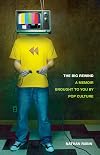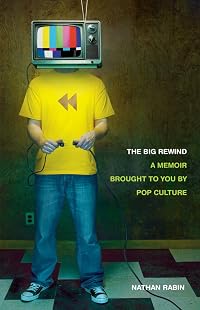
The Big Rewind: A Memoir Brought to You by Pop Culture
by Nathan Rabin
On This Page
Description
"As a child and teenager, Nathan Rabin viewed pop culture as a life-affirming form of escape. Today, pop culture is his life. For more than a decade, he's served as head writer for A.V. Club, the entertainment section of The Onion. In The Big Rewind, Rabin shares his too-strange-for-fiction life story. From a psilocybin-addled trip to the Anne Frank House to having focus groups for his movie-review panel show opine that all the male critics seemed 'gay' and that the show as a whole was 'too show more gay,' Rabin discusses his personal evolution in prose as hilarious as it is unexpectedly poignant. Using a specific song, album, book, film, or television show as a springboard to discuss a period in his life, Rabin recounts his heartwarming tale of triumph over adversity with biting wit and unwise candor. The pop culture touchstones Rabin uses here reflect his broad frame of reference with comic dissertations on The Simpsons, The Catcher in the Rye, Dr. Dre, Grey Gardens, The Great Gatsby, the Magnetic Fields, the uncanny parallels between Ol' Dirty Bastard and John F. Kennedy, and how the stock market mirrors the pimp game. Rabin writes movingly about how pop culture helped save him from suicidal despair, institutionalization, and parental abandonment -- throughout a childhood that sent him ricocheting from a mental hospital to a foster home to a group home for emotionally disturbed adolescents. The Big Rewind is also a touching narrative of a motherless child's search for family and acceptance and a darkly comic valentine to Rabin's lovable, hard-luck dad. Featuring cameos by Billy Bob Thornton, a vomiting Topher Grace, and Barack Obama, The Big Rewind chronicles the surreal journey of Rabin's life and its intersection with the dizzying, maddening, wonderful world of entertainment" -- from publsiher's description. show lessTags
Recommendations






Member Reviews
(Reprinted from the Chicago Center for Literature and Photography [cclapcenter.com]. I am the original author of this essay, as well as the owner of CCLaP; it is not being reprinted illegally.)
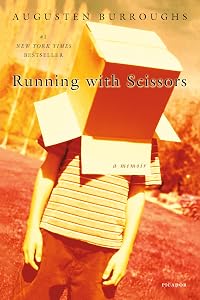
It's no secret that I'm a huge fan of The Onion's arts and culture publication, The AV Club (or at least I used to be, until mean-spirited "Hater" posts seemingly took over the majority of daily content there); and in particular I'm a slobbering devotee of their smart and funny head entertainment writer, Nathan Rabin, whose remarkable "My Year of Flops" essay series was the direct inspiration for my own "CCLaP 100" series on literary classics. So I was overjoyed to learn that Rabin had recently written a full-length book away from his AV Club show more duties -- a memoir, in fact, that purports to tell the story of why he finds pop culture so interesting to begin with, and how his love for cheesy movies and gangsta rap led him to the high-profile career he now has. But whoa, then I actually read it, and realized the fascinating truth about Rabin, that he comes from a background so dysfunctional as to make Augusten Burroughs look like one of the Von Trapp kids; and that when he glibly mentions that "pop culture saved my life," he means that as a literal statement of fact, with it frankly being a minor miracle that he's actually a functioning member of society at all, instead of some junkie living in a dumpster behind a Taco Bell, much less the respected journalist and cultural essayist that he is.
And in fact for the vast majority of its 350 pages, The Big Rewind is one unending, cringe-inducing nightmare, the tale of a spindly little Jewish nerd who's had the deck stacked against him nearly from birth -- the child of two '70s radicals who both eventually burned out but in vastly different ways, by puberty Rabin had already been institutionalized against his will, sent to and rejected by a foster family in the tony North Shore of the Chicago suburbs, and eventually consigned to a sort of halfway house for kids with behavioral problems in the dangerous Rogers Park neighborhood. And yes, as you can expect, Rabin uses these situations to relate a whole series of nightmarish anecdotes, a litany of horrors sure to be appreciated by any fan of Running With Scissors; but unlike Burroughs, Rabin uses these opportunities to deliver a lot of laugh-out-loud humor as well (typical line -- "I cannot stress this enough: do not take powerful hallucinogens before going to a Holocaust memorial"), and unbelievably enough mostly tries to stay light-hearted and optimistic when relaying all these past traumas. (Or, well, that's not the only difference between Burroughs and Rabin; unlike the former, for example, Rabin is actually a decent writer, and also doesn't feel the compulsion to just make up stupid sh-t whenever the narrative gets a little slow.)
Eventually, of course, Rabin ends up at the University of Wisconsin in Madison, where in typical fashion he falls in with a houseful of smelly hippies and hot undergraduate girlfriends who practice a lopsided form of polyamory (i.e. she gets to attend swinger conventions and be a "sacred prostitute," while he stays at home and smokes a lot of dope); and I say "of course" because Madison is where The Onion was originally founded, which for many years existed as not much more than a xeroxed zine handed out at record stores, and that didn't become the international cultural touchstone it now is until the rise of the Dot Com era in the 1990s. And I have to guiltily admit, there's something truly joyful about seeing someone with a dream job plainly confess that he considers it a dream job too; and I also have to admit, it's legitimately heartwarming to see Rabin confess near the end of the book that The Onion pretty much saved his life, and was what finally let him turn into the responsible, prolific adult he now is.
Now, let's also admit that the book has its problems, ones that were mostly minor for me but that will bother others a lot more; just for starters, his actual writing style can get awfully immature at a lot of points, and it's obvious as well that he still has some issues to work out regarding his sexual orientation, given the uncomfortable frequency in which he obsesses over people who mistake him for gay, a semi-homophobic aspect of this book that I found a real turn-off. (And dear Lord, if you're the kind of person who chafes at the sight of random quotes from old Simpsons episodes, you need to avoid this book like the freaking plague.) All in all, though, I found The Big Rewind to be a very pleasant surprise, given that Rabin could've so easily just put together a compilation of his best AV Club material instead, and made a ton more money without any of the dirty laundry. It's a gutsy book, a riveting one at points, and it comes recommended to anyone who enjoys a brisk, witty read.
Out of 10: 8.6 show less
It's no secret that I'm a huge fan of The Onion's arts and culture publication, The AV Club (or at least I used to be, until mean-spirited "Hater" posts seemingly took over the majority of daily content there); and in particular I'm a slobbering devotee of their smart and funny head entertainment writer, Nathan Rabin, whose remarkable "My Year of Flops" essay series was the direct inspiration for my own "CCLaP 100" series on literary classics. So I was overjoyed to learn that Rabin had recently written a full-length book away from his AV Club show more duties -- a memoir, in fact, that purports to tell the story of why he finds pop culture so interesting to begin with, and how his love for cheesy movies and gangsta rap led him to the high-profile career he now has. But whoa, then I actually read it, and realized the fascinating truth about Rabin, that he comes from a background so dysfunctional as to make Augusten Burroughs look like one of the Von Trapp kids; and that when he glibly mentions that "pop culture saved my life," he means that as a literal statement of fact, with it frankly being a minor miracle that he's actually a functioning member of society at all, instead of some junkie living in a dumpster behind a Taco Bell, much less the respected journalist and cultural essayist that he is.
And in fact for the vast majority of its 350 pages, The Big Rewind is one unending, cringe-inducing nightmare, the tale of a spindly little Jewish nerd who's had the deck stacked against him nearly from birth -- the child of two '70s radicals who both eventually burned out but in vastly different ways, by puberty Rabin had already been institutionalized against his will, sent to and rejected by a foster family in the tony North Shore of the Chicago suburbs, and eventually consigned to a sort of halfway house for kids with behavioral problems in the dangerous Rogers Park neighborhood. And yes, as you can expect, Rabin uses these situations to relate a whole series of nightmarish anecdotes, a litany of horrors sure to be appreciated by any fan of Running With Scissors; but unlike Burroughs, Rabin uses these opportunities to deliver a lot of laugh-out-loud humor as well (typical line -- "I cannot stress this enough: do not take powerful hallucinogens before going to a Holocaust memorial"), and unbelievably enough mostly tries to stay light-hearted and optimistic when relaying all these past traumas. (Or, well, that's not the only difference between Burroughs and Rabin; unlike the former, for example, Rabin is actually a decent writer, and also doesn't feel the compulsion to just make up stupid sh-t whenever the narrative gets a little slow.)
Eventually, of course, Rabin ends up at the University of Wisconsin in Madison, where in typical fashion he falls in with a houseful of smelly hippies and hot undergraduate girlfriends who practice a lopsided form of polyamory (i.e. she gets to attend swinger conventions and be a "sacred prostitute," while he stays at home and smokes a lot of dope); and I say "of course" because Madison is where The Onion was originally founded, which for many years existed as not much more than a xeroxed zine handed out at record stores, and that didn't become the international cultural touchstone it now is until the rise of the Dot Com era in the 1990s. And I have to guiltily admit, there's something truly joyful about seeing someone with a dream job plainly confess that he considers it a dream job too; and I also have to admit, it's legitimately heartwarming to see Rabin confess near the end of the book that The Onion pretty much saved his life, and was what finally let him turn into the responsible, prolific adult he now is.
Now, let's also admit that the book has its problems, ones that were mostly minor for me but that will bother others a lot more; just for starters, his actual writing style can get awfully immature at a lot of points, and it's obvious as well that he still has some issues to work out regarding his sexual orientation, given the uncomfortable frequency in which he obsesses over people who mistake him for gay, a semi-homophobic aspect of this book that I found a real turn-off. (And dear Lord, if you're the kind of person who chafes at the sight of random quotes from old Simpsons episodes, you need to avoid this book like the freaking plague.) All in all, though, I found The Big Rewind to be a very pleasant surprise, given that Rabin could've so easily just put together a compilation of his best AV Club material instead, and made a ton more money without any of the dirty laundry. It's a gutsy book, a riveting one at points, and it comes recommended to anyone who enjoys a brisk, witty read.
Out of 10: 8.6 show less
I wouldn't recommend Nathan Rabin's midlife memoir to everybody, but it does expose a glaring weakness in a lot of other autobiographies by the not-yet-elderly – one that's so commonplace that I more or less stopped noticing it. Memoirs like "The Liars Club" or "The Glass Castle" seem to imply that the authors have gotten over whatever was troubling them in their youth. They grew up, got some therapy, and are able to look back at their pasts with clear eyes to write about it. Considering some of the hair-raisingly awful upbringings that have been made into memoirs lately, I'm sort of an awe that many authors are able to do this, but that's not Nathan, and Nathan knows it. He still seems to be fighting it out with his messy past, and show more in a way, that makes "The Big Rewind" seem refreshingly honest. He's not above it all; he's still horny, obsessed with pop culture, and laughing through the goddamn tears. Good for him for admitting it.
As far as the book goes – eh. Nathan's a consistently funny writer, and his stuff here is better-edited than much of his work for The Onion's review section, which tends to run long, like a lot of internet writing. He's good at sketching memorable characters, and he's met more than his share. Still, the book isn't that well-structured. For much of the book, I wasn't sure exactly how his parents' came to abandon him, and his sister barely shows up at all, though I suppose she might have asked to be left out. Also, because the author chose to write this one while still a young-ish man, certain episodes in his life, like his tenure on a short-lived TV show and his involvement with a hot, irresponsible polyamorist, are probably given more prominence than they would in a more conventional memoir. People's messed-up childhoods are always interesting, but there still might not be enough here to make a book. Still, I can't say I didn't enjoy reading it, and have to say I finished it feeling some affection for the author. show less
As far as the book goes – eh. Nathan's a consistently funny writer, and his stuff here is better-edited than much of his work for The Onion's review section, which tends to run long, like a lot of internet writing. He's good at sketching memorable characters, and he's met more than his share. Still, the book isn't that well-structured. For much of the book, I wasn't sure exactly how his parents' came to abandon him, and his sister barely shows up at all, though I suppose she might have asked to be left out. Also, because the author chose to write this one while still a young-ish man, certain episodes in his life, like his tenure on a short-lived TV show and his involvement with a hot, irresponsible polyamorist, are probably given more prominence than they would in a more conventional memoir. People's messed-up childhoods are always interesting, but there still might not be enough here to make a book. Still, I can't say I didn't enjoy reading it, and have to say I finished it feeling some affection for the author. show less
This really earnestly wants to be a much more solid memoir. There are many, many wonderful things about this memoir's tone and lightheartedly honest treatment of some very heavy life experiences, and the author is very funny, engaging, and sincere. Rabin's voice is an extremely endearing one, and the way he handles issues such as depression is a breath of fresh air. One review I read (probably here on LT) expressed appreciation for Rabin's status of "still figuring things out" as he wrote this -- that it was a refreshing angle for such a hard-knock memoir in contrast to the usual "here I sit in fully-recovered normalcy as I look back on my difficult youth" point of view. I totally agree.
Unfortunately, I did not finish the book because I show more found a few nuts and bolts of the narrative perturbingly hard to piece together. I love well-written and insightful anecdotes as much as anyone, but there were too many instances where I was distracted from enjoying his writing because I was trying to make sense of some concrete aspect of the larger story -- how events related to each other in sequence, for example, or exactly when or where a particular story was taking place.
Now, I recognize that putting minor things in clear sequence really, truly doesn't matter in the grand scheme of a memoir like this, but we're inclined to make as much sense of things as we can and it is frustrating when a narrative doesn't allow that to happen naturally.
A secondary nitpicky issue I encountered was the author's apparent determination to make Deeply Insightful Observations (some of which are brilliantly astute, but which occur far too often to all be winners) a priority over crafting a solid structure for the book. With the life experience Rabin had to work with, going light on the insightful observations would have worked just fine and would likely have given them more impact.
Structure-wise, the pop-culture threads which begin each chapter provide better framework for some chapters than for others, and that's to be expected. However, this device doesn't support the weight of the work as a whole and the attention to overall narrative structure is lacking. This might have made a fine serialization.
The gems in this book are impressive, but want for a little more careful arranging. show less
Unfortunately, I did not finish the book because I show more found a few nuts and bolts of the narrative perturbingly hard to piece together. I love well-written and insightful anecdotes as much as anyone, but there were too many instances where I was distracted from enjoying his writing because I was trying to make sense of some concrete aspect of the larger story -- how events related to each other in sequence, for example, or exactly when or where a particular story was taking place.
Now, I recognize that putting minor things in clear sequence really, truly doesn't matter in the grand scheme of a memoir like this, but we're inclined to make as much sense of things as we can and it is frustrating when a narrative doesn't allow that to happen naturally.
A secondary nitpicky issue I encountered was the author's apparent determination to make Deeply Insightful Observations (some of which are brilliantly astute, but which occur far too often to all be winners) a priority over crafting a solid structure for the book. With the life experience Rabin had to work with, going light on the insightful observations would have worked just fine and would likely have given them more impact.
Structure-wise, the pop-culture threads which begin each chapter provide better framework for some chapters than for others, and that's to be expected. However, this device doesn't support the weight of the work as a whole and the attention to overall narrative structure is lacking. This might have made a fine serialization.
The gems in this book are impressive, but want for a little more careful arranging. show less
This is a pretty damn good modern memoir. Great for fans of Chuck Klosterman who are looking for something a little more personal, maybe.
The intro was a little rocky for me, to be totally honest, and I'll tell you why. The intro seemed packed full of jokes and references that were used in humor, but it kind of freaked me out because I thought I'd be half way through the book believing comedic references and basically confusing Rabin's life with that of a Simpsons character. But that's because I'm dumb. But fear not, fellow dum-dums. After the intro the book evens out a little and you'll fall right into the natural pacing and humor. If you're still not sure, skip ahead to the chapter where Rabin descirbes the reaction of a focus group to show more Movie Club> (maybe about pg. 300. Goddamn hilarious. show less
The intro was a little rocky for me, to be totally honest, and I'll tell you why. The intro seemed packed full of jokes and references that were used in humor, but it kind of freaked me out because I thought I'd be half way through the book believing comedic references and basically confusing Rabin's life with that of a Simpsons character. But that's because I'm dumb. But fear not, fellow dum-dums. After the intro the book evens out a little and you'll fall right into the natural pacing and humor. If you're still not sure, skip ahead to the chapter where Rabin descirbes the reaction of a focus group to show more Movie Club> (maybe about pg. 300. Goddamn hilarious. show less
I wanted to love it.....I did at first, but I found his manic storytelling abilities a little too over the top for me.
That said, Nathan has had a sad life - and he starting writing this when he was only 31!
Abandoned by his mother, sent to a foster and then a group home as his fathers MS and unemployment made it impossible for him to care for Nathan and his older sister; this guy has had a tough tough life.
His stories - each prefaced with some "pop culture" reference that highlights that chapter, whether it be a movie or a song; just got old for me.
That said, Nathan has had a sad life - and he starting writing this when he was only 31!
Abandoned by his mother, sent to a foster and then a group home as his fathers MS and unemployment made it impossible for him to care for Nathan and his older sister; this guy has had a tough tough life.
His stories - each prefaced with some "pop culture" reference that highlights that chapter, whether it be a movie or a song; just got old for me.
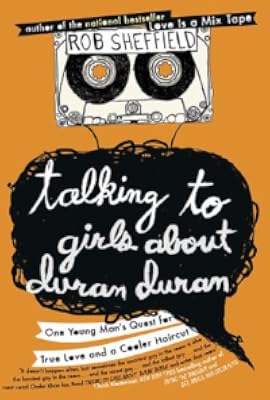
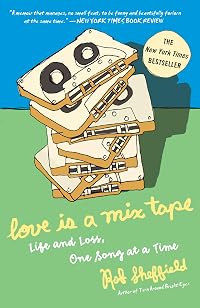
As a fan of "The Onion" I really wanted to like this, but I just didn't. Rabin's memoir tries to be oddball and strange like Augusten Burrough's "Running with Scissors" but instead it just felt disjointed and sad. Most of the pop culture references to songs and movies were pretty obscure and as a result, they were unrecognizable to me. I much preferred "Love is a Mix Tape" by Rob Sheffield.
The author tells us the story of his very unhappy and unsettled childhood. How he managed to grow up to be a resourceful and independent person is beyond me. And what was the answer to his problems? Popular culture. Despite some dark content, the book was humorous and irreverent.
Members
- Recently Added By
Lists

WTF! with Marc Maron
20 works; 1 member
Author Information

12+ Works 634 Members
Nathan Rabin is the head writer for The A.V. Club, the entertainment guide of The Onion. He is also the author of a memoir, The Big Rewind, and an essay collection based on one of his columns, My Year of Flops. He most recently collaborated with pop parodist Weird Al Yankovic on a coffee-table book called Weird Al: The Book. Rabin's writing has show more also appeared in The Wall Street Journal, Spin, The Huffington Post, The Boston Globe, Nerve, and Modern Humorist. He lives in Chicago with his wife and has learned to love both Faygo and extended guitar Solos. show less
Some Editions
Common Knowledge
- Original publication date
- 2009-07-07
- Blurbers
- Ebert, Roger; Klosterman, Chuck; Pollack, Neal; Dahm, Rich; Oswalt, Patton
Classifications
- Genres
- Nonfiction, Biography & Memoir, General Nonfiction
- DDC/MDS
- 306.0973 — Society, government, & culture Social sciences, sociology & anthropology Social Behavior - Dating, Marriage, Divorce Social history North America United States
- LCC
- E169 .Z83 .R33 — History of the United States United States General
- BISAC
Statistics
- Members
- 162
- Popularity
- 202,231
- Reviews
- 8
- Rating
- (3.23)
- Languages
- English
- Media
- Paper, Ebook
- ISBNs
- 3
- ASINs
- 4