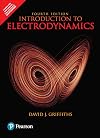
Introduction to Electrodynamics
by David J. Griffiths
On This Page
Description
This well-known undergraduate electrodynamics textbook is now available in a more affordable printing from Cambridge University Press. The Fourth Edition provides a rigorous, yet clear and accessible treatment of the fundamentals of electromagnetic theory and offers a sound platform for explorations of related applications (AC circuits, antennas, transmission lines, plasmas, optics and more). Written keeping in mind the conceptual hurdles typically faced by undergraduate students, this show more textbook illustrates the theoretical steps with well-chosen examples and careful illustrations. It balances text and equations, allowing the physics to shine through without compromising the rigour of the math, and includes numerous problems, varying from straightforward to elaborate, so that students can be assigned some problems to build their confidence and others to stretch their minds. A Solutions Manual is available to instructors teaching from the book; access can be requested from the resources section at www.cambridge.org/electrodynamics. show lessTags
Recommendations





































Member Reviews
This is one of my all-time favorite reference books. It covers vector analysis and electrodynamics very comprehensively. Although I've never had a class that has required this textbook, I frequently found myself using it as a reference in courses I took in optics and fields and waves, and even for brushing up my vector math skills.
This book is an introduction on electricity and magnetism covering:
Electrostatics
Electric Fields
Magnetostatics
Magnetic Fields
Radiation
Relativistic Electrodynamics
The style of the book is very concise. In my opinion the majority of the examples are a bit abstract. Still the explanations are clear and the main points are indicated in such a way that you cannot miss them. For instance, in the story about Faraday’s law, the sentence
“A changing magnetic field induces an electric field.”
is printed in bold with a box around it and lots of whitespace. To be honest, I first tried winging it, only reading handouts and lecture notes. This was a big mistake. Having this book in my possession was a huge improvement.
Electrostatics
Electric Fields
Magnetostatics
Magnetic Fields
Radiation
Relativistic Electrodynamics
The style of the book is very concise. In my opinion the majority of the examples are a bit abstract. Still the explanations are clear and the main points are indicated in such a way that you cannot miss them. For instance, in the story about Faraday’s law, the sentence
“A changing magnetic field induces an electric field.”
is printed in bold with a box around it and lots of whitespace. To be honest, I first tried winging it, only reading handouts and lecture notes. This was a big mistake. Having this book in my possession was a huge improvement.
Second year E&M textbook at Cornell circa 1991. Thorough and well-presented. Lots of exercises at the end of the chapters.
Ratings
Members
- Recently Added By
Lists

University Presses
155 works; 1 member

The r/AskScience Reading List
159 works; 3 members

Mathematics and Physics
29 works; 1 member
Author Information

7 Works 2,007 Members
Work Relationships
Has as a teacher's guide
Common Knowledge
- Canonical title
- Introduction to Electrodynamics
Classifications
Statistics
- Members
- 964
- Popularity
- 27,425
- Reviews
- 3
- Rating
- (4.03)
- Languages
- 5 — English, German, Greek, Portuguese, Turkish
- Media
- Paper, Ebook
- ISBNs
- 28
- ASINs
- 10