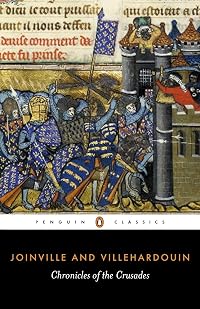
Chronicles of the Crusades
by Jean de Joinville, Geoffroi de Villehardouin
On This Page
Description
From the Publisher: Two famous, firsthand accounts of the holy war in the Middle Ages. Originally composed in Old French, the two chronicles brought together here offer some of the most vivid and reliable accounts of the Crusades from a Western perspective. Villehardouin's Conquest of Constantinople, distinguished by its simplicity and lucidity, recounts the controversial Fourth Crusade, which descended into an all-out attack on the Eastern Christians of Byzantium. In Life of Saint Louis, show more Joinville draws on his close attachment to King Louis IX of France to recall his campaigning in the Holy Land. Together these narratives comprise a fascinating window on events that, for all their remoteness, offer startling similarities to our own age. show lessTags
Recommendations














Member Reviews
This edition brings together two eye-witness texts about the Crusades—Geoffroi de Villehardouin's account of the Fourth Crusade, and Jean de Joinville's of the Seventh Crusade some fifty years later. A solid translation, though it's much easier to warm to Joinville than it is to Villehardouin—the latter may have a far better sense of how to structure a narrative, but Joinville seems to have understood people better. There are some wonderful vignettes here, full of character, even if they mostly served to convince me that Louis IX really was a bit of a prig.
I much preferred Joinville's warmly human account to Villehardouin's war-correspondent style. Though I can see how he would not be everyone's cup of tea - he wanders off the thread of his story at times and there is some repetition. Those interested in the details of military maneuvers and diplomatic wrangling would most likely prefer Villehardouin.
I developed a soft spot for Joinville reading the book's introduction - the translator writes that both accounts were most likely dictated as reading or writing was not considered necessary to a knight's education. It is not known if Villehardouin could write, but "three short documents in a childish scrawl, with the statement 'this was written by me'.. attest Joinville's pride in a rare show more achievement."
Joinville is interested in everything - there is a lovely description of a fossil. He is clearly devoted to Louis IX, the king who would later be canonised, but is not afraid to disagree with him at times. He disapproves of the king's emotional neglect of his wife and children.(Sadly, the queen can never take comfort in the platitude "he's no saint but...") Joinville also convinces the king to prolong his stay instead of returning to France as he is worried about those who will be left behind, unable to afford to get back to France. There is a touching scene where Joinville leans with his arms through a grating, anxiously waiting for the king to make a decision. Examples given to emphasise the king's piety may seem a bit odd to modern sensibilities - a man who murders three robbers in a vigilante attack is given a place in the king's retinue (he's a good shot..) while someone caught swearing is subjected to facial mutilation. Much as this is a hagiography, the king comes across as a bit of a ninny - he is rather easily influenced, and finally fatally conned into going off on a last crusade by his brother(Joinville wisely stayed home for that one). show less
I developed a soft spot for Joinville reading the book's introduction - the translator writes that both accounts were most likely dictated as reading or writing was not considered necessary to a knight's education. It is not known if Villehardouin could write, but "three short documents in a childish scrawl, with the statement 'this was written by me'.. attest Joinville's pride in a rare show more achievement."
Joinville is interested in everything - there is a lovely description of a fossil. He is clearly devoted to Louis IX, the king who would later be canonised, but is not afraid to disagree with him at times. He disapproves of the king's emotional neglect of his wife and children.(Sadly, the queen can never take comfort in the platitude "he's no saint but...") Joinville also convinces the king to prolong his stay instead of returning to France as he is worried about those who will be left behind, unable to afford to get back to France. There is a touching scene where Joinville leans with his arms through a grating, anxiously waiting for the king to make a decision. Examples given to emphasise the king's piety may seem a bit odd to modern sensibilities - a man who murders three robbers in a vigilante attack is given a place in the king's retinue (he's a good shot..) while someone caught swearing is subjected to facial mutilation. Much as this is a hagiography, the king comes across as a bit of a ninny - he is rather easily influenced, and finally fatally conned into going off on a last crusade by his brother(Joinville wisely stayed home for that one). show less
De Villehardouin's work is a shocking record of the incompetently prosecuted fourth crusade. The planning is virtually non-existent, the leadership is distinctly lacking, the aims of the expedition are unclear and they end up invading another Christian nation and directly causing the death of thousands of innocent civilians. You really feel for the poor Greeks. De Villehardouin keeps criticising people who either abandon the crusade or fail to turn up. Obviously they saw there were problems from the start. The author appears to be oblivious as to how much he's actually revealing. The unlikely hero of the piece turns out to be King Johanitza, who, despite his penchant for flaying prisoners alive, has the sole virtue of waging war show more competently.
De Joinville's work claims to be a biography of Louis IX and it is bracketed with a bit about him, but what this really is is de Joinville's memoirs of the seventh crusade. There's a clear narrative with some well realised battle scenes. Thoroughly enjoyable and a great window into the Medieval mind. Misguided as de Joinville may be you can't help feeling for him. show less
De Joinville's work claims to be a biography of Louis IX and it is bracketed with a bit about him, but what this really is is de Joinville's memoirs of the seventh crusade. There's a clear narrative with some well realised battle scenes. Thoroughly enjoyable and a great window into the Medieval mind. Misguided as de Joinville may be you can't help feeling for him. show less
This NF read is considered two of the most important and accurate first hand accounts of the crusades. Villehardouin's The Conquest of Constantinople is a soldier's account of the 4th crusade and includes the sack of Constantinople in 1204, and not for the religious reasons usually touted. Jean de Joinville writes about the 7th crusade and Louis IX's moral character, piety, and military failure(s). I like these 2 particular takes as they present a balanced view of both the military and religious aspects of the crusades. 384 pages
Originally I skimmed through this book almost a decade ago in preparation for my Senior History Oral Exam and only focused on the overall theme questions listed in my study guide at the time. However this past week while actually reading Chronicles of the Crusades and found thanks to the excellent translation, a easy read and very informative on its subject matters. Of the two chroniclers, I found Jean de Joinville the easier to read because of his style of writing. Most likely the spread and evolution of romantic literature influenced Joinville's style of being more down-to-earth and slightly easier to read when compared to Geoffrey of Villehardouin, who was more matter-of-fact and somewhat "stiff." However, just because Geoffrey's show more style is a little "stiffer" doesn't mean it's not easy to read nor informative about the establish and early years of the Latin Empire of Constantinople. If you're interested about first-hand accounts of the Crusades, specifically the 4th and 7th, this is the book for you. show less
Eyewitness account of the 4th Crusade by French nobleman Geoffrey de Villehardouin, Marshal of Champagne and Roumania [Byzantine Empire]. He was one of the major players in those events. His account begins in the late 1100s with the call to Crusade, taking us through the Sack of Constantinople, and through later ineptly fought battles and skirmishes involving other cities in that area, ending in 1207. His opponents were Greeks and the Wallachian king, Johannitza--not Saracens. It ended abruptly with the death of Marquis Boniface of Montferrat.
He seemed completely honest [by his lights] and leaves us a logical, reasonable recitation of the facts. He did no bragging about himself; in fact he wrote about himself in 3rd person and gave no show more more importance to himself than to anyone else. It was interesting to read an account by a crusader who thought it perfectly acceptable to turn on another Christian city so violently. Most discussions of the 4th Crusade bring out how horrible and unfair it was. Style was simple but somewhat stilted. The repetitious vocabulary could have been the fault of the particular translation. But the text was limpid and flowed along. It lacked any descriptive flourishes and bored me with interminable names of the noblemen and their titles. Three Byzantine emperors named Alexius confused me; it took me awhile to figure out exactly who he was writing about any time Alexius was mentioned. This is a valuable primary source on this historical period. It is not meant for entertainment or enjoyment. show less
He seemed completely honest [by his lights] and leaves us a logical, reasonable recitation of the facts. He did no bragging about himself; in fact he wrote about himself in 3rd person and gave no show more more importance to himself than to anyone else. It was interesting to read an account by a crusader who thought it perfectly acceptable to turn on another Christian city so violently. Most discussions of the 4th Crusade bring out how horrible and unfair it was. Style was simple but somewhat stilted. The repetitious vocabulary could have been the fault of the particular translation. But the text was limpid and flowed along. It lacked any descriptive flourishes and bored me with interminable names of the noblemen and their titles. Three Byzantine emperors named Alexius confused me; it took me awhile to figure out exactly who he was writing about any time Alexius was mentioned. This is a valuable primary source on this historical period. It is not meant for entertainment or enjoyment. show less
I found this a compelling first-hand account, well-written and informative.
Members
- Recently Added By
Lists

r/History Recommended Reading List
603 works; 12 members

Further Reading Recommended by Herrin's Byzantium
151 works; 1 member
Author Information

15+ Works 1,720 Members
1 Work 1,627 Members
Some Editions
Series
Belongs to Publisher Series
Work Relationships
Common Knowledge
- Canonical title
- Chronicles of the Crusades
- Original publication date
- 1308
- People/Characters
- Louis IX, King of France; Marguerite of Provence, Queen of France
- Important places
- Jerusalem; Constantinople; Cairo, Egypt; Alexandria, Egypt
- Important events
- First Crusade (1096 ∙ | 1099); Second Crusade; Third Crusade (1189 ∙ | 1192); Fourth Crusade (1202 ∙ | 1204); Sack of Constantinople (1204); Seventh Crusade
- Disambiguation notice
- This work contains two contemporary French accounts of the Crusades, one by Geoffroi de Villehardouin and one by Jean de Joinville. If any of the listed editions can be identified as being one account only, plea... (show all)se separate them and add the information to this note.
Confirmed as both authors:
Penguin Classics: ISBNs 0140441247, 0140449981.
Everyman's Library #333: ISBN 0313238561.
(There are also a large number of pre-ISBN copies of the Everyman's edition).
Classifications
Statistics
- Members
- 1,631
- Popularity
- 13,864
- Reviews
- 9
- Rating
- (3.64)
- Languages
- English
- Media
- Paper, Ebook
- ISBNs
- 29
- ASINs
- 41
