
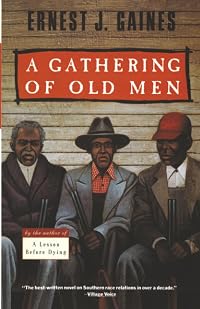
A Gathering of Old Men
by Ernest J. Gaines
On This Page
Description
Stirring, heroic, and wonderfully laced with the musical languages of the Bayou, Ernest J. Gaines - the foremost voice in contemporary African American literature - adds another breathtaking saga to his canon with A Gathering of Old Men. When Sheriff Mapes is summoned to a sugarcane plantation to find a dead Cajun farmer, he knows who committed the crime. Mapes finds himself powerless, however, when nearly 20 elderly black men confess to the murder. Can justice be served, or will the dead show more man's brutish father pass judgment his way? Building to a climax that is as stunning as it is inevitable, A Gathering of Old Men powerfully describes the racial tensions in 1970s Louisiana. Narrators Peter Francis James, Michelle-Denise Woods, Sally Darling, Graham Brown, Murphy Guyer, Tom Stechschulte and Mark Hammer bring Gaines' masterful prose to vivid life. This insightful novel takes its place among Gaines' thought-provoking classics, The Autobiography of Miss Jane Pittman and In My Father's House. show lessTags
Recommendations




Member Reviews
Books like this make me wish I believed in reincarnation so that could come back as a teacher and share this book with young impressionable minds. It is an amazing book, especially so because of the deft, multifaceted approach it takes in attacking the subject of racism.
It tackles it directly. This is does by relating stories which, while fictional within these pages, were duplicated countless times over in real life. It tells of black men who volunteered to fight in World War I, who served with distinction and who were decorated for their bravery. But when they returned home they were not given heroes’ welcomes but were feared and oppressed all the more because they had had the gall to think that they could get away with killing show more white men, even if they were Germans.
It attacks its inhumanity by discussing the many little ways that an entire people can be thought of as something less than human, something unfit to breathe the same air and drink the same water as human beings.
It attacks its impersonality. In almost every case, the old men justified their actions by relating events that occurred long in the past and had nothing to do with the victim of the crime at hand. Why did this happen to this man? Because he’s a white man and must share the guilt with all white men. Similarly, when Gil hears what happens to his brother, he immediately behaves as if his black teammate is in some way responsible. People are racist not because they find an individual offensive but because the faults they perceive in that person’s race are applied without exception to all of its members.
It attacks the way racism plays with our fears. If you want to get a white man riled up, ask him how he’d feel if his wife or daughters were raped by one of them. If you see a group of them armed with shotguns, you immediately assume aggressive, rather than defensive intentions.
While Gaines’ book can be treated as a treatise against racism, it is still an amazingly gentle book, full of characters you, for the most part, will become very attached to. It is also very much a book about loyalty and the courage to stand up for your friends, your beliefs, and yourself.
FYI: On a 5-point scale I assign stars based on my assessment of what the book needs in the way of improvements:
*5 Stars – Nothing at all. If it ain’t broke, don’t fix it.
…Actually, there is no point to go on. This is a five point book, my favorite so far this year. I really loved it. show less
It tackles it directly. This is does by relating stories which, while fictional within these pages, were duplicated countless times over in real life. It tells of black men who volunteered to fight in World War I, who served with distinction and who were decorated for their bravery. But when they returned home they were not given heroes’ welcomes but were feared and oppressed all the more because they had had the gall to think that they could get away with killing show more white men, even if they were Germans.
It attacks its inhumanity by discussing the many little ways that an entire people can be thought of as something less than human, something unfit to breathe the same air and drink the same water as human beings.
It attacks its impersonality. In almost every case, the old men justified their actions by relating events that occurred long in the past and had nothing to do with the victim of the crime at hand. Why did this happen to this man? Because he’s a white man and must share the guilt with all white men. Similarly, when Gil hears what happens to his brother, he immediately behaves as if his black teammate is in some way responsible. People are racist not because they find an individual offensive but because the faults they perceive in that person’s race are applied without exception to all of its members.
It attacks the way racism plays with our fears. If you want to get a white man riled up, ask him how he’d feel if his wife or daughters were raped by one of them. If you see a group of them armed with shotguns, you immediately assume aggressive, rather than defensive intentions.
While Gaines’ book can be treated as a treatise against racism, it is still an amazingly gentle book, full of characters you, for the most part, will become very attached to. It is also very much a book about loyalty and the courage to stand up for your friends, your beliefs, and yourself.
FYI: On a 5-point scale I assign stars based on my assessment of what the book needs in the way of improvements:
*5 Stars – Nothing at all. If it ain’t broke, don’t fix it.
…Actually, there is no point to go on. This is a five point book, my favorite so far this year. I really loved it. show less
A dead man. A running tractor. A white woman who claims she shot him. A gathering of old men with shotguns. A sheriff who knows everyone is lying. A father who needs revenge.
What is so marvelous about this work is that Gaines tells it from a variety of viewpoints, as different characters narrate chapters. Candy Marshall is the woman who owns the plantation that has been in her family for generations. It is she who spreads the word among those in “the Quarters” that the men need to show up at Mattu’s place. By the time Sheriff Mapes is called and arrives there are dozens of elderly black men, each with a fired shotgun, though many can barely hold the gun let alone aim and fire it with any accuracy. One by one they tell their show more stories of how and why they shot Beau Bouton.
Meanwhile Beau’s brother, Gil, comes home to meet with his father, Fix, who wants nothing more than to call up his group of Klansmen to “take care of this problem.” It is Fix’s arrival that the group of old men is awaiting. One by one they tell their stories of how and why they shot Beau Bouton.
Their stories are simply but eloquently told. Oppression lasting for generations. Men who will not take it any longer. Their decision to stand up for what is right and against those who would continue the sins of the past has been coming for a long time and they are united and steadfast in their determination to see this through. And that includes NOT allowing some white woman, however well-intentioned, to “save” them. No, they will save themselves, or die trying.
Gaines’s writing is evocative of time and place. I can feel the humid heat, taste the dust that fills the air, hear the buzz of mosquitos as evening comes, smell the swamp and sweat. This is the second book by Gaines that I have read (and I’ve read A Lesson Before Dying three times), but I have all his works on my tbr. The world of literature lost a great writer when he passed on in 2019. show less
What is so marvelous about this work is that Gaines tells it from a variety of viewpoints, as different characters narrate chapters. Candy Marshall is the woman who owns the plantation that has been in her family for generations. It is she who spreads the word among those in “the Quarters” that the men need to show up at Mattu’s place. By the time Sheriff Mapes is called and arrives there are dozens of elderly black men, each with a fired shotgun, though many can barely hold the gun let alone aim and fire it with any accuracy. One by one they tell their show more stories of how and why they shot Beau Bouton.
Meanwhile Beau’s brother, Gil, comes home to meet with his father, Fix, who wants nothing more than to call up his group of Klansmen to “take care of this problem.” It is Fix’s arrival that the group of old men is awaiting. One by one they tell their stories of how and why they shot Beau Bouton.
Their stories are simply but eloquently told. Oppression lasting for generations. Men who will not take it any longer. Their decision to stand up for what is right and against those who would continue the sins of the past has been coming for a long time and they are united and steadfast in their determination to see this through. And that includes NOT allowing some white woman, however well-intentioned, to “save” them. No, they will save themselves, or die trying.
Gaines’s writing is evocative of time and place. I can feel the humid heat, taste the dust that fills the air, hear the buzz of mosquitos as evening comes, smell the swamp and sweat. This is the second book by Gaines that I have read (and I’ve read A Lesson Before Dying three times), but I have all his works on my tbr. The world of literature lost a great writer when he passed on in 2019. show less
Looks like Ernest Gaines used multiple narrators before it became trendy. He drew each character deftly, even the minor characters. This book shows a community after the Civil Rights movement that's still rife with racism. How each person moves forward reveals not only their posture, but the fault lines in society.
After the second time I read this book, I noticed that Ernest Gaines doesn't care to depict the protagonists in his books as particularly admirable, noble, virtuous, etc. In fact he tends to go the other way and depict them as often crude and even disgusting in their appearance and habits. I always remember one of the old black men snarling at his wife and one of the other old black men with a stale cigarette hanging out of his mouth and dropping ash on the ground. A child at the beginning of the story, surely younger than ten, is shown in the middle of what sounds like a sexual game with another child when an adult calls him home. Basically, most or all of the characters, black and white, are part of the redneck culture and Gaines show more chooses to describe them with complete realism.
Gaines also likes mocking the white rednecks in this book, spelling Fix Boutan's pronunciations phonetically and clearly depicting as ridiculous the process of his debate over whether he should lynch the black men. He declares to his family and friends that he alone makes these decisions for the family, and a few minutes later asks them what they think he should do. show less
Gaines also likes mocking the white rednecks in this book, spelling Fix Boutan's pronunciations phonetically and clearly depicting as ridiculous the process of his debate over whether he should lynch the black men. He declares to his family and friends that he alone makes these decisions for the family, and a few minutes later asks them what they think he should do. show less
I loved this book! It’s like "The Magnificent Seven" transformed into The Geriatric Eighteen. It is both comedic and tragic, and I believe it deserves its status as a classic of recent American literature.
The story takes place on one day in the late seventies on a former plantation in Louisiana, now run by 30-year-old Candy Marshall. Candy’s parents died in a car wreck when she was very young, so she was raised by Miss Merle – the mistress of a neighboring plantation, and Mathu, an old black man – now 82 - on Candy’s plantation. Candy has come to Mathu's, and finds him holding an empty shotgun, with the plantation's white Cajun farmer, Beau Boutan, lying dead nearby. Candy sends out an alert for everyone to come to Mathu’s show more yard right away and bring spent twelve-gauge shotguns and number five shells. She believes Mathu has killed Beau Boutan, who was a cruel, racist man that no one likes. But Beau’s father “Fix” is even worse. There has never been an incident of a black man killing a white man in this parish before, and it is thought by everyone that Fix and his cohorts will come out to the plantation in short order for a lynching.
When Sheriff Mapes arrives, what he discovers is that not only is Candy claiming she killed Beau, but everyone else is too. These are men in their seventies and eighties, who had never stood up to the white man before, who had spent their lifetimes enduring insults, beatings, and killings in their families. Now they were ready to take a stand. But some of their wives are there at Mathu’s too, and they participate as well. As each of the men and women who have gathered at Mathu’s testifies to the sheriff why he or she had justification to kill Beau, they reveal the history of the hurt that characterized their lives as blacks in the Deep South. Beuleh, one of the old men’s wives, is telling why she killed Beau when she is interrupted by Sheriff Mapes: “You’re talking about thirty-five, forty, fifty years ago, Beulah. … And you got no proof Fix was mixed up in that.” Beulah lashes out at him:
"‘Now, ain’t that just like white folks?’ Beulah said to us, but still looking at Mapes. ‘Black people get lynched, get drowned, get shot, guts all hanging out – and here he come up with ain’t no proof who did it. The proof was them two little children laying there in them two coffins. That’s proof enough they was dead. And let’s don’t be getting off into that thirty-five, forty, fifty years ago stuff, either. Things ain’t changed that much round here. In them demonstrations, somebody was always coming up missing. So let’s don’t be putting it all on no thirty-five, forty, fifty years ago like everything is so nicey-nicey now. No, his seeds is still around. Even if he is old now, the rest of them had their hands in some of that dirt.”
Fifteen different narrators tell this story, beginning with the voice of a child, Snookum. Gaines’ ability to assume so realistically the voices of old, young, black, white, male, and female is an incredible tour de force; each voice has its own distinctive tone, nuance, dialect, and vocabulary – and these are so distinct he makes you feel as if you can actually hear each and every one.
The eighteen men, the women, Candy, Mapes, and some others, all sit on the porch at Mathu's and wait for “the riders,” whom they feel sure will be out to exact vengeance when night falls.
Discussion: In the book, none of the main characters speaks as a narrator. Rather, impressions of them and of their motives are provided by the other speakers. Further, each person’s story is given to Mapes as if testifying in church. It’s a wonderful narrative technique that reflects aspects of the storytelling tradition where Gaines grew up. And while the old men, who can hardly see and barely aim make an uproariously funny grouping, they also make a gloriously courageous panorama, as they get ready to die at last as men, for their principles.
Evaluation: This is one of those books that made me so excited by reading it. It’s an ineffable feeling that hits you when you know you have come upon something really good. I’d love to tell you how it turns out in the end and the amazing form of redemption that Gaines constructs. But that would be a spoiler: you’ll just have to read it yourself! show less
The story takes place on one day in the late seventies on a former plantation in Louisiana, now run by 30-year-old Candy Marshall. Candy’s parents died in a car wreck when she was very young, so she was raised by Miss Merle – the mistress of a neighboring plantation, and Mathu, an old black man – now 82 - on Candy’s plantation. Candy has come to Mathu's, and finds him holding an empty shotgun, with the plantation's white Cajun farmer, Beau Boutan, lying dead nearby. Candy sends out an alert for everyone to come to Mathu’s show more yard right away and bring spent twelve-gauge shotguns and number five shells. She believes Mathu has killed Beau Boutan, who was a cruel, racist man that no one likes. But Beau’s father “Fix” is even worse. There has never been an incident of a black man killing a white man in this parish before, and it is thought by everyone that Fix and his cohorts will come out to the plantation in short order for a lynching.
When Sheriff Mapes arrives, what he discovers is that not only is Candy claiming she killed Beau, but everyone else is too. These are men in their seventies and eighties, who had never stood up to the white man before, who had spent their lifetimes enduring insults, beatings, and killings in their families. Now they were ready to take a stand. But some of their wives are there at Mathu’s too, and they participate as well. As each of the men and women who have gathered at Mathu’s testifies to the sheriff why he or she had justification to kill Beau, they reveal the history of the hurt that characterized their lives as blacks in the Deep South. Beuleh, one of the old men’s wives, is telling why she killed Beau when she is interrupted by Sheriff Mapes: “You’re talking about thirty-five, forty, fifty years ago, Beulah. … And you got no proof Fix was mixed up in that.” Beulah lashes out at him:
"‘Now, ain’t that just like white folks?’ Beulah said to us, but still looking at Mapes. ‘Black people get lynched, get drowned, get shot, guts all hanging out – and here he come up with ain’t no proof who did it. The proof was them two little children laying there in them two coffins. That’s proof enough they was dead. And let’s don’t be getting off into that thirty-five, forty, fifty years ago stuff, either. Things ain’t changed that much round here. In them demonstrations, somebody was always coming up missing. So let’s don’t be putting it all on no thirty-five, forty, fifty years ago like everything is so nicey-nicey now. No, his seeds is still around. Even if he is old now, the rest of them had their hands in some of that dirt.”
Fifteen different narrators tell this story, beginning with the voice of a child, Snookum. Gaines’ ability to assume so realistically the voices of old, young, black, white, male, and female is an incredible tour de force; each voice has its own distinctive tone, nuance, dialect, and vocabulary – and these are so distinct he makes you feel as if you can actually hear each and every one.
The eighteen men, the women, Candy, Mapes, and some others, all sit on the porch at Mathu's and wait for “the riders,” whom they feel sure will be out to exact vengeance when night falls.
Discussion: In the book, none of the main characters speaks as a narrator. Rather, impressions of them and of their motives are provided by the other speakers. Further, each person’s story is given to Mapes as if testifying in church. It’s a wonderful narrative technique that reflects aspects of the storytelling tradition where Gaines grew up. And while the old men, who can hardly see and barely aim make an uproariously funny grouping, they also make a gloriously courageous panorama, as they get ready to die at last as men, for their principles.
Evaluation: This is one of those books that made me so excited by reading it. It’s an ineffable feeling that hits you when you know you have come upon something really good. I’d love to tell you how it turns out in the end and the amazing form of redemption that Gaines constructs. But that would be a spoiler: you’ll just have to read it yourself! show less
Written in a simple and straightforward fashion, this book is anything but simple in its message and impact. The choice of having a different narrator for each chapter would not work well in just anyone’s hands, but Gaines is not just anyone, and he makes this device serve to reveal the truth of the situation without any bias or personal slant.
How could anyone read this without feeling a great deal of pride for the subject old men? Each of them reaches into his deepest self and emerges as his own master, a role they have each been denied for most of their lives. When Charlie declares, “I am a man,” he seems to speak not just for himself, but for all of the old men.
An excellent and important read.
How could anyone read this without feeling a great deal of pride for the subject old men? Each of them reaches into his deepest self and emerges as his own master, a role they have each been denied for most of their lives. When Charlie declares, “I am a man,” he seems to speak not just for himself, but for all of the old men.
An excellent and important read.
My daughter was assigned to read books by [a:Ernest J. Gaines|3533|Ernest J. Gaines|https://images.gr-assets.com/authors/1255909167p2/3533.jpg] for school, and in order to discuss them with her I agreed to read them too. This is the first and I loved it.
"And let’s don’t be getting off into that thirty-five, forty, fifty years ago stuff, either. Things ain’t changed that much round here. In them demonstrations, somebody was always coming up missing. So let’s don’t be putting it all on no thirty-five, forty, fifty years ago like everything is so nicey-nicey now."
The story starts when Candy Marshall sends frantic word for the men in the neighborhood (all of whom are old) to gather at Mathu's place. It appears that Mathu has shot show more and killed a Cajun farmer in his front yard. By the time Sheriff Mapes arrives, everyone is claiming to have been the one who shot the man, and Mapes knows he's got an explosive situation on his hands.
Confusing! The book is told from 15(!) different viewpoints, all first-person and a few repeated (but don't let that slow you down). It's also written in the local dialect, and I'm still not sure what some of the words meant. It's very much a story about racial tensions, but often I wasn't even sure about a character's race, and it took me a while just to figure out when the story takes place. And yet I expect this is all on purpose and very cleverly done by the author, as the different viewpoints effectively convey the confusion of the situation and develop a quickly escalating tension - I wish I could have read this in one sitting. It's a powerful story of race relations and about men standing up for themselves. This short book could very easily be paired with [b:To Kill a Mockingbird|2657|To Kill a Mockingbird|Harper Lee|https://images.gr-assets.com/books/1361975680s/2657.jpg|3275794] in high school classes.
“Won’t it ever stop?” he asked. He looked around at all of them. “Won’t it ever stop? I do all I can to stop it. Every day of my life, I do all I can to stop it. Won’t it ever stop?” show less
"And let’s don’t be getting off into that thirty-five, forty, fifty years ago stuff, either. Things ain’t changed that much round here. In them demonstrations, somebody was always coming up missing. So let’s don’t be putting it all on no thirty-five, forty, fifty years ago like everything is so nicey-nicey now."
The story starts when Candy Marshall sends frantic word for the men in the neighborhood (all of whom are old) to gather at Mathu's place. It appears that Mathu has shot show more and killed a Cajun farmer in his front yard. By the time Sheriff Mapes arrives, everyone is claiming to have been the one who shot the man, and Mapes knows he's got an explosive situation on his hands.
Confusing! The book is told from 15(!) different viewpoints, all first-person and a few repeated (but don't let that slow you down). It's also written in the local dialect, and I'm still not sure what some of the words meant. It's very much a story about racial tensions, but often I wasn't even sure about a character's race, and it took me a while just to figure out when the story takes place. And yet I expect this is all on purpose and very cleverly done by the author, as the different viewpoints effectively convey the confusion of the situation and develop a quickly escalating tension - I wish I could have read this in one sitting. It's a powerful story of race relations and about men standing up for themselves. This short book could very easily be paired with [b:To Kill a Mockingbird|2657|To Kill a Mockingbird|Harper Lee|https://images.gr-assets.com/books/1361975680s/2657.jpg|3275794] in high school classes.
“Won’t it ever stop?” he asked. He looked around at all of them. “Won’t it ever stop? I do all I can to stop it. Every day of my life, I do all I can to stop it. Won’t it ever stop?” show less
Members
- Recently Added By
Lists

Southern Fiction
212 works; 51 members

Books Set in Louisiana
29 works; 8 members

Black Authors
384 works; 28 members

Fiction For Men
142 works; 11 members
Small Town Fiction
66 works; 13 members

The American Experience
173 works; 18 members
Books Set in Small Towns and Villages
278 works; 16 members
Racism and Race Relations in Literature
48 works; 9 members

Literary Works Read in College
316 works; 15 members

Swinging Seventies
255 works; 18 members

AP Lit
363 works; 6 members
Author Information

18+ Works 9,995 Members
Ernest James Gaines was born on January 15, 1933, on the River Lake Plantation, Pointe Coupee Parish, Louisiana. His 1993 novel, A Lesson Before Dying, won the National Book Critics Circle Award for fiction. Gaines has been a MacArthur Foundation fellow, awarded the National Humanities Medal, and inducted into the French Ordre des Arts et des show more Lettres (Order of Arts and Letters) as a Chevalier. Although he was educated in California (at San Francisco State College and Stanford University), his fiction is dominated by images and characters drawn from rural Louisiana, where he was born and raised. Unquestionably the most recognizable, and probably the best, of Gaines's novels is The Autobiography of Miss Jane Pittman (1971), a fictional account of the long life of a black woman born a slave on a Louisiana plantation. Through the stories of the many fascinating people who touch Jane's life, Gaines presents not only a moving perspective on the struggles of African Americans but also a social history of the United States since the Civil War. It is a testimony to Gaines's skill as a writer and storyteller that many people believe Jane Pittman was a real person. Indeed, the novel is frequently misshelved in the biography section of bookstores. In 1993 Gaines also won the Dos Passos Prize and in 2000 he won the National Humanities Medal. Of Gaines's other works, Bloodline (1976), a collection of five short stories, stands out for its powerful portrayals of young men in search of self-respect and dignity. In 2013 President Barack Obama presented Mr. Gaines with the National Medal of Arts. Ernest J. Gaines passed away on November 5,2019 at this home in Oscar, LA at the age of 86. (Bowker Author Biography) show less
Awards and Honors
Distinctions
Work Relationships
Has the adaptation
Has as a student's study guide
Common Knowledge
- Original publication date
- 1983
- People/Characters
- Mathu; Candy Marshall; Sheriff Mapes; George "Snookum" Eliot, Jr.; Janice "Janey" Robinson; Robert "Chimley" Louis Stevenson Banks (show all 19); Matthew "Matt" Lincoln Brown; Grant "Cherry" Bello; Cyril "Clatoo" Robillard; Louis "Lou Dimes" Alfred Dimoulin; Joseph "Rufe" Seaberry; Thomas "Sully" Vincent Sullivan; Jacques "Tee Jack" Thibeaux; Albert "Rooster" Jackson; Sidney "Coot" Brooks; Horace "Sharp" Thompson; Luke Will; Gil Boutan; Beau Boutain
- Important places
- Louisiana, USA
- First words
- I heard Candy out in the front yard calling Gram Mon.
- Last words
- (Click to show. Warning: May contain spoilers.)I felt her other hand against me, searching for my hand; then I felt her squeezing my fingers.
- Disambiguation notice
- Swedish title (1986): Gamla män samlas
Book; do not combine with the movie this book is based on.
Classifications
Statistics
- Members
- 1,207
- Popularity
- 20,558
- Reviews
- 30
- Rating
- (4.01)
- Languages
- English, French, German, Swedish
- Media
- Paper, Audiobook, Ebook
- ISBNs
- 30
- ASINs
- 6