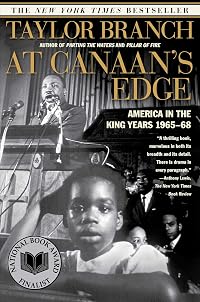
On This Page
Description
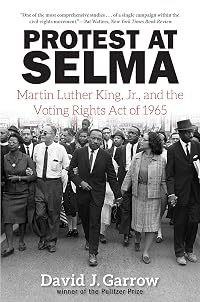
This book concludes a 3-volume history of American race, violence, and democracy. As the book begins, King and his movement are one decade into an epic struggle for the promises of democracy. The quest to cross Selma's Edmund Pettus Bridge on March 7, 1965 engages the conscience of the world, strains the civil rights coalition, and embroils King with the U.S. government. After Selma, freedom workers are murdered, but sharecroppers learn to read, dare to vote, and build their own political show more party, while Stokely Carmichael leaves the movement in frustration to proclaim his famous Black Power doctrine. King takes nonviolence into Northern urban ghettoes, exposing hatreds and fears no less virulent than those in the South. We watch King bring all his eloquence into dissent from the Vietnam War, and make an embattled decision to concentrate on poverty; we reach Memphis, the garbage workers' strike, and King's assassination.--From publisher description. Also includes information on Ralph Abernathy, Harry Belafonte, James Bevel, Black Power, Bloody Sunday, Julian Bond, Hubert Rap Brown, Brown Chapel AME Church, Brown v. Board of Education, McGeorge Bundy, Stokely Carmichael, Chicago, Illinois, Chicago Freedom Movement, Jim Clark, Jonathan Myrick Daniels, Cartha DeLoach, Dexter Avenue Baptist Church, Edmund Pettus Bridge, Episcopal Church, Episcopalians, Federal Bureau of Investigation, James Forman, William Fulbright, Arthur Goldberg, Abraham Heschel, Ho Chi Minh, J. Edgar Hoover, Gloria Larry House, Howard University, John Hulett, Hubert Humphrey, Jesse Jacdson, Jews, Frank M. Johnson, Lady Bird Johnson, Lyndon B. Johnson, U.S. Justice Department, Nicholas Katzenbach, John F. Kennedy, Robert F. Kennedy, Ku Klux Klan, Bernard Lafayette, James Lawson, Bernard Lee, Stanley Levison, John Robert Lewis, Viola Liuzzo, Lowndes County (Alabama), Robert McNamara, Harry McPherson, March Against Fear, Thrugood Marshall, Memphis (Tennessee), Montgomery (Alabama), Bob Moses, Bill Moyers, Daniel Patrick Moynihan, A.J. Muste, National Association for the Advancement of Colored People (NAACP), New York Times, Richard Nixon, nonviolence, Adam Clayton Powell, Al Raby, Ronad Reagan, James J. Reeb, Richard Russell, Bayard Rustin, William Rutherford, St. Paul's Episcopal Church, segregation, Selma (Alabama), Selma to Montgomery Marches, Southern Christian Leadership Conference (SCLC), Student Non violent Coordinating Committee (SNCC), Vietnam War, Voting Rights Act (1965), Harry Wachtel, George Wallace, Watts riots, Webb v. Board of Education of Chicago, William Westmoreland, Hosea Williams, Andrew Young, etc. show lessTags
Recommendations



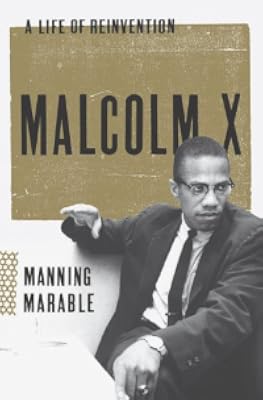
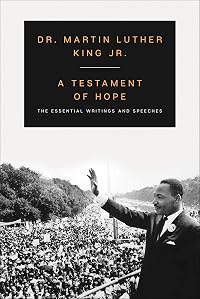
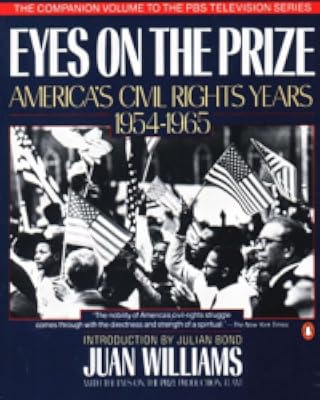
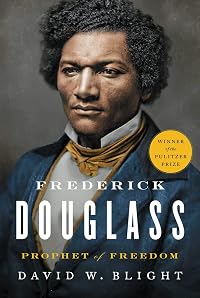
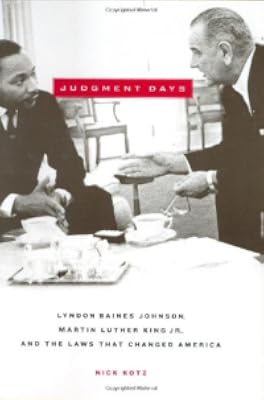
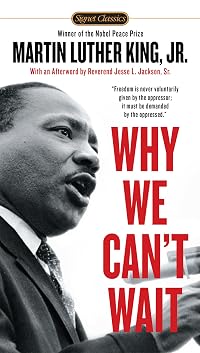

Member Recommendations

Member Reviews
These concluding years of the freedom era show King at the height of his powers even as his worldly prestige falls under withering attack. We witness non-violent advances for democracy in the face of growing factionalism and fear. We meet heroines and martyrs; enter a world battered by private doubts, public dreams, contagious inspiration, official harassment, and poisonous discord over the Vietnam War. The narrative begins with violence before the pivotal 1965 Selma march for the right to vote, a dangerous time. From landmark victory there, King's movement comes under threat from competing forces. Branch chronicles dramatic campaigns in Mississippi and Alabama, King's tormented alliance with Lyndon Johnson, his painful break with show more Stokey Carmichael over black power, and persecution by Hoover's FBI. Like "Parting the Waters" and "Pillar of Fire", "At Canaan's Edge" is a magnificent achievement that brings the decades of the Civil Rights struggle alive and preserves the integrity of those who marched and died. show less
The concluding volume of historian Taylor Branch's trilogy about the Civil Rights era (which began with the Pulitzer-Prize-winning "Parting the Waters" and continued with "Pillar of Fire") follows the final years of Martin Luther King's life, from the struggles in Selma in 1965 to his assassination in April 1968. In this volume, Branch explicitly follows the analogy of King to Moses found in the titles of the books, drawn from King's final public address, often known as the "I have been to the mountaintop" address.
While the comparison to Moses is unavoidable -- King oratorically placing himself on the mountaintop overlooking the promised land the night before his death is impossible to avoid -- Branch also implicitly compares King to show more another leader in this book, Jesus Christ. The fourth and final section of the book, titled "Passion," might point to any religious martyrdom, but also points Christ's crucifixion.
In a nutshell, this overarching narrative frame is the strength and the limitation of this very fine book. Branch continues to focus on King as the soul of America in the Civil Rights era. This is difficult to avoid, King's presence looms largest over the time, but Branch's careful history demonstrates that King by the end of his life, the Civil Rights movement had fragmented and marginalized King and his leadership. The narrative arc, though, leads to the unfortunate conclusion that the best of the era ended with King's death, which conveniently fits into our desire for historical starting points and ending points, but which doesn't really fit the data.
This is a quibble, though, in the face of Branch's staggering depth and insight as he presents the events of these years. In particular, Branch is skilled at evoking the key personalities of the age in all of the complexity. If King is the conscience of this time period, President Lyndon Johnson is the anguished soul, struggling to do the right thing in the face of significant opposition -- both political opposition and his own inner demons. If possible, Johnson might even be a more compelling figure in this book than King.
Branch details the divided efforts for Civil Rights after the passage of the 1965 Voting Rights Act: the voter registration drives in the southern states, including the formation of the Black Panther political party for the 1966 election in Alabama; the protests against the war in Vietnam; the demand for better housing in the north; the reactions to continued violence against activists and volunteers; marches in support of striking workers.
In the end, Branch believes that it is King's continued practice of nonviolence throughout this era, and particularly in the final years of his life, that is the great legacy of the age. If this seems a rather trite conclusion given conventional wisdom about the Civil Rights era, the narrative impact of this is striking. The divided efforts of the age lead to divided strategies, with nonviolence being shelved by most other activists as unproductive or even counter-productive. King alone, Branch argues, followed nonviolence to the end.
The book is fascinating, and is certainly a worthy final volume in Branch's trilogy. It is difficult to overstate Branch's achievement with the three books. They have been acclaimed by most critics, and rightly so. show less
While the comparison to Moses is unavoidable -- King oratorically placing himself on the mountaintop overlooking the promised land the night before his death is impossible to avoid -- Branch also implicitly compares King to show more another leader in this book, Jesus Christ. The fourth and final section of the book, titled "Passion," might point to any religious martyrdom, but also points Christ's crucifixion.
In a nutshell, this overarching narrative frame is the strength and the limitation of this very fine book. Branch continues to focus on King as the soul of America in the Civil Rights era. This is difficult to avoid, King's presence looms largest over the time, but Branch's careful history demonstrates that King by the end of his life, the Civil Rights movement had fragmented and marginalized King and his leadership. The narrative arc, though, leads to the unfortunate conclusion that the best of the era ended with King's death, which conveniently fits into our desire for historical starting points and ending points, but which doesn't really fit the data.
This is a quibble, though, in the face of Branch's staggering depth and insight as he presents the events of these years. In particular, Branch is skilled at evoking the key personalities of the age in all of the complexity. If King is the conscience of this time period, President Lyndon Johnson is the anguished soul, struggling to do the right thing in the face of significant opposition -- both political opposition and his own inner demons. If possible, Johnson might even be a more compelling figure in this book than King.
Branch details the divided efforts for Civil Rights after the passage of the 1965 Voting Rights Act: the voter registration drives in the southern states, including the formation of the Black Panther political party for the 1966 election in Alabama; the protests against the war in Vietnam; the demand for better housing in the north; the reactions to continued violence against activists and volunteers; marches in support of striking workers.
In the end, Branch believes that it is King's continued practice of nonviolence throughout this era, and particularly in the final years of his life, that is the great legacy of the age. If this seems a rather trite conclusion given conventional wisdom about the Civil Rights era, the narrative impact of this is striking. The divided efforts of the age lead to divided strategies, with nonviolence being shelved by most other activists as unproductive or even counter-productive. King alone, Branch argues, followed nonviolence to the end.
The book is fascinating, and is certainly a worthy final volume in Branch's trilogy. It is difficult to overstate Branch's achievement with the three books. They have been acclaimed by most critics, and rightly so. show less
I find Branch's style too terse; the really significant moments in his narrative almost seem to get less attention than the trivial. It's an important history, and worth such a full retelling. But honestly, you'll appreciate this book more if you're already familiar with the basic contours of the story.
The first book was excellent; the second book was pretty good; this one, like the civil rights movement itself, foundered a bit on the Vietnam War. The civil rights movement was already too big and had too much to discuss - these books weren't particularly clear in explaining why some people or events were included and others weren't - and adding Vietnam just compounded the issue.
This is a very well written history of the United States during 4 years at the height of the Civil Rights era and escalation in the U.S. involvement in Vietnam War. I lived through this period and well remember it, but was still surprised at some of the things I had forgotten, like the rise of the Black Panthers and how very influential J. Edgar Hoover was in many, many areas he never should have been involved in. After reading the book I had greater respect for Lyndon Johnson and Martin Luther King, Jr. and total revulsion toward J. Edgar Hoover.
I don't have time at the moment to give this book the review I want to write, but just a placeholder to say -- Wow. Even better than the first. Until now I've always thought of the Civil Rights movement of the 1960's and the Vietnam protests as separate phases of history; this book completely and compellingly explains how they were intertwined -- and the dilemma it created for King, who saw non-violence as his calling, as much as Civil Rights.
4132 At Canaan's Edge America in the King Years 1965-68, by Taylor Branch (read 23 Feb 2006) This is the third and final volume of Branch's magisterial work on the King years. I read volume I on 15 Dec 1994 and volume II on 31 Jan 1999. This volume has 771 pages of text, 202 pages of footnotes and an eleven page bibliography. It is as far as I can tell perfectly done, and is unmitigatedly absorbing reading, as it tells the King story from Selma in March 1965 till the day he was killed in 1968--at which point the book stops, except for a superbly-done five page epilogue. One stands in amazement at how vicious the racism was in those years (1965-1968), not only in the South but in Chicago, e.g. , which makes one astounded how much things show more seem to have changed . The book tells much of LBJ and his interaction with King and of course his travail with the Vietnam dilemma. show less
Members
- Recently Added By
Lists

Books All Georgians Should Read 2010
25 works; 1 member

Mustich's 1000 Books to Read Before You Die: A Life Changing List
1,001 works; 20 members
Author Information

13+ Works 5,588 Members
Taylor Branch is the bestselling author of Parting the Waters: America in the King Years, 1954-63; Pillar of Fire: America in the King Years, 1963-65; At Canaan's Edge: America in the King Years, 1965-1968; and The Clinton Tapes. He has won the Pulitzer Prize, the National Book Critics Circle Award, the National Humanities Medal, and the Dayton show more Literary Peace Prize's Life-time Achievement Award. He lives in Baltimore with his wife, Christy Macy. show less
Some Editions
Awards and Honors
Awards
Distinctions
Series

Work Relationships
Common Knowledge
- Original publication date
- 2006
- People/Characters
- Martin Luther King, Jr.
- Important events
- African-American Civil Rights Movement
Classifications
- Genres
- Nonfiction, Politics and Government, History, General Nonfiction, Biography & Memoir
- DDC/MDS
- 323.1196 — Society, government, & culture Political science Civil Rights & Liberties/ Human Rights Minority Politics Specific Groups Biography And History African Origin
- LCC
- E185.615 .B67 — History of the United States United States
- BISAC
Statistics
- Members
- 1,040
- Popularity
- 24,982
- Reviews
- 12
- Rating
- (4.52)
- Languages
- English
- Media
- Paper, Audiobook, Ebook
- ISBNs
- 8
- ASINs
- 9