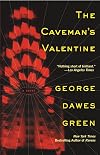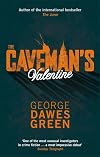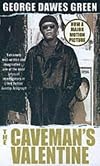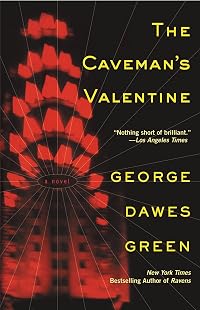
The Caveman's Valentine
by George Dawes Green
On This Page
Description
Romulus Ledbetter wasn't always homeless. He once was a devoted husband, father, and musician with a bright future. He now forages for food in the trash cans of the city's better neighborhoods and wages a strenuous one-man war against Cornelius Gould Stuyvesant, an evil -- and imaginary -- power broker who is responsible for society's ills, as well as the sinister Y- and Z-rays that are corrupting humankind. Then one wintry night, Rom finds a corpse at the mouth of his cave that rouses his show more well-defined sense of ethics and launches him on an obsessive quest for answers. Forced to reconnect with society, Rom leaves his world and journeys through a spiraling web of clues and hunches, straight into a sinister den of money, temptation, and murder--otherwise known as the "civilized" world. show lessTags
Recommendations





















Member Reviews
The Caveman's Valentine is a murder mystery with a very singular protagonist. Romulus Ledbetter is a Julliard dropout, a brilliant pianist who has been derailed by clinical paranoia and now lives in a cave in New York City's Inwood Park, at the very northern tip of Manhattan Island. At times he can cope quite well, but when he's upset, the seraphs in his head take over, and he is likely to begin angry rants about Cornelius Gould Stuyvesant, the evil genius bent on world domination whose headquarters is the Chrysler Building, whence he sends out his evil Y-Rays. So when Rom finds a dead body near his cave entrance in the dead of winter, realizes that the dead man is the lover of his friend, Matthew, and that there has been foul play, he show more has trouble convincing the police of . . . well, of anything. So he sets off on his own investigation, using as cover his former identity as a musical prodigy.
There are some rather too convenient plot points in the novel, such as Rom's musical brilliance that opens doors for him and the fact that Rom's daughter happens to be a police officer, which provides a "benefit of the doubt" element for him that most cave-dwelling paranoid bums would not experience. These gave the book a slightly off-kilter element for me. I could, in fact, easily imagine this book as a graphic novel. However, that reservation aside, I really did enjoy reading The Cavemen's Valentine. It was original and moved right along, and the plotting was mostly fine, as well. Also, there was some very nice writing, indeed. For example, we get this description of a vase falling off a piano during a scuffle:
"The vase in front of him leapt up and dove down and hit the floor, and it was every shard for itself."
The whimsical and somehow perfectly descriptive nature of that "every shard for itself" somehow encapsulates much of what I found admirable in this novel.
The book was published in the mid-1990s, and the AIDS epidemic serves as a mostly unspoken but strong underlying current to the narrative. show less
There are some rather too convenient plot points in the novel, such as Rom's musical brilliance that opens doors for him and the fact that Rom's daughter happens to be a police officer, which provides a "benefit of the doubt" element for him that most cave-dwelling paranoid bums would not experience. These gave the book a slightly off-kilter element for me. I could, in fact, easily imagine this book as a graphic novel. However, that reservation aside, I really did enjoy reading The Cavemen's Valentine. It was original and moved right along, and the plotting was mostly fine, as well. Also, there was some very nice writing, indeed. For example, we get this description of a vase falling off a piano during a scuffle:
"The vase in front of him leapt up and dove down and hit the floor, and it was every shard for itself."
The whimsical and somehow perfectly descriptive nature of that "every shard for itself" somehow encapsulates much of what I found admirable in this novel.
The book was published in the mid-1990s, and the AIDS epidemic serves as a mostly unspoken but strong underlying current to the narrative. show less
In some ways a pretty standard "regular guy gets drawn into intrigue" sort of mystery. Only here our regular guy is a barking mad ex-musician who lives in a cave in a NYC park.
Green does a very good job with that character, making his worldview farcical yet believable and creating an interesting play the delusions that overcome him, the illusions he believes but which he knows are illusions, and a real world that sometimes seems indistinguishable from delusion.
I would have said his black middle-class family owes a lot to Stephen Carter's Emperor of Ocean Park if this hadn't been written first. By no means great, this book is certainly much better than the run of the mill.
Green does a very good job with that character, making his worldview farcical yet believable and creating an interesting play the delusions that overcome him, the illusions he believes but which he knows are illusions, and a real world that sometimes seems indistinguishable from delusion.
I would have said his black middle-class family owes a lot to Stephen Carter's Emperor of Ocean Park if this hadn't been written first. By no means great, this book is certainly much better than the run of the mill.
I've finished the book and enjoyed it although I'm finding myself enjoying the movie for it's frenetic pacing slightly more. While the book certainly ties up more of the plot's loose ends and shows a glimmer of hope for Rom's future, the pacing of the story suffers near the middle as the motivations and histories of all the different characters (many who are left out of the film) are introduced and explored.
After reading this book I am really curious how a movie could portray Romulus with his Y-Rays and other ramblings. I can't imagine it would be as funny as the book. Early in the book I thought the reader was going to be led to a much darker place than the quirky mind of this paranoid schizophrenic. There are some serious subjects touched on, to be sure, but the humor keeps the book from becoming grim.
As the story unfolds, there are hints that our hero will experience an epiphany and recover his sanity. His progress is satisfying but not conventional or cliched. The same could be said of almost all aspects of the book, from romance to mystery to character development.
As the story unfolds, there are hints that our hero will experience an epiphany and recover his sanity. His progress is satisfying but not conventional or cliched. The same could be said of almost all aspects of the book, from romance to mystery to character development.
Unique mystery in which the detective is a mentally ill homeless man called Romulus. Romulus is spurred into action (and propelled out into the "real world") when someone Romulus cares about is murdered and left outside the cave that Romulus calls home. The story is sometimes funny, sometimes sad, but always interesting. Romulus is a believable and sympathetic character. Reading the book has caused me to feel more compassion for the homeless around me; that alone made it worth reading.
This was titled as The Caveman in Australia.
In addition to a having a pretty good murder mystery, you get to see the plot and characters through the eyes and mind of Romulus, a paranoid schizophrenic who must struggle to suppress the voices in his head and the conspiracies all around him.
While overall this is a great read, its treatment of homelessness as a matter of choice is perhaps a bit glib.
This book won the Edgar award and I believe that it was made into a movie with Samuel L. Jackson. It is, however, hard to imagine how a film could do the workings of Romulus's bizarre mind justice.
In addition to a having a pretty good murder mystery, you get to see the plot and characters through the eyes and mind of Romulus, a paranoid schizophrenic who must struggle to suppress the voices in his head and the conspiracies all around him.
While overall this is a great read, its treatment of homelessness as a matter of choice is perhaps a bit glib.
This book won the Edgar award and I believe that it was made into a movie with Samuel L. Jackson. It is, however, hard to imagine how a film could do the workings of Romulus's bizarre mind justice.
I read so little of this that I can't honestly rate it, but I also read lots of reviews, and enough to know it's not for me. Much too high a yuck factor, for one. But the bigger problem is that the voice of Romulus doesn't ring true. I'm just not sure how well the author actually understands the different kinds of people with mental illness, or the different kinds of people who live on the street, much less the ones who are only one or the other. That is to say, none of us need to have our prejudice that 'homeless are crazy' reinforced. And even if he does have this Rom character down true, the story seems exploitative. Which is a bad thing.
Members
- Recently Added By
Lists

Edgar Award
418 works; 15 members

100 Best Thrillers of All Time
100 works; 6 members

Books Read in 2022
5,166 works; 114 members
Author Information

12+ Works 1,901 Members
George Dawes Green has written for such publications as The Ontario Review and Carolina Quarterly. His first novel, The Caveman's Valentine, won a 1995 Edgar Allan Poe Award for Best First Novel by an American Author. He also wrote The Juror, which was adapted as a screenplay starring Demi Moore and Alec Baldwin. (Bowker Author Biography)
Awards and Honors
Awards
Work Relationships
Has the adaptation
Common Knowledge
- Canonical title*
- Hulemanden
- Original title
- The Caveman's Valentine
- Original publication date
- 1994
- People/Characters
- Romulus Ledbetter; Cornelius Gould Stuyvesant
- Important places
- New York, New York, USA
- Related movies
- The Caveman's Valentine (2001 | IMDb)
- Dedication
- For beautiful Rachel
- First words
- You figure now you got me in your clutches, you going to read me, like a book, right?—going to look right into my brain and you going to read it page by page, like I was some cheap-jack midnight entertainment ... (show all)to make you forget the mess you're in—right?
- Last words
- (Click to show. Warning: May contain spoilers.)You did your work, and when it was done and not a moment before, you could let yourself tumble away.
- Blurbers
- Dunn, Katherine; Campbell, Robert; Klavan, Andrew; Muller, Marcia
*Some information comes from Common Knowledge in other languages. Click "Edit" for more information.
Classifications
Statistics
- Members
- 362
- Popularity
- 86,787
- Reviews
- 12
- Rating
- (3.59)
- Languages
- 8 — Danish, Dutch, English, Finnish, German, Greek, Norwegian (Bokmål), Spanish
- Media
- Paper, Ebook
- ISBNs
- 22
- ASINs
- 6