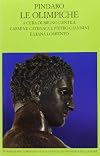
Olympian odes
by Píndar
On This Page
Description
English summary: Pindar was the most important representative of Greek lyrical poetry. Among the most essential of his surviving works are his epinikias, or odes to victory. The present translation and commentary offers readers a much needed introduction to these fourteen poems celebrating the original Olympics. French description: Ne a Cynoscephales en Beotie, vraisemblablement en 518 avant J.-C., Pindare est le plus important representant de la lyrique chorale grecque. Cependant, des 17 show more livres qui formaient, selon les Anciens, le recueil de ses oeuvres, seuls quatre livres nous sont parvenus. Si l'on sait que le poete a ecrit, entre autres, des peans, des hymnes et des dithyrambes, les textes que nous avons conserves appartiennent tous au genre de l'epinicie, ode triomphale celebrant la victoire aux jeux sportifs. Parmi eux, ceux d'Olympie sont sans nul doute les plus renommes. Les quatorze poemes des Olympiques celebrent les exploits de ces hommes, souvent de haute lignee, qui se distinguerent a ces jeux dont le fondateur mythique etaient Heracles. Notre edition fait le point, dans l'introduction generale, sur l'ensemble des connaissances concernant Pindare et ses oeuvres. La notice generale presente le texte des Olympiques, sa tradition manuscrite riche, mais complexe, et fournit une analyse detaillee des jeux olympiques. Chaque poeme est en outre precede d'une notice et du schema metrique, tandis que des notes accompagnent et eclairent le texte. show lessTags
Recommendations



















Member Reviews
Pindaro, il maggiore esponente della lirica corale arcaica nacque a Cinocefale, vicino a Tebe, attorno al 520 - 518 a.C. La fase matura della sua lunga esistenza coincise con quel profondo mutamento etico, politico e religioso dell’Ellade, che provocò lo scardinamento dei principi su cui si fondava l’educazione dell’età arcaica. In quegli anni si svolsero le guerre persiane su cui di dirigeva l’attenzione della società greca e Atene, grazie al ruolo avuto nella guerra, si apprestava a diventare un punto di riferimento per l’intera Ellade.
Nella sua lirica Pindaro manifesta invece la piena volontà di celebrare il passato e si sente estraneo al presente, i cui ideali sono sempre più lontani dai suoi. Per il poeta l’ideale show more di vita è quello eroico, che il nuovo regime democratico greco invece disprezzava, per questo egli si distacca dalla realtà storica anelando ad un ricongiungimento possibile solo rifugiandosi nella dimensione del mito. E' nel mito infatti che il poeta ritrova gli archetipi divini ed eroici, gli stessi che sembrano rivivere negli atleti vincitori delle gare olimpiche.
La poesia è in grado di celebrare la gloria del vincitore, esaltando la grandezza atletica e consentendo al mortale di innalzarsi in una sfera di valori assoluti ed eterni. show less
Nella sua lirica Pindaro manifesta invece la piena volontà di celebrare il passato e si sente estraneo al presente, i cui ideali sono sempre più lontani dai suoi. Per il poeta l’ideale show more di vita è quello eroico, che il nuovo regime democratico greco invece disprezzava, per questo egli si distacca dalla realtà storica anelando ad un ricongiungimento possibile solo rifugiandosi nella dimensione del mito. E' nel mito infatti che il poeta ritrova gli archetipi divini ed eroici, gli stessi che sembrano rivivere negli atleti vincitori delle gare olimpiche.
La poesia è in grado di celebrare la gloria del vincitore, esaltando la grandezza atletica e consentendo al mortale di innalzarsi in una sfera di valori assoluti ed eterni. show less
Jan 19, 2014Italian
Members
- Recently Added By
Author Information

174+ Works 1,934 Members
The Greek poet Pindar, a Boeotian aristocrat who wrote for aristocrats, lived at Thebes, studied at Athens, and stayed in Sicily at the court of Hieron at Syracuse. His epinicians, choral odes in honor of victors at athletic games, survive almost complete and are divided into four groups, depending upon whether they celebrate victory at the show more Olympian, Pythian, Nemean, or Isthmian games. Scholars surmise that these are representative of his other poetry, such as hymns, processional songs, and dirges, extant in fragments. The 44 surviving odes joyfully praise beautiful, brilliant athletes who are like the gods in their moment of triumph. Bold mythological metaphor, dazzling intricacy of language, and metrical complexity together create sublimity of thought and of style. Pindar was famous in his lifetime and later throughout the Hellenistic world, as is attested by the story that Alexander the Great in 335 B.C. ordered the poet's house spared when his army sacked Thebes. The "Pindaric ode" form used in England in the seventeenth and early eighteenth centuries was based on an incorrect understanding of Pindar's metrical schemes and was characterized by grandiose diction. Pindar is considered to be the greatest of the Greek lyric poets. (Bowker Author Biography) show less
Series
Belongs to Publisher Series
Bernat Metge (283)
Work Relationships
Is contained in
Common Knowledge
- Canonical title
- Olympian odes
Classifications
- Genres
- Poetry, Fiction and Literature, Literature Studies and Criticism
- DDC/MDS
- 884.01 — Literature & rhetoric Classical & modern Greek literatures Classical Greek lyric poetry
- LCC
- PA4274 .A2 — Language and Literature Greek language and literature. Latin language and literature Greek literature Individual authors
- BISAC
Statistics
- Members
- 62
- Popularity
- 497,527
- Reviews
- 1
- Rating
- (5.00)
- Languages
- 6 — Catalan, English, Finnish, French, Greek (Ancient), Italian
- Media
- Paper
- ISBNs
- 8