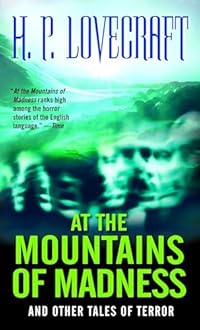
At the Mountains of Madness and Other Tales of Terror {4 stories}
by H. P. Lovecraft
On This Page
Description
The only audio edition of At the Mountains of Madness authorized by the H. P. Lovecraft Estate!A master of terror and nightmarish visions, H. P. Lovecraft solidified his place at the top of the horror genre with this macabre supernatural tale.
When a geologist leads an expedition to the Antarctic plateau, his aim is to find rock and plant specimens from deep within the continent. The barren landscape offers no evidence of any life-form—until they stumble upon the ruins of a lost show more civilization. Strange fossils of creatures unknown to man lead the team deeper, where they find carved stones dating back millions of years. But it is their discovery of the terrifying city of the Old Ones that leads them to an encounter with an untold menace.
Deliberately told and increasingly chilling, At the Mountains of Madness is a must-have for every fan of classic terror.
. show less
Tags
Recommendations























Member Recommendations

ghilbrae It seems that it inspired Lovecraft's story.
20
Member Reviews
In the title story, a Arctic expedition discovers unspeakable, unimaginably ancient horrors in previously unexplored regions—remnants of an alien civilization that was already ancient when dinosaurs roamed the earth. The horror lies not so much in what is actually there, but in how the author renders it; not with admiration of human pluck and faith in our abilities, not with Star Trek-like courageous curiosity, but with reticence, expressed in elevated language; with a sense of humanity’s smallness and vulnerability; and with a sense that humans may move with safety only in a limited sphere, for the universe is an awful and hostile place. There are parallels with The Lord of the Rings, especially in the breeding and enslavement of show more evil creatures, the unwise exploration of the deep, and the relative fragility of humankind. The narrator advises: “It is absolutely necessary, for the peace and safety of mankind, that some of earth’s dark, dead corners and unplumbed depths be let alone; lest sleeping abnormalities wake to resurgent life, and blasphemously surviving nightmares squirm and splash out of their black lairs to newer and wider conquests.” show less
I first read this Lovecraft novella in college some decades ago, and enjoyed it, but while I remembered the basic plot, I’d forgotten a lot of the specifics. The second time I read it, I found new things to discover.
One was how “authentic” the expedition to Antarctica reads, even today. In the research I did after I finished I discovered it’s because of Lovecraft’s life-long fascination with Antarctica and in following the exploits of its explorers. I even consulted a map to find out exactly where he placed the Mountains of Madness (and the further, even higher, Mountains of More Madness). Following the coordinates provided, there was no surprise in that the mountains and the ancient city are smack dab in the middle of the show more continent’s most remote sector. Interestingly, not far from Lake Vostok, though in Lovecraft’s day that area was unexplored. I’ll add that his anecdotes about geology and continental drift also read true and shows that he did his homework.
On the other hand, one thing that did not read true was the human characters’ ease with the altitude Lovecraft describes — the mountains passes are 24,000 feet to fly over in an airplane, and the plateau beyond 20,000 feet, so as New Englanders who are not accustomed to climbing high peaks they wouldn’t be so at ease in their explorations. Neither would they hear the “strange piping” in the mountains’ passes, because of the noise of the airplane whose engines in past times were much noisier than today. I am guessing Lovecraft never actually rode in an airplane or ascended more than a few thousand feet.
And for some reason I had invented parts of the story out of thin air. Like I was so sure there was a bit where the main character and his companion encounter the Elder Things as shadows on a wall as they fumble about with human-sized matches, trying to get them to light, and indeed the smell of the struck matches is what draws the humans to that spot. But I had fabricated all of that from my faulty memory. In the book, the humans smelled gasoline, and they never actually saw the (living) Elder Things or even shadows of them. Maybe the matches bit came from some other book.
I was also surprised at how Lovecraft repeated himself over and over in the text, which I don’t think would happen in this day of word processing. But it did set the mood. That’s what the story really was, a mood piece, with the main character giving his narration in the present day while treating his past self on the doomed expedition as a puppet of sorts. It was kind of amusing, especially how often he stops the narrative and coyly hints at, but doesn’t spell out, the terrors he sees out of kindness for the reader’s sensitivity, and gets very long-winded about it. This Victorian trope does not work, of course, as the reader only wants more, showing a puckish sense of humor at play.
There’s more humor, too, dark humor, in the idea that the unearthed Elder Things inflict on the humans the same thing the humans were going to inflict on them — vivisection.
The narrator’s ultimate purpose in conveying all this, he makes clear to the reader, is to discourage further explorations of Antarctica, which is doomed to have the opposite effect. Who of a scientific bent could resist following up on such a momentous discovery?
Another thing that struck me about the novella is how it blended SF, horror, and fantasy. In fact, it gave the fantastic beings mentioned previously in Lovecraft’s stories a scientific underpinning. Not demystification, for Mythos beings still lurk about unseen, but an actual rooting in prehuman history, discovered with archaeological legwork.
To sum it up: Untold eons ago the Elder Things — mobile, sea-cucumber-like aliens — came to a lifeless earth, brought life to it, and ushered it along. In the course of their occupancy they built cities, fought with other interloping aliens, and used dinosaurs as beasts of burden and primitive humans as court jesters. But their civilization devolved over time, and Earth’s last ice age brought the final blow. Only the ruins of one ancient city was left, the one in Antarctica over the Mountains of Madness and frozen in its glaciers, which the narrator and his companion discover and explore after an earlier party came to ruin. Conveniently they are well versed in certain fictional occult writings mentioned elsewhere in Lovecraft’s work, and draw allusions from the city and mountains they discover to Mythos elements like the Plateau of Leng, the shoggoths, the Necronomicon, and other creatures, places, and things. Gradually, the narrator realizes the ancient roots of all this mumbo-jumbo, distorted by time and human history… by following the Elder Thing cryo-mummies who turned out to be not so dead after all.
By no means was Lovecraft’s a planned mythology, like Tolkien’s. Lovecraft did not work alone. For his Mythos he mixed up real-world occult elements, like the Mesopotamiam god Dagon, with the creations of other writers he admired, like cribbing Edgar Allan Poe’s penguin cry of “Tekeli-li!” (copyright law not existing in its present state back when Lovecraft was writing.) He also encouraged his writing friends to use his creations in their works, and borrowing from them, with permission, elements of their writing that he liked. Indeed, their circle was like a round-robin writers’ group that existed in the early, heady days of the internet, when everything was text-based and the goal was to have fun. Lovecraft even gave his friends monikers and incorporated them into his stories, in-jokes that belie his reputation as a long-winded, racist, humorless prude.
Also unlike Tolkien, he did not take his creations at all seriously. For his fiction he treated them like Warner Brothers treated Bugs Bunny and his friends back in the day — in each cartoon they played different roles, but were always the same character with the same shtick. Yosemite Sam might be a Wild West sheriff in one cartoon and a Medieval knight with a pet dragon in another, but he was always himself, with the same low tolerance for frustration and explosive temper. Lovecraft treated elements like the shoggoths, Cthulhu and Leng the same way. For each story, they had different roles to play, but were always the same. Leng might be a real place in At the Mountains of Madness, but in another story, it was said to be in Tibet, or Lovecraft’s imaginary Dreamworld. But the Platonic ideal of Leng was always the same: a cold, elevated, barren, cursed place.
As a story rather than a mood piece, the plot was too convenient in places, and Lovecraft telegraphed the twists ahead, though this may have been because I had read the story before. But then, for a modern reader it doesn’t take much to connect the dots between “wrecked camp, dead humans, and missing alien corpses and supplies” to “the aliens did it!” in contrast to the thick narrator who refuses to come to that conclusion but heads off in pursuit for reasons he fumbles around.
Another convenience was how the narrator deduces all of the Elder Things’ earthly history from the carvings they made on the walls of their city. Come on, now. Humans have trouble plotting history even from human art. It was purely a plot device for Lovecraft to indulge himself and the reader in a dizzying, yet oddly familiar, tale of a civilization’s journey through time. Personally, I’d rather he left things more mysterious, as I thought I remembered from the excited blur of my first reading.
Also misremembered, by me, was the description of a shoggoth’s passage through the tunnel. In my mind I saw it pouring through like a horizontal blender in reverse — the grayish (in my mind) protoplasm of it being propelled by being sucked through its “anus” and ejected through its “mouth” to pour over its sides and move it along like a capsule in a pneumatic tube. But on this re-read, it was described as rushing like a subway train, not a reversed tornado.
(For the record, though, I’ve always found the Mi-Go the most horrifying of Lovecraft’s monsters.) show less
One was how “authentic” the expedition to Antarctica reads, even today. In the research I did after I finished I discovered it’s because of Lovecraft’s life-long fascination with Antarctica and in following the exploits of its explorers. I even consulted a map to find out exactly where he placed the Mountains of Madness (and the further, even higher, Mountains of More Madness). Following the coordinates provided, there was no surprise in that the mountains and the ancient city are smack dab in the middle of the show more continent’s most remote sector. Interestingly, not far from Lake Vostok, though in Lovecraft’s day that area was unexplored. I’ll add that his anecdotes about geology and continental drift also read true and shows that he did his homework.
On the other hand, one thing that did not read true was the human characters’ ease with the altitude Lovecraft describes — the mountains passes are 24,000 feet to fly over in an airplane, and the plateau beyond 20,000 feet, so as New Englanders who are not accustomed to climbing high peaks they wouldn’t be so at ease in their explorations. Neither would they hear the “strange piping” in the mountains’ passes, because of the noise of the airplane whose engines in past times were much noisier than today. I am guessing Lovecraft never actually rode in an airplane or ascended more than a few thousand feet.
And for some reason I had invented parts of the story out of thin air. Like I was so sure there was a bit where the main character and his companion encounter the Elder Things as shadows on a wall as they fumble about with human-sized matches, trying to get them to light, and indeed the smell of the struck matches is what draws the humans to that spot. But I had fabricated all of that from my faulty memory. In the book, the humans smelled gasoline, and they never actually saw the (living) Elder Things or even shadows of them. Maybe the matches bit came from some other book.
I was also surprised at how Lovecraft repeated himself over and over in the text, which I don’t think would happen in this day of word processing. But it did set the mood. That’s what the story really was, a mood piece, with the main character giving his narration in the present day while treating his past self on the doomed expedition as a puppet of sorts. It was kind of amusing, especially how often he stops the narrative and coyly hints at, but doesn’t spell out, the terrors he sees out of kindness for the reader’s sensitivity, and gets very long-winded about it. This Victorian trope does not work, of course, as the reader only wants more, showing a puckish sense of humor at play.
There’s more humor, too, dark humor, in the idea that the unearthed Elder Things inflict on the humans the same thing the humans were going to inflict on them — vivisection.
The narrator’s ultimate purpose in conveying all this, he makes clear to the reader, is to discourage further explorations of Antarctica, which is doomed to have the opposite effect. Who of a scientific bent could resist following up on such a momentous discovery?
Another thing that struck me about the novella is how it blended SF, horror, and fantasy. In fact, it gave the fantastic beings mentioned previously in Lovecraft’s stories a scientific underpinning. Not demystification, for Mythos beings still lurk about unseen, but an actual rooting in prehuman history, discovered with archaeological legwork.
To sum it up: Untold eons ago the Elder Things — mobile, sea-cucumber-like aliens — came to a lifeless earth, brought life to it, and ushered it along. In the course of their occupancy they built cities, fought with other interloping aliens, and used dinosaurs as beasts of burden and primitive humans as court jesters. But their civilization devolved over time, and Earth’s last ice age brought the final blow. Only the ruins of one ancient city was left, the one in Antarctica over the Mountains of Madness and frozen in its glaciers, which the narrator and his companion discover and explore after an earlier party came to ruin. Conveniently they are well versed in certain fictional occult writings mentioned elsewhere in Lovecraft’s work, and draw allusions from the city and mountains they discover to Mythos elements like the Plateau of Leng, the shoggoths, the Necronomicon, and other creatures, places, and things. Gradually, the narrator realizes the ancient roots of all this mumbo-jumbo, distorted by time and human history… by following the Elder Thing cryo-mummies who turned out to be not so dead after all.
By no means was Lovecraft’s a planned mythology, like Tolkien’s. Lovecraft did not work alone. For his Mythos he mixed up real-world occult elements, like the Mesopotamiam god Dagon, with the creations of other writers he admired, like cribbing Edgar Allan Poe’s penguin cry of “Tekeli-li!” (copyright law not existing in its present state back when Lovecraft was writing.) He also encouraged his writing friends to use his creations in their works, and borrowing from them, with permission, elements of their writing that he liked. Indeed, their circle was like a round-robin writers’ group that existed in the early, heady days of the internet, when everything was text-based and the goal was to have fun. Lovecraft even gave his friends monikers and incorporated them into his stories, in-jokes that belie his reputation as a long-winded, racist, humorless prude.
Also unlike Tolkien, he did not take his creations at all seriously. For his fiction he treated them like Warner Brothers treated Bugs Bunny and his friends back in the day — in each cartoon they played different roles, but were always the same character with the same shtick. Yosemite Sam might be a Wild West sheriff in one cartoon and a Medieval knight with a pet dragon in another, but he was always himself, with the same low tolerance for frustration and explosive temper. Lovecraft treated elements like the shoggoths, Cthulhu and Leng the same way. For each story, they had different roles to play, but were always the same. Leng might be a real place in At the Mountains of Madness, but in another story, it was said to be in Tibet, or Lovecraft’s imaginary Dreamworld. But the Platonic ideal of Leng was always the same: a cold, elevated, barren, cursed place.
As a story rather than a mood piece, the plot was too convenient in places, and Lovecraft telegraphed the twists ahead, though this may have been because I had read the story before. But then, for a modern reader it doesn’t take much to connect the dots between “wrecked camp, dead humans, and missing alien corpses and supplies” to “the aliens did it!” in contrast to the thick narrator who refuses to come to that conclusion but heads off in pursuit for reasons he fumbles around.
Another convenience was how the narrator deduces all of the Elder Things’ earthly history from the carvings they made on the walls of their city. Come on, now. Humans have trouble plotting history even from human art. It was purely a plot device for Lovecraft to indulge himself and the reader in a dizzying, yet oddly familiar, tale of a civilization’s journey through time. Personally, I’d rather he left things more mysterious, as I thought I remembered from the excited blur of my first reading.
Also misremembered, by me, was the description of a shoggoth’s passage through the tunnel. In my mind I saw it pouring through like a horizontal blender in reverse — the grayish (in my mind) protoplasm of it being propelled by being sucked through its “anus” and ejected through its “mouth” to pour over its sides and move it along like a capsule in a pneumatic tube. But on this re-read, it was described as rushing like a subway train, not a reversed tornado.
(For the record, though, I’ve always found the Mi-Go the most horrifying of Lovecraft’s monsters.) show less
(Review Specifically for At the Mountains of Madness)
There are some things that human beings are meant to see and know, and then there are the things that H.P. Lovecraft writes about. Up until recently I had only heard of this horror author, thinking that horror, even if it has some sci fi in it, isn’t for me. My mind was irrevocably changed after reading this suspenseful novella. H.P. Lovecraft’s brand of horror is best described as that feeling when you know you’ve reached the edge of a cliff and you tell yourself not to look down, and then you look down. It’s thrilling and memorable.
When a group of explorers decides to tackle the wintry continent of Antarctica, some of the members of the expedition get way more than they show more bargained for. While some got off lucky with a premature death, two men, William Dyer and Danforth, saw more than any human was ever meant to see. They may have made it over the mysterious mountain range in Antarctica and back with their lives, but Danforth left his sanity behind with a forbidden glimpse of something from before the time of man. Read More show less
There are some things that human beings are meant to see and know, and then there are the things that H.P. Lovecraft writes about. Up until recently I had only heard of this horror author, thinking that horror, even if it has some sci fi in it, isn’t for me. My mind was irrevocably changed after reading this suspenseful novella. H.P. Lovecraft’s brand of horror is best described as that feeling when you know you’ve reached the edge of a cliff and you tell yourself not to look down, and then you look down. It’s thrilling and memorable.
When a group of explorers decides to tackle the wintry continent of Antarctica, some of the members of the expedition get way more than they show more bargained for. While some got off lucky with a premature death, two men, William Dyer and Danforth, saw more than any human was ever meant to see. They may have made it over the mysterious mountain range in Antarctica and back with their lives, but Danforth left his sanity behind with a forbidden glimpse of something from before the time of man. Read More show less
Erudite, lucid, & profound, several stories in this volume are remarkable, but "The Case of Charles Dexter Ward" stands out entirely - perhaps the best tale of horror/urban fantasy ever written, certainly the most intelligently repulsive.
I came across H.P. Lovecraft’s short story collection about four years ago and I found them to be very intriguing and extremely creepy – not creepy like Stephen-King-creepy but creepy in a very – I would even say extremely – weird way (IMHO more scary than the mentioned works of Stephen King because everything takes part in minds of people and everything is only hinted – very rarely you see actual monsters roaming around – so at the end you do not know if there truly is anything strange going around or everything is just a product of a very deranged mind). Not being fan of horror genre I moved on to other genres I like and never came across Lovecraft’s work again.
Well, until last Friday when I found this gem on a local show more book fair. Being fan of “lost-civilization” kind of stories I got hooked up immediately after reading summary on the back of the book.
Story is rather short (some 200 pages) but reader is very fast immersed into it (and to be honest entire feeling is like the story itself was written just a few years ago – just one of the proofs of Lovecraft’s qualities as a writer). Story is being told by one of the survivors of Antarctica expedition as a warning that no man should be sent to that distant region again (another expedition is being planned as the survivor begins his story). As a proof survivor discloses events and findings previously kept secret – for fear of all surviving members of the original expedition that they may be declared lunatics if they publish them. After finding out that new expedition is planned they decide that humanity would be endangered if whatever lurks the Antarctica wastelands is set free (as it surely would be if new expedition continues the research), so they put aside their personal fears and start campaign to warn the public.
This one you’ll read in one breath.
Recommended. show less
Well, until last Friday when I found this gem on a local show more book fair. Being fan of “lost-civilization” kind of stories I got hooked up immediately after reading summary on the back of the book.
Story is rather short (some 200 pages) but reader is very fast immersed into it (and to be honest entire feeling is like the story itself was written just a few years ago – just one of the proofs of Lovecraft’s qualities as a writer). Story is being told by one of the survivors of Antarctica expedition as a warning that no man should be sent to that distant region again (another expedition is being planned as the survivor begins his story). As a proof survivor discloses events and findings previously kept secret – for fear of all surviving members of the original expedition that they may be declared lunatics if they publish them. After finding out that new expedition is planned they decide that humanity would be endangered if whatever lurks the Antarctica wastelands is set free (as it surely would be if new expedition continues the research), so they put aside their personal fears and start campaign to warn the public.
This one you’ll read in one breath.
Recommended. show less
Lovecraft weaves a unique tale, with the trip to the Antarctic reminiscent to me of John Carpenter's "The Thing." I found it challenging to read this book to anything but jazz, oddly. Usually just silence. The horror he imbues throughout the tale is palatable. He gets in your head. There is an epic mythos behind the story. I quite enjoyed it, but Arthur Machen is still my favorite weird fiction author.
I'm looking forward to chatting about this book at the next Rapscallions meeting.
I'm looking forward to chatting about this book at the next Rapscallions meeting.
I was not thrilled with "At the Mountains of Madness." The story of an Antarctic expedition that discovers a madness-inducing mountain with horrifying creatures was overwrought. I mean, how many pages do you really need to describe the strange (and again with the madness-inducing) architecture. The story could have done with some serious cutting of redundant paragraphs. But it wasn't entirely without merit and had some moments, where the action moved at enough of a pace to keep me reading.
The second story, "The Shunned House," was better, in part because it was shorter and therefore more concise. Still a lot of overworked descriptions and very little dialog, but the ending image was awesome and one that has sparked my imagination.
"The show more Dreams in the Witch House" was good, about a man obsessed with a story of an old witch, who claimed to know secret geometries that allowed her to bend dimensional space. Lovecraft clearly loved the theme of insanity-inducing angles and architecture (along with bizarre old ladies, which also appeared in "At the Mountains of Madness," and again with the labored, overworked descriptions.
As for the finale story, "The Statement of Randolph Carter," I won't bother to give a description, and will just say, lame.
I don't find myself eager to read any more of Lovecraft's work (also considering what I've learned about his pervasive racism). Though I will probably also read, "The Call of Cthulhu," because I love the Cthulhu pop-culture cult following that has popped up all over the the internet. show less
The second story, "The Shunned House," was better, in part because it was shorter and therefore more concise. Still a lot of overworked descriptions and very little dialog, but the ending image was awesome and one that has sparked my imagination.
"The show more Dreams in the Witch House" was good, about a man obsessed with a story of an old witch, who claimed to know secret geometries that allowed her to bend dimensional space. Lovecraft clearly loved the theme of insanity-inducing angles and architecture (along with bizarre old ladies, which also appeared in "At the Mountains of Madness," and again with the labored, overworked descriptions.
As for the finale story, "The Statement of Randolph Carter," I won't bother to give a description, and will just say, lame.
I don't find myself eager to read any more of Lovecraft's work (also considering what I've learned about his pervasive racism). Though I will probably also read, "The Call of Cthulhu," because I love the Cthulhu pop-culture cult following that has popped up all over the the internet. show less
Members
- Recently Added By
Lists

Weird and Weirder Fiction
266 works; 33 members

Books Set in the Polar Regions
16 works; 6 members
Survey of Gothic and Horror Literature
18 works; 4 members

To Read - Horror
137 works; 14 members

Books Read in 2025
4,090 works; 97 members
Author Information

1,911+ Works 73,639 Members
Howard Phillips Lovecraft, 1890 - 1937 H. P. Lovecraft was born on August 20, 1890 in Providence, Rhode Island. His mother was Sarah Susan Phillips Lovecraft and his father was Winfield Scott Lovecraft, a traveling salesman for Gorham & Co. Silversmtihs. Lovecraft was reciting poetry at the age of two and when he was three years old, his father show more suffered a mental breakdown and was admitted to Butler Hospital. He spent five years there before dying on July 19, 1898 of paresis, a form of neurosyphillis. During those five years, Lovecraft was told that his father was paralyzed and in a coma, which was not the case. His mother, two aunts and grandfather were now bringing up Lovecraft. He suffered from frequent illnesses as a boy, many of which were psychological. He began writing between the ages of six and seven and, at about the age of eight, he discovered science. He began to produce the hectographed journals, "The Scientific Gazette" (1899-1907) and "The Rhode Island Journal of Astronomy" (1903-07). His first appearance in print happened, in 1906, when he wrote a letter on an astronomical matter to The Providence Sunday Journal. A short time later, he began writing a monthly astronomy column for The Pawtuxet Valley Gleaner - a rural paper. He also wrote columns for The Providence Tribune (1906-08), The Providence Evening News (1914-18), The Asheville (N.C.) Gazette-News (1915). In 1904, his grandfather died and the family suffered severe financial difficulties, which forced him and his mother to move out of their Victorian home. Devastated by this, he apparently contemplated suicide. In 1908, before graduating from high school, he suffered a nervous breakdown. He didn't receive a diploma and failed to get into Brown University, both of which caused him great shame. Lovecraft was not heard from for five years, re-emerging because of a letter he wrote in protest to Fred Jackson's love story in The Argosy. His letter was published in 1913 and caused great controversy, which was noted by Edward F. Daas, President of the United Amateur Press Association (UAPA). Daas invited Lovecraft to join the UAPA, which he did in early 1914. He eventually became President and Official Editor of the UAPA and served briefly as President of the rival National Amateur Press Association (NAPA). He published thirteen issues of his own paper, The Conservative (1915-23) and contributed poetry and essays to other journals. He also wrote some fiction which titles include "The Beast in the Cave" (1905), "The Alchemist" (1908), "The Tomb" and "Dagon" (1917). In 1919, Lovecraft's mother was deteriorating, mentally and physically, and was admitted to Butler Hospital. On May 24, 1921, his mother died from a gall bladder operation. While attending an amateur journalism convention in Boston, Lovecraft met his future wife Sonia Haft Greene, a Russian Jew. They were married on March 3, 1924 and Lovecraft moved to her apartment in Brooklyn. Sonia had a shop on Fifth Avenue that went bankrupt. In 1925, Sonia went to Cleveland for a job and Lovecraft moved to a smaller apartment in the Red Hook district of Brooklyn. In 1926, he decided to move back to Providence. Lovecraft had his aunts bar his wife, Sonia, from going to Providence to start a business because he couldn't have the stigma of a tradeswoman wife. They were divorced in 1929. After his return to Providence, he wrote his greatest fiction, which included the titles "The Call of Cthulhu" (1926), "At the Mountains of Madness" (1931), and "The Shadow Out of Time" (1934-35). In 1932, his aunt, Mrs. Clark, died; and he moved in with his other aunt, Mrs. Gamwell, in 1933. Suffering from cancer of the intestine, Lovecraft was admitted to Jane Brown Memorial Hospital and on March 15, 1937 he died. (Bowker Author Biography) show less
Awards and Honors
Notable Lists
Series
Belongs to Publisher Series
Voyager Classics (29)
Work Relationships
Is contained in
Contains
Inspired
Common Knowledge
- Canonical title
- At the Mountains of Madness and Other Tales of Terror {4 stories}
- Original publication date
- 1936
- People/Characters
- William Dyer; Nyarlathotep; Brown Jenkin; Randolph Carter; Walter Gilman; Keziah Mason (show all 13); Elihu Whipple; Etienne Roulet; Danforth; Frank H. Pabodie; Lake; Atwood; Harley Warren
- Important places
- Dunwich, Massachusetts, USA (fictional); Arkham, Massachusetts, USA (fictional); Innsmouth, Massachusetts, USA (fictional); Boston, Massachusetts, USA; Antarctica; Providence, Rhode Island, USA
- Related movies
- The Thing (1982 | IMDb); Hellboy II: The Golden Army (2008 | IMDb); AVP: Alien vs. Predator (2004 | IMDb); The Unnamable II: The Statement of Randolph Carter (1993 | IMDb)
- Disambiguation notice
- This work is for an anthology of the following four stories:
• At the Mountains of Madness
• The Shunned House
• The Dreams in the Witch-House
• The Statement of Randolph Carter
Please do not combin... (show all)e with works containing a different direction of stories.
Classifications
Statistics
- Members
- 1,922
- Popularity
- 11,048
- Reviews
- 27
- Rating
- (3.96)
- Languages
- English, French, Italian
- Media
- Paper, Audiobook, Ebook
- ISBNs
- 17
- ASINs
- 22