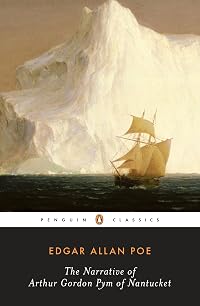
The Narrative of Arthur Gordon Pym of Nantucket
by Edgar Allan Poe
On This Page
Description
HarperCollins is proud to present its incredible range of best-loved, essential classics.'It was unnecessary for all to perish, when, by the death of one, it was possible, and even probable, that the rest might be finally preserved.'Travelling aboard a whaling vessel, a young stowaway is swept up in myriad misadventures - mutiny, shipwreck, cannibalism - narrowly escaping numerous brushes with death. This rousing story of a daring sea voyage also presents its antihero with a host of show more psychological dilemmas, and offers an important insight into Poe's work as a whole.The only complete novel by infamous gothic horror writer Edgar Allan Poe, 'The Narrative of Arthur Gordon Pym of Nantucket' has inspired other classic tales of maritime adventure, such as Herman Melville's 'Moby-Dick' and Jules Verne's 'Twenty Thousand Leagues Under the Sea'. show lessTags
Recommendations









































Member Recommendations

391 An Antarctic Mystery is Verne's response/sequel to Poe's book.
20

Twin_Cinema_Books This narrative hits its stride at sea, combining elements of the fantastic with a visit to a polar region.

bluepiano Each is an account of a shipwreck whose survivors are heading for an unearthly sort of place. Poe's tale is mostly about the voyage and Bernanos's about what happens on landfall. Both are great reading.

Member Reviews
Poe's only novel is extremely episodic, perhaps due to selling some parts as a serialized story, or in his foundations as a short story author. We go from one setpiece adventure to the next, starting out fairly conventionally with adventures on the high seas, mutinies, people cast adrift by the weather, but as the story moves into the second part and involves an expedition to the south it takes a turn toward a Lost World type story with some horror elements presaging what Lovecraft and others would write.
Poe also cribbed a lot of information from nonfiction sources which gives the narrative moments of strangely deep verisimilitude, as he goes over the proper way to stow cargo on a boat, or what the decking is made out of, how sails show more work, survival skills at sea and so on.
The story thus becomes a bit disjointed and ends inconclusively which annoyed both contemporary readers and so now me. While an interesting book, I'd recommend sticking to Poe's strengths as a short story author. show less
Poe also cribbed a lot of information from nonfiction sources which gives the narrative moments of strangely deep verisimilitude, as he goes over the proper way to stow cargo on a boat, or what the decking is made out of, how sails show more work, survival skills at sea and so on.
The story thus becomes a bit disjointed and ends inconclusively which annoyed both contemporary readers and so now me. While an interesting book, I'd recommend sticking to Poe's strengths as a short story author. show less
You have to define "science fiction" pretty broadly to include The Narrative of Arthur Gordon Pym as some people do; if we're going to backdate 20th-century genres onto the 19th century, I'd rather go with "fantasy," and even then, the fantasy elements are pretty minimal-- if pivotal. But the book is gripping all the same. I haven't read much Poe (if any), but I really liked how this novel always had this slight bent of surrealism. For most of the novel, everything that happened was within the realm of possibility, but it always felt slightly off. Arthur, our narrator, spends several chapters trapped in the hold of a ship, and his inability to know what's going on and his struggled to just move around is artfully portrayed-- as is his show more harrowing struggle with what he finds locked in with him. Things only get weirder from there, and I was always hooked. There are some scenes that are absolutely gruesome where Poe uses sparse, uncharged language-- and this only heightens the effect. It's a gripping, enthralling book, especially once the characters get to the islands mentioned in the (very long) full title, and things get really weird. And the ending is a killer. You can see why Poe never wrote another novel, but I'm very glad he penned this one. show less
The Narrative of Arthur Gordon Pym of Nantucket, by Edgar Allan Poe (1838)
Verne wrote the 44th book in his Extraordinary Voyages ("An Antarctic Mystery", aka "The Sphinx of the Ice Fields", 1897) as a sequel and homage to Edgar Allan Poe's "The Narrative of Arthur Gordon Pym of Nantucket". In preparation for reading Verne's book, I first read Poe's work, the only novel the American author wrote.
What is it about?: Young Arthur Gordon Pym stows away aboard a whaling ship called the Grampus. Various adventures and misadventures befall him, including mutiny, shipwreck and cannibalism. Later, after miraculously surviving, Pym continues his adventures further south, aboard the ship Jane Guy. As they get closer to the South Pole, their ship show more encounters scheming natives and strange phenomena.
Poe's novel is far from perfect, but it possesses an energy and intensity that kept me glued to my ebook device. In that sense, it reminded me of the best pulp adventure stories from the beginning of the 2oth century. It's a ripping yarn, a real page-turner, with the virtues and flaws of such excessive tales. It has many elements in common with other 19th century adventure stories about sea voyage, but at the same time it's a very personal work, full of Poe's obsessions and terrors.
When published, this novel was not successful, neither critically nor commercially, and Poe himself called it "a very silly book", but at the same time it has influenced and earned the admiration of writers like Herman Melville, Jules Verne, H. G. Wells, Arthur Conan Doyle, Charles Baudelaire, Henry James, H. P. Lovecraft and Jorge Luis Borges.
The novel is composed of two very different parts, with different tones and only linked by the title character's sea voyages and by a certain self-destructive tendency he has that pushes him into terrible situations.
The first half is a more traditional sea adventure, with mutineers, shipwrecks, privations... but this does not give you an idea of how terrifying, dark, extreme, gruesome and claustrophobic the story is. It's a relentless narration, never giving the characters or the reader a respite. Poe really was very different from Verne. Verne's mind is rational and well-ordered, while Poe's mind is twisted, full of dark corners.
The second part, starting at chapter XIV, is such a sudden change of tack that it leaves some readers disconcerted and disgruntled. The pace here is less frantic and oppressive. It now feels like a 19th century sea exploration story. Poe imitates the non-fiction travel narratives of his century, much like Verne will do later in his own novels, describing the islands the ship visits and giving their coordinates. Poe even gives us a long overview of the Antarctic exploration that had been done at the time, which is something that Verne will also do in his stories of polar exploration.
Of course, beyond a certain point, the Antarctic regions were unknown at the time, a large blank area on the maps. And Poe fills it with his fantasy. The so far realistic story of exploration becomes increasingly fantastic.
And then there's the ending. What an ending. Infuriating, a disconcerting cop-out, unsatisfactory... Yes, it's all that, but also, how memorable and intriguing, suggesting so many things and leaving the reader wondering. Verne would write about it "Who shall continue it? Someone braver than me, someone more willing to enter the domain of impossible things." Twenty years after writing that, Verne must have felt brave enough to make the attempt, and the result was "An Antarctic Mystery" (aka "The Sphinx of the Ice Fields"). But that's a different book, to be discussed elsewhere.
Coming back to Poe's novel: it's too gruesome and truculent. It's not well-structured as a novel, feeling like a fix-up of two novellas, very different in tone. Also, it lacks a proper ending. It is deserving of criticism. But at the same time it's so vivid, its imagery so powerful, that it is still read much after its critics are gone and forgotten.
Enjoyment factor: I enjoyed it a lot. A lot of elements in common with Verne's stories, but at the same time so different... show less
Verne wrote the 44th book in his Extraordinary Voyages ("An Antarctic Mystery", aka "The Sphinx of the Ice Fields", 1897) as a sequel and homage to Edgar Allan Poe's "The Narrative of Arthur Gordon Pym of Nantucket". In preparation for reading Verne's book, I first read Poe's work, the only novel the American author wrote.
What is it about?: Young Arthur Gordon Pym stows away aboard a whaling ship called the Grampus. Various adventures and misadventures befall him, including mutiny, shipwreck and cannibalism. Later, after miraculously surviving, Pym continues his adventures further south, aboard the ship Jane Guy. As they get closer to the South Pole, their ship show more encounters scheming natives and strange phenomena.
Poe's novel is far from perfect, but it possesses an energy and intensity that kept me glued to my ebook device. In that sense, it reminded me of the best pulp adventure stories from the beginning of the 2oth century. It's a ripping yarn, a real page-turner, with the virtues and flaws of such excessive tales. It has many elements in common with other 19th century adventure stories about sea voyage, but at the same time it's a very personal work, full of Poe's obsessions and terrors.
When published, this novel was not successful, neither critically nor commercially, and Poe himself called it "a very silly book", but at the same time it has influenced and earned the admiration of writers like Herman Melville, Jules Verne, H. G. Wells, Arthur Conan Doyle, Charles Baudelaire, Henry James, H. P. Lovecraft and Jorge Luis Borges.
The novel is composed of two very different parts, with different tones and only linked by the title character's sea voyages and by a certain self-destructive tendency he has that pushes him into terrible situations.
The first half is a more traditional sea adventure, with mutineers, shipwrecks, privations... but this does not give you an idea of how terrifying, dark, extreme, gruesome and claustrophobic the story is. It's a relentless narration, never giving the characters or the reader a respite. Poe really was very different from Verne. Verne's mind is rational and well-ordered, while Poe's mind is twisted, full of dark corners.
The second part, starting at chapter XIV, is such a sudden change of tack that it leaves some readers disconcerted and disgruntled. The pace here is less frantic and oppressive. It now feels like a 19th century sea exploration story. Poe imitates the non-fiction travel narratives of his century, much like Verne will do later in his own novels, describing the islands the ship visits and giving their coordinates. Poe even gives us a long overview of the Antarctic exploration that had been done at the time, which is something that Verne will also do in his stories of polar exploration.
Of course, beyond a certain point, the Antarctic regions were unknown at the time, a large blank area on the maps. And Poe fills it with his fantasy. The so far realistic story of exploration becomes increasingly fantastic.
And then there's the ending. What an ending. Infuriating, a disconcerting cop-out, unsatisfactory... Yes, it's all that, but also, how memorable and intriguing, suggesting so many things and leaving the reader wondering. Verne would write about it "Who shall continue it? Someone braver than me, someone more willing to enter the domain of impossible things." Twenty years after writing that, Verne must have felt brave enough to make the attempt, and the result was "An Antarctic Mystery" (aka "The Sphinx of the Ice Fields"). But that's a different book, to be discussed elsewhere.
Coming back to Poe's novel: it's too gruesome and truculent. It's not well-structured as a novel, feeling like a fix-up of two novellas, very different in tone. Also, it lacks a proper ending. It is deserving of criticism. But at the same time it's so vivid, its imagery so powerful, that it is still read much after its critics are gone and forgotten.
Enjoyment factor: I enjoyed it a lot. A lot of elements in common with Verne's stories, but at the same time so different... show less
Poe's only novel, this is a unique mix of seafaring adventures & misadventures (many to the point of horror), travel narrative/diary with the sort of flora/fauna/navigational notations that were popular on exploration trips of the day, fantastical locations/peoples/creatures, allegory, allusions, & a very strange, abrupt ending, all built on Poe's special scaffolding of creeping dread. Though I've read conflicting reviews on this book (& I agree that parts of it are uneven), there is no doubt that it has certainly inspired & influenced many famous literary works (ranging from Moby-Dick; or, The Whale to Life of Pi); I think this book should be categorized as a 'lost' American classic, one that needs a bigger audience than it seemingly show more has. A riveting, hard-to-categorize book.
(Even though I had extremely mixed feelings about Life of Pi, I loved that the tiger was named Richard Parker. How can you not love a tiger with a name like that? Turns out, Yann Martel named the tiger after one of Poe's characters. Also, for the Borges fans here, apparently Borges touted The Narrative of Arthur Gordon Pym... as "Poe's greatest work".)
In addition to Jules Verne writing a book that continues the story (An Antarctic Mystery), H.P. Lovecraft also crafted a sequel (At the Mountains of Madness). My copy of Poe's book (Penguin Classics) had a very abridged version of Verne's story in the back. (That's what it seemed to be....) So, I think I've got the gist of Verne's continuation of the story, even though I still plan to read the full-length version. And, of course, all this was started by my wanting to read the contemporary satire Pym by Mat Johnson. Not sure about tackling Lovecraft's book (maybe too much horror for me), but I might consider it for October reading. show less
(Even though I had extremely mixed feelings about Life of Pi, I loved that the tiger was named Richard Parker. How can you not love a tiger with a name like that? Turns out, Yann Martel named the tiger after one of Poe's characters. Also, for the Borges fans here, apparently Borges touted The Narrative of Arthur Gordon Pym... as "Poe's greatest work".)
In addition to Jules Verne writing a book that continues the story (An Antarctic Mystery), H.P. Lovecraft also crafted a sequel (At the Mountains of Madness). My copy of Poe's book (Penguin Classics) had a very abridged version of Verne's story in the back. (That's what it seemed to be....) So, I think I've got the gist of Verne's continuation of the story, even though I still plan to read the full-length version. And, of course, all this was started by my wanting to read the contemporary satire Pym by Mat Johnson. Not sure about tackling Lovecraft's book (maybe too much horror for me), but I might consider it for October reading. show less
Poe never ceases to fascinate. His only novel starts like a realistic narrative of life at sea, then turns into a horrific story of survival, and then morphs into a fantasy about aboriginal island tribes and an imaginary trip to a completely-divorced-from-reality version of the south pole. Quite different from the short stories and poems by which he is known, but still an intriguing read.
Perfect Poe: a physical adventure - descending a rock wall - becomes a nail-biting metaphor for the descent of a mind into madness...
"It was some time before I could summon sufficient resolution to follow him [down the sheer face of the cliff.] .... I fastened this rope to the bushes, and let myself down rapidly, striving by the vigor of my movements, to banish the trepidation which I could overcome in no other manner. This answered sufficiently well for the first four or five steps; but presently I found my imagination growing terribly excited by thoughts of the vast depths yet to be descended, and the precarious nature of the pegs and soapstone holes which were my only support. It was in vain I endeavored to banish these reflections, show more and to keep my eyes steadily bent upon the flat surface of the cliff before me. The more earnestly I struggled NOT TO THINK, the more intensely vivid became my conceptions, and the more horribly distinct. At length arrived that crisis of fancy, so fearful in all similar cases, the crisis in which we begin to anticipate the feelings with which we SHALL fall - to picture to ourselves the sickness, and dizziness, and the last struggle, and the half swoon, and the final bitterness of the rushing and headlong descent. And now I found these fancies creating their own realities, and all imagined horrors crowding upon me in fact. I felt my knees strike violently together, while my fingers were gradually but certainly relaxing their grasp. There was a ringing in my ears, and I said, 'This is my knell of death!' And now I was consumed with the irrepressible desire of looking below. I could not, I would not, confine my glances to the cliff; and, with a wild indefinable emotion, half of horror, half of a relieved oppression, I threw my vision far down into the abyss. For one moment my fingers clutched convulsively upon their hold, while, with the movement, the faintest possible idea of ultimate escape wandered, like a shadow, through my mind - in the next my whole soul was pervaded with a LONGING TO FALL; a desire, a yearning, a passion utterly uncontrollable. I let go at once my grasp upon the peg, and, turning half round from the precipice, remained tottering for an instant against its naked face. But now there came a spinning of the brain; a shrill-sounding and phantom voice screamed within my ears; a dusky, fiendish, and filmy figure stood immediately beneath me; and, sighing, I sunk down with a bursting heart, and plunged within its arms."
Kindle location 2897-2916
Edgar Allan Poe's only novel, THE NARRATIVE OF ARTHUR GORDON PYM, published in 1838, is an Antarctic adventure with a startling and puzzling ending. The book inspired at least 3 writers to create their own versions of Pym's quest for the South Pole. Each book is a fun read in its own very different way.
THE SPHINX OF THE ICE REALM by Jules Verne, 1897
AT THE MOUNTAINS OF MADNESS by H.P. Lovecraft, 1936
PYM: A NOVEL by Mat Johnson, 2011 show less
"It was some time before I could summon sufficient resolution to follow him [down the sheer face of the cliff.] .... I fastened this rope to the bushes, and let myself down rapidly, striving by the vigor of my movements, to banish the trepidation which I could overcome in no other manner. This answered sufficiently well for the first four or five steps; but presently I found my imagination growing terribly excited by thoughts of the vast depths yet to be descended, and the precarious nature of the pegs and soapstone holes which were my only support. It was in vain I endeavored to banish these reflections, show more and to keep my eyes steadily bent upon the flat surface of the cliff before me. The more earnestly I struggled NOT TO THINK, the more intensely vivid became my conceptions, and the more horribly distinct. At length arrived that crisis of fancy, so fearful in all similar cases, the crisis in which we begin to anticipate the feelings with which we SHALL fall - to picture to ourselves the sickness, and dizziness, and the last struggle, and the half swoon, and the final bitterness of the rushing and headlong descent. And now I found these fancies creating their own realities, and all imagined horrors crowding upon me in fact. I felt my knees strike violently together, while my fingers were gradually but certainly relaxing their grasp. There was a ringing in my ears, and I said, 'This is my knell of death!' And now I was consumed with the irrepressible desire of looking below. I could not, I would not, confine my glances to the cliff; and, with a wild indefinable emotion, half of horror, half of a relieved oppression, I threw my vision far down into the abyss. For one moment my fingers clutched convulsively upon their hold, while, with the movement, the faintest possible idea of ultimate escape wandered, like a shadow, through my mind - in the next my whole soul was pervaded with a LONGING TO FALL; a desire, a yearning, a passion utterly uncontrollable. I let go at once my grasp upon the peg, and, turning half round from the precipice, remained tottering for an instant against its naked face. But now there came a spinning of the brain; a shrill-sounding and phantom voice screamed within my ears; a dusky, fiendish, and filmy figure stood immediately beneath me; and, sighing, I sunk down with a bursting heart, and plunged within its arms."
Kindle location 2897-2916
Edgar Allan Poe's only novel, THE NARRATIVE OF ARTHUR GORDON PYM, published in 1838, is an Antarctic adventure with a startling and puzzling ending. The book inspired at least 3 writers to create their own versions of Pym's quest for the South Pole. Each book is a fun read in its own very different way.
THE SPHINX OF THE ICE REALM by Jules Verne, 1897
AT THE MOUNTAINS OF MADNESS by H.P. Lovecraft, 1936
PYM: A NOVEL by Mat Johnson, 2011 show less
Claimed to be Edgar Alan Poe’s only novel, but it reads to me like a collection of three, possibly four, short stories. It was published in 1838 before he had achieved significant sales as an author, he was making a living as a critic, reviewer and writer of articles and stories. A year later he published a two volume collection of his short stories: ‘Tales of the Grotesque and the Arabesque’ and the stories in The Narrative of Arthur Gordon Pym would not have been out off place had they been included.
The frontispiece to the “novel” gives the game away almost at once:
COMPRISING THE DETAILS OF A MUTINY AND ATROCIOUS BUTCHERY ON BOARD THE AMERICAN BRIG GRAMPUS, ON HER WAY TO THE SOUTH SEAS, IN THE MONTH OF JUNE, 1827
WITH AN show more ACCOUNT OF THE RECAPTURE OF THE VESSEL BY THE SURVIVORS; THEIR SHIPWRECK AND SUBSEQUENT HORRIBLE SUFFERINGS FROM FAMINE; THEIT DELIVERANCE BY MEANS OF THE BRITISH SCHOONER JANE GUY; THE BRIEF CRUISE OF THIS LATTER VESSEL IN THE ANTARCTIC OCEAN; HER CAPTURE AND THE MASSACRE OF HER CREW AMONG A GROUP OF ISLANDS IN THE
EIGHTY-FOURTH PARALLEL OF SOUTHERN LATTITUDE;
TOGETHER WITH THE INCREDIBLE ADVENTURE AND DISCOVERIES STILL FURTHER SOUTH TO WHICH THAT DISTRESSING CALAMITY GAVE RISE.
If this all sounds like a blurb to suck in readers to an adventure story which will titillate and excite then it would not be far wrong from my reading of the book. The titillation is provided by the reference to horrible sufferings and atrocious butchery, while the excitement is the fantasy of what lies beyond the eighty-fourth parallel which remained uncharted at the time. It would be another 60 years before Robert Falcon Scott in the ship Discovery got passed 82 degrees South and discovered the Polar plateau.
The continuity between the three stories is provided by Arthur Gordon Pym who in each of the tales is in danger of death by starvation; first on board the American Brig the Grampus where he is a stowaway locked in the hold and must survive a mutiny taking place above him and his reliance on a friend who can no longer get to him with food and water, then on the hull of the brig where he and three companions are marooned following the retaking of the vessel and its near destruction through violent storms, finally on an island in the warmer waters beyond the 84th parallel where he is trapped by hostile savages. Poe is at his best when describing the sufferings and and vicissitudes of people in a desperate situation and where there appears little hope of survival. He has a way of communicating the desperation of his characters plight that is both macabre and exciting.
The Cruise on the British Schooner the Jane Guy in little known waters and which visits some of the remotest known islands like The Kerguelen Islands and Tristan D’acuna reads like a travelogue, something that might appear in the National Geographical magazine and has given rise to some people thinking it could have been inspiration for Herman Melville’s style of writing in Moby-Dick. The final section/story in the novel is the discovery of a mysterious group of islands in the warmer waters that Poe tells us lie beyond the ice towards the South Pole. We are now reading a fantasy, a story that has led to this book being heralded as early science fiction. Poe provides us with a surprise ending that takes into consideration the events of the final section, but bears little relation to what has gone before.
This is a collection of nautical adventure stories that are well written and very readable. Poe is able to provide plenty of atmosphere in stories that kept me wanting to turn the pages (can you say that when reading on a Kindle?). I just don’t see it as a novel and so as a collection of short stories it is rated as 3.5 stars and as a novel 2 stars. show less
The frontispiece to the “novel” gives the game away almost at once:
COMPRISING THE DETAILS OF A MUTINY AND ATROCIOUS BUTCHERY ON BOARD THE AMERICAN BRIG GRAMPUS, ON HER WAY TO THE SOUTH SEAS, IN THE MONTH OF JUNE, 1827
WITH AN show more ACCOUNT OF THE RECAPTURE OF THE VESSEL BY THE SURVIVORS; THEIR SHIPWRECK AND SUBSEQUENT HORRIBLE SUFFERINGS FROM FAMINE; THEIT DELIVERANCE BY MEANS OF THE BRITISH SCHOONER JANE GUY; THE BRIEF CRUISE OF THIS LATTER VESSEL IN THE ANTARCTIC OCEAN; HER CAPTURE AND THE MASSACRE OF HER CREW AMONG A GROUP OF ISLANDS IN THE
EIGHTY-FOURTH PARALLEL OF SOUTHERN LATTITUDE;
TOGETHER WITH THE INCREDIBLE ADVENTURE AND DISCOVERIES STILL FURTHER SOUTH TO WHICH THAT DISTRESSING CALAMITY GAVE RISE.
If this all sounds like a blurb to suck in readers to an adventure story which will titillate and excite then it would not be far wrong from my reading of the book. The titillation is provided by the reference to horrible sufferings and atrocious butchery, while the excitement is the fantasy of what lies beyond the eighty-fourth parallel which remained uncharted at the time. It would be another 60 years before Robert Falcon Scott in the ship Discovery got passed 82 degrees South and discovered the Polar plateau.
The continuity between the three stories is provided by Arthur Gordon Pym who in each of the tales is in danger of death by starvation; first on board the American Brig the Grampus where he is a stowaway locked in the hold and must survive a mutiny taking place above him and his reliance on a friend who can no longer get to him with food and water, then on the hull of the brig where he and three companions are marooned following the retaking of the vessel and its near destruction through violent storms, finally on an island in the warmer waters beyond the 84th parallel where he is trapped by hostile savages. Poe is at his best when describing the sufferings and and vicissitudes of people in a desperate situation and where there appears little hope of survival. He has a way of communicating the desperation of his characters plight that is both macabre and exciting.
The Cruise on the British Schooner the Jane Guy in little known waters and which visits some of the remotest known islands like The Kerguelen Islands and Tristan D’acuna reads like a travelogue, something that might appear in the National Geographical magazine and has given rise to some people thinking it could have been inspiration for Herman Melville’s style of writing in Moby-Dick. The final section/story in the novel is the discovery of a mysterious group of islands in the warmer waters that Poe tells us lie beyond the ice towards the South Pole. We are now reading a fantasy, a story that has led to this book being heralded as early science fiction. Poe provides us with a surprise ending that takes into consideration the events of the final section, but bears little relation to what has gone before.
This is a collection of nautical adventure stories that are well written and very readable. Poe is able to provide plenty of atmosphere in stories that kept me wanting to turn the pages (can you say that when reading on a Kindle?). I just don’t see it as a novel and so as a collection of short stories it is rated as 3.5 stars and as a novel 2 stars. show less
Members
- Recently Added By
Lists

501 Must-Read Books
529 works; 72 members

Cawthorn and Moorcock's Fantasy: The 100 Best Books
110 works; 7 members

Harold Bloom - The Western Canon: C. The Democratic Age
336 works; 15 members

The Guardian's 100 Best Novels Written in English
105 works; 13 members

Carole's List
445 works; 13 members

Best Horror Mega-List
342 works; 6 members

recalling favorites...
105 works; 2 members

Romans
49 works; 1 member

Reedsydiscovery 100 Best Horror Books of All Time
100 works; 5 members

American Lit for Eng 11 Research Project
368 works; 6 members

Fiction (Mostly) in Selective Bibliography of American Literature 1775-1900
431 works; 3 members

Books Read in 2021
5,361 works; 113 members
Jones & Newman: Best Horror Books Further Recommended Reading
577 works; 4 members

Internationale Romantik
15 works; 1 member

DigitalDreamDoor top 300
300 works; 4 members
Author Information

3,808+ Works 107,423 Members
Edgar Allan Poe was born in Boston, Massachusetts on January 19, 1809. In 1827, he enlisted in the United States Army and his first collection of poems, Tamerlane and Other Poems, was published. In 1835, he became the editor of the Southern Literary Messenger. Over the next ten years, Poe would edit a number of literary journals including the show more Burton's Gentleman's Magazine and Graham's Magazine in Philadelphia and the Broadway Journal in New York City. It was during these years that he established himself as a poet, a short story writer, and an editor. His works include The Fall of the House of Usher, The Tell-Tale Heart, The Murders in the Rue Morgue, The Mystery of Marie Roget, A Descent into the Maelstrom, The Masque of the Red Death, and The Raven. He struggle with depression and alcoholism his entire life and died on October 7, 1849 at the age of 40. (Bowker Author Biography) show less
Some Editions
Awards and Honors
Series
Belongs to Publisher Series
L&PM Pocket (7)
detebe-Klassiker (21267)
Work Relationships
Is contained in
The Mystery of Arthur Gordon Pym: The Narrative of Arthur Gordon Pym of Nantucket & The Sphinx of the Ice-Fields by Edgar Allan Poe
Arthur Gordon Pym: A Trilogy: Narrative of Arthur Gordon Pym of Nantucket, An Antarctic Mystery, A Strange Discovery by Edgar Allan Poe
The Sphinx of the Ice Realm: The First Complete English Translation, with the Full Text of The Narrative of Arthur Gordon Pym by Edgar Allan Poe by Jules Verne
Has the (non-series) sequel
Has as a student's study guide
Common Knowledge
- Canonical title
- The Narrative of Arthur Gordon Pym of Nantucket
- Original title
- The Narrative of Arthur Gordon Pym of Nantucket
- Alternate titles
- Die denkwürdigen Erlebnisse des Arthur Gordon Pym; Umständlicher Bericht des Arthur Gordon Pym von Nantucket; Aventuras de Arthur Gordon Pym (PT) (PT)
- Original publication date
- 1838
- People/Characters
- Arthur Gordon Pym; Augustus Barnard (son of sea captain, friend of Pym); Capt. E.T.V. Block; Capt. Barnard; Peterson (grandfather of A. Gordon Pym); Tiger (Newfoundland dog of A. Gordon Pym) (show all 11); Dirk Peters (line manager, sailing seaman); Richard Parker (sailor); Capt. Guy; Too-Wit (chief of the Tsalal); Nu-Nu
- Important places
- South Pole; Antarctica; Nantucket, Massachusetts, USA; Christmas Harbor, Desolation Island; Tristan da Cunha; Inaccessible Island (show all 10); St Helena; Ascension Island; Nightingale Island; Tsalal
- First words*
- Die Abenteuer des Arthur Gordon Pym: Als ich von der Südsee und anderswo nach einer Reihe merkwürdiger Abenteuer, über die ich in diesem Buch berichten werde, vor wenigen Monaten in die Vereinigten Staaten zurückkehrte, g... (show all)eriet ich zufällig in die Gesellschaft einiger Herren aus Richmond in Virginia.
König Pest: In einer Oktobernacht gegen zwölf Uhr - es war unter der ritterlichen Regierung König Eduards des Dritten - bemerkten zwei Seeleute, die der Mannschaft eines kleinen, augenblicklich in der Themse vor Anker lieg... (show all)enden Handelsschiffes angehörten, mit einigem Erstaunen, dass sie sich in einer Kneipe befanden, die im Kirchspiel Sanct Andreas lag und als Schild das Porträt einer "fidelen Teerjacke" trug.
Die Maske des Roten Todes: Der Rote Tod hatte schon lange schon im Lande gewütet; noch nie hatte die Pest grauenhaftere Verheerungen angerichtet.
Der Untergang des Hauses Usher: An einem dunklen stummen Herbsttag, an dem die Wolken tief und schwer fast bis zur Erde herabhingen, war ich lange Zeit durch eine eigentümlich trübe Gegend geritten und sah endlich, als sich... (show all) schon die Abendschatten niedersenkten, das Stammhaus der Familie Usher vor mir.
Der Teufel im Glockenstuhl: Jedermann weiss, dass der holländische Marktflecken Spiessburgh der schönste Ort der Welt ist - oder ach! - war. - Last words*
- (Click to show. Warning: May contain spoilers.)Die Abenteuer des Arthur Gordon Pym: "Eingegraben habe ich es in die Hügel und meine Rache in den Staub des Felsens."
(Click to show. Warning: May contain spoilers.)König Pest: ... und steuerte geradenwegs auf den Hafen zu, gefolgt von dem ebenfalls mit bestem Winde segelnden Hugo Luckenfenster, der, nachdem er sich drei- oder viermal tüchtig ausgeniest hatte, mit der Erzherzogin Ana-Pest hinter ihm her schnaufte.
(Click to show. Warning: May contain spoilers.)Die Maske des Roten Todes: Und Finsternis und Verwesung legten sich über das Totenschloss.
(Click to show. Warning: May contain spoilers.)Der Untergang des Hauses Usher: Ein langes, verworrenes Getöse, wie von tausend Wasserstürzen - und der tiefe, dunkle Teich zu meinen Füssen schloss sich finster und schweigend über den Trümmern des Hauses Usher.
(Click to show. Warning: May contain spoilers.)Der Teufel im Glockenstuhl: Lasst uns eine feste Schar nach Spiessburgh ziehen, um dort die Ordnung dadurch wiederherzustellen, dass wir den Burschen von dem Turme herunterstürzen! - Original language*
- Engels
*Some information comes from Common Knowledge in other languages. Click "Edit" for more information.
Classifications
Statistics
- Members
- 2,573
- Popularity
- 7,383
- Reviews
- 58
- Rating
- (3.62)
- Languages
- 19 — Catalan, Czech, Danish, Dutch, English, Finnish, French, German, Galician, Greek, Hungarian, Italian, Romanian, Russian, Serbian, Spanish, Swedish, Turkish, Portuguese (Portugal)
- Media
- Paper, Audiobook, Ebook
- ISBNs
- 295
- ASINs
- 109