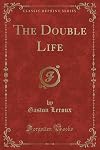
The Double Life
by Gaston Leroux
On This Page
Description
Reproduction of the original: The Double Life by Gaston LerouxTags
Recommendations

















Member Reviews
This book is a mess. It was first published in serial form under the title “Le chercheur des trésors” for the magazine Le Matin, and this shows in the repetitions and reminders to the readers. The treasure hunt was a marketing gimmick for the paper, which apparently hid clues to prizes cached in Paris in the series instalments. At any rate, the treasure mentioned in the first chapters is completely ignored until chapter 26, and ignored again after its finder is killed.
So what is this about? Naïve, inoffensive Théophraste Longuet has retired from his rubberstamp business and wants to educate himself in the history of Paris, so he visits the notorious Conciergerie prison with his wife and best friend. They soon notice a strange show more change in his behaviour, and it becomes obvious that a second soul inhabits Théo’s body: the famous 18th century bandit Cartouche. They seek help from a noted spiritualist, but the criminal proves hard to shake, and poor Théo even finds himself on an extended stay in the subterranean fields of Paris among a strange people, the Talpa.
The author as journalist pretends to build his story from a variety of papers written by different people and offered to him by Théo’s best friend and executor. The style of the various sections changes with every witness-contributor, commented with a sharp and often nasty pen by the compiler. There’s a “psychic surgery” intended to get rid of Cartouche, a truly hideous description of Cartouche’s torture in the dungeons of the Conciergerie which also affects Théo, more nastiness whenever Cartouche’s soul takes over and reenacts his crimes in modern-day Paris, and then the final, absurd episode when Théo and police commissioner Mifroid drop into the catacombs and Mifroid spouts the latest scientific fads much in the manner of Dickens’ Mr Gradgrind. The story remains an episodic hodgepodge, and some of the scenes need a strong stomach. The author also exercises a cruel wit at the expense of his characters. It left me wondering what Leroux had been smoking or drinking when he concocted this.
ETA: The ebook was very carefully formatted and transcribed. show less
So what is this about? Naïve, inoffensive Théophraste Longuet has retired from his rubberstamp business and wants to educate himself in the history of Paris, so he visits the notorious Conciergerie prison with his wife and best friend. They soon notice a strange show more change in his behaviour, and it becomes obvious that a second soul inhabits Théo’s body: the famous 18th century bandit Cartouche. They seek help from a noted spiritualist, but the criminal proves hard to shake, and poor Théo even finds himself on an extended stay in the subterranean fields of Paris among a strange people, the Talpa.
The author as journalist pretends to build his story from a variety of papers written by different people and offered to him by Théo’s best friend and executor. The style of the various sections changes with every witness-contributor, commented with a sharp and often nasty pen by the compiler. There’s a “psychic surgery” intended to get rid of Cartouche, a truly hideous description of Cartouche’s torture in the dungeons of the Conciergerie which also affects Théo, more nastiness whenever Cartouche’s soul takes over and reenacts his crimes in modern-day Paris, and then the final, absurd episode when Théo and police commissioner Mifroid drop into the catacombs and Mifroid spouts the latest scientific fads much in the manner of Dickens’ Mr Gradgrind. The story remains an episodic hodgepodge, and some of the scenes need a strong stomach. The author also exercises a cruel wit at the expense of his characters. It left me wondering what Leroux had been smoking or drinking when he concocted this.
ETA: The ebook was very carefully formatted and transcribed. show less
Ratings
Members
- Recently Added By
Author Information

168+ Works 19,810 Members
Gaston Leroux is best known as the creator of the 1911 novel, The Phantom of the Opera, about a masked figure who haunts the hidden parts of the Paris Opera House. The novel appeared first in serial installments a year before publication, ultimately grew into several movie versions, and later became an Tony Award-winning Andrew Lloyd Webber show more musical. Leroux was born in Paris in 1868. The only child of financially well-off parents, he moved easily into a clerk job in a law office. While working there, he wrote essays and short stories, many of which were accepted by publishers. This fired his enthusiasm, and he became a full-time reporter/writer in 1890. Law experience covering famous cases and theater reviews fueled his writing career, but it was his news reporter job that took him around the world at the turn of the century, providing details for his novels. Leroux wrote several mystery and fantasy novels, including the well-received The Mystery of the Yellow Room (1907) and The Man Who Came Back from the Dead (1912). Leroux also helped pioneer the character of the amateur detective who solves crime, so commonly seen today in movies and television. Gaston Leroux continued to write until his death on April 16, 1927. (Bowker Author Biography) show less
Work Relationships
Common Knowledge
- Original title
- La double vie de Théophraste Longuet
- Original publication date
- 1903
- People/Characters
- Cartouche, Louis-Dominique
- Original language
- French
Classifications
- Genres
- Fiction and Literature, Mystery, Fantasy, Horror
- DDC/MDS
- 843.912 — Literature & rhetoric French Literature French fiction 1900- 20th Century 1900-1945
- LCC
- PQ2623 .E6 .D6 — Language and Literature French, Italian, Spanish and Portuguese literatures French literature Modern literature 1900-1960
- BISAC
Statistics
- Members
- 23
- Popularity
- 1,150,684
- Reviews
- 1
- Rating
- (2.50)
- Languages
- English, French, German
- Media
- Paper, Audiobook, Ebook
- ISBNs
- 16
- ASINs
- 8