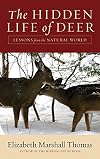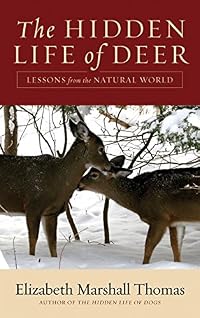
The Hidden Life of Deer: Lessons from the Natural World
by Elizabeth Marshall Thomas
On This Page
Description
InThe Hidden Life of Deer, Elizabeth Marshall Thomas, the New York Times bestselling author of The Hidden Life of Dogs, turns her attention to wild deer, and the many lessons we can learn by observing nature. A narrative masterpiece and a naturalist's delight, The Hidden Life of Deer is based on the twelve months Thomas, a renowned anthropologist, spent studying the local deer population near her home in New Hampshire.Tags
Recommendations







Member Reviews
Marshall becomes interested in the deer on her property and begins to study them intently. Over a particularly harsh winter when her oak trees don't make acorns (they do this every now and then), she begins feeding the deer corn. As she watches them she finds ways to recognize them, by family groups, not as individuals, as each group exhibits different behavior, and, of course, she becomes quite attached to each group, the Alphas, Deltas and Taus and others. For almost the first half of the book, in between her observations and guesses as to reasons for different behaviors she is talking to herself, back and forth, about the wisdom of feeding wild animals. Later, when discussing predators, she includes us - as hunters and drivers of show more cars, speculating about how the deer are adjusting to the change in predator habits (say, hunting season only for a few weeks in November). I will add here, not Thomas, There is also a slowly spreading possibly rural legend (except I swear I saw it) of witnessing deer looking both ways before crossing the road. Coyotes have already got this figured out and probably the smarter foxes too ....
The last couple of chapters widen to include a grove of Black Gums on her property (a rarity this far north) and anecdotes about various home invasions by rats and mice as well as the story of a bear whose life she unequivocally saved when he was hit by a car and injured - the desire on the part of everyone else was to shoot him to put him 'out of his misery' . But it was her land and she succeeded in protecting him and he grew up to be a lame but very large bear doing just fine. She learns too, it may be all right to feed deer, but it is NOT all right to feed a bear.
There is much in here that people who fall on both sides of the equation (don't be sentimental versus hard-core sentimental) will find to criticize as the book is not either hard science or a chirpy book about the darlings in your back yard. For me, it was a delightful easy read about one person's experience, about allowing herself to become immersed, feeling doubt and concern and joy -- above all -- connection with everything around her. show less
The last couple of chapters widen to include a grove of Black Gums on her property (a rarity this far north) and anecdotes about various home invasions by rats and mice as well as the story of a bear whose life she unequivocally saved when he was hit by a car and injured - the desire on the part of everyone else was to shoot him to put him 'out of his misery' . But it was her land and she succeeded in protecting him and he grew up to be a lame but very large bear doing just fine. She learns too, it may be all right to feed deer, but it is NOT all right to feed a bear.
There is much in here that people who fall on both sides of the equation (don't be sentimental versus hard-core sentimental) will find to criticize as the book is not either hard science or a chirpy book about the darlings in your back yard. For me, it was a delightful easy read about one person's experience, about allowing herself to become immersed, feeling doubt and concern and joy -- above all -- connection with everything around her. show less
I found this book mostly charming and intriguing, but occasionally irritating. The author, an anthropologist by profession, closely observed white-tailed deer on her New Hampshire farm after she started feeding them corn during a winter in which the oaks had not dropped any acorns. First they seemed to just be an undifferentiated mass, but then she was able to identify consistent family groupings. Marshall uses this as a springboard into learning and writing about deer behavior and social interactions, all of which I found fascinating as someone who has been looking at deer all my life. She branches off into hunting traditions and the lives of people who have passed on ancestral wisdom for centuries, and eventually into the value of show more close observation of all living things, plants included.
Although Marshall is rigorous in her observations, and generally in her respect for science, what I found irritating was the way she sometimes verged into anthropomorphism. She in fact discusses this very issue late in the book, arguing that the "extreme caution" of scientists and editors about anything that seems anthropomorphic is really a fear of acknowledging that we are more similar to other species than we would like to think. I found this thought-provoking, but am not completely convinced. show less
Although Marshall is rigorous in her observations, and generally in her respect for science, what I found irritating was the way she sometimes verged into anthropomorphism. She in fact discusses this very issue late in the book, arguing that the "extreme caution" of scientists and editors about anything that seems anthropomorphic is really a fear of acknowledging that we are more similar to other species than we would like to think. I found this thought-provoking, but am not completely convinced. show less
The Hidden Life of Deer: Lessons from the Natural World is Elizabeth Marshall Thomas’s description of what she observed about the wild animals, particularly the deer, in her backyard. It wasn’t what the title led me to expect. Nonetheless, I enjoyed reading that she often did what I do and thought what I think about the wildlife, particularly the deer, in my own backyard.
I thought this book was going to be an authoritative explanation of the lives of the deer we see in our backyards every day. Instead, she mostly describes what she observes, which turned out to be more than I see because I don’t look for as long as she does. And through her observations, I learned what deer do when I’m not looking at them in my backyard or when show more they are hidden in trees and bushes. It made me want to watch more and more carefully. I want to see what she sees.
Elizabeth Thomas and I think alike about wildlife in general. For instance, a big issue for me is the guilt I feel when my husband puts corn in our backyard for the deer. The Humane Society of the United States (HSUS) says it’s bad to feed wild animals for various reasons. But Keith and I (and Elizabeth Thomas) always thought, everyone feeds birds; so what do they have against larger wild animals? And when they’re literally starving, why is it OK to watch them starve?
So the most welcome part of this book for me was the chapter having to do with feeding wild animals.
Elizabeth Thomas lives in New Hampshire. Every year New Hampshire Fish and Game gives residents pamphlets citing reasons (the same reasons given by HSUS) that they should not feed larger wild animals. For each reason Elizabeth Thomas explains how it does not apply to her specific case, which is similar to our case. Then she comes to the last reason, and she can’t entirely negate it, although she tries. It’s the one I worry about, too: if the deer are crowding each other as they eat the corn we put out for them, they may be spreading diseases among themselves and to other wild animals (such as turkeys) eating with them. But we try to justify our actions: they’re hungry in the rough winters in New Hampshire and Michigan (where we live with our wild animals), so we feed them corn. Besides, in our backyard in Michigan, we have never seen more than 12 deer at once, usually fewer than 6, and then they are spread out, not crowding each other for the food.
I learned much more from this book, the best being the explanations for deer behavior that we’ve observed but could only guess about. Of course, sometimes she was guessing, too, about their motivations, but her guesses were more educated than ours.
One reader review of The Hidden Life of Deer on goodreads.com calls this book a satire. One of us is misunderstanding. show less
I thought this book was going to be an authoritative explanation of the lives of the deer we see in our backyards every day. Instead, she mostly describes what she observes, which turned out to be more than I see because I don’t look for as long as she does. And through her observations, I learned what deer do when I’m not looking at them in my backyard or when show more they are hidden in trees and bushes. It made me want to watch more and more carefully. I want to see what she sees.
Elizabeth Thomas and I think alike about wildlife in general. For instance, a big issue for me is the guilt I feel when my husband puts corn in our backyard for the deer. The Humane Society of the United States (HSUS) says it’s bad to feed wild animals for various reasons. But Keith and I (and Elizabeth Thomas) always thought, everyone feeds birds; so what do they have against larger wild animals? And when they’re literally starving, why is it OK to watch them starve?
So the most welcome part of this book for me was the chapter having to do with feeding wild animals.
Elizabeth Thomas lives in New Hampshire. Every year New Hampshire Fish and Game gives residents pamphlets citing reasons (the same reasons given by HSUS) that they should not feed larger wild animals. For each reason Elizabeth Thomas explains how it does not apply to her specific case, which is similar to our case. Then she comes to the last reason, and she can’t entirely negate it, although she tries. It’s the one I worry about, too: if the deer are crowding each other as they eat the corn we put out for them, they may be spreading diseases among themselves and to other wild animals (such as turkeys) eating with them. But we try to justify our actions: they’re hungry in the rough winters in New Hampshire and Michigan (where we live with our wild animals), so we feed them corn. Besides, in our backyard in Michigan, we have never seen more than 12 deer at once, usually fewer than 6, and then they are spread out, not crowding each other for the food.
I learned much more from this book, the best being the explanations for deer behavior that we’ve observed but could only guess about. Of course, sometimes she was guessing, too, about their motivations, but her guesses were more educated than ours.
One reader review of The Hidden Life of Deer on goodreads.com calls this book a satire. One of us is misunderstanding. show less
Have you ever been entranced with the wildlife that frequents your backyard? Have you watched them tirelessly with fascination and pleasure? Have you fed them, or been tempted to feed them? Do you love animals and harbor a keen curiosity to know more about their social life, thought processes, and emotion? If this sounds like you, then you should strongly consider reading The Hidden Life of Deer by Elizabeth Marshall Thomas.
The author is an accomplished anthropologist and novelist. She lives in New Hampshire in a home bordering a large natural wooded area. It abounds with deer, wild turkeys, coyotes, mountain lions, bobcats, and bear. During the winter of 2006/2007, the oak trees in her portion of the world did something that is show more perfectly natural for them: they produced an extremely poor supply of acorns as a natural means of controlling the overabundance of predators that were feeding on their seeds and preventing the trees from multiplying more successfully. This is the oak trees' form of natural pest control. Of course, what this meant for the author's local deer and turkey population was starvation.
As a result, the author started feeding the deer and turkeys. What started as a powerful impulse of compassion, ended up as a yearlong research project. In the height of that winter, she was feeding approximately 25 deer and 50 wild turkeys on seventy-five pounds of corn per day!
Many readers, myself included, will find fault with her meddling with nature and perhaps temporarily upsetting the natural ecological balance of her native local woods. But others will find solace in her many reasoned justifications. Personally, I found them clouded in psychological rationalization. However, I must admit that I, too, would have been sorely tempted to follow suit, and might indeed have done exactly as she did given the same circumstances. It is hard to buck your own inner compassion with reasoned scientific logic!
I thoroughly enjoyed reading this book. The author writes well; her book is easy and pleasant to read. I read it in one day, not because I had to, but because it kept me interested and involved. There is a lot of astute scientific observation and general information about deer, wild turkeys, and other natural processes. The reading experience is not overly scientific; rather, it is more like listening to a neighbor who is telling you about her exciting experiences and research as an armchair naturalist.
I was disturbed by what the author decided to do about feeding the animals the following winter, when the acorn yield was once again abundant. But I say this realizing full well that the urge for compassion is hard to control.
I am very glad that I read the book and recommend it to all who have a strong interest in the social and emotional life of wild animals. show less
The author is an accomplished anthropologist and novelist. She lives in New Hampshire in a home bordering a large natural wooded area. It abounds with deer, wild turkeys, coyotes, mountain lions, bobcats, and bear. During the winter of 2006/2007, the oak trees in her portion of the world did something that is show more perfectly natural for them: they produced an extremely poor supply of acorns as a natural means of controlling the overabundance of predators that were feeding on their seeds and preventing the trees from multiplying more successfully. This is the oak trees' form of natural pest control. Of course, what this meant for the author's local deer and turkey population was starvation.
As a result, the author started feeding the deer and turkeys. What started as a powerful impulse of compassion, ended up as a yearlong research project. In the height of that winter, she was feeding approximately 25 deer and 50 wild turkeys on seventy-five pounds of corn per day!
Many readers, myself included, will find fault with her meddling with nature and perhaps temporarily upsetting the natural ecological balance of her native local woods. But others will find solace in her many reasoned justifications. Personally, I found them clouded in psychological rationalization. However, I must admit that I, too, would have been sorely tempted to follow suit, and might indeed have done exactly as she did given the same circumstances. It is hard to buck your own inner compassion with reasoned scientific logic!
I thoroughly enjoyed reading this book. The author writes well; her book is easy and pleasant to read. I read it in one day, not because I had to, but because it kept me interested and involved. There is a lot of astute scientific observation and general information about deer, wild turkeys, and other natural processes. The reading experience is not overly scientific; rather, it is more like listening to a neighbor who is telling you about her exciting experiences and research as an armchair naturalist.
I was disturbed by what the author decided to do about feeding the animals the following winter, when the acorn yield was once again abundant. But I say this realizing full well that the urge for compassion is hard to control.
I am very glad that I read the book and recommend it to all who have a strong interest in the social and emotional life of wild animals. show less
Unlike the rest of Elizabeth Marshall Thomas's books, this one was very slight both in size and depth. In a way it was a postscript of life at home to [b:The Old Way: A Story of the First People|544855|The Old Way A Story of the First People|Elizabeth Marshall Thomas|http://photo.goodreads.com/books/1312005141s/544855.jpg|17429294]. That was a wonderful book of the hunter/gatherers of the Kalahari that the author knew so well as 'home' herself, and written about in such depth. Deer might live the Old Way, but most people don't and this was the author living the 'new' way, in the USA.
It was also a long, well-thought out reply to the local Conservation Department's injunction not to feed deer (EMT likes feeding deer, a lot). I did enjoy show more it, I didn't learn as much as from her other books, but what I did learn was absolutely fascinating and sometimes quite funny. Her feminist, or at least female, sensibilities often give insights into animal behaviour that other ethologists have not written about, certainly we never see them in popular natural history documentaries.
Female deer, the does, might be chosen for breeding by a buck they don't particularly fancy in which case they will move away. However, if he is insistent, as soon as he's mounted and got his end away, she pushes him off and moves away sharply, leaving the poor, frustrated buck bellowing. But if that isn't successful and she does get bred, she has one trick left. She squats down right in front of the buck and squeezes out the semen. He might have got sex but she isn't letting him breed any babies on her. So much for the big bucks dominating the harem!
Originally reviewed 10 May 2011, rewritten 14 March 2012 show less
It was also a long, well-thought out reply to the local Conservation Department's injunction not to feed deer (EMT likes feeding deer, a lot). I did enjoy show more it, I didn't learn as much as from her other books, but what I did learn was absolutely fascinating and sometimes quite funny. Her feminist, or at least female, sensibilities often give insights into animal behaviour that other ethologists have not written about, certainly we never see them in popular natural history documentaries.
Female deer, the does, might be chosen for breeding by a buck they don't particularly fancy in which case they will move away. However, if he is insistent, as soon as he's mounted and got his end away, she pushes him off and moves away sharply, leaving the poor, frustrated buck bellowing. But if that isn't successful and she does get bred, she has one trick left. She squats down right in front of the buck and squeezes out the semen. He might have got sex but she isn't letting him breed any babies on her. So much for the big bucks dominating the harem!
Originally reviewed 10 May 2011, rewritten 14 March 2012 show less
I couldn't put this book down. Thomas's careful observation of these exquisite creatures was fascinating, her huge-hearted embrace of all of nature (predators as well as prey) inspiring. Her indefatigable pursuit of information and insatiable curiosity motivates the naturalist in us all.
From the title, “Hidden Life of Deer”, I assumed this book was written by a naturalist and intended to give laymen more insight about these beautiful animals. But it’s really written by a layperson, telling of her observation of the deer that she feeds on her property.
So my expectations were completely off. And I found myself really irritated with the lack of science, and the constant rationalizations of behavior that goes against recommendations of wildlife experts.
I might have really enjoyed this book, if I’d had appropriate expectations. Elizabeth Marshall Thomas obviously loves her deer friends, and has entertaining anecdotes to share. She’s a kind-hearted soul, and a keen observer of “her” animals. Her writing is show more warm and friendly, rambling like a cozy conversation over a cup of tea – with occasional passionate outbursts.
If you’d like a cozy, relaxing narrative non-fiction about one woman’s relationship with her local deer, this is your book. If you’re looking for science, look elsewhere. show less
So my expectations were completely off. And I found myself really irritated with the lack of science, and the constant rationalizations of behavior that goes against recommendations of wildlife experts.
I might have really enjoyed this book, if I’d had appropriate expectations. Elizabeth Marshall Thomas obviously loves her deer friends, and has entertaining anecdotes to share. She’s a kind-hearted soul, and a keen observer of “her” animals. Her writing is show more warm and friendly, rambling like a cozy conversation over a cup of tea – with occasional passionate outbursts.
If you’d like a cozy, relaxing narrative non-fiction about one woman’s relationship with her local deer, this is your book. If you’re looking for science, look elsewhere. show less
Members
- Recently Added By
Published Reviews
ThingScore 75
In this slim and amiable book Ms. Thomas gathers a pile of small, not uninteresting observations about deer, and in doing so she subtly alters the way you look at them in a forest or from a window.
added by Shortride
If anthropologist Elizabeth Marshall Thomas has a chip on her shoulder (impatience with self-aggrandizing humans), she wears it with style, one reason why The Hidden Life of Deer is such testy fun.
added by Shortride
Author Information

19+ Works 4,107 Members
Elizabeth Marshall Thomas is a noted anthropologist and is also the author of "The Hidden Life of Dogs" (Pocket 1996), "The Tribe of Tiger", "The Harmless People", "Warrior Herdsmen", & the novels "Certain Poor Shepherds", "Reindeer Moon", & "The Animal Wife". She lives in Peterborough, New Hampshire and the Boston area. (Bowker Author Biography)
Classifications
Statistics
- Members
- 148
- Popularity
- 219,016
- Reviews
- 8
- Rating
- (3.73)
- Languages
- English
- Media
- Paper, Ebook
- ISBNs
- 3
- ASINs
- 3