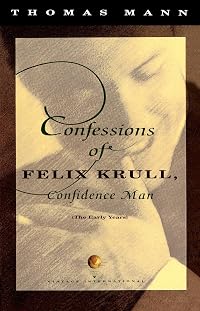
Confessions of Felix Krull, Confidence Man: The Early Years
by Thomas Mann 
On This Page
Description
Recounts the enchanted career of the con man extraordinaire Felix Krull--a man unhampered by the moral precepts that govern the conduct of ordinary people.-- publisher's description.Tags
Recommendations


























Member Recommendations

Member Reviews
Thomas Mann tinkered with this book for almost fifty years, releasing excerpts from the work-in-progress from time to time starting in 1911, before publishing the definitive version of Part One in 1954. At that point he seems to have accepted that he wasn't going to write the remainder of the story: Part Two never got beyond a brief outline. Maybe a classic demonstration of the principle that comic fiction is much harder to write than serious intellectual stuff...?
Because, unlikely though that might seem if you don't know it, this is a picaresque comic novel. Of a sort, anyway. Mann conceived it as a kind of anti-autobiography, a parody of the worthy and self-important memoirs of a Great German Artist (he seems to have had Goethe in show more mind particularly, but a lot of the time it also feels as though he's mocking himself).
Felix Krull, born in the 1870s in a small town on the Rhine, has drawn the logical conclusion from his bourgeois, provincial German upbringing that the only way to get ahead in life is to lie, cheat and steal, whilst doing all you can to avoid getting tied up in human relationships. With a great deal of pompous prose and circumlocution, he tells us about his marvellous successes in life, most of which turn out to be defeats and humiliations by any objective standard. He fails high school, gets out of military service only by faking an epileptic fit, and earns a living hailing cabs outside theatres, pimping for a Frankfurt street-walker, and then working as a lift-boy and waiter in a Paris hotel. It's only in the final chapters that he achieves some sort of temporary glory, swapping lives with an aristocrat who prefers suburban bliss with his girlfriend to being sent on a world tour by his parents. And even there, the world tour has only got him from Paris to Lisbon by the end of Part One, and we have our reasons to suspect that he won't get much further.
There's quite a bit of sharp social observation along the way, as well as some moderately racy chapters where the lovely Felix is being pursued by would-be lovers of either gender, or is doing a bit of dilly-dallying on his own account. But there also some long digressions that seem to have slipped out from drafts of the Magic Mountain whilst the author wasn't paying attention, including a 20-page science lesson Felix gets from a fellow traveller in the restaurant car of the Lisbon express, which only seems to be there to feed the running joke about the way Felix grabs and relentlessly recycles every fragment of general knowledge that comes his way.
If you're after the racy memoirs of a (fictional) rogue this possibly isn't the best place to start, but it's definitely worth reading for the "other side of" Thomas Mann it exposes to us. Thomas Mann might have had his limitations as a comedian, but he still had plenty to say with this book. show less
Because, unlikely though that might seem if you don't know it, this is a picaresque comic novel. Of a sort, anyway. Mann conceived it as a kind of anti-autobiography, a parody of the worthy and self-important memoirs of a Great German Artist (he seems to have had Goethe in show more mind particularly, but a lot of the time it also feels as though he's mocking himself).
Felix Krull, born in the 1870s in a small town on the Rhine, has drawn the logical conclusion from his bourgeois, provincial German upbringing that the only way to get ahead in life is to lie, cheat and steal, whilst doing all you can to avoid getting tied up in human relationships. With a great deal of pompous prose and circumlocution, he tells us about his marvellous successes in life, most of which turn out to be defeats and humiliations by any objective standard. He fails high school, gets out of military service only by faking an epileptic fit, and earns a living hailing cabs outside theatres, pimping for a Frankfurt street-walker, and then working as a lift-boy and waiter in a Paris hotel. It's only in the final chapters that he achieves some sort of temporary glory, swapping lives with an aristocrat who prefers suburban bliss with his girlfriend to being sent on a world tour by his parents. And even there, the world tour has only got him from Paris to Lisbon by the end of Part One, and we have our reasons to suspect that he won't get much further.
There's quite a bit of sharp social observation along the way, as well as some moderately racy chapters where the lovely Felix is being pursued by would-be lovers of either gender, or is doing a bit of dilly-dallying on his own account. But there also some long digressions that seem to have slipped out from drafts of the Magic Mountain whilst the author wasn't paying attention, including a 20-page science lesson Felix gets from a fellow traveller in the restaurant car of the Lisbon express, which only seems to be there to feed the running joke about the way Felix grabs and relentlessly recycles every fragment of general knowledge that comes his way.
If you're after the racy memoirs of a (fictional) rogue this possibly isn't the best place to start, but it's definitely worth reading for the "other side of" Thomas Mann it exposes to us. Thomas Mann might have had his limitations as a comedian, but he still had plenty to say with this book. show less
This is Mann's last novel, left unfinished at his death. (More on that later.) Both comic (in a way I haven't seen in his other novels) and serious, this tells the tale of Felix Krull in his own voice, for he is the narrator, at times delightful, at times borderline insufferable. Starting with his childhood, with a godfather who liked to dress him up in various costumes, Felix delighted in trying on different personalities and generally deceiving people (for example, pretending to be sick to avoid school and really getting into the part). His father was the proprietor of a company that made very inferior champagne and, despite the fact that the company was on shaky financial ground, his parents frequently threw wild, drunken parties; show more that is, until the day when the creditors came to take away all their furniture and their house and the father killed himself.
Thus starts a new life for Felix, his mother, and his sister, one of poverty. His godfather comes to the rescue with plans for each of them; Felix is to go work in a hotel in Paris but first he must find a way to avoid his required military service. This is the first time the reader sees Felix's persistence and dedication, as well as his imagination. Before he ultimately fools the military recruiters, he spends evenings wandering through the streets of the better part of Frankfurt, learning all the details of the highest quality of jewelry, clothes, food, and much more. And then off to Paris he goes, with a border stop where at customs the jewelry case of a lady standing in front of him somehow winds up in his suitcase. He starts out as an elevator operator, but is so charming that he soon is promoted to a waiter. Various romantic and criminal activities take place in the course of this sojourn at the hotel, and the reader sees how Felix throws himself into not just into doing his job and getting ahead but also has a secret stash of money and elegant clothing that he keeps in a rented apartment (the hotel workers live in dorms within the hotel) so that he can go out with a completely different persona on his days off.
It is while Felix is out in these upper class surroundings that he finds the opportunity to masquerade as the Marquis de Venosta, leave his job, and go on an around-the-world tour that the Marquis's parents are forcing the real Marquis to go on so he will forget the dance hall woman he is love with. The first stop in the Marquis's travels is Lisbon, from where he will take a ship to South America; on the train, Felix, traveling as the Marquis, meets a professor who introduces him first to natural history, evolution, and the geological history of the planet and then to his utterly charming wife and daughter. Complications develop.
So this is the plot. Clearly, Mann is exploring issues of identity, deception, and class; he also has Felix obsessed with the idea of "doubles" -- early on, a sister and brother, later the Portuguese wife and daughter, and of course himself and the Marquis. How this would have evolved if Mann had finished the book is an open question. Felix loves life and has a high self-regard not just for his vaunted good looks but also for his ability to conquer all obstacles and adapt to any situation. He is by and large a fun character.
It is clear from the book that Mann intended it to be much longer, for Felix refers to other people he pretended to be, but the book never extends past Lisbon and his role as the Marquis. And, delightful as much of this book is, it is too long in spots; I like to think that if Mann had lived he would not just have extended Felix's tale but would also have returned to edit some of the places where the narrative drags.
As a note on the translation, I found several peculiarities. While early on the translator refers to the Gare du Nord in Paris as "North Station" and translates a French person's name as "Bob," he also leaves paragraphs in French (and one in Italian) (obviously where Mann wrote in those languages instead of German) without a footnoted translation. I can read French (and can guess at Italian), but how could the translator and the publisher have assumed that all readers can? show less
Thus starts a new life for Felix, his mother, and his sister, one of poverty. His godfather comes to the rescue with plans for each of them; Felix is to go work in a hotel in Paris but first he must find a way to avoid his required military service. This is the first time the reader sees Felix's persistence and dedication, as well as his imagination. Before he ultimately fools the military recruiters, he spends evenings wandering through the streets of the better part of Frankfurt, learning all the details of the highest quality of jewelry, clothes, food, and much more. And then off to Paris he goes, with a border stop where at customs the jewelry case of a lady standing in front of him somehow winds up in his suitcase. He starts out as an elevator operator, but is so charming that he soon is promoted to a waiter. Various romantic and criminal activities take place in the course of this sojourn at the hotel, and the reader sees how Felix throws himself into not just into doing his job and getting ahead but also has a secret stash of money and elegant clothing that he keeps in a rented apartment (the hotel workers live in dorms within the hotel) so that he can go out with a completely different persona on his days off.
It is while Felix is out in these upper class surroundings that he finds the opportunity to masquerade as the Marquis de Venosta, leave his job, and go on an around-the-world tour that the Marquis's parents are forcing the real Marquis to go on so he will forget the dance hall woman he is love with. The first stop in the Marquis's travels is Lisbon, from where he will take a ship to South America; on the train, Felix, traveling as the Marquis, meets a professor who introduces him first to natural history, evolution, and the geological history of the planet and then to his utterly charming wife and daughter. Complications develop.
So this is the plot. Clearly, Mann is exploring issues of identity, deception, and class; he also has Felix obsessed with the idea of "doubles" -- early on, a sister and brother, later the Portuguese wife and daughter, and of course himself and the Marquis. How this would have evolved if Mann had finished the book is an open question. Felix loves life and has a high self-regard not just for his vaunted good looks but also for his ability to conquer all obstacles and adapt to any situation. He is by and large a fun character.
It is clear from the book that Mann intended it to be much longer, for Felix refers to other people he pretended to be, but the book never extends past Lisbon and his role as the Marquis. And, delightful as much of this book is, it is too long in spots; I like to think that if Mann had lived he would not just have extended Felix's tale but would also have returned to edit some of the places where the narrative drags.
As a note on the translation, I found several peculiarities. While early on the translator refers to the Gare du Nord in Paris as "North Station" and translates a French person's name as "Bob," he also leaves paragraphs in French (and one in Italian) (obviously where Mann wrote in those languages instead of German) without a footnoted translation. I can read French (and can guess at Italian), but how could the translator and the publisher have assumed that all readers can? show less
A really cheersome, good-hearted exploration of the libidinal economy in all its aspects--starting with pacing, which is slow and sensual. The book remains unfinished after Mann's death, but a short novel paced like a long one is kind of a nice experience--no frenetic pace, no heavy symbolic build, no catharsis. Just a guided stroll through Felix's life, illuminated by his love of life. This is a parody of Goethe's autobiography Dichtung und Wahrheit, but Mann doesn't hold Felix up as a Goethe-proxy to be mocked per se; he offers him as an alternative to the humourless self-importance of the sage of Weimar, the one who does creature of destiny right, suggesting Narcissus, Adonis, Paris, Icarus, but never settling, laughing it up, the show more game never quite worth the candle. Felix loves us and he wants the same back, and it's as fascinating to see him gradually seduced by the idea of taking on the role of the Marquis de Venosta--a con equal to his magnificent need to be loved. (As he romances the professor's wife and daughter in Lisbon, he nevertheless dubs him "the man with the starry eyes," and you feel the admiration--like, anyone who wants to can sleep with my wife and daughter--assuming they're also into it, of course--as long as he respects me and doesn't think he's got the better of me. Felix's generosity of spirit makes it all seem just ducky.)
And oh, the class valences of all that--social capital: I'm reading Bourdieu's language book right now, and the way Felix deploys French and English and Italian and the characteristic words and gestures of the roles he inhabits, bellhop and rakehell and gamine and cod-aristocrat, exemplifies B's observations on aristocratic linguistic capital perfectly. That is Felix's gift: the bourgeous social capital he inherits from his sinking wine family and photographic memory (endless litanies of gewgaws and sartorie and natural-historical artifacts in this one that put Dorian Gray to shame) allows him to get on the board, but it's his gift for mimickry and nuance of signification that sends him rocketing to the top--neither confidence man nor Casanova really but The Talented M. Kroull (or in ways an unsour, bourgeois Lucky Jim, unsour because bourgeous and thus not fatally hampered like Jim no doubt). The scenes where he talks his way into a job in Paris, and then talks the fence into buying his stolen jewels, are perfection, not least because it's only a joe job in a hotel and because he gets only half what he bargains for from the guy. Felix may unavoidably dazzle a bit around the edges (though we have only his word that the world finds him quite as irresistible as all that), but he's no aggressive Euro-lover, all speedo and hands; it's his hard work, dreamy circumspection, and amiability that make us acquiesce to be dazzled by this charmessence of dust. show less
And oh, the class valences of all that--social capital: I'm reading Bourdieu's language book right now, and the way Felix deploys French and English and Italian and the characteristic words and gestures of the roles he inhabits, bellhop and rakehell and gamine and cod-aristocrat, exemplifies B's observations on aristocratic linguistic capital perfectly. That is Felix's gift: the bourgeous social capital he inherits from his sinking wine family and photographic memory (endless litanies of gewgaws and sartorie and natural-historical artifacts in this one that put Dorian Gray to shame) allows him to get on the board, but it's his gift for mimickry and nuance of signification that sends him rocketing to the top--neither confidence man nor Casanova really but The Talented M. Kroull (or in ways an unsour, bourgeois Lucky Jim, unsour because bourgeous and thus not fatally hampered like Jim no doubt). The scenes where he talks his way into a job in Paris, and then talks the fence into buying his stolen jewels, are perfection, not least because it's only a joe job in a hotel and because he gets only half what he bargains for from the guy. Felix may unavoidably dazzle a bit around the edges (though we have only his word that the world finds him quite as irresistible as all that), but he's no aggressive Euro-lover, all speedo and hands; it's his hard work, dreamy circumspection, and amiability that make us acquiesce to be dazzled by this charmessence of dust. show less
I recently reread Confessions of Felix Krull, Confidence Man (The Early Years), Thomas Mann's last novel and a comic masterpiece. Felix Krull's confessions are filled with humorous episodes worthy of the Mann's story-telling mastery. Mann based the novel on an expanded version of a story he had written in 1911 and he managed to finish, and publish part one of the Confessions of Felix Krull, but due to his death in 1955 the saga of the morally flexible and irresistible conman, Felix, remained unfinished. In spite of that it is still one of the best novels I have read dealing with the question of identity. It is that and much more.
Early in the story Felix learns to deal with circumstances by changing his character as needed and he show more continues to shift identities becoming whomever he needs to be in all the ensuing predicaments that he encounters. The expression of a latent admiration for a human being who can metamorphose himself into multiple identities reminds me of The Confidence Man by Herman Melville. That earlier novel is in a way a precursor to the modernity of Mann's unfinished opus. Felix Krull seems to view the world like a chessboard on which he can take pleasure in manipulating the pieces at will and cultivate his ambition and his knowledge of the ways of the world by spending whole days peering into shop windows.
There are three moments in the Confessions that exemplify the merging of identity and destiny of young Felix Krull. Early in the story Felix encounters an actor, Muller -Rose, whose extravagant operetta performance makes an indelible impression on him. The contrast between his stage character and his backstage repulsive self is a vision that impresses the young boy. The second moment occurs in Paris when Felix attends the circus. The performance of the acrobats and the high wire equilibrist Andromache were mesmerizing to Felix. "Andromache! Her vision, painful and uplifting at once, lingered in my mind long after her act was over and others had replaced it." (p 194)
The third moment occurs after Felix has settled into his identity as Venosta and is established in Lisbon. There is a bullfight which combines the flamboyance of the toreador costumes with the ravishing sensation of the duel to the death with the bull. Felix describes his impressions:
"the atmosphere that lay over all, at once oppressive and solemnly joyous, a unique mingling of jest, blood, and dedication, primitive holiday-making combined with the profound ceremonial of death." (p 375)
Each of these moments capture the sensation of Eros and Thanatos, pleasure and death, and form a counterpart to the often light-hearted way that Felix led his life as a confidence man.
He fools Venosta's parents with a lengthy letter that mimics the style of the man whose identity he has assumed and goes on to impress his contacts in Lisbon. Yet, he maintains a calm demeanor throughout his escapades filled with confidence in his ability. The reader eventually succumbs to his charm in spite of an episodic life in different identities that was full of nervous suspense. It seems that Mann still had more story-telling magic left at the end of his life after World War II and decades after his great beginnings with Buddenbrooks and Death in Venice. The only regret is that Mann was unable to finish the novel; yet, the "early years" of Felix Krull still amounts to a small masterpiece. show less
Early in the story Felix learns to deal with circumstances by changing his character as needed and he show more continues to shift identities becoming whomever he needs to be in all the ensuing predicaments that he encounters. The expression of a latent admiration for a human being who can metamorphose himself into multiple identities reminds me of The Confidence Man by Herman Melville. That earlier novel is in a way a precursor to the modernity of Mann's unfinished opus. Felix Krull seems to view the world like a chessboard on which he can take pleasure in manipulating the pieces at will and cultivate his ambition and his knowledge of the ways of the world by spending whole days peering into shop windows.
There are three moments in the Confessions that exemplify the merging of identity and destiny of young Felix Krull. Early in the story Felix encounters an actor, Muller -Rose, whose extravagant operetta performance makes an indelible impression on him. The contrast between his stage character and his backstage repulsive self is a vision that impresses the young boy. The second moment occurs in Paris when Felix attends the circus. The performance of the acrobats and the high wire equilibrist Andromache were mesmerizing to Felix. "Andromache! Her vision, painful and uplifting at once, lingered in my mind long after her act was over and others had replaced it." (p 194)
The third moment occurs after Felix has settled into his identity as Venosta and is established in Lisbon. There is a bullfight which combines the flamboyance of the toreador costumes with the ravishing sensation of the duel to the death with the bull. Felix describes his impressions:
"the atmosphere that lay over all, at once oppressive and solemnly joyous, a unique mingling of jest, blood, and dedication, primitive holiday-making combined with the profound ceremonial of death." (p 375)
Each of these moments capture the sensation of Eros and Thanatos, pleasure and death, and form a counterpart to the often light-hearted way that Felix led his life as a confidence man.
He fools Venosta's parents with a lengthy letter that mimics the style of the man whose identity he has assumed and goes on to impress his contacts in Lisbon. Yet, he maintains a calm demeanor throughout his escapades filled with confidence in his ability. The reader eventually succumbs to his charm in spite of an episodic life in different identities that was full of nervous suspense. It seems that Mann still had more story-telling magic left at the end of his life after World War II and decades after his great beginnings with Buddenbrooks and Death in Venice. The only regret is that Mann was unable to finish the novel; yet, the "early years" of Felix Krull still amounts to a small masterpiece. show less
This is Thomas Mann's last novel and his comic masterpiece. The story of Felix Krull is filled with humorous episodes worthy of the Mann's story-telling mastery. Mann based the novel on an expanded version of a story he had written in 1911 and he managed to finish, and publish part one of the Confessions of Felix Krull, but due to his death in 1955 the saga of the morally flexible and irresistible conman, Felix, remained unfinished. In spite of that it is still one of the best novels dealing with the question of identity.
Early in the story Felix learns to deal with circumstances by changing his character as needed and he continues to shift identities becoming whomever he needs to be in all the ensuing predicaments that he encounters. show more The expression of a latent admiration for a human being who can metamorphose himself into multiple identities reminds me of The Confidence Man by Herman Melville. That earlier novel is a precursor to the modernity of Mann's unfinished opus. Felix Krull seems to view the world like a chessboard on which he can take pleasure in manipulating the pieces at will and cultivate his ambition and his knowledge of the ways of the world by spending whole days peering into shop windows. His own calm demeanor throughout his escapades did not transfer to this reader who found his episodic life in different identities full of nervous suspense in a strangely vicarious way. It seems that Mann still had more story-telling magic left at the end of his life after World War II and decades after his great beginnings with Buddenbrooks and Death in Venice. The only regret is that Mann was unable to finish the novel; yet, the "early years" of Felix Krull still amounts to a small masterpiece. show less
Early in the story Felix learns to deal with circumstances by changing his character as needed and he continues to shift identities becoming whomever he needs to be in all the ensuing predicaments that he encounters. show more The expression of a latent admiration for a human being who can metamorphose himself into multiple identities reminds me of The Confidence Man by Herman Melville. That earlier novel is a precursor to the modernity of Mann's unfinished opus. Felix Krull seems to view the world like a chessboard on which he can take pleasure in manipulating the pieces at will and cultivate his ambition and his knowledge of the ways of the world by spending whole days peering into shop windows. His own calm demeanor throughout his escapades did not transfer to this reader who found his episodic life in different identities full of nervous suspense in a strangely vicarious way. It seems that Mann still had more story-telling magic left at the end of his life after World War II and decades after his great beginnings with Buddenbrooks and Death in Venice. The only regret is that Mann was unable to finish the novel; yet, the "early years" of Felix Krull still amounts to a small masterpiece. show less
My only complaint about this book is that Thomas Mann died before he could make it any longer. Damned inconsiderate of him. Felix Krull is aptly named; this young man with good looks and invulnerable self-confidence rises from obscurity and penury to the very height of European society. He's a fraud, but a sincere fraud, an artistic fraud, and doesn't that make him more genuine than the usual sincere sort? He certainly thinks so, and his narration is enjoyable enough to make such pleading sound plausible. This book is what happens when a Nobelist decides to write a beach read, and beautifully succeeds.
A friend's review of this is: great first half, dull second half. My review is the exact opposite, which suggests that this is just about taste. The first half, for me, was a little too cutesy with the symbolism, as Krull discovers how much he enjoys acting, impersonating, and being praised for his beauty. Well done, but also (for me) hampered by the impossibility of doing anything new with the first part of life-stories. You'll be surprised to learn that Felix has a family, there is a crisis, he matures and strikes out to start life on his own. There is fun to be had with the threefold perspective of young Felix, narrating Felix, and implied author Mann, but to be honest, if you haven't had your fill of unreliable narrators at this show more point of history, I don't know what to say.
The second half, on the other hand, is a perfectly done 18th century picaresque, but in the early 20th century--and here the threefold perspective comes into its own, since the combination of modernist narrator and picaresque tale is something I, at least, haven't seen much of before (I don't count the pomo narrators in this category).
There's not much else to say. It's very funny, parts of it remind me of many other novels I have loved (a dash of Proust; a hint of Bassani; Mann's other works, of course). I, unlike my aforementioned friend, am very sad that he never finished it. This could easily have surpassed Buddenbrooks and the Mountain, simply because big serious novels are so rarely hilariously funny.
Also, I read somewhere that Mann modeled the narrative voice after Goethe's memoirs, which he found unbearably pompous. I enjoyed reading it much more once I could assume that the pseudo-aristocratic style really was meant to be mocked. show less
The second half, on the other hand, is a perfectly done 18th century picaresque, but in the early 20th century--and here the threefold perspective comes into its own, since the combination of modernist narrator and picaresque tale is something I, at least, haven't seen much of before (I don't count the pomo narrators in this category).
There's not much else to say. It's very funny, parts of it remind me of many other novels I have loved (a dash of Proust; a hint of Bassani; Mann's other works, of course). I, unlike my aforementioned friend, am very sad that he never finished it. This could easily have surpassed Buddenbrooks and the Mountain, simply because big serious novels are so rarely hilariously funny.
Also, I read somewhere that Mann modeled the narrative voice after Goethe's memoirs, which he found unbearably pompous. I enjoyed reading it much more once I could assume that the pseudo-aristocratic style really was meant to be mocked. show less
Members
- Recently Added By
Lists

German Literature
518 works; 55 members

Unreliable Narrators
170 works; 43 members

20th Century Literature
1,161 works; 54 members
Harold Bloom - The Western Canon: D. The Chaotic Age
833 works; 24 members

1950s
340 works; 22 members

Literary Works Read in College
316 works; 15 members
Author Information

946+ Works 51,369 Members
Thomas Mann was born into a well-to-do upper class family in Lubeck, Germany. His mother was a talented musician and his father a successful merchant. From this background, Mann derived one of his dominant themes, the clash of views between the artist and the merchant. Mann's novel, Buddenbrooks (1901), traces the declining fortunes of a merchant show more family much like his own as it gradually loses interest in business but gains an increasing artistic awareness. Mann was only 26 years old when this novel made him one of Germany's leading writers. Mann went on to write The Magic Mountain (1924), in which he studies the isolated world of the tuberculosis sanitarium. The novel was based on his wife's confinement in such an institution. Doctor Faustus (1947), his masterpiece, describes the life of a composer who sells his soul to the devil as a price for musical genius. Mann is also well known for Death in Venice (1912) and Mario the Magician (1930), both of which portray the tensions and disturbances in the lives of artists. His last unfinished work is The Confessions of Felix Krull, Confidence Man (1954), a brilliantly ironic story about a nineteenth-century swindler. An avowed anti-Nazi, Mann left Germany and lived in the United States during World War II. He returned to Switzerland after the war and became a celebrated literary figure in both East and West Germany. In 1929 he was awarded the Nobel Prize for literature. (Bowker Author Biography) show less
Thomas Mann has a Legacy Library. Legacy libraries are the personal libraries of famous readers, entered by LibraryThing members from the Legacy Libraries group.
Some Editions
Awards and Honors
Distinctions
Notable Lists
Series
Belongs to Publisher Series
Work Relationships
Common Knowledge
- Canonical title*
- Bekenntnisse des Hochstaplers Felix Krull
- Original title
- Bekenntnisse des Hochstaplers Felix Krull. Der Memoiren, erster Teil.
- Alternate titles*
- Felix Krull (Rückentitel) (Rückentitel)
- Original publication date
- 1954
- People/Characters
- Felix Krull; Marquis de Venosta; Professor Kuckuck; Suzanna Kuckuck
- Important places
- Paris, France; Lisbon, Portugal; Frankfurt am Main, Hesse, Germany; Berlin, Germany
- Related movies*
- Bekenntnisse des Hochstaplers Felix Krull (1982 | IMDb); Bekenntnisse des Hochstaplers Felix Krull (1957 | IMDb)
- First words
- As I take up my pen at leisure and in complete retirement—in good health, furthermore, though tired, so tired I shall only be able to proceed by short stages and with frequent pauses for rest—as I take up my pen, then, to... (show all) commit my confessions to this patient paper in my own neat and attractive handwriting, I am assailed by a brief misgiving about the educational background I bring to an intellectual enterprise of this kind.
- Last words
- (Click to show. Warning: May contain spoilers.)And high and stormy, under my ardent caresses, stormier than at the Iberian game of blood, I saw the surging of that queenly bosom.
- Publisher's editor*
- Edhasa
- Blurbers
- Muir, Edwin
- Original language
- German
*Some information comes from Common Knowledge in other languages. Click "Edit" for more information.
Classifications
- Genres
- General Fiction, Fiction and Literature
- DDC/MDS
- 833.912 — Literature & rhetoric German & related literatures German fiction 1900- 1900-1990 1900-1945
- LCC
- PT2625 .A44 .B313 — Language and Literature German, Dutch and Scandinavian literatures German literature Individual authors or works 1860/70-1960
- BISAC
Statistics
- Members
- 2,144
- Popularity
- 9,521
- Reviews
- 28
- Rating
- (3.80)
- Languages
- 24 — Catalan, Czech, Danish, Dutch, English, Estonian, Finnish, French, German, Greek, Hebrew, Hungarian, Icelandic, Italian, Japanese, Norwegian (Bokmål), Norwegian, Polish, Russian, Serbian, Spanish, Swedish, Turkish, Portuguese (Portugal)
- Media
- Paper, Audiobook, Ebook
- ISBNs
- 96
- UPCs
- 2
- ASINs
- 80