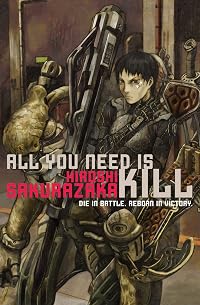
All You Need Is Kill
by Hiroshi Sakurazaka
On This Page
Description
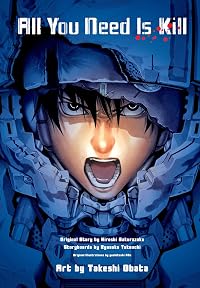
The original novel that inspired the sci-fi blockbuster film starring Tom Cruise! When the alien Mimics invade, Keiji Kiriya is just one of many recruits shoved into a suit of battle armor called a Jacket and sent out to kill. Keiji dies on the battlefield, only to be reborn each morning to fight and die again and again. On his 158th iteration, he gets a message from a mysterious ally-the female soldier known as the Full Metal Bitch. Is she the key to Keiji's escape or his final death?Tags
Recommendations
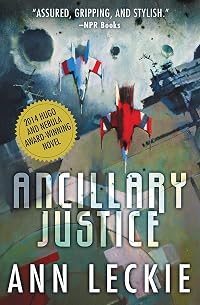
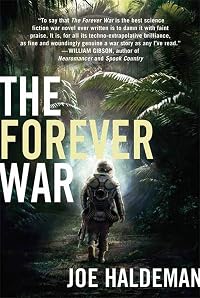
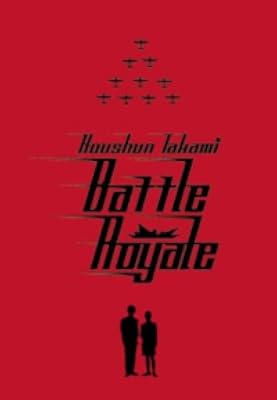
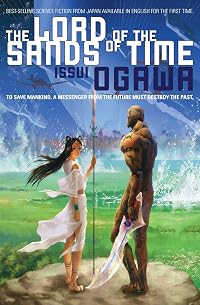



Member Recommendations
dClauzel Starship Troopers et All You Need Is Kill ont tous les deux la même intensité, avec de brèves périodes de forte violence pour une quête de la recherche du sens.

dClauzel Des militaires enfoncés dans une sale situation bizarrement compliquée, avec des équipements lourds, dans un futur proche. Même rythme soutenu, sarcasme désabusé, et exposition de tripes en plein air.
dClauzel Des soldats dans des armures de combat. Des extraterrestres. Vélocité. Mourir un millier de fois et recommencer.
Member Reviews
I heard about a movie based on this first, which was described to me as a kind of science fiction military version of Groundhog's Day, then about the book. I figured "What the heck -- having Tom Cruise in a movie shouldn't ruin the book."
I finished it in one sitting. I cared about the main character, I thought the premise was very well conceived (and, despite some superficial similarity, it wasn't much like Groundhog's Day at all), and the narrative tone was both engaging and evocative. The pacing was brisk. The ending was good, with a twist that makes so much sense it looks inevitable in hindsight (even as it might make you feel just a little sad for the protagonist). It's a really good military scifi story, but the real value of it show more for me wasn't either the military or the scifi. It's just a great read that I really enjoyed. Of course, military scifi tends to be that way, in my experience; maybe that subgenre just attracts good writers. Judging by how the military aspects of it feel, I suspect the author has read a lot of military science fiction and/or fantasy, and done a bit of research on what it's like to actually be in the military, even if I doubt (without having looked up anything about the author) he was ever in the military himself -- which would make the effort a pretty brave attempt to strike a note of authenticity without having lived in that environment.
If you're the kind of reader who complains that a book is "too dark" if people have unpleasant "on-screen" deaths that have a very personal effect on a first-person protagonist, avoid this book. It's gritty that way, and it doesn't deserve your poor ratings and reviews. The title should be a hint.
If you're the kind of reader who complains about strong language in a book, don't read this book (or any other military fiction worth its salt). All You Need Is Kill, like the actual military, is full of profanities, and doesn't deserve your poor ratings and reviews.
If you're the kind of reader who thinks "genre fiction" is beneath you because of some unreasonable belief that "unrealistic" elements of a genre make it impossible to tell a good story, provide a good character study, or otherwise act as a vehicle for some great writing, stay the hell away from this book. It doesn't deserve your pretentious, irrational biases mucking up its ratings and reviews.
I'm sure the Hollywood flick won't be anywhere near as good as the novel. show less
I finished it in one sitting. I cared about the main character, I thought the premise was very well conceived (and, despite some superficial similarity, it wasn't much like Groundhog's Day at all), and the narrative tone was both engaging and evocative. The pacing was brisk. The ending was good, with a twist that makes so much sense it looks inevitable in hindsight (even as it might make you feel just a little sad for the protagonist). It's a really good military scifi story, but the real value of it show more for me wasn't either the military or the scifi. It's just a great read that I really enjoyed. Of course, military scifi tends to be that way, in my experience; maybe that subgenre just attracts good writers. Judging by how the military aspects of it feel, I suspect the author has read a lot of military science fiction and/or fantasy, and done a bit of research on what it's like to actually be in the military, even if I doubt (without having looked up anything about the author) he was ever in the military himself -- which would make the effort a pretty brave attempt to strike a note of authenticity without having lived in that environment.
If you're the kind of reader who complains that a book is "too dark" if people have unpleasant "on-screen" deaths that have a very personal effect on a first-person protagonist, avoid this book. It's gritty that way, and it doesn't deserve your poor ratings and reviews. The title should be a hint.
If you're the kind of reader who complains about strong language in a book, don't read this book (or any other military fiction worth its salt). All You Need Is Kill, like the actual military, is full of profanities, and doesn't deserve your poor ratings and reviews.
If you're the kind of reader who thinks "genre fiction" is beneath you because of some unreasonable belief that "unrealistic" elements of a genre make it impossible to tell a good story, provide a good character study, or otherwise act as a vehicle for some great writing, stay the hell away from this book. It doesn't deserve your pretentious, irrational biases mucking up its ratings and reviews.
I'm sure the Hollywood flick won't be anywhere near as good as the novel. show less
I liked it. I usually find time travel irritating. However, the groundhog-day time loop that capture the protagonist was interesting and avoided most of the problems with time travel. It also does a good job of keeping the aperture small. Sakurazaka doesn't do much world building, but he doesn't have to because its a character driven tory and the action occurs on a pretty small patch.
I also really like short novels and this one is lean and engaging throughout.
I also really like short novels and this one is lean and engaging throughout.
I saw the movie Edge of Tomorrow this past summer, which was based on this book. The movie was fucking awesome, so I absolutely had to read this book. The book didn't have quite the Hollywood happy ending as the movie, but it did have an ending that made a bit more sense.
Often times, when I read a book after seeing the movie, I quit reading halfway through, because fuck, I know what's going to happen. Why bother? Well, with this book, I had no fucking clue what was going to happen, because it was that much different from the movie. I mean, the basic ideas are the same. Guy kills an alien which puts him in a time loop, so every time he dies, he comes back to life at the same point in time, like Groundhog Day. But there were so many show more differences in the details, that it was still a compelling page turner.
This book is about a war with invading aliens. And about a man who doesn't want to have anything to do with the war. But he is thrust into it, by his superiors. He knows that going into battle would be a death sentence, because he isn't a fucking soldier, goddamnit. He's a fucking paper-pusher. He doesn't know how to fight.
He is sent into battle, anyway. Because to the marines, he is just cannon fodder. He's just another expendable body to throw at the aliens. Somehow, he survives the battle, after executing a bomb, that he was sure would kill him, and the attacking alien. But it turns out, that it didn't actually kill him. Instead, it sent him into a time loop. He's back at the base, being introduced to the Sergeant, once again.
So, he ends up going into battle, over and over. Dying, over and over. Until he meets a woman who trains him to fight. She trains him to use the time loop, to stop the alien invasion.
I can't recommend this book enough. And the movie. The movie was great, even with that psycho weirdo Tom Cruise. Both the book, and the movie are non-stop action. Compelling, and not predictable, at all. There. I'm done with the ball washing. I can only drool so much, goddamnit. show less
Often times, when I read a book after seeing the movie, I quit reading halfway through, because fuck, I know what's going to happen. Why bother? Well, with this book, I had no fucking clue what was going to happen, because it was that much different from the movie. I mean, the basic ideas are the same. Guy kills an alien which puts him in a time loop, so every time he dies, he comes back to life at the same point in time, like Groundhog Day. But there were so many show more differences in the details, that it was still a compelling page turner.
This book is about a war with invading aliens. And about a man who doesn't want to have anything to do with the war. But he is thrust into it, by his superiors. He knows that going into battle would be a death sentence, because he isn't a fucking soldier, goddamnit. He's a fucking paper-pusher. He doesn't know how to fight.
He is sent into battle, anyway. Because to the marines, he is just cannon fodder. He's just another expendable body to throw at the aliens. Somehow, he survives the battle, after executing a bomb, that he was sure would kill him, and the attacking alien. But it turns out, that it didn't actually kill him. Instead, it sent him into a time loop. He's back at the base, being introduced to the Sergeant, once again.
So, he ends up going into battle, over and over. Dying, over and over. Until he meets a woman who trains him to fight. She trains him to use the time loop, to stop the alien invasion.
I can't recommend this book enough. And the movie. The movie was great, even with that psycho weirdo Tom Cruise. Both the book, and the movie are non-stop action. Compelling, and not predictable, at all. There. I'm done with the ball washing. I can only drool so much, goddamnit. show less
I prefer to read books before they're adapted into films. I don't mind it the other way around. But reading the book first gives me a chance to establish the character in my head before seeing it on screen. When I started seeing previews for the film Edge of Tomorrow and discovered that it was based on this book, I made sure to snap it up ASAP. The premise sounded very interesting and I wanted to be sure to read the source material before Tom Cruise got too far into my head. I'm glad I did, because he's almost the exact opposite of the twenty-something Asian protagonist of the novel. On the other hand, he's so different that it would be difficult for anyone to mistake his world-weary fifty-something American character for the same guy. show more It will be interesting to see what bits the filmmakers kept and what they completely reinvented.
The premise is simple. As the film poster puts it: Live. Die. Repeat. This is basically Groundhog Day meets Starship Troopers. Keiji Kiriya is a fresh recruit in a war against alien invaders. He's thrown into battle, barely prepared, and comes to a pretty quick end. But then he wakes up and is pretty sure it was only a dream. Except he re-lives the events of the dream in startling detail until the sense of deja vu is overwhelming and only explanation is that it wasn't a dream. He's actually stuck in some sort of time loop.
Since this is translated into English from Japanese, it's difficult to know how much of the terse writing style comes from the original author and how much from the translator. I'm sure it's a bit of both. It fits the story and keeps the reader turning pages. It's very readable and I never felt lost. Description and introspection is applied appropriately. War is gritty, messy and painful. Soldiers are real people. Backstory is skillfully woven into unfolding events. The story keeps moving. I'm sure the word count puts this more into novella territory than novel, but there is plenty of character and story to make this a novel.
I really liked this book. It's well worth reading before Tom Cruise gets into your head. show less
The premise is simple. As the film poster puts it: Live. Die. Repeat. This is basically Groundhog Day meets Starship Troopers. Keiji Kiriya is a fresh recruit in a war against alien invaders. He's thrown into battle, barely prepared, and comes to a pretty quick end. But then he wakes up and is pretty sure it was only a dream. Except he re-lives the events of the dream in startling detail until the sense of deja vu is overwhelming and only explanation is that it wasn't a dream. He's actually stuck in some sort of time loop.
Since this is translated into English from Japanese, it's difficult to know how much of the terse writing style comes from the original author and how much from the translator. I'm sure it's a bit of both. It fits the story and keeps the reader turning pages. It's very readable and I never felt lost. Description and introspection is applied appropriately. War is gritty, messy and painful. Soldiers are real people. Backstory is skillfully woven into unfolding events. The story keeps moving. I'm sure the word count puts this more into novella territory than novel, but there is plenty of character and story to make this a novel.
I really liked this book. It's well worth reading before Tom Cruise gets into your head. show less
This is one story with three titles. The original Japanese light novel is All You Need is Kill. The theatrical release starring Tom Cruise was called Edge of Tomorrow, and the version released on DVD, Blue-ray, and streaming was Live, Die, Repeat.
My interest in the movie was initially piqued because of the D-Day inspired trailer, and because I had greatly enjoyed Tom Cruise's competent performance in his previous sci-fi movie, Oblivion. I didn't get a chance to see the movie in theatres, so I picked it up on Blu-ray when it came out.
By that time, the title of the movie had changed. The re-branding of the movie with the tagline from the theatrical release did not dampen my enjoyment of what turned out to be a war movie blended with the show more essence of almost all videogames: infinite lives. It is really the combination that makes this movie interesting. Matching up with the trailer, this is a grunt's eye view of war. Confusion, regret, and death barely kept in check with black humor. The idea that war is hell has been done better elsewhere; what is really horrifying is the idea that you have to live out that last, awful day of your life, over, and over, and over.
At least, until you figure out that death is never final [although it is inevitable], and you can do whatever you want with no repercussions. Much like Bill Murray's cynical weatherman in Groundhog Day, Cruise's dilettantish REMF Major Cage travels through disbelief to despair to acceptance to something like grace. Dying seems to have been the best thing that ever happened to Major Cage. Cruise does a good everyman performance, saying and doing the things most of us fear we would do if trapped in a horrible situation, but ultimately turning into something like the best version of himself after getting unlimited chances to rectify all his mistakes.
The movie was well-done, the central conceit turned out to be thought-provoking [at least for me], and I found the characterization plausible. Not bad for a movie that seemed to be inspired by videogames. It has long been true that all movies based on videogames are bad. It is also true that most videogames based on movies are bad. The kinds of stories you tell in the two forms of entertainment differ markedly, particularly in that videogames are supposed to be repetitive. If the hero fails in his quest, you just respawn and try again. Finding a way to turn this into an interesting narrative was quite an achievement. Even more so, when I discovered the movie was based on a light novel by Hiroshi Sakurazaka.
Thus, it is even more remarkable that this game mechanic turned story mechanism survived the transition to the screen, because novels and movies also are forced to tell their stories in different ways. To successfully blend the novel and the videogame, and to then successfully adapt that to the kind of story that Hollywood does best, deserves praise.
Despite pulling in as much money as blockbuster movies do, videogames have almost no effect on the wider society. This has been changing, slowly. Wreck-It Ralph is the best videogame movie ever made, but to say that risks damning the movie with faint praise. I'm starting to see more videogame references in other kinds of media, but perhaps this is just a Kuhnian revolution where all the old guard are dying off, and the new content producers just find videogames a natural part of their life.
Perhaps another reason for all this is popular entertainment is converging in on a common point. Many big movies now have a novelization [sometimes a new one is created even when it was based on a novel!], and if it is an action or sci-fi movie, also a videogame tie-in. If you can market some toys and other merchandise too, all the better. From a production point of view, it makes sense to tell stories in a way that makes it easier to generate all that valuable ancillary content.
Sakurazaka's novel fits into that paradigm in a very Japanese way. Light novels, as the name implies, are disposable popular entertainment marketed to young adults. Popular light novels are illustrated or animated, serving as the farm team for content generation in the Japanese market. This one was popular enough to be optioned by Hollywood, and it gives us a good case study for how different media and different markets produce subtle differences.
The basic story in the novel is much the same as the movie. Unstoppable alien monsters. A hopeless war. Mechanized infantry are the last hope for humanity. A soldier trapped endlessly in a fight against unstoppable hordes. Sakurazaka's book was very traditional military sci-fi. Lots of salt of the earth soldiering, and no visibility to the grand schemes of the brass. Unlike Cruise's Major Cage, Sakurazaka'a protagonist was a plain old grunt, Private Kiriya, fresh out of boot. Even in translation, the book is very Japanese. The idioms, the expectations of the soldiers, even the kinds of women they dream about, different from an American, or even a western novel of the same type.
Also, the ending is different. My editorial policy is to discuss the ending of any story without warning, but here is your spoiler warning regardless. While I think the ending has much of the same spirit in the American movie as in the Japanese book, the critical difference is that the book goes for the tragic ending while the movie goes for the happy one. What they have in common is that each ending upends the idea of infinite lives in a videogame, where the enemies keep doing the same thing over and over while you learn more and more, and posits an enemy that has exactly the same experience you do, and learns with every iteration.
The whole thing almost ends up where it began, with everything coming down to one climactic battle, much like it would in a world were you couldn't rewind time back to before you died. The crucial difference between book and movie is how this all plays out for the protagonist and his friends. Up until the very end, I liked the book better than the movie. It was harder sci-fi, with better military know-how and better science. But at the end, Hollywood demonstrated why it makes so much money worldwide. They know the human heart better, and that made all the difference.
Tragedy has its place, but it takes greater strength of character to insist that it really will turn out well in the end. show less
My interest in the movie was initially piqued because of the D-Day inspired trailer, and because I had greatly enjoyed Tom Cruise's competent performance in his previous sci-fi movie, Oblivion. I didn't get a chance to see the movie in theatres, so I picked it up on Blu-ray when it came out.
By that time, the title of the movie had changed. The re-branding of the movie with the tagline from the theatrical release did not dampen my enjoyment of what turned out to be a war movie blended with the show more essence of almost all videogames: infinite lives. It is really the combination that makes this movie interesting. Matching up with the trailer, this is a grunt's eye view of war. Confusion, regret, and death barely kept in check with black humor. The idea that war is hell has been done better elsewhere; what is really horrifying is the idea that you have to live out that last, awful day of your life, over, and over, and over.
At least, until you figure out that death is never final [although it is inevitable], and you can do whatever you want with no repercussions. Much like Bill Murray's cynical weatherman in Groundhog Day, Cruise's dilettantish REMF Major Cage travels through disbelief to despair to acceptance to something like grace. Dying seems to have been the best thing that ever happened to Major Cage. Cruise does a good everyman performance, saying and doing the things most of us fear we would do if trapped in a horrible situation, but ultimately turning into something like the best version of himself after getting unlimited chances to rectify all his mistakes.
The movie was well-done, the central conceit turned out to be thought-provoking [at least for me], and I found the characterization plausible. Not bad for a movie that seemed to be inspired by videogames. It has long been true that all movies based on videogames are bad. It is also true that most videogames based on movies are bad. The kinds of stories you tell in the two forms of entertainment differ markedly, particularly in that videogames are supposed to be repetitive. If the hero fails in his quest, you just respawn and try again. Finding a way to turn this into an interesting narrative was quite an achievement. Even more so, when I discovered the movie was based on a light novel by Hiroshi Sakurazaka.
Thus, it is even more remarkable that this game mechanic turned story mechanism survived the transition to the screen, because novels and movies also are forced to tell their stories in different ways. To successfully blend the novel and the videogame, and to then successfully adapt that to the kind of story that Hollywood does best, deserves praise.
Despite pulling in as much money as blockbuster movies do, videogames have almost no effect on the wider society. This has been changing, slowly. Wreck-It Ralph is the best videogame movie ever made, but to say that risks damning the movie with faint praise. I'm starting to see more videogame references in other kinds of media, but perhaps this is just a Kuhnian revolution where all the old guard are dying off, and the new content producers just find videogames a natural part of their life.
Perhaps another reason for all this is popular entertainment is converging in on a common point. Many big movies now have a novelization [sometimes a new one is created even when it was based on a novel!], and if it is an action or sci-fi movie, also a videogame tie-in. If you can market some toys and other merchandise too, all the better. From a production point of view, it makes sense to tell stories in a way that makes it easier to generate all that valuable ancillary content.
Sakurazaka's novel fits into that paradigm in a very Japanese way. Light novels, as the name implies, are disposable popular entertainment marketed to young adults. Popular light novels are illustrated or animated, serving as the farm team for content generation in the Japanese market. This one was popular enough to be optioned by Hollywood, and it gives us a good case study for how different media and different markets produce subtle differences.
The basic story in the novel is much the same as the movie. Unstoppable alien monsters. A hopeless war. Mechanized infantry are the last hope for humanity. A soldier trapped endlessly in a fight against unstoppable hordes. Sakurazaka's book was very traditional military sci-fi. Lots of salt of the earth soldiering, and no visibility to the grand schemes of the brass. Unlike Cruise's Major Cage, Sakurazaka'a protagonist was a plain old grunt, Private Kiriya, fresh out of boot. Even in translation, the book is very Japanese. The idioms, the expectations of the soldiers, even the kinds of women they dream about, different from an American, or even a western novel of the same type.
Also, the ending is different. My editorial policy is to discuss the ending of any story without warning, but here is your spoiler warning regardless. While I think the ending has much of the same spirit in the American movie as in the Japanese book, the critical difference is that the book goes for the tragic ending while the movie goes for the happy one. What they have in common is that each ending upends the idea of infinite lives in a videogame, where the enemies keep doing the same thing over and over while you learn more and more, and posits an enemy that has exactly the same experience you do, and learns with every iteration.
The whole thing almost ends up where it began, with everything coming down to one climactic battle, much like it would in a world were you couldn't rewind time back to before you died. The crucial difference between book and movie is how this all plays out for the protagonist and his friends. Up until the very end, I liked the book better than the movie. It was harder sci-fi, with better military know-how and better science. But at the end, Hollywood demonstrated why it makes so much money worldwide. They know the human heart better, and that made all the difference.
Tragedy has its place, but it takes greater strength of character to insist that it really will turn out well in the end. show less
As the source material for the film, Edge of Tomorrow, this is a short, fast-paced actioner. The book goes into greater depth with regards to the origin of the alien invaders. I don't recall any back-story for the Mimics in the movie but in the book, they are here for a reason - and it's not compatible with the indigenous life on Earth. I appreciated the small amount of time the book spent creating that back-story. It made everything else just a little bit more logical.
Another change the movie made was the setting. In the film, Tom Cruise and Emily Blunt are running around Europe with their reset-point in London. The book takes place entirely in Japan. This change really made no difference to my enjoyment of either medium.
But the show more biggest difference between book and film is the ending. That HEA ending in the movie really bugged me. It almost ruined the rest of the film IMHO. The book ends very differently in confronting the protagonist with a difficult choice. A choice that must be made if humanity is to survive the Mimic invasion. Ok, maybe it doesn't make a whole lot more sense than the movie ending - but I happen to prefer a bittersweet ending to one comprised entirely of saccharin. show less
Another change the movie made was the setting. In the film, Tom Cruise and Emily Blunt are running around Europe with their reset-point in London. The book takes place entirely in Japan. This change really made no difference to my enjoyment of either medium.
But the show more biggest difference between book and film is the ending. That HEA ending in the movie really bugged me. It almost ruined the rest of the film IMHO. The book ends very differently in confronting the protagonist with a difficult choice. A choice that must be made if humanity is to survive the Mimic invasion. Ok, maybe it doesn't make a whole lot more sense than the movie ending - but I happen to prefer a bittersweet ending to one comprised entirely of saccharin. show less
Let's start off with the fact that All You Need is Kill is a way better title than Edge of Tomorrow! Even though I saw the movie first, it didn't ruin anything and I was so happy to read Sakurazaka's original novel. The basis for the screenplay is there, but the character development is so much better than the adaptation. Enough about the film, on to the novel:
All You Need is Kill is a story of an alien invasion, 20 years into the fight, with chief character Keiji repeating the same 30 hours over and over. The nature of this gift or curse is developed over the course of the novel, and is well drawn out to keep the audience experiencing it as Keiji, a piece at a time. The action takes place in Japan, concerning an island that the show more Japanese forces are trying to take back along side US Special Forces operators, including the "Full Metal Bitch". I really liked all of the premises set up by Sakurazaka and even though the reveal at the end was spoiled for me by someone extolling the virtues of film vs book, I can honestly say it didn't take away from my enjoyment when finally reading it. While technology plays a huge role, concerning the "jackets" (armored suits) used by the warriors on the ground, it just becomes an extension of the characters, and quickly dissolves into the background.
Sakurazaka's afterward talks about his inspiration coming from video games where you reset the game over and over until you win, so that winning becomes an inevitable thing. Keiji's story, though he keeps learning and applying his experience in battle like hitting reset, takes this and expands it much further. I like this theme that faced with doing the same thing over and over with no end in sight, you can't help but become a master in your own right, and then being thrown in with someone else living the same experience and feeling like you can't hold a candle to them. The story teaches us to be humble, turn the other cheek (despite being set in a war), and puts the concern for others on top, even at the expense of the relationship with them.
If you liked the movie I highly recommend you read this novel, and if you haven't seen the movie yet, this is one of those rare books where I feel like you can do either first and it doesn't take away from the other. The plot lines are really vastly different, and of course the Hollywood version created a whole different do or die ending and a little ribbon tied around the closing scene with Tom Cruise giving a pretty boy smile to camera. show less
All You Need is Kill is a story of an alien invasion, 20 years into the fight, with chief character Keiji repeating the same 30 hours over and over. The nature of this gift or curse is developed over the course of the novel, and is well drawn out to keep the audience experiencing it as Keiji, a piece at a time. The action takes place in Japan, concerning an island that the show more Japanese forces are trying to take back along side US Special Forces operators, including the "Full Metal Bitch". I really liked all of the premises set up by Sakurazaka and even though the reveal at the end was spoiled for me by someone extolling the virtues of film vs book, I can honestly say it didn't take away from my enjoyment when finally reading it. While technology plays a huge role, concerning the "jackets" (armored suits) used by the warriors on the ground, it just becomes an extension of the characters, and quickly dissolves into the background.
Sakurazaka's afterward talks about his inspiration coming from video games where you reset the game over and over until you win, so that winning becomes an inevitable thing. Keiji's story, though he keeps learning and applying his experience in battle like hitting reset, takes this and expands it much further. I like this theme that faced with doing the same thing over and over with no end in sight, you can't help but become a master in your own right, and then being thrown in with someone else living the same experience and feeling like you can't hold a candle to them. The story teaches us to be humble, turn the other cheek (despite being set in a war), and puts the concern for others on top, even at the expense of the relationship with them.
If you liked the movie I highly recommend you read this novel, and if you haven't seen the movie yet, this is one of those rare books where I feel like you can do either first and it doesn't take away from the other. The plot lines are really vastly different, and of course the Hollywood version created a whole different do or die ending and a little ribbon tied around the closing scene with Tom Cruise giving a pretty boy smile to camera. show less
Members
- Recently Added By
Lists

Books discovered on LibraryThing
256 works; 36 members

Best Science Fiction Originally Published in a Language Other Than English
449 works; 31 members

Books With the Most Memorable Titles
478 works; 158 members

Reading Glasses Podcast
410 works; 3 members

Favorite Books in Translation
320 works; 133 members

Favorite Science Fiction
452 works; 216 members
Author Information

15+ Works 1,248 Members
Some Editions
Awards and Honors
Awards
Distinctions
Series
Belongs to Publisher Series
Work Relationships
Common Knowledge
- Original title
- オール ユー ニード イズ キル
- Alternate titles
- Edge of Tomorrow
- Original publication date
- 2004-12-18
- People/Characters
- Keiji Kiyira; Rita Vrataski
- Important places
- Kotoiushi Island, Japan
- Related movies
- Edge of Tomorrow (2014 | IMDb)
- Publisher's editor
- Miyuki Matsumoto
- Blurbers
- Scalzi, John
- Original language
- Japanese
Classifications
- Genres
- Science Fiction, Fiction and Literature
- DDC/MDS
- 895.6 — Literature & rhetoric Asian Literature Literatures of East and Southeast Asia Japanese
- LCC
- PL875.5 .A45 .O7813 — Language and Literature Languages and literatures of Eastern Asia, Africa, Oceania Languages of Eastern Asia, Africa, Oceania Japanese language and literature Japanese literature
- BISAC
Statistics
- Members
- 1,087
- Popularity
- 23,411
- Reviews
- 78
- Rating
- (3.82)
- Languages
- 5 — Chinese, English, French, German, Japanese
- Media
- Paper, Audiobook, Ebook
- ISBNs
- 15
- ASINs
- 4