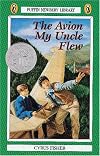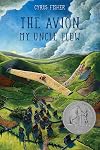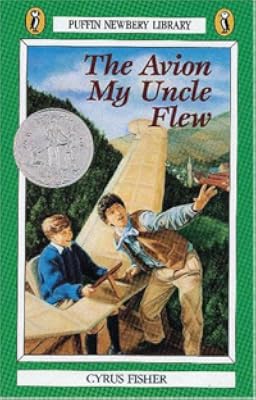
The Avion My Uncle Flew
by Cyrus Fisher
On This Page
Description
While visiting his uncle in the mountains of France shortly after World War II, Johnny stumbles upon an evil plot being hatched by a fugitive Nazi spy.Tags
Recommendations







Member Recommendations

Member Reviews
When twelve-year-old Johnny Littlehorn's father returns from the front lines, after WWII is over, and announces they're spending the summer in France, Johnny doesn't want to leave their Wyoming ranch. But what starts off as a boring trip soon turns into a frightening adventure. A sinister man trails Johnny throughout Paris and follows him to his uncle's village of St. Chamant.
With the help of his new friends, Suzanne and Charles, Johnny follows a winding trail that leads to a fugitive spy, a German pistolet hidden in a loaf of bread, and a stolen fortune. Before long, he's learning French, helping his oncle Paul build an avion, and unraveling an evil Nazi plot!
With the help of his new friends, Suzanne and Charles, Johnny follows a winding trail that leads to a fugitive spy, a German pistolet hidden in a loaf of bread, and a stolen fortune. Before long, he's learning French, helping his oncle Paul build an avion, and unraveling an evil Nazi plot!
When twelve-year-old Johnny Littlehorn's father returns from the front lines, after WWII is over, and announces they're spending the summer in France, Johnny doesn't want to leave their Wyoming ranch. But what starts off as a boring trip soon turns into a frightening adventure. A sinister man trails Johnny throughout Paris and follows him to his uncle's village of St. Chamant.
With the help of his new friends, Suzanne and Charles, Johnny follows a winding trail that leads to a fugitive spy, a German pistolet hidden in a loaf of bread, and a stolen fortune. Before long, he's learning French, helping his oncle Paul build an avion, and unraveling an evil Nazi plot!
With the help of his new friends, Suzanne and Charles, Johnny follows a winding trail that leads to a fugitive spy, a German pistolet hidden in a loaf of bread, and a stolen fortune. Before long, he's learning French, helping his oncle Paul build an avion, and unraveling an evil Nazi plot!
When twelve-year-old Johnny Littlehorn's father returns from the front lines, after WWII is over, and announces they're spending the summer in France, Johnny doesn't want to leave their Wyoming ranch. But what starts off as a boring trip soon turns into a frightening adventure. A sinister man trails Johnny throughout Paris and follows him to his uncle's village of St. Chamant.
With the help of his new friends, Suzanne and Charles, Johnny follows a winding trail that leads to a fugitive spy, a German pistolet hidden in a loaf of bread, and a stolen fortune. Before long, he's learning French, helping his oncle Paul build an avion, and unraveling an evil Nazi plot!
With the help of his new friends, Suzanne and Charles, Johnny follows a winding trail that leads to a fugitive spy, a German pistolet hidden in a loaf of bread, and a stolen fortune. Before long, he's learning French, helping his oncle Paul build an avion, and unraveling an evil Nazi plot!
As read from OpenLibrary, I found this surprisingly charming.
It's mostly about the boy, John (Jean when he's in France) as he faces the challenges of growing from a pampered boy to a stronger and wiser young man. He's sort of forced to 'man up' in just a few weeks, as he's left to live with his 'oncle' in a poor village where there are almost no speakers of English, while still recovering from a badly broken leg, without his parents.... and then a thrilling adventure on top of it all!
But the 'German spies' are individuals, not indicated to be representative of Germans in general. Ditto the French, and the Americans for that matter.
The boy does complain how the French language makes no sense (for example, 'the house of the woman' instead show more of 'the woman's house), but it's obviously meant to be humor, as the reader laughs at (and with) the boy instead of at the French.
I believe the Newbery committee liked the idea of pointing out that war also has an impact on the home front, and that recovery is a challenge in that war isn't actually over when it's dated as such. I believe they also liked all the French vocabulary words, and the bits of French culture and history. Of course they liked the boy's developing maturity, and probably they hoped that young readers would like the humor and the adventure, too.
I think this story would make a terrific movie.
This edition, the 1967 Scholastic, downloaded as scanned, does contain some typos. The most annoying was, sometimes, viola for voila. (They did use the accent marks, but I can't seem to reproduce them here without screwing up the rest of my text.) show less
It's mostly about the boy, John (Jean when he's in France) as he faces the challenges of growing from a pampered boy to a stronger and wiser young man. He's sort of forced to 'man up' in just a few weeks, as he's left to live with his 'oncle' in a poor village where there are almost no speakers of English, while still recovering from a badly broken leg, without his parents.... and then a thrilling adventure on top of it all!
But the 'German spies' are individuals, not indicated to be representative of Germans in general. Ditto the French, and the Americans for that matter.
The boy does complain how the French language makes no sense (for example, 'the house of the woman' instead show more of 'the woman's house), but it's obviously meant to be humor, as the reader laughs at (and with) the boy instead of at the French.
I believe the Newbery committee liked the idea of pointing out that war also has an impact on the home front, and that recovery is a challenge in that war isn't actually over when it's dated as such. I believe they also liked all the French vocabulary words, and the bits of French culture and history. Of course they liked the boy's developing maturity, and probably they hoped that young readers would like the humor and the adventure, too.
I think this story would make a terrific movie.
This edition, the 1967 Scholastic, downloaded as scanned, does contain some typos. The most annoying was, sometimes, viola for voila. (They did use the accent marks, but I can't seem to reproduce them here without screwing up the rest of my text.) show less
A young boy from Wyoming breaks his leg and falls into a kind of depression because of it. To help him break out of his feelings of helplessness, his parents decide to take him to France (this is just after WWII and his father is still stationed there). He stays for the summer with his uncle in the south of France, helps him build a glider airplane, and gets mixed up with a Nazi in hiding looking for buried treasure.
This is a pretty fun one, really. There's suspense and mystery in the story about the Nazi, but the best bit is that John learns some French, bit by bit, throughout the book, and so can young readers right along with him, so that by the end they can read the letter John writes to his mother, in simple and understandable show more French. Pretty cool. show less
This is a pretty fun one, really. There's suspense and mystery in the story about the Nazi, but the best bit is that John learns some French, bit by bit, throughout the book, and so can young readers right along with him, so that by the end they can read the letter John writes to his mother, in simple and understandable show more French. Pretty cool. show less
This was one of many books I snitched from my older sister's room, and read on the sly. I have not owned a copy or read it in years, but have very fond memories of this story, which takes place in France just after WW2. Johnny Littlehorn winds up spending the Summer in a tiny and poor village in the mountains of South France. The only thing of interest, he feels, is watching his French 'oncle' build an avion, airplane.
But then things get more interesting...
January 25, 2013: I indulged myself in a reread, and found it to be as charming and fun to read as I'd remembered.
But then things get more interesting...
January 25, 2013: I indulged myself in a reread, and found it to be as charming and fun to read as I'd remembered.
While visiting his uncle in the mountains of France shortly after World War II, Johnny stumbles upon an evil plot being hatched by a fugitive Nazi spy.
Members
- Recently Added By
Lists

Favorite Childhood Books
1,646 works; 518 members

Best Newbery Honor Books
241 works; 31 members

Newbery Honor Books By Year - I - 1922-1980
199 works; 3 members

Books Read in 2024
4,623 works; 126 members
Talk Discussions
Past Discussions
The Avion My Uncle Flew in Combiners! (December 2022)
Author Information

29 Works 792 Members
Some Editions
Awards and Honors
Awards
Common Knowledge
- Original publication date
- 1946
- People/Characters
- John "Jean" Littlehorn
- Important places
- Paris, France; Saint-Chamant, Auvergne-Rhône-Alpes, France
- Important events
- World War II (1939 | 1945)
- Dedication
- Oddly enough, this book about the unusual adventures of young Mr. Littlehorn last summer in France is dedicated with much affection to three young ladies whose great-grandfather came from that very same part of France:
MAR... (show all)TA JEHANNE
SARAL DIETER
and JEHANNE HILDEGARDE LEORA - First words
- My father says I should write down all about what happened to me last summer when I got planted in that little French mountain town which was probably one of the awfulest sells in the world because nobody there ever learned a... (show all) proper language to speak---I mean, a language like the kind of language you and I and sensible folks speak.
- Quotations
- "Pouf!" He snapped his fingers. "Am I not a Langres?"
- Last words
- (Click to show. Warning: May contain spoilers.)Ah, tout est beau le jour de la fête de l'avion de l'oncle de Jean Littlehorn.
La Fin
Classifications
- Genres
- Fiction and Literature, Children's Books, Kids
- DDC/MDS
- 823.914 — Literature & rhetoric English & Old English literatures English fiction 1900- 1901-1999 1945-1999
- LCC
- PZ7 .F4998 .A — Language and Literature Fiction and juvenile belles lettres Fiction and juvenile belles lettres Juvenile belles lettres
- BISAC
Statistics
- Members
- 644
- Popularity
- 44,951
- Reviews
- 7
- Rating
- (3.95)
- Languages
- English
- Media
- Paper, Ebook
- ISBNs
- 6
- ASINs
- 6