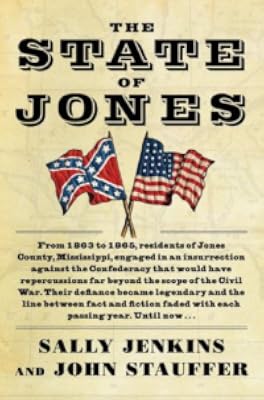
The State of Jones: The Small Southern County that Seceded from the Confederacy
by Sally Jenkins, John Stauffer
On This Page
Description
In Jones County, Mississippi, a farmer named Newton Knight led his neighbors, white and black alike, in an insurrection against the Confederacy at the height of the Civil War. Knight's life story mirrors the little-known story of class struggle in the South--and it shatters the image of the Confederacy as a unified front against the Union.Tags
Recommendations











Member Reviews
There is a part of the history of the American Civil War that is not very well-known, that is rarely taught in the schools. It is the story of southerners who believed in the Union, who not only refused to fight for the Confederacy, but actively fought against it. Some did so by joining the Union forces, others did so by engaging in guerrilla warfare. The rural county of Jones in Mississippi was a stronghold of men who opposed secession. Some were staunch Unionists. Some were anti-slavery. Some believed it was a rich man's war and a poor man's fight. One such man was Newton Knight, and this is his story.
Newton Knight was the grandson of Jackie Knight, one of the early settlers in this part of Mississippi. By the time war came, he was show more "merely a rich man in a state full of tycoons", but the owner of several hundred acres of cotton and rice, and of a couple of dozen slaves. But his son, Albert, Newton's father, unlike Jackie's other children, refused to own any slaves, and led a modest life as a shoemaker and tanner. This split in the family would echo down through the years and the generations.
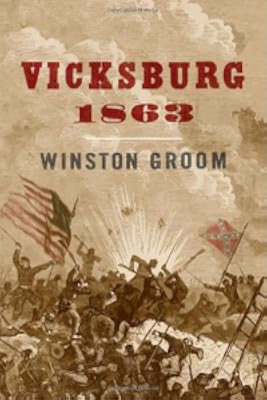
When the Civil War began, Newton, like many others, was forced into service in the Confederate Army. After Vicksburg, he, like many others, deserted. He spent the rest of the war with a band of like-minded souls, fighting the Confederacy in Jones County. The book does not, however, end with Lee's surrender, because the war really didn't end there. There was a period when men like Knight were in the ascendancy, when it looked as though the Union had won the war. But it soon became apparent that, in Mississippi at least, the South had won. National politics meant that the federal government soon declined to enforce the rule of law, and ex-Confederates came to power through murder and intimidation at the polls, leaving a legacy of racial injustice that still haunts this country today.
There's another part of Newton's story that's told here, the story of his love for a black woman, a woman named Rachel who was owned by his grandfather. Newton was married to a woman named Serena, by whom he had several children, but he also had children by Rachel. Now, it wasn't unusual for a white man to have children by a slave woman. What was unusual was that theirs was a true consensual relationship. He viewed her as his wife (the authors suggest that later conversions of some members of the family to Mormonism might have been caused, at least in part, by that faith's then recognition of plural marriage), he recognized and helped to raise and support his children by her, he made sure she had financial independence.
One would like to know what it was that caused Albert (and, through him, his children) to be not only opposed to slavery, but a friend to African-Americans. I cannot, however, fault the authors for being unable to answer this question; it is, at this remove, likely unanswerable.
I was, for the most part, riveted by this book. If I have any quibble with it, it is that in the early part it jumps around a bit too much for my taste. However, the authors combine serious scholarship and research (among other things, they located and interviewed descendants of Knight) with good storytelling. Civil War buffs will appreciate the vivid descriptions of the battle of Corinth, the siege of Vicksburg, and the guerrilla bands. About the only folks who won't like this book are those who don't want their preconceived ideas about the south and the Confederacy disturbed.
(For another story of Union sympathizers in the South, this one fiction, I highly recommend Sharyn McCrumb's Ghost Riders, one of her "Ballad Series".) show less
Newton Knight was the grandson of Jackie Knight, one of the early settlers in this part of Mississippi. By the time war came, he was show more "merely a rich man in a state full of tycoons", but the owner of several hundred acres of cotton and rice, and of a couple of dozen slaves. But his son, Albert, Newton's father, unlike Jackie's other children, refused to own any slaves, and led a modest life as a shoemaker and tanner. This split in the family would echo down through the years and the generations.
When the Civil War began, Newton, like many others, was forced into service in the Confederate Army. After Vicksburg, he, like many others, deserted. He spent the rest of the war with a band of like-minded souls, fighting the Confederacy in Jones County. The book does not, however, end with Lee's surrender, because the war really didn't end there. There was a period when men like Knight were in the ascendancy, when it looked as though the Union had won the war. But it soon became apparent that, in Mississippi at least, the South had won. National politics meant that the federal government soon declined to enforce the rule of law, and ex-Confederates came to power through murder and intimidation at the polls, leaving a legacy of racial injustice that still haunts this country today.
There's another part of Newton's story that's told here, the story of his love for a black woman, a woman named Rachel who was owned by his grandfather. Newton was married to a woman named Serena, by whom he had several children, but he also had children by Rachel. Now, it wasn't unusual for a white man to have children by a slave woman. What was unusual was that theirs was a true consensual relationship. He viewed her as his wife (the authors suggest that later conversions of some members of the family to Mormonism might have been caused, at least in part, by that faith's then recognition of plural marriage), he recognized and helped to raise and support his children by her, he made sure she had financial independence.
One would like to know what it was that caused Albert (and, through him, his children) to be not only opposed to slavery, but a friend to African-Americans. I cannot, however, fault the authors for being unable to answer this question; it is, at this remove, likely unanswerable.
I was, for the most part, riveted by this book. If I have any quibble with it, it is that in the early part it jumps around a bit too much for my taste. However, the authors combine serious scholarship and research (among other things, they located and interviewed descendants of Knight) with good storytelling. Civil War buffs will appreciate the vivid descriptions of the battle of Corinth, the siege of Vicksburg, and the guerrilla bands. About the only folks who won't like this book are those who don't want their preconceived ideas about the south and the Confederacy disturbed.
(For another story of Union sympathizers in the South, this one fiction, I highly recommend Sharyn McCrumb's Ghost Riders, one of her "Ballad Series".) show less
The story of the pro-Union guerrilla resistance organized by hard-scrabble dirt farmer Newton Knight in southeastern Mississippi, which appears to be the Wild West of the South. Despite his great success, at great cost, Knight's post-war struggle against the overwhelming pressures of the Southern Cause is heart-breaking. The aristocrats who made up the Confederacy shoved through secession even though Jones County was overwhelmingly pro-Union. When the war ended, politics returned them to power starting with President Andrew Johnson, Lincoln's Southern Democrat successor who may have been pro-Union, but was unrelentingly racist. Congress took the power over the South away from him and kicked the rebels out, but Grant, of all people, show more returned them to power as a trade-off, then the Democrats, seeking to replace the Republicans in office, defanged and later removed the military occupiers, letting the ex-Confederates drive out and kill Republicans and blacks - who were often the same - and use the law as locally interpreted, to keep the black man down for another 100 years. Knight, who should've been a hero, was forced to withdraw to his farm, always armed against possible assassination. But while he rode during the Civil War with his Union guerrillas - so recognized by the North - he delivered amazing rear-area victories. Well-deserved recognition for a man little known whose story will be retold, in Hollywood fashion, in an upcoming Mathew McConaughey movie. Brilliant story, a genuine page-turner. Revealing in its view of life in the South, the attitude towards the aristocratic secessionists, and the success in achieving rebel goals after the war ended, among other things. show less
This amazing history book reads like a novel. I was fascinated at every turn: The description of the siege at Vicksburg, the utter decimation visited on the South as wartime policy, and the heartrending aftermath of the war. I'd been aware that blacks had been granted the vote in the immediate aftermath of the Civil War; I had never fully understood why the federal government allowed Jim Crow laws and the essential reversal of all the North fought for.
This beautifully written tome explains a great deal of how deep and all-encompassing not only Southern pride, but Southern racism really was. Is? It didn't touch on current politics, seeming to assume that in the decades since the Civil Rights Act, the teeming morass of racism, classism show more and political division has been largely tamped -- or perhaps assuming it best not to touch on current issues.
I finished this book shocked and horrified at all the atrocities committed during the Civil War and the following decades. During the first part of the book, Newton Knight and his band of Unionists reminded me so much of Robin Hood that I was actually disappointed when Confederate generals succeeded in hanging or shooting men from Jones County. Disappointed not just for the pointless deaths, but that Knight hadn't ridden down like an avenging angel and stopped the Confederate troops after they caught his men.
Ridiculous, I know, but seriously. Read about Knight defying Confederate-installed sheriffs, robbing from rich plantation owners to feed the poor whites and emancipated slaves, and living in the Mississippi swamps throughout the war and try not to make the Robin Hood parallel.
It's a boldly written, beautifully pieced-together book. It's rife with heroism, love, and betrayal -- all on both a grand and a personal scale. This is probably the most evocative, intriguing look at the Civil War South I've ever had the pleasure of reading. show less
This beautifully written tome explains a great deal of how deep and all-encompassing not only Southern pride, but Southern racism really was. Is? It didn't touch on current politics, seeming to assume that in the decades since the Civil Rights Act, the teeming morass of racism, classism show more and political division has been largely tamped -- or perhaps assuming it best not to touch on current issues.
I finished this book shocked and horrified at all the atrocities committed during the Civil War and the following decades. During the first part of the book, Newton Knight and his band of Unionists reminded me so much of Robin Hood that I was actually disappointed when Confederate generals succeeded in hanging or shooting men from Jones County. Disappointed not just for the pointless deaths, but that Knight hadn't ridden down like an avenging angel and stopped the Confederate troops after they caught his men.
Ridiculous, I know, but seriously. Read about Knight defying Confederate-installed sheriffs, robbing from rich plantation owners to feed the poor whites and emancipated slaves, and living in the Mississippi swamps throughout the war and try not to make the Robin Hood parallel.
It's a boldly written, beautifully pieced-together book. It's rife with heroism, love, and betrayal -- all on both a grand and a personal scale. This is probably the most evocative, intriguing look at the Civil War South I've ever had the pleasure of reading. show less
This is a dark and unrelenting book about a dark and unrelenting time. All wars are brutal, but the Civil War was particularly so, and this book doesn't stint on making one understand its horrors.
One of the co-authors of the book, John Stauffer, wrote the book Giants: the Parallel Lives of Frederick Douglass and Abraham Lincoln, which I read and thoroughly enjoyed.
State of Jones is centered on the story of one man, Newton Knight, who was a poor farmer in Jones county, Mississippi. Knight's grandfather was a fairly wealthy slave owner, but his eldest son and all twelve of the son's children refused to own slaves. This may have come from being Primitive Baptists, who believed that all souls were equal.
Knight was not in favor of succession show more when it happened, but was conscripted into the Confederate army and fought, but deserted a couple of times. There were probably a couple of points that broke his will to fight... one was when the Confederate government passed a bill that those who owned twenty slaves or more were exempt from fighting. Another was the siege of Vicksburg, which he endured and survived. Moreover his family may have been in dire straits, as many of the wives of soldiers were close to starvation.
After Knight escaped for the last time and returned to Jones County, he was forced to live in the local swamps, which he knew intimately. He wasn't the only one. The swamps were full of soldiers who had deserted, and runaway slaves. They all helped each other, and Knight became the leader of a pro-Union band of soldiers who ran a guerilla operation for the rest of the war. At one time most of the lower third of Mississippi was out of effecftive Confederate control. The partisans of the free state of Jones were poorer yeoman farmers who didn't own slaves, and resented the slave-owning aristocracy. During the war, Knight met a slave named Rachel, and they were as close to married as they could be, given that he was already married. He continued to live with and have children with both women until Rachel's death. Sometime after that his white wife left him.
The Confederates lost the war, the land was devastated, but they determined they would win the peace, and they did. By the late 1879s the Northern populace, including President Grant, had become apathethic and no longer willing to fight. The Democrats took over by a reign of terror that didn't let up until the Civil Rights movement of the 1960s. The Ku Klux Klan were the terrorists, and blacks and Republicans were murdered, including by lynching, for the crimes of voting, seeking social equality, or for speaking up for their rights. How Knight survived is a mystery, except that he always had a pistol and a shotgun with him and people knew it. He and his large mixed-race family became socially isolated, as even his former fellow soldiers couldn't abide his domestic arrangements.
The book takes one story and through it tells some difficult truths about Southern history. Fisrt of all, it explodes the myth of the solid South. There were many pro-Union Southerners. Moreover the Southern revenge and the regaining of power were not a win for democracy. The former slave owners won back power by terror pure and simple, like many of the worst dictators in history.
I have an odd reaction to books about the Civil War and the South. I am a white woman born in the South who has spent most of my life here, an for most of that time, I've hated the bigotry and despised Southern romanticism about the Old South... something my mother was prone to. This book in a way gives me a sense of coming home, knowing that there were Southerners who repudiated slavery and even a few who believed in the equality of all.
It also sheds an interesting light on General Sherman, Sherman's brutality in war was born of the conviction that making the war one of maximum destruction would shorten it. His opinon about war was summed up in the following quote: "Its glory is all moonshine; even success the most brilliant is over dead and mangled bodies, with the anguish and lamentation of distant families." (p. 166)
The book is as well written as I expected from Stauffer. It has good footnotes, not obrusive, and a good bibliography. My copy was an advanced reader's copy, and is missing features I hope will be in the final book, including an index, maps, and photographs.
Exvellent book of history about a brutal time and place whose effects still reverberate in our culture. show less
One of the co-authors of the book, John Stauffer, wrote the book Giants: the Parallel Lives of Frederick Douglass and Abraham Lincoln, which I read and thoroughly enjoyed.
State of Jones is centered on the story of one man, Newton Knight, who was a poor farmer in Jones county, Mississippi. Knight's grandfather was a fairly wealthy slave owner, but his eldest son and all twelve of the son's children refused to own slaves. This may have come from being Primitive Baptists, who believed that all souls were equal.
Knight was not in favor of succession show more when it happened, but was conscripted into the Confederate army and fought, but deserted a couple of times. There were probably a couple of points that broke his will to fight... one was when the Confederate government passed a bill that those who owned twenty slaves or more were exempt from fighting. Another was the siege of Vicksburg, which he endured and survived. Moreover his family may have been in dire straits, as many of the wives of soldiers were close to starvation.
After Knight escaped for the last time and returned to Jones County, he was forced to live in the local swamps, which he knew intimately. He wasn't the only one. The swamps were full of soldiers who had deserted, and runaway slaves. They all helped each other, and Knight became the leader of a pro-Union band of soldiers who ran a guerilla operation for the rest of the war. At one time most of the lower third of Mississippi was out of effecftive Confederate control. The partisans of the free state of Jones were poorer yeoman farmers who didn't own slaves, and resented the slave-owning aristocracy. During the war, Knight met a slave named Rachel, and they were as close to married as they could be, given that he was already married. He continued to live with and have children with both women until Rachel's death. Sometime after that his white wife left him.
The Confederates lost the war, the land was devastated, but they determined they would win the peace, and they did. By the late 1879s the Northern populace, including President Grant, had become apathethic and no longer willing to fight. The Democrats took over by a reign of terror that didn't let up until the Civil Rights movement of the 1960s. The Ku Klux Klan were the terrorists, and blacks and Republicans were murdered, including by lynching, for the crimes of voting, seeking social equality, or for speaking up for their rights. How Knight survived is a mystery, except that he always had a pistol and a shotgun with him and people knew it. He and his large mixed-race family became socially isolated, as even his former fellow soldiers couldn't abide his domestic arrangements.
The book takes one story and through it tells some difficult truths about Southern history. Fisrt of all, it explodes the myth of the solid South. There were many pro-Union Southerners. Moreover the Southern revenge and the regaining of power were not a win for democracy. The former slave owners won back power by terror pure and simple, like many of the worst dictators in history.
I have an odd reaction to books about the Civil War and the South. I am a white woman born in the South who has spent most of my life here, an for most of that time, I've hated the bigotry and despised Southern romanticism about the Old South... something my mother was prone to. This book in a way gives me a sense of coming home, knowing that there were Southerners who repudiated slavery and even a few who believed in the equality of all.
It also sheds an interesting light on General Sherman, Sherman's brutality in war was born of the conviction that making the war one of maximum destruction would shorten it. His opinon about war was summed up in the following quote: "Its glory is all moonshine; even success the most brilliant is over dead and mangled bodies, with the anguish and lamentation of distant families." (p. 166)
The book is as well written as I expected from Stauffer. It has good footnotes, not obrusive, and a good bibliography. My copy was an advanced reader's copy, and is missing features I hope will be in the final book, including an index, maps, and photographs.
Exvellent book of history about a brutal time and place whose effects still reverberate in our culture. show less
Review of: The State of Jones, by Sally Jenkins and John Stauffer,
by Stan Prager (9-24-16)
A stubborn incongruity to the again resurgent southern “Myth of the Lost Cause” is that the commitment to secession was far from universal. In fact, about one hundred thousand white southern loyalists fought for the Union; except for South Carolina every state of the Confederacy sent at least one battalion to join the northern ranks. More significantly perhaps is that there were multiple geographies where Unionist sentiment prevailed throughout the conflict, especially those where hardscrabble farming was far removed from the arena of the slave-holding plantation elite. Indeed, a great chunk of a cornerstone Confederate state broke off to show more become the new loyal union state of West Virginia. A less well known locale is the subject of The State of Jones, by Sally Jenkins and John Stauffer, the tale – a blurred mix of fact and legend – of how pockets of loyalists in Jones County, in eastern Mississippi, were led by the colorful Newton Knight to secede from the Confederacy and form the “Free State of Jones.” This book, which dates back to 2009, served as the basis for the 2016 motion picture featuring Matthew McConaughey, which has brought the story to a much wider audience.
Despite the title, Newton Knight – rather than the State of Jones – is the true central character, which forms both a strength and a weakness to the book. The strength is that a biographical figure serving as focal point often enriches an unfolding historical narrative. The weakness in this case is that the perspective is often severely delimited to that figure, which diminishes the wider view. The authors introduce us to Newton Knight in 1921, interviewed in the twilight of his days by journalist Meigs Frost. It is hard to know what to make of him, especially since much of what is known about him is derived from his reminisces and those partisans who were loyal to him. Was he a heroic figure with a strong moral core and loyalty to an unwavering ideological outlook? Or was he rather an opportunistic scalawag, a narcissistic self-serving outlaw that constructed his ethical framework entirely to suit his own interests? He seems to be a bit of both, and to their credit Jenkins and Stauffer largely tell the story as they have it and leave it to the reader to pass judgment, although overall Knight tends to come off as more of a sympathetic figure than not in the course of this account.
Newton Knight was apparently a larger than life character, imposing both physically by his great stature and otherwise by the strength of his disposition, which encompassed a devotion to his Baptist “primitive” faith, a personal aversion to alcohol and a moral opposition to slavery. Knight, like many others in Jones County, was a poor white dirt farmer who had little sympathy for the Confederate cause, especially because of his anti-slavery views. Nevertheless, as the draft loomed, he joined the army and served as both soldier and hospital orderly. His service did not last long. Disillusioned, he deserted and teamed up with other Unionists as a guerrilla fighter, leading the “Knight Company,” the genesis of the forces that eventually broke Jones County off from the CSA and what was later more or less formalized as the “Free State of Jones.”
Naturally, pro-Confederates viewed Knight and his band as traitors. And while the reader may be sympathetic to Knight’s cause, it is often difficult not to wince at his methods, which as a guerrilla frequently eschewed the rules of war to include bushwhacking and the assassination of opponents, in and out of uniform. Also, it becomes increasingly ambiguous whether Knight was really fighting for any cause other than what best suited Newton Knight.
Knight differed from the majority of southern Unionists not only in his opposition to secession but also in his stand against slavery and his views on African-Americans, which encompassed not only abolition but a kind of equality which would have been viewed at the time as extremely radical, north or south. Knight, who was married and had multiple children with his Caucasian wife, also became involved with an African-American former slave named Rachel with whom he sired many more children. While it was hardly unusual for southern white men to consort with black women in the antebellum era – slaveholders including such notable figures as Jefferson commonly (if hardly publicly) had slave concubines that they impregnated – Knight went a giant step further as he eventually also took Rachel to be his wife, and came to treat all of his offspring and various relatives, white and black, as full equals. This story spills over into the post-war period, with Knight serving as a despised Republican officeholder in the Reconstruction era. This is perhaps the most captivating part of the book, as the “Free State of Jones” is left in the dust and we observe the tragedy in microcosm in eastern Mississippi as the south loses the war but essentially wins the peace, as Reconstruction gives way to Redemption, as the brief experiment of attempts at equality end ruthlessly as African-Americans are murdered, terrorized, dehumanized and turned into second-class citizens for a century to come. Yet, somehow Newton Knight not only weathers the calamities about him but thrives, carving out his own enclave for his ever expanding inter-racial family, which somewhat uncomfortably intermarries amongst themselves. Hero or villain or a blend of the two, Newton Knight remained a fascinating and singular character throughout his long life.
Given the wealth of great material, this should have been a far better book, but alas it often falls flat. I would chalk that up to the fact that there are two authors, which frequently is problematic in any such volume. Audiophiles will tell you that CD’s never sound as good as vinyl records because the highs and lows are averaged out – Keith Moon’s percussion is simply not as dramatic on a “Who” CD as it is on vinyl; the passion is, if not lost, deeply compromised. Something similar often occurs when two authors attempt to speak with a single voice in a narrative – in this case Stauffer, a Harvard professor of history, and Jenkins, an award-winning journalist – and here again what is most conspicuously diminished is the passion of the telling of the tale. Still, it remains a compelling story and despite this flaw I would recommend it.
My review of: "The State of Jones," by Sally Jenkins & John Stauffer, is live on my book blog: https://regarp.com/2016/09/25/review-of-the-state-of-jones-by-sally-jenkins-and-... show less
by Stan Prager (9-24-16)
A stubborn incongruity to the again resurgent southern “Myth of the Lost Cause” is that the commitment to secession was far from universal. In fact, about one hundred thousand white southern loyalists fought for the Union; except for South Carolina every state of the Confederacy sent at least one battalion to join the northern ranks. More significantly perhaps is that there were multiple geographies where Unionist sentiment prevailed throughout the conflict, especially those where hardscrabble farming was far removed from the arena of the slave-holding plantation elite. Indeed, a great chunk of a cornerstone Confederate state broke off to show more become the new loyal union state of West Virginia. A less well known locale is the subject of The State of Jones, by Sally Jenkins and John Stauffer, the tale – a blurred mix of fact and legend – of how pockets of loyalists in Jones County, in eastern Mississippi, were led by the colorful Newton Knight to secede from the Confederacy and form the “Free State of Jones.” This book, which dates back to 2009, served as the basis for the 2016 motion picture featuring Matthew McConaughey, which has brought the story to a much wider audience.
Despite the title, Newton Knight – rather than the State of Jones – is the true central character, which forms both a strength and a weakness to the book. The strength is that a biographical figure serving as focal point often enriches an unfolding historical narrative. The weakness in this case is that the perspective is often severely delimited to that figure, which diminishes the wider view. The authors introduce us to Newton Knight in 1921, interviewed in the twilight of his days by journalist Meigs Frost. It is hard to know what to make of him, especially since much of what is known about him is derived from his reminisces and those partisans who were loyal to him. Was he a heroic figure with a strong moral core and loyalty to an unwavering ideological outlook? Or was he rather an opportunistic scalawag, a narcissistic self-serving outlaw that constructed his ethical framework entirely to suit his own interests? He seems to be a bit of both, and to their credit Jenkins and Stauffer largely tell the story as they have it and leave it to the reader to pass judgment, although overall Knight tends to come off as more of a sympathetic figure than not in the course of this account.
Newton Knight was apparently a larger than life character, imposing both physically by his great stature and otherwise by the strength of his disposition, which encompassed a devotion to his Baptist “primitive” faith, a personal aversion to alcohol and a moral opposition to slavery. Knight, like many others in Jones County, was a poor white dirt farmer who had little sympathy for the Confederate cause, especially because of his anti-slavery views. Nevertheless, as the draft loomed, he joined the army and served as both soldier and hospital orderly. His service did not last long. Disillusioned, he deserted and teamed up with other Unionists as a guerrilla fighter, leading the “Knight Company,” the genesis of the forces that eventually broke Jones County off from the CSA and what was later more or less formalized as the “Free State of Jones.”
Naturally, pro-Confederates viewed Knight and his band as traitors. And while the reader may be sympathetic to Knight’s cause, it is often difficult not to wince at his methods, which as a guerrilla frequently eschewed the rules of war to include bushwhacking and the assassination of opponents, in and out of uniform. Also, it becomes increasingly ambiguous whether Knight was really fighting for any cause other than what best suited Newton Knight.
Knight differed from the majority of southern Unionists not only in his opposition to secession but also in his stand against slavery and his views on African-Americans, which encompassed not only abolition but a kind of equality which would have been viewed at the time as extremely radical, north or south. Knight, who was married and had multiple children with his Caucasian wife, also became involved with an African-American former slave named Rachel with whom he sired many more children. While it was hardly unusual for southern white men to consort with black women in the antebellum era – slaveholders including such notable figures as Jefferson commonly (if hardly publicly) had slave concubines that they impregnated – Knight went a giant step further as he eventually also took Rachel to be his wife, and came to treat all of his offspring and various relatives, white and black, as full equals. This story spills over into the post-war period, with Knight serving as a despised Republican officeholder in the Reconstruction era. This is perhaps the most captivating part of the book, as the “Free State of Jones” is left in the dust and we observe the tragedy in microcosm in eastern Mississippi as the south loses the war but essentially wins the peace, as Reconstruction gives way to Redemption, as the brief experiment of attempts at equality end ruthlessly as African-Americans are murdered, terrorized, dehumanized and turned into second-class citizens for a century to come. Yet, somehow Newton Knight not only weathers the calamities about him but thrives, carving out his own enclave for his ever expanding inter-racial family, which somewhat uncomfortably intermarries amongst themselves. Hero or villain or a blend of the two, Newton Knight remained a fascinating and singular character throughout his long life.
Given the wealth of great material, this should have been a far better book, but alas it often falls flat. I would chalk that up to the fact that there are two authors, which frequently is problematic in any such volume. Audiophiles will tell you that CD’s never sound as good as vinyl records because the highs and lows are averaged out – Keith Moon’s percussion is simply not as dramatic on a “Who” CD as it is on vinyl; the passion is, if not lost, deeply compromised. Something similar often occurs when two authors attempt to speak with a single voice in a narrative – in this case Stauffer, a Harvard professor of history, and Jenkins, an award-winning journalist – and here again what is most conspicuously diminished is the passion of the telling of the tale. Still, it remains a compelling story and despite this flaw I would recommend it.
My review of: "The State of Jones," by Sally Jenkins & John Stauffer, is live on my book blog: https://regarp.com/2016/09/25/review-of-the-state-of-jones-by-sally-jenkins-and-... show less
This book can't decide if it wants to be a historical fiction or a history book. It provides a fairly comprehensive walk through the life of a very interesting historical figure who is not nearly as well known as he should be, but it starts by trying to bring the story out in the form of a flashback narrative. This attempt largely fizzles out and the story loses the perspective it sets up at the start and devolves into an unemotional historical summary.
There are a lot of things that couldn't be known by the elderly Knight who is supposedly recounting the story and it is unclear how much of this is known fact or pure conjecture. Other circumstances are told with the uncertainty of a non-fiction but are things that Knight would have show more definitely known the details of.
Sources are occasionally cited and exact quotes given but often times you are left wondering what is fact and what is conjecture.
What this amounts to is a poorly cited historical account seasoned poorly with small amounts of fiction that detract and confuse at times.
A decent account overall, but not suitable for historical research and not woven well enough into a narrative to be organically entertaining. The book tries to be two things and ends up partially failing at both. show less
There are a lot of things that couldn't be known by the elderly Knight who is supposedly recounting the story and it is unclear how much of this is known fact or pure conjecture. Other circumstances are told with the uncertainty of a non-fiction but are things that Knight would have show more definitely known the details of.
Sources are occasionally cited and exact quotes given but often times you are left wondering what is fact and what is conjecture.
What this amounts to is a poorly cited historical account seasoned poorly with small amounts of fiction that detract and confuse at times.
A decent account overall, but not suitable for historical research and not woven well enough into a narrative to be organically entertaining. The book tries to be two things and ends up partially failing at both. show less
First let me say this is a well written book that I enjoyed very much. It is the story of the Union sympathizers in south east Mississippi (in and around Jones county) who made life very difficult for the Confederate authorities during the Civil War. They opposed secession and when they served in the Confederate army they sooner or later deserted and returned home to resist the CSA in one way or the other (although Jones county never really seceded from the Confederacy). The story is almost exclusively about Newton Knight and his experiences during the Civil War and Reconstruction and apparently for some that is the problem with the book. The book has been criticized for what other reviewers and historians regard as over emphasizing the show more role of Knight in the war time resistance and in his relationships with slaves and freedmen. The book is based on a screenplay for a movie about Knight and some people felt that the authors’ relied too much on supposition in order to inflate Knight’s part. I certainly can’t speak to the historical facts but I did notice the following phases on just one random page: “would have” (twice), “almost certainly,” “had likely,” “would likely,” “was probably,” “may have” and “might have.” But aside from all the controversy let me repeat that it was a good story well told. show less
Members
- Recently Added By
Published Reviews
ThingScore 58
Jenkins and Stauffer create a lively narrative, but is it factual — or fictionalized, like the movie script about Knight by the screenwriter Gary Ross, which, the authors report, inspired them to write the book?... Jenkins and Stauffer bring historical contexts to life and offer provocative interpretations, but they pile hunch upon hunch about Knight himself. Unless a new cache of sources show more about his life turns up, he’ll remain as elusive to biographers as he was to the Confederate troops that chased him through the wooded marshes of Jones County. show less
added by Shortride
This sounds like a gripping tale, but it falls flat in the hands of Washington Post reporter Sally Jenkins and Harvard professor John Stauffer. Taking a bare framework of documented evidence, they upholster it heavily with supposition, presumption and contrived scenes based on the experiences of people who had little or nothing to do with Knight. The result is a discursive kind of pseudohistory.
added by Shortride
Ms. Jenkins, a journalist, and Mr. Stauffer, a historian, have brought fresh attention to a little-known and interesting sidebar of Civil War history...It would have helped the authors’ argument if the book were simply better organized—the narrative is often difficult to follow—and if they had been more comfortable with Civil War history.
added by Shortride
Lists

Books Read in 2014
2,343 works; 89 members
Author Information

13+ Works 3,918 Members

15+ Works 1,018 Members
John Stauffer has published numerous articles on photography and social reform in America, and is the recipient of grants and awards from the National Endowment for the Humanities, the Woodrow Wilson National Fellowship Foundation, The Pew Program in Religion and American History, and the Gilder Lehrman Institute of American History. His show more forthcoming book, The Black Hearts of Men, won the 1999 Ralph Henry Gabriel Prize for the best dissertation in American Studies from the American Studies Association. He is Assistant Professor of English, History and Literature at Harvard University. (Bowker Author Biography) show less
Common Knowledge
- Original publication date
- 2009
- People/Characters
- Newton Knight
- Important places
- Jones County, Mississippi, USA
- Important events
- Battle of Corinth, Mississippi (1862); Siege of Vicksburg, Mississippi (1863); American Civil War (1861 | 1865)
- Epigraph
- I see a book kissed here which I suppose to be the Bible, or at least the New Testament. That teaches me that all things whatsoever I would that men do to me, I should do even so to them. It teaches me, further, to "remember ... (show all)those that are in bonds, as bound with them." I endeavored to act up to that instruction. I say, I am yet too young to understand that God is any respecter of persons. I believe that to have interfered as I have done, in behalf of his despised poor, was not wrong, but right. - John Brown, "Last Address to the Virginia Court," 1859
- Dedication
- For Gary Ross, Phyllis Grann, and Jim Kelly, the three great minds who brought us together, with enormous gratitude and affection.
- First words
- The newspaperman drove his big car along a rutted red-clay country road, sending up garlands of Mississippi backwoods dust.
1921, Border of Jones and Jasper Counties, Mississippi
The newspaperman drove his big city car along a rutted red-clay country road, sending up garlands of Mississippi backwoods dust. - Last words
- (Click to show. Warning: May contain spoilers.)Still the genetic matter of Newton and Rachel Knight spun on, twined and parted, and then intertwined again, dual spirals and strands, parallels and anti-parallels, in a never-ending hourglass shape, running like ribbons throughout the whole country.
(Click to show. Warning: May contain spoilers.)Still the genetic matter of Newton and Rachel Knight spun on, twined and parted, and then intertwined again, dual spirals and strands, parallels and non-parallels, in a never-ending hourglass shape, running like ribbons through the whole country. - Blurbers
- Brokaw, Tom; Maraniss, David; Coll, Steve; Simon, James; Von Drehle, David; Atkinson, Rick (show all 7); Kunhardt, Philip B., III
Classifications
Statistics
- Members
- 330
- Popularity
- 96,534
- Reviews
- 14
- Rating
- (3.75)
- Languages
- English
- Media
- Paper, Audiobook, Ebook
- ISBNs
- 8
- UPCs
- 1
- ASINs
- 4