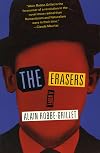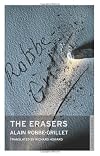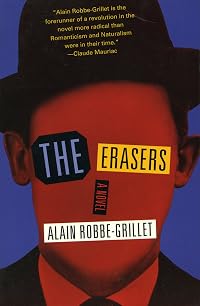
The Erasers
by Alain Robbe-Grillet
On This Page
Description
Alain Robbe-Grillet is internationally hailed as the chief spokesman for the noveau roman and one of the great novelists of the twentieth century. The Erasers, his first novel, reads like a detective story but is primarily concerned with weaving and then probing a complete mixture of fact and fantasy. The narrative spans the twenty-four-hour period following a series of eight murders in eight days, presumably the work of a terrorist group. After the ninth murder, the investigation is turned show more over to a police agent, who may in fact be the assassin. Both an engrossing mystery and a sinister deconstruction of reality, The Erasers intrigues and unnerves with equal force as it pull us along to its ominous conclusion. show lessTags
Recommendations

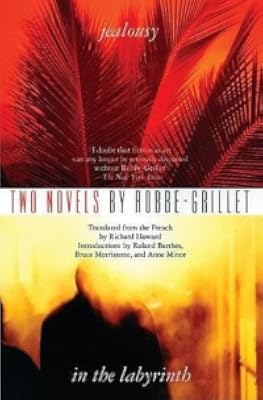

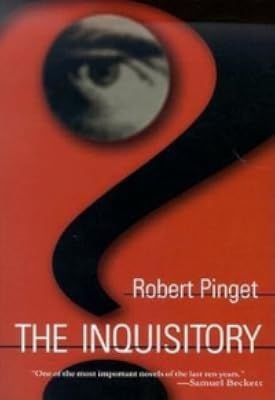


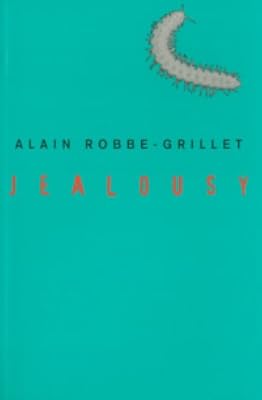























Member Reviews
In an odd twist of fate, Alain Robbe-Grillet died the same week that I finally finished reading his debut novel, The Erasers. I don’t ascribe any importance to that, it was just odd.
The Erasers reminds me of Black Sabbath’s Black Sabbath or The Stooges The Stooges or Metallica’s Kill ‘Em All or Public Enemy’s Yo! Bum Rush the Show. There is something great here, it isn’t perfected yet, but there is hint of something amazing to come. This grand experiment will yield a Paranoid or a Fun House or a Master of Puppets or a It Takes A Nation of Millions….
In many ways, The Erasers is the most ‘conventional’ of Robbe-Grillet’s novels if for no other reason than it was his first stab at the New Novel. On the surface, the show more story can even be perceived as a more intricate form of crime fiction. In a small seaside town, Daniel Dupont, a professor, becomes the ninth victim in nine days of an unknown assassin. Theories abound as to the murder’s true identity: a terrorist group unhappy with the professor’s political leanings or a long lost bastard child. Arriving in town the day after the murder is one Detective Wallas who has been sent to investigate the murder. And so it begins…
Over a 24-hour period, Robbe-Grillet has us following Wallas, wandering down blind alleys, retracing steps, replaying scenes over and over again, as he would in Jealousy and In the Labyrinth. We are introduced to the assassin, or are we? We meet many witnesses, but have they actually seen anything? Soon we are forced to ask a disturbing question: Is Wallas in fact the assassin? Is he investigating himself much like Gian Maria Volontè’s police inspector in the classic Elio Petri film, Investigation of a Citizen Above Suspicion.
The twisting labyrinthine plot – what would become Robbe-Grillet’s hallmark – draws you into the story, taking it to a psychological level that most crime novels (and lesser authors) are unable to achieve. You are forced to consider the possibility that Wallace has a dark side to his character that even his own brain will not reveal to the reader (something RG used even more effectively in The Voyeur). Only by ‘tailing’ Wallas do we start to see the pieces of the disjointed puzzle pulled together and ultimately the grim, inevitable outcome.
In The Erasers, Robbe-Grillet has not completely abandoned traditional use of character and plot. There is a storyline here, but it is condensed into a frenetic series of meetings, arguments, subterfuge, and yes, murders. We are left with dead ends, miscues, faulty memories, and cryptic messages that the confound the reader as much as Wallas. It is this aspect that can turn someone away; the plot is not laid out as a simple series of events and an impatient readers quickly shut down. But compared to Robbe-Grillet’s later novels, The Erasers is a great entry point to his writing, the rabbit-hole if you will.
As I said, I don’t consider The Erasers to be Robbe-Grillet’s finest work. He is a young sprite, playing with new ideas. He wouldn’t hit his stride until Jealousy and In the Labyrinth. But my god, what a hell of a debut. And still more infinitely fascinating and perfectly executed than the endless train of ‘meta-novels’ unleashed in years after by lesser writers. It stands in the shadows of Robbe-Grillet’s later work, but still exists as one of the great experiments in novel writing. And more importantly, the story is still intriguing, fascinating, and addictive. show less
The Erasers reminds me of Black Sabbath’s Black Sabbath or The Stooges The Stooges or Metallica’s Kill ‘Em All or Public Enemy’s Yo! Bum Rush the Show. There is something great here, it isn’t perfected yet, but there is hint of something amazing to come. This grand experiment will yield a Paranoid or a Fun House or a Master of Puppets or a It Takes A Nation of Millions….
In many ways, The Erasers is the most ‘conventional’ of Robbe-Grillet’s novels if for no other reason than it was his first stab at the New Novel. On the surface, the show more story can even be perceived as a more intricate form of crime fiction. In a small seaside town, Daniel Dupont, a professor, becomes the ninth victim in nine days of an unknown assassin. Theories abound as to the murder’s true identity: a terrorist group unhappy with the professor’s political leanings or a long lost bastard child. Arriving in town the day after the murder is one Detective Wallas who has been sent to investigate the murder. And so it begins…
Over a 24-hour period, Robbe-Grillet has us following Wallas, wandering down blind alleys, retracing steps, replaying scenes over and over again, as he would in Jealousy and In the Labyrinth. We are introduced to the assassin, or are we? We meet many witnesses, but have they actually seen anything? Soon we are forced to ask a disturbing question: Is Wallas in fact the assassin? Is he investigating himself much like Gian Maria Volontè’s police inspector in the classic Elio Petri film, Investigation of a Citizen Above Suspicion.
The twisting labyrinthine plot – what would become Robbe-Grillet’s hallmark – draws you into the story, taking it to a psychological level that most crime novels (and lesser authors) are unable to achieve. You are forced to consider the possibility that Wallace has a dark side to his character that even his own brain will not reveal to the reader (something RG used even more effectively in The Voyeur). Only by ‘tailing’ Wallas do we start to see the pieces of the disjointed puzzle pulled together and ultimately the grim, inevitable outcome.
In The Erasers, Robbe-Grillet has not completely abandoned traditional use of character and plot. There is a storyline here, but it is condensed into a frenetic series of meetings, arguments, subterfuge, and yes, murders. We are left with dead ends, miscues, faulty memories, and cryptic messages that the confound the reader as much as Wallas. It is this aspect that can turn someone away; the plot is not laid out as a simple series of events and an impatient readers quickly shut down. But compared to Robbe-Grillet’s later novels, The Erasers is a great entry point to his writing, the rabbit-hole if you will.
As I said, I don’t consider The Erasers to be Robbe-Grillet’s finest work. He is a young sprite, playing with new ideas. He wouldn’t hit his stride until Jealousy and In the Labyrinth. But my god, what a hell of a debut. And still more infinitely fascinating and perfectly executed than the endless train of ‘meta-novels’ unleashed in years after by lesser writers. It stands in the shadows of Robbe-Grillet’s later work, but still exists as one of the great experiments in novel writing. And more importantly, the story is still intriguing, fascinating, and addictive. show less
“I am certain that a novelist is someone who attributes a different reality-value to the characters and events of his story than to those of 'real' life. A novelist is someone who confuses his own life with that of his characters.”
― Alain Robbe-Grillet
The Erasers is one of the most convoluted, complex, knotty novels a reader could possibly encounter, a novel that can be approached from multiple perspectives and on multiple levels, everything from an intricate detective mystery to a meditation on the circularity of time, from the phenomenology of perception to the story of Oedipus, to name several.
For the purpose of this review, I will focus on one aspect of The Erasers I have not come across in any of the commentary I’ve read show more by scholars, literary critics or book reviewers – the prevalence of ugliness in the city where the novel is set.
With its winding streets and system of canals, the novel’s city has been likened to Amsterdam, but any likeness to this beautiful, charming Dutch city ends there. The cold Northern European industrial city we encounter in The Erasers is ugly and creepy, lacking any trace of charm or warmth.
The main character, special agent Wallas, who travels to the city to solve a murder, repeatedly reflects on this lack of aesthetic attraction and beauty, as when we read: “a city completely barren of appeal for an art lover," and then again, “a huge stone building ornamented with scrolls and scallops, fortunately few in number – in short, of rather somber ugliness.” From Wallas’s multiple observations, this unnamed city’s stark ugliness can bring to my mind Golconda by the surrealist René Magritte, a painting of a cityscape raining men in black suits and bowlers, painted in the same year as the publication of The Erasers.
This unattractiveness also extends to the people inhabiting the city. Two men described in some detail are both fat and flabby and move in a stiff and mechanical way: first, the manager of the café, portrayed as follows: “A fat man is standing here, the manager . . . greenish, his features blurred, liverish, and fleshy in his aquarium.” Second, Laurent, the chief commissioner: “He is a short, plump man with a pink face and a bald skull . . . his overfed body shakes from fits of laughter.”
Tom, one of the condemned prisoners, from Jean-Paul Sartre’s story The Wall is such a flabby, fat man. Also, Antoine Roquentin, the main character in Sartre’s novel Nausea, describes the shaking hands of another fat man: “Then there was his hand like a fat white worm in my own hand. I dropped it almost immediately and the arm fell back flabbily.”
So, why am I highlighting these facts? Because I have the strong impression both Robbe-Grillet and Sartre (a great influence on the author) saw flab and fat as repulsive and ugly, a counter to the possibility of freedom and spontaneity and fluidity we can experience in our human embodiment.
In contradistinction, Wallas is a tall, calm young man with regular features and who walks with an elastic, confident gate. But at every turn Wallas encounters ugliness, even in an automat where there is a sign reading: “Please Hurry. Thank you.” And this sign is repeated many times on the white walls of the automat. How nauseating! Not surprisingly, Wallas eats too fast, resulting in an upset stomach. Shortly thereafter he returns to a familiar dirty café and he continues to feel ill.
Here are few more direct quotes on what Wallas sees in this city:
• “Mouth open, the man is staring into space, one elbow on the table propping up his bloated head.”
• “Once again, Wallas is walking toward the bridge. Ahead of him, under a snowy sky, extends the Rue de Brabant – and its grim housefronts.”
• “From another angle, the man assumes an almost coarse expression that has something vulgar, self-satisfied, rather repugnant about it.”
True, Wallas encounters one saleswoman who is upbeat and slightly provocative, but the other people he encounters, to the extent these men and woman are described, are drab and shabby and decidedly unattractive.
An entire city of unsightly sights and repellent people. Is it too much of a stretch to interpret the pistol Wallas shoots at the end of the novel as, in part, a reaction to overbearing ugliness? Perhaps in the same way the pistol shots in Albert Camus’s The Stranger (a work Alain Robbe-Grillet counts as one of his prime influences) are a reaction to the searing heat and glare from the sun and the young Arab’s knife blade?
Rather than providing a definitive answer, this raises another set of questions: Are we as readers so coarse and dull and deadened by the modern mechanized world that we accept the ugly as the norm? Does this acceptance account for the fact that all the essays and reviews I have read on this novel do not draw attention to the ugliness Wallas confronts? show less
“I am certain that a novelist is someone who attributes a different reality-value to the characters and events of his story than to those of 'real' life. A novelist is someone who confuses his own life with that of his characters.”
― Alain Robbe-Grillet
The Erasers is one of the most convoluted, complex, knotty novels a reader could possibly encounter, a novel that can be approached from multiple perspectives and on multiple levels, everything from an intricate detective mystery to a meditation on the circularity of time, from the phenomenology of perception to the story of Oedipus, to name several. For the purpose of this review, I will focus on one aspect of The Erasers I have not come across in any of the commentary I’ve read show more by scholars, literary critics or book reviewers – the prevalence of ugliness in the city where the novel is set.
With its winding streets and system of canals, the novel’s city has been likened to Amsterdam, but any likeness to this beautiful, charming Dutch city ends there. The cold Northern European industrial city we encounter in The Erasers is ugly and creepy, lacking any trace of charm or warmth. The main character, special agent Wallas, who travels to the city to solve a murder, repeatedly reflects on this lack of aesthetic attraction and beauty, as when we read: “a city completely barren of appeal for an art lover," and then again, “a huge stone building ornamented with scrolls and scallops, fortunately few in number – in short, of rather somber ugliness.” From Wallas’s multiple observations, this unnamed city’s stark ugliness can bring to my mind Golconda by the surrealist René Magritte, a painting of a cityscape raining men in black suits and bowlers, painted in the same year as the publication of The Erasers.
This unattractiveness also extends to the people inhabiting the city. Two men described in some detail are both fat and flabby and move in a stiff and mechanical way: first, the manager of the café, portrayed as follows: “A fat man is standing here, the manager . . . greenish, his features blurred, liverish, and fleshy in his aquarium.” Second, Laurent, the chief commissioner: “He is a short, plump man with a pink face and a bald skull . . . his overfed body shakes from fits of laughter.”
Tom, one of the condemned prisoners, from Jean-Paul Sartre’s story The Wall is such a flabby, fat man. Also, Antoine Roquentin, the main character in Sartre’s novel Nausea, describes the shaking hands of another fat man: “Then there was his hand like a fat white worm in my own hand. I dropped it almost immediately and the arm fell back flabbily.”
So, why am I highlighting these facts? Because I have the strong impression both Robbe-Grillet and Sartre (who had a great influence on Robbe-Grillet) saw flab and fat as repulsive and ugly, a counter to the possibility of freedom and spontaneity and fluidity we can experience in our human embodiment.
In contradistinction, Wallas is a tall, calm young man with regular features and who walks with an elastic, confident gate. But at every turn Wallas encounters ugliness, even in an automat where there is a sign reading: “Please Hurry. Thank you.” And this sign is repeated many times on the white walls of the automat. How nauseating! Not surprisingly, Wallas eats too fast, resulting in an upset stomach. Shortly thereafter he returns to a familiar dirty café and he continues to feel ill.
Here are few more direct quotes on what Wallas sees in this city:
• “Mouth open, the man is staring into space, one elbow on the table propping up his bloated head.”
• “Once again, Wallas is walking toward the bridge. Ahead of him, under a snowy sky, extends the Rue de Brabant – and its grim housefronts.”
• “From another angle, the man assumes an almost coarse expression that has something vulgar, self-satisfied, rather repugnant about it.”
True, Wallas encounters one saleswoman who is upbeat and slightly provocative, but the other people he encounters, to the extent these men and woman are described, are drab and shabby and decidedly unattractive. An entire city of unsightly sights and repellent people. Is it too much of a stretch to interpret the pistol Wallas shoots at the end of the novel as, in part, a reaction to overbearing ugliness? Perhaps in the same way the pistol shots in Albert Camus’s The Stranger (a work Alain Robbe-Grillet counts as one of his prime influences) are a reaction to the searing heat and glare from the sun and the young Arab’s knife blade?
Rather than providing a definitive answer, this raises another question: Are we as readers so coarse and dull and deadened by the modern mechanized world that we accept the ugly as the norm? Does this acceptance account for the fact that all the essays and reviews I have read on this novel do not draw attention to the ugliness Wallas confronts? show less
One would have expected that when Alain Robbe – Grillet (1922 – 2008 ), a young engineer, fresh from the Agricultural institute of Paris and himself a son of an engineer, would choose a subject for his first book, he would decide for recounting the time he spent as a conscripted worker in Nazi - Germany or of his experiences in the French colonies.
But no, “Les Gommes”, which was published in 1953 by les “Editions de Minuit” had all the appearances of a simple whodunit à la Gaston Leroux or Maurice Leblanc, what the French call a “Polar” or a ‘Roman Policier”, The first readers however noted immediately that something was different with this whodunit. Already from the first pages it is clear that there has been no show more murder, that the surprised would-be assassin only wounded his victim. The identity of the hit man, holding the smoking gun, is instantly revealed, and so is the identity of his evil sponsor. The wounded victim however disappears together with the criminal and a newly appointed agent, a man with the very foreign name “Wallas” enters the scene and sets himself the task to find both victim and assassin.
It is a strange “Polar” indeed, for Robbe – Grillet, this young engineer who has decided to dedicate his life to literature, has just delivered to the French public the first “Nouveau Roman”. While a first, the writer appears confident enough and he is very clear in explaining his literary aims and the theoretical background of his books. Jerôme Lindon, the director of “Les editions de Minuit, impressed by the young man’s new ideas, appoints him on the spot as his literary consultant. Robbe - Grillet enters the French literary scene, not as any newcomer but immediately as the “Pope” of the “Nouveau Roman”
Le “Nouveau Roman” is too often dismissed as a mere demonstration of craftsmanship, of “savoir faire”, an exhibition of the skill of the writers to play with words, syntaxes, and phrases. Often the story as such is of lesser importance and reduced to its bare essentials like a simple fait divers from a newspaper, an anecdote like the case in “l’Amante Anglaise” by Marguerite Duras. And neither is there a “message”, philosophical, ethical or political, hidden behind the words.
The “Nouveau Roman” was understandably accused of breaking with tradition, to make tabula rasa with all what has been written before. In the case of les Gommes, it proved to be the opposite. Unaware of what really was flowing out of his revolutionary pen, Alain Robbe – Grillet, bridged thousands of years of narrative tradition and turned out with a variant on the most classical of all texts…
We need an engineer like Alain Robbe – Grillet, to explain us in a clear way what his intentions were and which tools he used. In the article “Du nouveau Roman et la nouvelle Autobiographie”, he invites us on an imaginary scaffold (l’échafaudage structurel) surrounding the text to have a look at the work and craftsmanship involved in the conception of his book.
Initially Robbe – Grillet wanted not so much to write a book with an original story, but rather one that challenged the traditional way stories were told, the linear narrative structure, to which the public had grew accustomed to since the 19th century “Bourgeois Age” of Balzac. Like other contemporary experimental authors he would try his hand at a circular narrative, one where the end and the beginning would coincide and fused into one another.
The young engineer had been fascinated by the “Ouroboros numbers”, the magical sequence of numbers studied by the ancient priests of Egypt. The Ouroboros snake, better known as the snake that eats its own tail, had according to the Egyptian legend 108 rings of dorsal scales, numbered not in a traditional 1, 2, 3 way, but in a special more arcane sequence. Every Ouroboros number is the sum of the two preceding ones. When that sum is higher than 108, it is subtracted by 108, so that with number 108, you come back to 1. It is therefore a circular order and hence the numerological reference to the mythical snake. What fascinated the Egyptian priests as well as Alain Robbe – Grillet, was that if you do that you get all the traditional numbers and never twice the same.
Robbe – Grillet sat down at his desk and wrote a straightforward police story narrated in a linear way. Then he cut his story up in 108 pieces and wrote these “events” down on index cards. He reshuffled the cards in an “ouroboros” way and saw what happened to his story if it came out in a circular logic.
It did not work, the scaffold collapsed. The structure could not hold the tension of the narrative and in the words of Robbe - Grillet “exploded”. While he realized that he could not charm this Ouroboros snake, this chtonic reptile reminded him of another snake, the Python hiding under the Delphic Oracle and another cyclical story : the endless battle between Apollo Sauroctonos ( the day ) and the reptile ( the night ). Each one of them would alternatively win and lose the battle in an endless cycle of revolving days.
During his narrative experiment, Alain Robbe – Grillet suddenly realized that in the fragments of his earlier trials appeared something like a variant of Sophocles Oedipus Rex story, one of the more famous victims of the Delphic oracle. Oedipus investigates a murder until he realizes that he, himself, is the murderer. The premonitions, oracles and the dramatic outcomes of that classical story had indeed all the characteristics of a circular narrative.
Robbe – Grillet returned to his writing table. He replaced the Delphic Oracle with the heading of his “fait-divers” in the local newspaper “A murder has been committed!”. But some readers of the newspaper, witnesses, know that there has been no killing. The victim was slightly wounded but not killed. But what is written in a newspaper is expected to be true so… In “les Gommes”, Wallas, the Policeman is investigating a murder that did not happen but has been predicted.
The young writer, who had read “Ulysses” by Joyce and who confessed that without the help of Valery Larbaud, he would not have had a clue about what that book was all about, realized that his own book was rather obscure too. He had to decide if he would hide the classical text within his story or help his readers to discover it. He decided, just like Joyce to be helpful. To help the reader uncover the hidden myth, he opened the story with a slightly adapted epigram of Sophocles:
“le temps qui veille à tout a donné la solution malgré toi »( time who takes care of everything has given the solution…)
It did not really help. In an interview, Robbe - Grillet told his interviewer, that despite the hints, not one of the early readers saw the parallels with Sophocles text. Not even Roland Barthes, who was known to be a Sophocles specialist and who made an extensive study on the famous classical text.
“Les Gommes” is something like an experiment. It is the knowledge of what Robbe – Grillet is trying to do, that makes it so exciting. The result is highly recommended. show less
But no, “Les Gommes”, which was published in 1953 by les “Editions de Minuit” had all the appearances of a simple whodunit à la Gaston Leroux or Maurice Leblanc, what the French call a “Polar” or a ‘Roman Policier”, The first readers however noted immediately that something was different with this whodunit. Already from the first pages it is clear that there has been no show more murder, that the surprised would-be assassin only wounded his victim. The identity of the hit man, holding the smoking gun, is instantly revealed, and so is the identity of his evil sponsor. The wounded victim however disappears together with the criminal and a newly appointed agent, a man with the very foreign name “Wallas” enters the scene and sets himself the task to find both victim and assassin.
It is a strange “Polar” indeed, for Robbe – Grillet, this young engineer who has decided to dedicate his life to literature, has just delivered to the French public the first “Nouveau Roman”. While a first, the writer appears confident enough and he is very clear in explaining his literary aims and the theoretical background of his books. Jerôme Lindon, the director of “Les editions de Minuit, impressed by the young man’s new ideas, appoints him on the spot as his literary consultant. Robbe - Grillet enters the French literary scene, not as any newcomer but immediately as the “Pope” of the “Nouveau Roman”
Le “Nouveau Roman” is too often dismissed as a mere demonstration of craftsmanship, of “savoir faire”, an exhibition of the skill of the writers to play with words, syntaxes, and phrases. Often the story as such is of lesser importance and reduced to its bare essentials like a simple fait divers from a newspaper, an anecdote like the case in “l’Amante Anglaise” by Marguerite Duras. And neither is there a “message”, philosophical, ethical or political, hidden behind the words.
The “Nouveau Roman” was understandably accused of breaking with tradition, to make tabula rasa with all what has been written before. In the case of les Gommes, it proved to be the opposite. Unaware of what really was flowing out of his revolutionary pen, Alain Robbe – Grillet, bridged thousands of years of narrative tradition and turned out with a variant on the most classical of all texts…
We need an engineer like Alain Robbe – Grillet, to explain us in a clear way what his intentions were and which tools he used. In the article “Du nouveau Roman et la nouvelle Autobiographie”, he invites us on an imaginary scaffold (l’échafaudage structurel) surrounding the text to have a look at the work and craftsmanship involved in the conception of his book.
Initially Robbe – Grillet wanted not so much to write a book with an original story, but rather one that challenged the traditional way stories were told, the linear narrative structure, to which the public had grew accustomed to since the 19th century “Bourgeois Age” of Balzac. Like other contemporary experimental authors he would try his hand at a circular narrative, one where the end and the beginning would coincide and fused into one another.
The young engineer had been fascinated by the “Ouroboros numbers”, the magical sequence of numbers studied by the ancient priests of Egypt. The Ouroboros snake, better known as the snake that eats its own tail, had according to the Egyptian legend 108 rings of dorsal scales, numbered not in a traditional 1, 2, 3 way, but in a special more arcane sequence. Every Ouroboros number is the sum of the two preceding ones. When that sum is higher than 108, it is subtracted by 108, so that with number 108, you come back to 1. It is therefore a circular order and hence the numerological reference to the mythical snake. What fascinated the Egyptian priests as well as Alain Robbe – Grillet, was that if you do that you get all the traditional numbers and never twice the same.
Robbe – Grillet sat down at his desk and wrote a straightforward police story narrated in a linear way. Then he cut his story up in 108 pieces and wrote these “events” down on index cards. He reshuffled the cards in an “ouroboros” way and saw what happened to his story if it came out in a circular logic.
It did not work, the scaffold collapsed. The structure could not hold the tension of the narrative and in the words of Robbe - Grillet “exploded”. While he realized that he could not charm this Ouroboros snake, this chtonic reptile reminded him of another snake, the Python hiding under the Delphic Oracle and another cyclical story : the endless battle between Apollo Sauroctonos ( the day ) and the reptile ( the night ). Each one of them would alternatively win and lose the battle in an endless cycle of revolving days.
During his narrative experiment, Alain Robbe – Grillet suddenly realized that in the fragments of his earlier trials appeared something like a variant of Sophocles Oedipus Rex story, one of the more famous victims of the Delphic oracle. Oedipus investigates a murder until he realizes that he, himself, is the murderer. The premonitions, oracles and the dramatic outcomes of that classical story had indeed all the characteristics of a circular narrative.
Robbe – Grillet returned to his writing table. He replaced the Delphic Oracle with the heading of his “fait-divers” in the local newspaper “A murder has been committed!”. But some readers of the newspaper, witnesses, know that there has been no killing. The victim was slightly wounded but not killed. But what is written in a newspaper is expected to be true so… In “les Gommes”, Wallas, the Policeman is investigating a murder that did not happen but has been predicted.
The young writer, who had read “Ulysses” by Joyce and who confessed that without the help of Valery Larbaud, he would not have had a clue about what that book was all about, realized that his own book was rather obscure too. He had to decide if he would hide the classical text within his story or help his readers to discover it. He decided, just like Joyce to be helpful. To help the reader uncover the hidden myth, he opened the story with a slightly adapted epigram of Sophocles:
“le temps qui veille à tout a donné la solution malgré toi »( time who takes care of everything has given the solution…)
It did not really help. In an interview, Robbe - Grillet told his interviewer, that despite the hints, not one of the early readers saw the parallels with Sophocles text. Not even Roland Barthes, who was known to be a Sophocles specialist and who made an extensive study on the famous classical text.
“Les Gommes” is something like an experiment. It is the knowledge of what Robbe – Grillet is trying to do, that makes it so exciting. The result is highly recommended. show less
3.5 to 4, but I'll give the book the benefit of the doubt. This is not your typical detective story; very French new wave (OK, after all, Robbe-Grillet wrote the screenplay for Last Year at Marienbad), and thoroughly enjoyable.
If you liked "Memento" you should read this author. Reviewed as "the new novel" because critics did not know what to make of it. This is his first and he just gets better. Recently deceased.
I read Les gommes when I was a student, when I pretended I understood these nouveaux romans. What are they all about?
Members
- Recently Added By
Lists

Top Five Books of 2018
802 works; 265 members

1950s
340 works; 22 members

Harold Bloom - The Western Canon: D. The Chaotic Age
833 works; 24 members

Canon de la narrativa universal del s. XX (cicutadry)
499 works; 3 members
Author Information

59+ Works 5,386 Members
Writer and filmmaker Alain Robbe-Grillet was born in Brest, France in 1922. Robbe-Grillet's first novel, The Erasers (1953) is considered to be one of the first books of the nouveau roman, or new novel, in which external reality is more important than character or plot. His other works included The Voyeur (1955), Jealousy (1957) and Djinn (1981). show more He worked in the film industry as a writer, actor and director. He died at the age of 85 on February 18, 2008. (Bowker Author Biography) show less
Some Editions
Awards and Honors
Awards
Notable Lists
Series
Belongs to Publisher Series
Work Relationships
Is abridged in
Common Knowledge
- Canonical title*
- 消しゴム
- Original title
- Les Gommes
- Alternate titles*
- Ein Tag zuviel
- Original publication date
- 1953
- People/Characters
- Wallas; Antoine; Garinati; Jean Bonaventure; Daniel Dupont; Jeanette (show all 15); Doctor Juard; Anna Smite; Adolphe Marchat; Commissioner Laurent; Fabius; Madame Bex; Juliette Dexter; Madame Jean; Émilie Lebermann
- Blurbers
- Mauriac, Claude
*Some information comes from Common Knowledge in other languages. Click "Edit" for more information.
Classifications
- Genres
- Fiction and Literature, General Fiction, Mystery
- DDC/MDS
- 843.914 — Literature & rhetoric French Literature French fiction 1900- 20th Century 1945-1999
- LCC
- PQ2635 .O117 .G6413 — Language and Literature French, Italian, Spanish and Portuguese literatures French literature Modern literature 1900-1960
- BISAC
Statistics
- Members
- 689
- Popularity
- 41,713
- Reviews
- 11
- Rating
- (3.79)
- Languages
- 12 — Czech, English, Estonian, French, German, Hungarian, Italian, Japanese, Farsi/Persian, Polish, Spanish, Turkish
- Media
- Paper, Ebook
- ISBNs
- 28
- ASINs
- 15