
Giorgio de Chirico (1888–1978)
Author of Hebdomeros with Monseiur Dudron's Adventure and Other Metaphysical Writings
About the Author
Image credit: Photograph by Carl Van Vechten, 1936 Nov. 5.
Works by Giorgio de Chirico
Hebdomeros with Monseiur Dudron's Adventure and Other Metaphysical Writings (1929) 321 copies, 3 reviews
Giorgio De Chirico, Self Portraits 7 copies
G. de Chirico: [catalogue of an exhibition held at the Wildenstein Gallery] 7th to 28th April 1976 (1976) 3 copies
Il meccanismo del pensiero: Critica, polemica, autobiografia, 1911-1943 (Saggi) (Italian Edition) (1985) 2 copies
Giorgio de Chirico e il teatro in Italia : Gabinetto disegni e stampe degli Uffizi, Firenze, 23 maggio-31 agosto 1989 (1989) 2 copies
Catalogo generale Giorgio de Chirico 2 copies
Αναμνήσεις από την ζωή μου 1 copy
Associated Works
Theories of Modern Art: A Source Book by Artists and Critics (1968) — Contributor — 855 copies, 6 reviews
The End of the European Era: 1890 to the Present (1970) — Cover artist, some editions — 456 copies, 2 reviews
Tagged
Common Knowledge
- Canonical name
- де Кирико, Джорджо
- Legal name
- Chirico, Giorgio De
- Birthdate
- 1888-07-10
- Date of death
- 1978-11-20
- Gender
- male
- Education
- Academy of Fine Arts, Munich, Germany
- Occupations
- artist
- Organizations
- Académie des Beaux-Arts (1974)
- Relationships
- Savinio, Alberto (brother)
- Nationality
- Greece
Italy - Birthplace
- Volos, Greece
- Places of residence
- Rome, Italy
Florence, Italy
Munich, Bavaria, Germany - Place of death
- Rome, Italy
- Burial location
- Chiesa di San Francesco a Ripa, Lazio, Italy
- Associated Place (for map)
- Italy
Members
Reviews
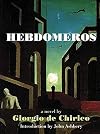
For the 1st 15pp or so I was inclined to give this a 5 star rating. It wasn't long after that the rating slipped down a notch. By the end of the bk I was close to giving it a 3. "Hebdomeros", the longest section, was my favorite. In John Ashberry's introduction he writes:
"The novel has no story, though it reads as if it did. Its soul character is Hebdomeros, a kind of "metaphysician" who evolves through various landscapes and situations, alone or accompanied by a shadowy band of young show more disciples."
Fair enuf.. & that's what I liked most about it. I often found myself reading something in it & suddenly stopping, thinking 'How did it get here?' & then backtracking a bit to trace the writing from the last part I remembered. Here's an excerpt:
"Sometimes a window would open and against the dark background of the room a figure would appear; but people said they were ancestral ghosts and nothing but a figment of the imagination. Though the district was now unquestionably elegant and so much more lively, Hebdomeros shunned it in favor of the park where the pine trees grew. They were martyred trees, for a strange epidemic was raging among them, these attractive, friendly trees, so healthy and tonic. Each one bore a stairway mode of white wood, twined round its trunk like a giant snake; these spiral staircases ended in a kind of platform, a regular torture-collar which choked the unfortunate tree, on which the man known as King Lear to the habitués of the palace amused himself by spying on the birds, hoping to catch them in little-known poses and expressions. He watched out especially for sparrows. Lying down on the platform, as motionless as a log, he no longer looked like a human being. But he did not look like a staute, either. Even when he turned over to take a few minutes' rest, there was nothing in his attitude reminiscent of those figures that lie on stone sarcophagi, be they Etruscan couples of landgraves armed from head to foot. Nor was there anything that reminded one of those old men with flowing beards and gentle eyes, indecently naked and regally reclining among reeds, with their elbows supported by amphorae lying on their sides, and who in ancient statuary represented rivers, the source of the richness of lands."
Anyway, I like De Chirico's metaphysical/enigma paintings but I've never found them to be impressively made technically. To my surpise, I found the writing more articulate. What I DIDN'T really find to be very articulate, or, at least convincing, was his more manifesto-like writing. In "Hebdomeros" strong opinions wd be put forth & it seemed somewhat arbitrary to me whether Hebdomeros supported the opinions or detested them. Later in the bk there's another story called "That evening M. Dudron . . .". Monsieur Dudron is a painter & may be a proxy for de Chirico. Writing about Dudron's reaction to enthusiasts of his work, there's "Another thing that caused him profound horror was when they spoke of dreams and mystery regarding his pictures." Really? That text may've been written 9 yrs after "Hebdomeros". show less
"The novel has no story, though it reads as if it did. Its soul character is Hebdomeros, a kind of "metaphysician" who evolves through various landscapes and situations, alone or accompanied by a shadowy band of young show more disciples."
Fair enuf.. & that's what I liked most about it. I often found myself reading something in it & suddenly stopping, thinking 'How did it get here?' & then backtracking a bit to trace the writing from the last part I remembered. Here's an excerpt:
"Sometimes a window would open and against the dark background of the room a figure would appear; but people said they were ancestral ghosts and nothing but a figment of the imagination. Though the district was now unquestionably elegant and so much more lively, Hebdomeros shunned it in favor of the park where the pine trees grew. They were martyred trees, for a strange epidemic was raging among them, these attractive, friendly trees, so healthy and tonic. Each one bore a stairway mode of white wood, twined round its trunk like a giant snake; these spiral staircases ended in a kind of platform, a regular torture-collar which choked the unfortunate tree, on which the man known as King Lear to the habitués of the palace amused himself by spying on the birds, hoping to catch them in little-known poses and expressions. He watched out especially for sparrows. Lying down on the platform, as motionless as a log, he no longer looked like a human being. But he did not look like a staute, either. Even when he turned over to take a few minutes' rest, there was nothing in his attitude reminiscent of those figures that lie on stone sarcophagi, be they Etruscan couples of landgraves armed from head to foot. Nor was there anything that reminded one of those old men with flowing beards and gentle eyes, indecently naked and regally reclining among reeds, with their elbows supported by amphorae lying on their sides, and who in ancient statuary represented rivers, the source of the richness of lands."
Anyway, I like De Chirico's metaphysical/enigma paintings but I've never found them to be impressively made technically. To my surpise, I found the writing more articulate. What I DIDN'T really find to be very articulate, or, at least convincing, was his more manifesto-like writing. In "Hebdomeros" strong opinions wd be put forth & it seemed somewhat arbitrary to me whether Hebdomeros supported the opinions or detested them. Later in the bk there's another story called "That evening M. Dudron . . .". Monsieur Dudron is a painter & may be a proxy for de Chirico. Writing about Dudron's reaction to enthusiasts of his work, there's "Another thing that caused him profound horror was when they spoke of dreams and mystery regarding his pictures." Really? That text may've been written 9 yrs after "Hebdomeros". show less
Hebdomeros is difficult to read. It is a series of feelings, of moods and day dreams of Hebdomeros. Poetic meanderings without plot or conventional characters.
It's all in Hebdomeros' head, He sees something in the real world and it reminds him of something and he expresses a detailed account of his day dreams.
I only recommend this to people interested in Surrealism, Metaphysical art and Giorgio de Chirico.
There are some additional essays by de Chirico about his art. These are insightful and show more excellent. Most artists fail to express in words what they express in paint. De Chirico shares his opinions on art. show less
It's all in Hebdomeros' head, He sees something in the real world and it reminds him of something and he expresses a detailed account of his day dreams.
I only recommend this to people interested in Surrealism, Metaphysical art and Giorgio de Chirico.
There are some additional essays by de Chirico about his art. These are insightful and show more excellent. Most artists fail to express in words what they express in paint. De Chirico shares his opinions on art. show less

I found De Chirico's memoirs pretty amusing, so I expected Hebdomeros to be at least mildly entertaining. Instead, I had to give up after just a couple of pages. There is no plot and the random imagery is not nearly as effective in a written description as it is in his paintings.

Awards


You May Also Like


Associated Authors
Statistics
- Works
- 58
- Also by
- 9
- Members
- 647
- Popularity
- #39,005
- Rating
- 3.8
- Reviews
- 8
- ISBNs
- 81
- Languages
- 7
- Favorited
- 1