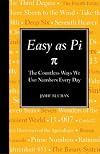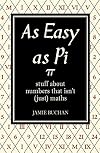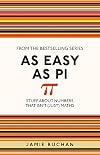
As Easy As Pi: Stuff About Numbers That Isn't (Just) Maths
by Jamie Buchan
Blackboard Books (Math (Advanced))
On This Page
Description
Have you ever stopped to think how many countless ways we use numbers? From the ring of the alarm clock to the numbers triggering our cell phones, our world is designed with numbers in mind. In this book, you'll get the 4-1-1 on the fascinating origin of many of the numbers we use or read about every day.Tags
Recommendations











Member Reviews
This might be a mildly amusing toilet-time read for the right person, but I suspect I'm not really in the target audience for the book.
The first of its five sections deals with the occurrence of numbers in popular sayings (at sixes and sevens, et al.), and discusses these sayings' etymologies. Alas, the most interesting examples in this section are either fairly well known already or else the etymology is unknown, and it's not particularly interesting to read that "Nineteen to the dozen is a thing people say. But no one knows why."
Next up is a section on numbers in fiction, which is really a short list of films and books the author is familiar with and which have a number in the title — 8 Mile, Seven Samurai, Debbie Does Dallas 9, show more etc. — or else numbers that are mildly famous because of their appearance in some fictional medium — 007 from James Bond, 42 from Hitchhiker's Guide, and so on. Nothing here is particularly interesting; if you know about the books and films discussed then you probably already know why that number appears, otherwise you probably won't care a great deal.
Third is "Numbers in culture", or perhaps that should be "Stuff that didn't fit in the other four sections". Those scam emails from Nigerian princes are apparently called "419 scams", so they're discussed here. There's an enduring fallacy that we only use ten per cent of our brains. And ten's a number. So that's discussed here. To be honest most of this section feels a bit tacked on, things the author saw on QI and wanted to discuss rather than anything to do with numbers.
Religion and mythology are treated next. A lot of this section looks at gematria and numerology, things which interest me not at all. Buchan repeatedly points out how meaningless these pursuits are, yet does give a dismaying number of pages over to them.
Finally comes "Numbers in Maths and Science." Within this section a smattering of interesting facts concerning numbers and number systems are discussed. The author admits in the book's introduction that he's not a professional scientist or mathematician, and this section in particular smacks of repetition — regurgitated titbits obtained from email interviews with academics and purloined (but not in a plagiaristic sense) from pop-science and -maths books.
As I intimated earlier, I'm not really in the book's target audience. If each of the five sections was expanded into a full book by an expert in the relevant field then I'd probably enjoy some of the results, but in this form and with this level of seeming indifference to the subject I wasn't too fond of the result. And the acerbic final sentence didn't leave a good last impression either. show less
The first of its five sections deals with the occurrence of numbers in popular sayings (at sixes and sevens, et al.), and discusses these sayings' etymologies. Alas, the most interesting examples in this section are either fairly well known already or else the etymology is unknown, and it's not particularly interesting to read that "Nineteen to the dozen is a thing people say. But no one knows why."
Next up is a section on numbers in fiction, which is really a short list of films and books the author is familiar with and which have a number in the title — 8 Mile, Seven Samurai, Debbie Does Dallas 9, show more etc. — or else numbers that are mildly famous because of their appearance in some fictional medium — 007 from James Bond, 42 from Hitchhiker's Guide, and so on. Nothing here is particularly interesting; if you know about the books and films discussed then you probably already know why that number appears, otherwise you probably won't care a great deal.
Third is "Numbers in culture", or perhaps that should be "Stuff that didn't fit in the other four sections". Those scam emails from Nigerian princes are apparently called "419 scams", so they're discussed here. There's an enduring fallacy that we only use ten per cent of our brains. And ten's a number. So that's discussed here. To be honest most of this section feels a bit tacked on, things the author saw on QI and wanted to discuss rather than anything to do with numbers.
Religion and mythology are treated next. A lot of this section looks at gematria and numerology, things which interest me not at all. Buchan repeatedly points out how meaningless these pursuits are, yet does give a dismaying number of pages over to them.
Finally comes "Numbers in Maths and Science." Within this section a smattering of interesting facts concerning numbers and number systems are discussed. The author admits in the book's introduction that he's not a professional scientist or mathematician, and this section in particular smacks of repetition — regurgitated titbits obtained from email interviews with academics and purloined (but not in a plagiaristic sense) from pop-science and -maths books.
As I intimated earlier, I'm not really in the book's target audience. If each of the five sections was expanded into a full book by an expert in the relevant field then I'd probably enjoy some of the results, but in this form and with this level of seeming indifference to the subject I wasn't too fond of the result. And the acerbic final sentence didn't leave a good last impression either. show less
We are a people of numbers. We have phone numbers, house numbers, Social Security numbers, medical records numbers, lot numbers, and serial numbers. Even our computers and electronic devices function with numbers – you get the idea. Easy as Pi gives the read a glimpse into the world of numbers and how society uses them.
A brief summary of the divisions in Easy as Pi:
Numbers in our language – phrases using numbers explained
Numbers in Fiction – Movies, books and TV shows with numbers in the title
Numbers in Culture – gambling, Social Security, scams, etc.
Numbers in Mythology and Religion – numerology and significance of numbers in the Bible
Numbers in Math and Science – types of numbers, statistics, and oddities
This is not a show more mathematics instruction book. In Easy as Pi, I learned of the Piraha tribe, a small tribe in Brazil with a numbering system consisting of one, two and many – that’s all. I also learned about life without “0”, and all about Pi. Why did Ray Bradbury name his book Fahrenheit 451? Little snippets of information that help you gain insight into how important numbers are in our lives. Books like these are a fun interaction for families. Parents can quiz children or children can quiz their parents.
This is another wonderful book in the Reader's Digest Series. I have also reviewed:
I used to Know That by Caroline Taggart
A Certain "Je Ne Sais Quoi by Chloe Rhodes show less
A brief summary of the divisions in Easy as Pi:
Numbers in our language – phrases using numbers explained
Numbers in Fiction – Movies, books and TV shows with numbers in the title
Numbers in Culture – gambling, Social Security, scams, etc.
Numbers in Mythology and Religion – numerology and significance of numbers in the Bible
Numbers in Math and Science – types of numbers, statistics, and oddities
This is not a show more mathematics instruction book. In Easy as Pi, I learned of the Piraha tribe, a small tribe in Brazil with a numbering system consisting of one, two and many – that’s all. I also learned about life without “0”, and all about Pi. Why did Ray Bradbury name his book Fahrenheit 451? Little snippets of information that help you gain insight into how important numbers are in our lives. Books like these are a fun interaction for families. Parents can quiz children or children can quiz their parents.
This is another wonderful book in the Reader's Digest Series. I have also reviewed:
I used to Know That by Caroline Taggart
A Certain "Je Ne Sais Quoi by Chloe Rhodes show less
The title Easy as Pi can be misleading. I made the assumption that there would be a detailed section in the book breaking down the number Pi, but the little information that is included is very basic. The book is filled with many different ways we see numbers used in language, culture, religion, and fiction. There are only associations. I was thinking the book had a relation to math, but it doesn't. There is a section covering numbers in math and science, but it is very basic. You can find some interesting tidbits throughout, but not a book that is typically read from cover to cover.
I read through the introduction to try and gain an understanding of the purpose of the book and learned that the author doesn't have a math or professional show more background and wrote about the subject through research of subjects of interest. From that, I can understand this book was meant more for interesting facts to create a conversation starting with, "Did you know..." show less
I read through the introduction to try and gain an understanding of the purpose of the book and learned that the author doesn't have a math or professional show more background and wrote about the subject through research of subjects of interest. From that, I can understand this book was meant more for interesting facts to create a conversation starting with, "Did you know..." show less
This might be a mildly amusing toilet-time read for the right person, but I suspect I'm not really in the target audience for the book.
The first of its five sections deals with the occurrence of numbers in popular sayings (at sixes and sevens, et al.), and discusses these sayings' etymologies. Alas, the most interesting examples in this section are either fairly well known already or else the etymology is unknown, and it's not particularly interesting to read that "Nineteen to the dozen is a thing people say. But no one knows why."
Next up is a section on numbers in fiction, which is really a short list of films and books the author is familiar with and which have a number in the title — 8 Mile, Seven Samurai, Debbie Does Dallas 9, show more etc. — or else numbers that are mildly famous because of their appearance in some fictional medium — 007 from James Bond, 42 from Hitchhiker's Guide, and so on. Nothing here is particularly interesting; if you know about the books and films discussed then you probably already know why that number appears, otherwise you probably won't care a great deal.
Third is "Numbers in culture", or perhaps that should be "Stuff that didn't fit in the other four sections". Those scam emails from Nigerian princes are apparently called "419 scams", so they're discussed here. There's an enduring fallacy that we only use ten per cent of our brains. And ten's a number. So that's discussed here. To be honest most of this section feels a bit tacked on, things the author saw on QI and wanted to discuss rather than anything to do with numbers.
Religion and mythology are treated next. A lot of this section looks at gematria and numerology, things which interest me not at all. Buchan repeatedly points out how meaningless these pursuits are, yet does give a dismaying number of pages over to them.
Finally comes "Numbers in Maths and Science." Within this section a smattering of interesting facts concerning numbers and number systems are discussed. The author admits in the book's introduction that he's not a professional scientist or mathematician, and this section in particular smacks of repetition — regurgitated titbits obtained from email interviews with academics and purloined (but not in a plagiaristic sense) from pop-science and -maths books.
As I intimated earlier, I'm not really in the book's target audience. If each of the five sections was expanded into a full book by an expert in the relevant field then I'd probably enjoy some of the results, but in this form and with this level of seeming indifference to the subject I wasn't too fond of the result. And the acerbic final sentence didn't leave a good last impression either. show less
The first of its five sections deals with the occurrence of numbers in popular sayings (at sixes and sevens, et al.), and discusses these sayings' etymologies. Alas, the most interesting examples in this section are either fairly well known already or else the etymology is unknown, and it's not particularly interesting to read that "Nineteen to the dozen is a thing people say. But no one knows why."
Next up is a section on numbers in fiction, which is really a short list of films and books the author is familiar with and which have a number in the title — 8 Mile, Seven Samurai, Debbie Does Dallas 9, show more etc. — or else numbers that are mildly famous because of their appearance in some fictional medium — 007 from James Bond, 42 from Hitchhiker's Guide, and so on. Nothing here is particularly interesting; if you know about the books and films discussed then you probably already know why that number appears, otherwise you probably won't care a great deal.
Third is "Numbers in culture", or perhaps that should be "Stuff that didn't fit in the other four sections". Those scam emails from Nigerian princes are apparently called "419 scams", so they're discussed here. There's an enduring fallacy that we only use ten per cent of our brains. And ten's a number. So that's discussed here. To be honest most of this section feels a bit tacked on, things the author saw on QI and wanted to discuss rather than anything to do with numbers.
Religion and mythology are treated next. A lot of this section looks at gematria and numerology, things which interest me not at all. Buchan repeatedly points out how meaningless these pursuits are, yet does give a dismaying number of pages over to them.
Finally comes "Numbers in Maths and Science." Within this section a smattering of interesting facts concerning numbers and number systems are discussed. The author admits in the book's introduction that he's not a professional scientist or mathematician, and this section in particular smacks of repetition — regurgitated titbits obtained from email interviews with academics and purloined (but not in a plagiaristic sense) from pop-science and -maths books.
As I intimated earlier, I'm not really in the book's target audience. If each of the five sections was expanded into a full book by an expert in the relevant field then I'd probably enjoy some of the results, but in this form and with this level of seeming indifference to the subject I wasn't too fond of the result. And the acerbic final sentence didn't leave a good last impression either. show less
Fun book to read and discover mathematical ideas. The book deals with real life math ideas such as Fibonacci's Numbers and where they are used in real life to "fake" famous numbers such as 007 or 8 mile. The author expands upon how these numbers became famous and maybe why they were originally chosen. He even talks about numbers used in real life and not in math such as Dixie and how it relates to the number 10. Interesting book to flip through and read about random facts. I do feel that an index in the back of the book would be beneficial to the book.
I mostly skimmed through this book stopping whenever I came across something interesting to me. This isn't the type of book I would expect most children to read from cover to cover. Rather, this would be a fun reference book as it's full of a lot of fascinating trivia like the 10% myth and the Infinite Monkey Theorem. I would recommend this for children 12 and up who are interested in numbers, math, or trivia.
This is not a good book. Most of the pages are filled with numbers used in popular expressions and phrases (i.e. 12 Monkeys was the title of a motion picture). The blurbs lack value, meaning, and insight into the numbers themselves. The first line of this book is “To seriously damage someone or something.” This is not even a complete sentence and in no way entices me to read more!
This is what many would consider a bathroom book. It is filled with pseudo-facts that the author admittedly cannot trace. The few interesting tidbits included are buried in a pile of inane filler.
If you are looking for a list of pop-culture expressions that have numbers in them, this book is for you! If you are looking for a nonfiction book that is show more interesting, insightful, and educational, please pick up another book. show less
This is what many would consider a bathroom book. It is filled with pseudo-facts that the author admittedly cannot trace. The few interesting tidbits included are buried in a pile of inane filler.
If you are looking for a list of pop-culture expressions that have numbers in them, this book is for you! If you are looking for a nonfiction book that is show more interesting, insightful, and educational, please pick up another book. show less
Members
- Recently Added By
Author Information
1 Work 285 Members
Series

Common Knowledge
- Canonical title
- As Easy As Pi: Stuff About Numbers That Isn't (Just) Maths (Just)
- Original title
- As Easy As Pi: Stuff About Numbers That Isn't (Just) Maths (Just)
- Alternate titles
- As Easy As Pi: The Countless Ways We Use Numbers Every Day
- Original publication date
- 2009
- First words
- As you read this, the world may still be in the grip of severe economic crisis.
(Introduction, 2015 edition)
As you read this, the world may still be in the grip of severe economic crisis.
Do a number
To seriously damage something or someone.
(Book proper) - Last words
- (Click to show. Warning: May contain spoilers.)(And even if you didn't, you bought it and it's too late now.)
Classifications
Statistics
- Members
- 285
- Popularity
- 112,635
- Reviews
- 9
- Rating
- (3.02)
- Languages
- English, German
- Media
- Paper, Ebook
- ISBNs
- 6
- UPCs
- 1
- ASINs
- 2