
Chloe Rhodes
Author of A Certain "Je Ne Sais Quoi": The Origin of Foreign Words Used in English
About the Author
Works by Chloe Rhodes
A Certain "Je Ne Sais Quoi": The Origin of Foreign Words Used in English (2010) 199 copies, 10 reviews
Project X: Y5 Blue Band: Hidden Depths: Exploring the Deep (Project X Hidden Depths) (2009) 3 copies
Project X Origins: Gold Book Band, Oxford Level 9: Head to Head: An A-Z of Record Breakers (2014) 2 copies
Tagged
Common Knowledge
- Birthdate
- 1979-05-17
- Gender
- female
- Occupations
- freelance journalist
- Nationality
- UK
- Places of residence
- London, England, UK
- Associated Place (for map)
- England, UK
Members
Reviews
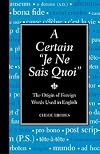
I am a word nerd. My favorite part of the National Spelling Bee is when the competitors ask for the definition or derivation of a word. I find it completely and totally fascinating to know the origins (sometimes far afield from our current usage) of the words we use in English today. English is such a polyglot language, almost a living organism picking up words from other languages that are just so appropriate for something we have yet to name. This book takes many of these words and phrases show more and informs the curious reader from whence they came.
Set up in a dictionary format with words and their explanations listed alphabetically, there are some delightfully tongue in cheek comments scattered throughout the text, especially in the example sentences. And the occasional cartoons illustrating some of the phrases are a complete hoot. I was surprised by how many of the words for which I already knew the origins. Even more interestingly, I use quite a few of these fabulous foreign imports in my daily life. I guess the fact that the words are listed in this book means they aren't as common as I'd thought and would explain the funny glazed expression people sometimes get on their faces when they are listening to me. (But really, who doesn't know what debacle means? Seriously.) This type of book probably doesn't have a widespread appeal but it is perfect reading for your average English major and even minor. Personally I thought it was just plain interesting. Now I have to get up the courage to read the one about math terms! show less
Set up in a dictionary format with words and their explanations listed alphabetically, there are some delightfully tongue in cheek comments scattered throughout the text, especially in the example sentences. And the occasional cartoons illustrating some of the phrases are a complete hoot. I was surprised by how many of the words for which I already knew the origins. Even more interestingly, I use quite a few of these fabulous foreign imports in my daily life. I guess the fact that the words are listed in this book means they aren't as common as I'd thought and would explain the funny glazed expression people sometimes get on their faces when they are listening to me. (But really, who doesn't know what debacle means? Seriously.) This type of book probably doesn't have a widespread appeal but it is perfect reading for your average English major and even minor. Personally I thought it was just plain interesting. Now I have to get up the courage to read the one about math terms! show less
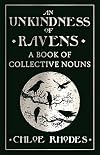
''Stand near woodland in early spring, after night has fallen and when the air is still, and if you're lucky, you'll hear the thrilling, trilling song of the nightingale.''
Few things can be more relaxing and soothing than the nightingales' song in the twilight. Those of us who live in the big cities where every sound of nature is drawn in a cacophony of cars and humans rarely get the chance to enjoy the chirping of Nature's greatest singers. Birds have always fascinated us. They embody show more tranquility and stealth and have attained something the human always seeks. The flight. So, there is no wondering why the majority of the collective nouns in the English Language refers to birds.
This little treasure of a book is a comprehensive guide to the collective nouns, tracing their origins back to scarcely recorded times and shows how historical and sociopolitical issues has always influenced our languages and our way of thinking. My favourites have always been ''A Murder of Crows'' and ''A Parliament of Owls.'' I mean, obviously....Nouns about people, professions, domestic and exotic animals in a book written in an effective, engaging and informative style without becoming boring like a textbook. This is perfect for teachers and students and for all of us who enjoy exploring the origins and influences of this magical thing we call ''Language''. show less
Few things can be more relaxing and soothing than the nightingales' song in the twilight. Those of us who live in the big cities where every sound of nature is drawn in a cacophony of cars and humans rarely get the chance to enjoy the chirping of Nature's greatest singers. Birds have always fascinated us. They embody show more tranquility and stealth and have attained something the human always seeks. The flight. So, there is no wondering why the majority of the collective nouns in the English Language refers to birds.
This little treasure of a book is a comprehensive guide to the collective nouns, tracing their origins back to scarcely recorded times and shows how historical and sociopolitical issues has always influenced our languages and our way of thinking. My favourites have always been ''A Murder of Crows'' and ''A Parliament of Owls.'' I mean, obviously....Nouns about people, professions, domestic and exotic animals in a book written in an effective, engaging and informative style without becoming boring like a textbook. This is perfect for teachers and students and for all of us who enjoy exploring the origins and influences of this magical thing we call ''Language''. show less
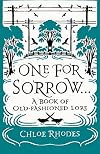
Day-to-day speech is peppered with certain phrases, pithy sayings and folkore and this little book endeavours to give us the origin, and meaning of some of those phrases, with little observations which have been handed down over time, and an idea of how these sayings have altered over time. Citing sources from as far back as the ancient Greeks, and in every instance citing the first English reference to each phrase, a history lesson is given for each saying. We learn how each has changed show more meaning over the centuries, and how some have a scientific truth behind them, making them more than just lore. Few regional variations are provided, and only one or two references to American versions but it's easy to see the links, especially for this former Australian who grew up with similar, but not exactly the same maxims as those included in the book.
Included is a bibliography, a handy index, and it is peppered throughout with woodcuts by Charles Bewick by way of illustration.
This book was a short, interesting read which corrected certain misinterpretations of adages on my part, and thus I think it two hours well spent. show less
Included is a bibliography, a handy index, and it is peppered throughout with woodcuts by Charles Bewick by way of illustration.
This book was a short, interesting read which corrected certain misinterpretations of adages on my part, and thus I think it two hours well spent. show less
This is a delightful book. A Cete of Badgers, a Superfluity of Nuns, a Bale of Turtles. Who would have thought?
The author gives a splendid explanation for all of these collective nouns (Chaucer and Shakespeare make numerous apperances)
My favourite has to be a Drunkship of Cobblers.
The author gives a splendid explanation for all of these collective nouns (Chaucer and Shakespeare make numerous apperances)
My favourite has to be a Drunkship of Cobblers.
You May Also Like


Statistics
- Works
- 17
- Members
- 575
- Popularity
- #43,588
- Rating
- 3.3
- Reviews
- 16
- ISBNs
- 33
- Languages
- 1