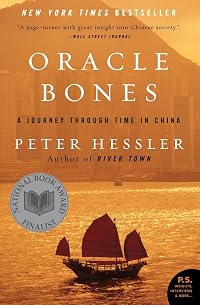
Oracle Bones: A Journey Through Time in China
by Peter Hessler
On This Page
Description
A century ago, outsiders saw China as a place where nothing ever changes. Today the country has become one of the most dynamic regions on earth. In Oracle Bones, Peter Hessler explores the human side of China's transformation, viewing modern-day China and its growing links to the Western world through the lives of a handful of ordinary people. In a narrative that gracefully moves between the ancient and the present, the East and the West, Hessler captures the soul of a country that is show more undergoing a momentous change before our eyes. show lessTags
Recommendations






Member Reviews
It is a bit disconcerting for a person of Chinese descent to learn about himself and his culture from a yanguezhi (foreign devil). Yet this is exactly what happened when I read Oracle Bones.
This is an extremely fine book, full of subtle observations and exquisite narratives of matters great and small. Like Pankaj Mishra's An End to Suffering, Peter Hessler attempts many things in this moveable feast. This is a travel journal, a small peek at how Hessler was able to parlay a stint in the Peace Corp teaching English in China to a freelance gig writing for the Wall Street Journal, New York Times, and The New Yorker. Mostly this is a expansive look and humanistic rumination on how the globalization of the free market has touched the lives show more of common people of China, as exemplified by a number of Hessler's English students. Hessler used the story of his Uighur friend Polat to give us a view of every day street life in Beijing as well as the life of an oppressed asylum seeker in the US.
This style can easily become clumsy and ponderous, but Hessler does a masterful job of keeping the narrative interesting and colorful enough to lead the reader along through the turbulence of the serial form without losing each of the intricate interweaving threads.
The key to Hessler's success with this form is his usage of the archeological history of the Oracle Bones in China as the rhythm section to his narrative. Much like a steady drum beat in a good song, the rhythm soon overtakes much of the decorative accompaniment and dominates the song. The story of the archeology serves as a solid counterpoint for Hessler's riffing on globalization, on the ever-changing business environment in China, and on the peculiar yet inscrutable reactions of the Chinese government to all these changes. As the story evolves, the story of the Oracle Bones and the scholar who deciphered them comes around to dominate the narrative. The story wends itself around all the previous threads and makes the juxtaposing lines of inquiry reasonable. The story of the scholar, his wife, his family, and his wife's family, and his various colleagues - friends or foe- is transcendental in its universality. The latter part of the book, majority of which is devoted to the story of the Oracle Bone scholar has the impact of a fine mystery novel and it gives the reader the punch in the gut that one rarely gets when reading a travelogue or a book of history, or an autobiographical portrait.
This book was thoroughly enjoyable; it was concomitantly informative and soothing to the soul. The writing was superb, rhythmic, and transformational in its structure and meaning. show less
This is an extremely fine book, full of subtle observations and exquisite narratives of matters great and small. Like Pankaj Mishra's An End to Suffering, Peter Hessler attempts many things in this moveable feast. This is a travel journal, a small peek at how Hessler was able to parlay a stint in the Peace Corp teaching English in China to a freelance gig writing for the Wall Street Journal, New York Times, and The New Yorker. Mostly this is a expansive look and humanistic rumination on how the globalization of the free market has touched the lives show more of common people of China, as exemplified by a number of Hessler's English students. Hessler used the story of his Uighur friend Polat to give us a view of every day street life in Beijing as well as the life of an oppressed asylum seeker in the US.
This style can easily become clumsy and ponderous, but Hessler does a masterful job of keeping the narrative interesting and colorful enough to lead the reader along through the turbulence of the serial form without losing each of the intricate interweaving threads.
The key to Hessler's success with this form is his usage of the archeological history of the Oracle Bones in China as the rhythm section to his narrative. Much like a steady drum beat in a good song, the rhythm soon overtakes much of the decorative accompaniment and dominates the song. The story of the archeology serves as a solid counterpoint for Hessler's riffing on globalization, on the ever-changing business environment in China, and on the peculiar yet inscrutable reactions of the Chinese government to all these changes. As the story evolves, the story of the Oracle Bones and the scholar who deciphered them comes around to dominate the narrative. The story wends itself around all the previous threads and makes the juxtaposing lines of inquiry reasonable. The story of the scholar, his wife, his family, and his wife's family, and his various colleagues - friends or foe- is transcendental in its universality. The latter part of the book, majority of which is devoted to the story of the Oracle Bone scholar has the impact of a fine mystery novel and it gives the reader the punch in the gut that one rarely gets when reading a travelogue or a book of history, or an autobiographical portrait.
This book was thoroughly enjoyable; it was concomitantly informative and soothing to the soul. The writing was superb, rhythmic, and transformational in its structure and meaning. show less
“Oracle Bones” is the latest book from Peter Hessler, Beijing correspondent for “The New Yorker.” In this book, he tells a number of stories that chronicle the changing landscape of China. Interspersed throughout is the story of the archeology and scholars of the Oracle Bones--bones that, in ancient China, were heated, cracked and read for divination.
In addition to the stories on the oracle bones, Hessler writes about some of his past students at Fuling Teachers College where he spent time as a Peace Corps volunteer. He describes their migration from the interior of China to the boom cities along the coast and of their travails and successes in these new locales. These were some of the same students that he wrote about in his show more previous book, “River Town.”
In these stories as well as the others in the book, Hessler demonstrates how the changes of China are impacting its people. This is a good read and a book that I am glad to have in my library. show less
In addition to the stories on the oracle bones, Hessler writes about some of his past students at Fuling Teachers College where he spent time as a Peace Corps volunteer. He describes their migration from the interior of China to the boom cities along the coast and of their travails and successes in these new locales. These were some of the same students that he wrote about in his show more previous book, “River Town.”
In these stories as well as the others in the book, Hessler demonstrates how the changes of China are impacting its people. This is a good read and a book that I am glad to have in my library. show less
Enlightening despite being not as cohesive as it could've been. The separate stories Hessler tells are keenly observed and intelligently told, but he's not entirely successful at fitting them into one overarching narrative. (Some of the sections, most notably the one about the factory employees, might've been better suited for his subsequent book, "Country Driving".) I still give this one four stars because of how well Hessler does at capturing a country in transition and the individuals trying to make their way through that process.
Like most "access books" written by journalists written on the promise of purchase on a certain exotic place or world, this is a bit of a clearinghouse of recycled or undeveloped ideas for Hessler's New Yorker pieces, underwritten by a certain amount of time spent establishing bona fides and bound together with two conceits--a series of parallel but mostly unintersecting personal narratives the author checks in with (his own, his Uyghur emigrant friend Polat's, his students Emily and William Jefferson Foster's, the logograph scholar Chen Mengjia's), and a look--through interviews, through personalities--at the development of Chinese writing and particularly the early practice of "oracle bones", animal bones with characters on them show more thrwon into the fire to crack for divination purposes. It's an embarrassment of scaffolding that never quite congeals to become high-concept, and the book feels haphazard as a result, certainly the kind of thing that would have been better as a series of magazine pieces. But there's also a lot of interesting fragments here if you're willing to comb through the ashes. show less
Interesting and unusual; an area I know nothing about. Lots of fascinating stuff - on the oracle bones themselves (amazingly-preserved early writing from the Shang dynasty - 14th and 13th centuries BC!), on the reaction amongst ordinary Chinese people to 9/11 (bootleg videos of the twin towers news footage being sold with dodgy credits and cutting like a disaster movie), on migration to new and growing cities. I keep on failing to put it down at the end of a chapter - lots of stories, lots of human interest, lots to carry on for.
I'm not sure that it has an overall structure but I'm very much enjoying it.
--
On finishing it - very interesting and readable, but not one to go back to again, I don't think.
I'm not sure that it has an overall structure but I'm very much enjoying it.
--
On finishing it - very interesting and readable, but not one to go back to again, I don't think.
I don't know much about China, but I have found Peter Hessler to be an excellent guide. His books are not profound or deep, but they demonstrate how interesting a book can be when written by an author with curiosity and a willingness to explore in unlikely places. Hessler is a freelance journalist and traveler in China since an earlier stay as a Peace Corp volunteer, which he wrote about in an earlier book. This book juggles several themes back and forth through time, but the result is a fresh look at China's past and where it might be going in the future. My youngest son will be traveling in China this summer. This book makes me wish I could go with him.
In some ways I enjoyed this more than Hessler's first China book, [b:River Town: Two Years on the Yangtze|94053|River Town Two Years on the Yangtze (P.S.)|Peter Hessler|http://photo.goodreads.com/books/1171271609s/94053.jpg|1441686]. Oracle Bones alternates between personal, historical, and political narratives that usefully reflect each other. It is often funny and frequently poignant. Read [i]River Town[/i] first.
Members
- Recently Added By
Lists

Books Read in 2020
4,379 works; 124 members

The China Project Book List
100 works; 2 members
Author Information

10+ Works 4,378 Members
Peter Hessler is a staff writer at The New Yorker, where he served as the Beijing correspondent from 2000 to 2007, and is also a contributing writer for National Geographic. He is the author of River Town, which won the Kiriyama Prize; Oracle Bones, which was a finalist for the National Book Award; and, most recently, Country Driving. He won the show more 2008 National Magazine Award for excellence in reporting, and he was named a MacArthur Fellow in 2011. He lives in Cairo. show less
Awards and Honors
Awards
Distinctions
Common Knowledge
- Original publication date
- 2007
- Important places
- China
Classifications
Statistics
- Members
- 1,218
- Popularity
- 20,337
- Reviews
- 27
- Rating
- (4.13)
- Languages
- Dutch, English
- Media
- Paper, Audiobook, Ebook
- ISBNs
- 11
- UPCs
- 1
- ASINs
- 8