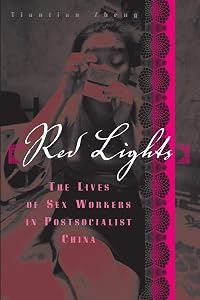
Red Lights: The Lives of Sex Workers in Postsocialist China
by Tiantian Zheng
On This Page
Description
In China today, sex work cannot be untangled from the phenomenon of rural-urban migration, the entertainment industry, and state power. In Red Lights, Tiantian Zheng highlights the urban karaoke bar as the locus at which these three factors intersect and provides a rich account of the lives of karaoke hostesses-a career whose name disguises the sex work and minimizes the surprising influence these women often have as power brokers. Zheng embarked on two years of intensely embedded show more ethnographic fieldwork in her birthplace, Dalian, a large northeastern Chinese seaport of over six million people. show lessTags
Recommendations
































Member Recommendations
mercure Both these books deal with rural young women in China that travel to the cities looking for a better life in China's current economic boom. Ms. chang concentrates on Donghuan in the Pearl River delta in the south of China, and Ms. Zheng on Dalian in the north. Ms. Zheng also concentrates on the one profession that Ms. Chang seemed less interested in. Both deal with the social changes that China goes through at the moment, although in that sense Factory Girls seems the better book.
mercure Check for yourself how the same profession is experienced in a neighbouring country in a different decade.
Member Reviews
According to the author, but not substantiated by a quote, the sex industry makes up 12 % of China’s GDP, which is every reason for looking at this subject as an important element of modern China.
Ms. Zheng does so in her hometown Dalian, a former beachhead of Japanese colonialism and now again a place of heavy Japanese investment. Ms. Zheng, a “feminist” anthropologist, claims that this Japanese involvement is as important to her subject as the involvement of the Chinese government. The government’s stake is both as a consumer of the industry’s services and as a collector of tax income (the parlours are much more heavily taxed than most other industries).
The industry is peopled by women from the countryside, who run a high show more risk of (sexual) violence. However, it is also considered one of the few opportunities in Dalian to make good money, and for quite a few a way to move up the ladder by becoming the wife, girlfriend, or second wife of some local hot shot. Although it is not considered morally good, it allows these women to be more filial daughters than when they pursued other careers, and therefore not altogether bad.
The most interesting part of the book I found was about the role of the client. The author states that many men are tested by their superiors by the way they handle these women. It is a sign of mental strength to show a certain disdain for hostesses. Just like it gives you face to spend a lot of money on hostesses, too much generates loss of face. show less
Ms. Zheng does so in her hometown Dalian, a former beachhead of Japanese colonialism and now again a place of heavy Japanese investment. Ms. Zheng, a “feminist” anthropologist, claims that this Japanese involvement is as important to her subject as the involvement of the Chinese government. The government’s stake is both as a consumer of the industry’s services and as a collector of tax income (the parlours are much more heavily taxed than most other industries).
The industry is peopled by women from the countryside, who run a high show more risk of (sexual) violence. However, it is also considered one of the few opportunities in Dalian to make good money, and for quite a few a way to move up the ladder by becoming the wife, girlfriend, or second wife of some local hot shot. Although it is not considered morally good, it allows these women to be more filial daughters than when they pursued other careers, and therefore not altogether bad.
The most interesting part of the book I found was about the role of the client. The author states that many men are tested by their superiors by the way they handle these women. It is a sign of mental strength to show a certain disdain for hostesses. Just like it gives you face to spend a lot of money on hostesses, too much generates loss of face. show less
Members
- Recently Added By
Author Information
7 Works 44 Members
Tiantian Zheng is professor of anthropology at State University of New York, Cortland. She is author or coauthor of eight books, including Red Lights: The Lives of Sex Workers in Postsocialist China (Minnesota, 2009), winner of the 2010 Sara A. Whaley Book Prize from the National Women's Studies Association.
Common Knowledge
- Important places
- Daliang, China; China
Classifications
- Genres
- Sociology, Nonfiction, Sexuality and Gender Studies, Anthropology, History
- DDC/MDS
- 306.740951 — Society, government, & culture Social sciences, sociology & anthropology Social Behavior - Dating, Marriage, Divorce Sexual relations Sex work and prostitution Standard subdivisions History, geographic treatment, biography Asia
- LCC
- HQ250 .A5 .Z44 — Social sciences The family. Marriage, Women and Sexuality The Family. Marriage. Women Sexual life Prostitution
- BISAC
Statistics
- Members
- 23
- Popularity
- 1,150,693
- Reviews
- 1
- Rating
- (3.50)
- Languages
- English
- Media
- Paper, Ebook
- ISBNs
- 3