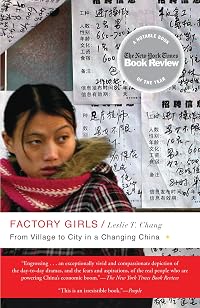
Factory Girls: From Village to City in a Changing China
by Leslie T. Chang
On This Page
Description
China has 130 million migrant workers-the largest migration in human history. In Factory Girls, Leslie T. Chang, a former correspondent for the Wall Street Journal in Beijing, tells the story of these workers primarily through the lives of two young women, whom she follows over the course of three years as they attempt to rise from the assembly lines of Dongguan, an industrial city in China's Pearl River Delta.As she tracks their lives, Chang paints a never-before-seen picture of migrant show more life-a world where nearly everyone is under thirty; where you can lose your boyfriend and your friends with the loss of a mobile phone; and where a few computer or English lessons can catapult you into a completely different social class. Chang takes us inside a sneaker factory so large that it has its own hospital, movie theater, and fire department; to posh karaoke bars that are fronts for prostitution; to makeshift English classes where students shave their heads in monklike devotion and sit day after day in front of machines watching English words flash by; and back to a farming village for the Chinese New Year, revealing the poverty and idleness of rural life that drive young girls to leave home in the first place. Throughout this riveting portrait, Chang also interweaves the story of her own family's migrations, within China and to the West, providing historical and personal frames of reference for her investigation.A book of global significance that provides new insight into China, Factory Girls demonstrates how the mass movement from rural villages to cities is remaking individual lives and transforming Chinese society, much as immigration to America's shores remade our own country a century ago. show lessTags
Recommendations


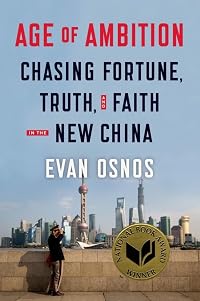
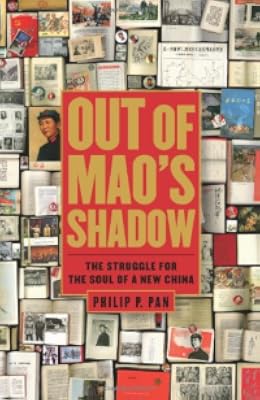
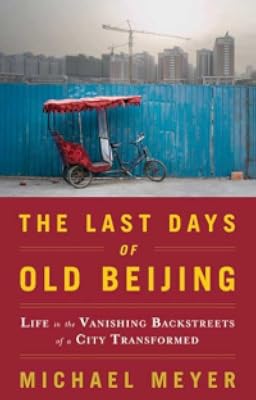
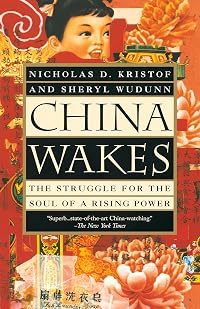







Member Recommendations
mercure Both these books deal with rural young women in China that travel to the cities looking for a better life in China's current economic boom. Ms. chang concentrates on Donghuan in the Pearl River delta in the south of China, and Ms. Zheng on Dalian in the north. Ms. Zheng also concentrates on the one profession that Ms. Chang seemed less interested in, so from reading both you get a more comprehensive idea of the social changes that China goes through.
30


Member Reviews
t is very hard to get reliable generalizations about today's China, thus the need for Chang's personal approach were we see the country one person and one snap shot at a time (mainly two girl's lives). My large complaint about the book is the author's inclusion of her family's history although full of interest that had so little to do with those young women working in the south of China. Compared with my own piece by piece knowledge of China's rural and small town populace the stories presented show great authenticity and insight and the relatively few generalizations expressed seem fair, needed and heightened while showing the reader some examples of the vital changes taking place in China.
Quotes: (page 30) “ So Dongguan was a place show more with conflicting versions of its past---one of a high-profile rejection of foreign presence in China, the other a stealthy embrace of it. Every Chinese school child learns about the burning of opium. But from the Taiping Handbag Factory, which did not appear in any textbook, I could trace a direct line to everyone I met in Dongguan...”
(page 316) 'The Chinese today have a trouble relationship with their past. On the surface, they take pride in it---China has five thousand years of history is constantly reminded as an American---but there is an aversion to going much deeper than the level of a Qing Dynasty television soap opera. Why did a great civilization collapse so rapidly when confronted by the West? What made people turn so readily on each other---in workplaces, in villages in families---during the political movements of the 1950s and 1960s? And how could they pick up their lives afterward as if nothing had happened?
The last question is the easiest: through forgetting. The Communist Party has not acknowledged the scale of catastrophes like the famine of the late 1950s and the Cultural Revolution.” show less
Quotes: (page 30) “ So Dongguan was a place show more with conflicting versions of its past---one of a high-profile rejection of foreign presence in China, the other a stealthy embrace of it. Every Chinese school child learns about the burning of opium. But from the Taiping Handbag Factory, which did not appear in any textbook, I could trace a direct line to everyone I met in Dongguan...”
(page 316) 'The Chinese today have a trouble relationship with their past. On the surface, they take pride in it---China has five thousand years of history is constantly reminded as an American---but there is an aversion to going much deeper than the level of a Qing Dynasty television soap opera. Why did a great civilization collapse so rapidly when confronted by the West? What made people turn so readily on each other---in workplaces, in villages in families---during the political movements of the 1950s and 1960s? And how could they pick up their lives afterward as if nothing had happened?
The last question is the easiest: through forgetting. The Communist Party has not acknowledged the scale of catastrophes like the famine of the late 1950s and the Cultural Revolution.” show less
Late in the book there is a disturbing account of a small-scale business operation in an apartment in Dongguan, Guangdong Province. The male running it keeps his female underlings working all day and forbids to them to leave the apartment except for a few hours once a week; they sleep in a cramped dormitory-style bedroom. Quiz: this operation is A) a brothel, B) a sweatshop, C) a religious cult, D) none of the above. D is correct: it's a private English language school for adults, mainly female factory workers between jobs who want to gain English credentials. Their teacher's notion of language learning is, like so much in China, quantitative-based and modeled on the factory assembly line: a machine he invented rapidly rotate words show more which the students must memorize as they flash by. This episode in Leslie Chang's book is representative in presenting two aspects of life in China for the hundreds of millions of migrant workers trying to achieve career stability or success in the city. On the one hand, there is the optimistic assessment, emphasized by Chang throughout the book, namely the freedom migrants now have to leave the village and go where opportunity beckons, with increasing numbers of success stories, primarily for female migrants, who often paradoxically enjoy greater freedom than males due to the obligations of male migrants to return to the village and care for their family. As Chang recounts with the stories of two migrants she befriended and followed for two years, Min and Chunming, the choices young Chinese women from the countryside now have at their disposal for upward mobility can be compared to the freedom and allure of worldwide travel young people from the developed world enjoy.
On the other hand, there is a powerful counterforce holding many Chinese back from freedom and autonomy: the imposing psychological control of group conformity. As a longtime American resident in China, I see this all the time in numerous guises among all social strata, not just migrants (and I write about this in my website attached to my Amazon profile). Although it is true that working conditions in factories have been improving over the past few years as workers learn about their rights and bargaining power through better communication (the internet) as well as negative publicity about labor exploitation at Foxconn, this still largely applies to skilled factory workers. For countless other workers in the service industry (restaurants, shop workers, the sex industry), working conditions remain awful - 12-14 hour days, 1-2 days off per month, minimum wage. Educated white-collar workers, for their part, experience a different kind of exploitation, hardly less grim: typically just as long working hours (though varying considerably from company to company) or 24-hour cellphone monitoring when off work, with elaborate penalty systems for failure to respond immediately to cellphone summons or other minor infractions (one highly educated female I know who worked as a journalist for a national newspaper quit because they were docking too much of her pay each month for largely unspecified penalties).
So returning to the aforementioned English training school, where Chang would describe the conditions experienced by these women as a matter of personal freedom and choice, we also recoil at the psychological coercion involved, which prevents them from rebelling, protesting and leaving. To be sure, this school is a bizarre exception, and most English schools in China, even unaccredited ones, are run like normal schools, with students present only during class hours. But another book needs to be written that deals with the dark side of China's economic success, even in these upwardly mobile times. It's good to have Chang's upbeat account, but for every migrant who achieves success like Min, how many millions of Chinese (including the educated class) remain locked and paralyzed in their internal cages of fear and anger, quietly spending their entire waking hours making superiors rich while they receive a pittance (not to mention the horrifying ongoing problem of companies that don't pay their workers at all, even an entire year's promised wages, folding up operations just before the Spring Festival and disappearing). After years of teaching in Chinese universities, I could see the mental slavery all around me on university campuses, which unlike universities almost anywhere in the world, are completely void of any signs of student protests. Largely enabling and ensuring China's economic expansion, in short, is group coercion and internalized fear on a scale few other societies know. show less
On the other hand, there is a powerful counterforce holding many Chinese back from freedom and autonomy: the imposing psychological control of group conformity. As a longtime American resident in China, I see this all the time in numerous guises among all social strata, not just migrants (and I write about this in my website attached to my Amazon profile). Although it is true that working conditions in factories have been improving over the past few years as workers learn about their rights and bargaining power through better communication (the internet) as well as negative publicity about labor exploitation at Foxconn, this still largely applies to skilled factory workers. For countless other workers in the service industry (restaurants, shop workers, the sex industry), working conditions remain awful - 12-14 hour days, 1-2 days off per month, minimum wage. Educated white-collar workers, for their part, experience a different kind of exploitation, hardly less grim: typically just as long working hours (though varying considerably from company to company) or 24-hour cellphone monitoring when off work, with elaborate penalty systems for failure to respond immediately to cellphone summons or other minor infractions (one highly educated female I know who worked as a journalist for a national newspaper quit because they were docking too much of her pay each month for largely unspecified penalties).
So returning to the aforementioned English training school, where Chang would describe the conditions experienced by these women as a matter of personal freedom and choice, we also recoil at the psychological coercion involved, which prevents them from rebelling, protesting and leaving. To be sure, this school is a bizarre exception, and most English schools in China, even unaccredited ones, are run like normal schools, with students present only during class hours. But another book needs to be written that deals with the dark side of China's economic success, even in these upwardly mobile times. It's good to have Chang's upbeat account, but for every migrant who achieves success like Min, how many millions of Chinese (including the educated class) remain locked and paralyzed in their internal cages of fear and anger, quietly spending their entire waking hours making superiors rich while they receive a pittance (not to mention the horrifying ongoing problem of companies that don't pay their workers at all, even an entire year's promised wages, folding up operations just before the Spring Festival and disappearing). After years of teaching in Chinese universities, I could see the mental slavery all around me on university campuses, which unlike universities almost anywhere in the world, are completely void of any signs of student protests. Largely enabling and ensuring China's economic expansion, in short, is group coercion and internalized fear on a scale few other societies know. show less
Factory Girls is set mostly in the Guangdong province of China where, among other things, 1/3 of the world's shoes and are made. The girls who go out from their rural farms to try to earn money and find an exciting life working in factories are the epitome of Norman Rockwell American cliched individualism. In fact cliche seem to be the basis for much of their planning. They are taken advantage of at every turn, cheated, mistreated, overlooked and overused and keep on striving for a better life. The book is fascinating on both a political and personal level. These young girls, and 80% of the workers in the factories are young women, come from farms where they have little power, where the living is communal, where the eldest male is the show more person to make decisions about everyone's life. They go to factories where they are all on their own, and they emphasize the fact that there is no one to help them, their decisions are their own. The bunk in factory rooms with 4 to 11 other women, they work 8 (at the least) to a mandated 12 or more hours a day with Sundays and maybe half day Saturdays (when business is slow) off. They scheme to find a way to earn a few hundred more yuan a month. They jump factory to factory, they turn to their families for advice but frequently don't heed it, they send money home to the farm but begin spending for themselves. They buy shoes and clothes, makeup, vitamin supplements and above all cell phones - their life lines. They meet men, they have affairs, they may not marry, they fall for pyramid schemes and they start their own businesses. They chase the American dream of personal and financial independence. I think most American women would never want their lives, but it appears more and more rural Chinese are going out to the factories and never going home to family control again. China is changing. These women don't care about politics, but the release from the power of family authority must effect the politics of the country, I would think. show less
Most books written about modern day China are patronising rubbish. its all so terrible, its all going to fall apart, it can't last. etc etc This is exceptional in its honest, sympathetic and human treatment of real people and real lives, and is shows how - just as is in the west - the industrial revolution is giving women the power to change and control their own lives, and to find their own paths. Yes factory conditions are bad, and the ability to "eat bitterness" is a pre requisite just as it was in America in the 19th century and Britain in the 18th century. But millions jump at the chance, not just for small wages but for the chance to be part of the modern world and for individual freedom. And this new found economic independence show more and personal liberty is changing family relations and the fabric of society very quickly.
The book focuses on two young women, Min and Chungmin, and their struggles to advance up the economic ladder, with little education and no support but their own wits and intelligence. Are they representative? Probably not - they were open minded enough to make the friendship of a foreign, albeit Chinese speaking, journalist. Are their stories typical? Very much so and as Chang herself points out the story of Napoleon's lowest foot soldier is more important that the story of Napoleon.
I couldn't agree more. A tremendous book show less
The book focuses on two young women, Min and Chungmin, and their struggles to advance up the economic ladder, with little education and no support but their own wits and intelligence. Are they representative? Probably not - they were open minded enough to make the friendship of a foreign, albeit Chinese speaking, journalist. Are their stories typical? Very much so and as Chang herself points out the story of Napoleon's lowest foot soldier is more important that the story of Napoleon.
I couldn't agree more. A tremendous book show less
"Factory girls" is a good read that doesn't truly fulfill its titular aspirations. The real factory girls are teenage migrant girls from the most underdeveloped regions of China who lack both the inclination and self-awareness to discuss their economic and life situation with an outside reporter. These are green kids who discover the world, growing up fast in an ever changing world. Compared to their parents, they grow up in a much more prosperous (consumer) environment. Compared to Western standards, their world is more like a mixture of the American Wild West and Manchester capitalism. The girls, however, are not powerless and often vote with their feet, changing employers at an alarming frequency. A constant re-invention of self show more (including abandoning friends and acquaintances) is the theme of their life. This re-invention is also changing the classic gender patterns. Given the increasing economic resources and the overabundance of men, these girls can choose whom to marry and where to work and live. A limited taste of freedom.
Instead of the factory girls, the author follows the lives of a few white collar women. Like in the Wild West, success seems to go to the cheaters and snake-oil sellers. It is not by hard work but by accepting bribes and kickbacks that one acquires a fortune. The right connections and the suitably forged documents are the ticket to wealth. Her description of manufacturing and business processes makes one wonder how the Chinese products hold together at all and manage to pass some quality controls. While the Japanese seem to strive for technical perfection, the Chinese aim to cut corners.
Hurt, they often are in this abrasive process. Despite their economic gains, Chang's account does not present happy people but drained women in a rat race who cannot enjoy what they have as long as an acquaintance has more. If hell is other people, China is not lacking in company. A Chinese train trip during the New Year season must indeed be painful.
A bit redundant among the tales of new China, Chang includes, over multiple chapters, the story of her rediscovering her own Chinese roots (at the other end of China). This highlights the book's big weakness: Her need to distinguish her Western, American, Taiwanese, educated, rich family/person from the poor, ignorant, Cantonese/provincial Chinese. Her husband, Peter Hessler, whose book Country Driving covers some of the same topics in its middle part, possesses the self assurance to be willing to look strange and foolish among the natives. Her Chinese roots (and thus the possibility of being actually considered Chinese) makes her struggle to maintain her superiority and distance, a fact her interlocutors notice too. Recommended. show less
Instead of the factory girls, the author follows the lives of a few white collar women. Like in the Wild West, success seems to go to the cheaters and snake-oil sellers. It is not by hard work but by accepting bribes and kickbacks that one acquires a fortune. The right connections and the suitably forged documents are the ticket to wealth. Her description of manufacturing and business processes makes one wonder how the Chinese products hold together at all and manage to pass some quality controls. While the Japanese seem to strive for technical perfection, the Chinese aim to cut corners.
Hurt, they often are in this abrasive process. Despite their economic gains, Chang's account does not present happy people but drained women in a rat race who cannot enjoy what they have as long as an acquaintance has more. If hell is other people, China is not lacking in company. A Chinese train trip during the New Year season must indeed be painful.
A bit redundant among the tales of new China, Chang includes, over multiple chapters, the story of her rediscovering her own Chinese roots (at the other end of China). This highlights the book's big weakness: Her need to distinguish her Western, American, Taiwanese, educated, rich family/person from the poor, ignorant, Cantonese/provincial Chinese. Her husband, Peter Hessler, whose book Country Driving covers some of the same topics in its middle part, possesses the self assurance to be willing to look strange and foolish among the natives. Her Chinese roots (and thus the possibility of being actually considered Chinese) makes her struggle to maintain her superiority and distance, a fact her interlocutors notice too. Recommended. show less
In the early aughts Leslie T. Chang was a foreign correspondent reporting for the “Wall Street Journal” on the transformative effects of socioeconomic change in China. Her exploration of the lives of the people she met led her, in 2004, to publish an article whose subject would eventually fill 432 pages of prose and become Chang’s first book, “Factory Girls” (Speigel & Grau, 2008), an impeccably-written survey of the lives female migrant workers—the young women who “go out” from China’s rural villages to find work in its urban factory cities. Over three years of reporting in Dongguan, one of a number of urban centers in China’s Pearl River Delta, Chang met women compelled by the promise of opportunity to leave home show more to find work, to jump from factory to factory in pursuit of higher wages, better working conditions, to be with a friend, a sister, a boyfriend. She encountered women who were in the shadows, women who worked in karaoke bars, women who taught themselves English at night school, women buffeted by the pleasures and pitfalls of new friendship.
"When you did make a friend, you did everything for her. If a friend quit her job and had nowhere to stay, you shared your bunk despite the risk of a ten-yuan fine, about $1.25, if you got caught. If she worked far away, you would get up early on a rare day off and ride hours on the bus, and at the other end your friend would take leave from work--this time, the fine one hundred yuan--to spend the day with you. You might stay at a factory you didn't like, or quit one you did, because a friend asked you to. Friends wrote letters every week, although the girls who had been out longer considered that childish. They sent messages by mobile phone instead." -Pg. 3 to 5
Unconvinced that decade-old reports about inhuman working conditions examined factory life from all sides, Chang began her investigation with a question: What do migrant workers make of their own experience? Along the way she discovered previously unrevealed facets of the factory story, where individual ambition, hard work, lying, and personal pluck lead to advancement, where life is fast-paced but monotonous, anonymous, in which work and workers are depersonalized, except to each other, where women came in from the provinces and return to them, their connections severed, if they can find their way back.
"The girls talked constantly of leaving. Workers were required to stay six months, and even then permission to quit was not always granted. The factory held the first two months of every worker’s pay; leaving without approval meant losing that money and starting all over somewhere else. That was a fact of factory life you couldn’t know from the outside: Getting into a factory was easy. The hard part was getting out." –Pg. 4
Told in part through the close observation of two women, Wu Chunming and Lu Qingmin, she meets while reporting, in part through an account of Chang’s own family’s history, and in part through descriptions of the city of Dongguan, Leslie T. Chang presents a picture of a culture beset with change, whose rapidly evolving economic landscape offers pressures and perils in quick step with opportunity, where millions of ambitious, hard-working individuals live lives on the brink of explosive transformation. Chang challenges her readers to discard received notions of China and discover it anew—as a place full of energy, bursting with the promise of advancement, of individual success, where lives beset by setback, ravaged by history, always have the potential to be renewed.
~Carlin M. Wragg, Editor, Open Loop Press show less
"When you did make a friend, you did everything for her. If a friend quit her job and had nowhere to stay, you shared your bunk despite the risk of a ten-yuan fine, about $1.25, if you got caught. If she worked far away, you would get up early on a rare day off and ride hours on the bus, and at the other end your friend would take leave from work--this time, the fine one hundred yuan--to spend the day with you. You might stay at a factory you didn't like, or quit one you did, because a friend asked you to. Friends wrote letters every week, although the girls who had been out longer considered that childish. They sent messages by mobile phone instead." -Pg. 3 to 5
Unconvinced that decade-old reports about inhuman working conditions examined factory life from all sides, Chang began her investigation with a question: What do migrant workers make of their own experience? Along the way she discovered previously unrevealed facets of the factory story, where individual ambition, hard work, lying, and personal pluck lead to advancement, where life is fast-paced but monotonous, anonymous, in which work and workers are depersonalized, except to each other, where women came in from the provinces and return to them, their connections severed, if they can find their way back.
"The girls talked constantly of leaving. Workers were required to stay six months, and even then permission to quit was not always granted. The factory held the first two months of every worker’s pay; leaving without approval meant losing that money and starting all over somewhere else. That was a fact of factory life you couldn’t know from the outside: Getting into a factory was easy. The hard part was getting out." –Pg. 4
Told in part through the close observation of two women, Wu Chunming and Lu Qingmin, she meets while reporting, in part through an account of Chang’s own family’s history, and in part through descriptions of the city of Dongguan, Leslie T. Chang presents a picture of a culture beset with change, whose rapidly evolving economic landscape offers pressures and perils in quick step with opportunity, where millions of ambitious, hard-working individuals live lives on the brink of explosive transformation. Chang challenges her readers to discard received notions of China and discover it anew—as a place full of energy, bursting with the promise of advancement, of individual success, where lives beset by setback, ravaged by history, always have the potential to be renewed.
~Carlin M. Wragg, Editor, Open Loop Press show less
A real eye-opener. In order to succeed in Chinese business you must throw away any shred of integrity you possess. Lie about your age, job experience, education, and everything else in order to obtain a position you are unqualified for and fake it until you make it. Then after a couple of weeks to a couple of months of being in this job, leave it for a newer, better one. Because that amount of time makes you a certified expert in whatever field. The only traits you must possess are confidence bordering on audacity, tenacity, and the ability to manipulate other people. Other people are virtually disposable and can be thrown under the bus whenever for your own advancement.
The flip side to all of this is that basically the Chinese show more are living the American Dream. That is to say that anybody can become somebody. These Chinese are no longer fettered by nationalism, idealism, or filial piety. Those brave enough to "go out" to work in the factories can choose their own path, date whom they please, spend what they want, and indeed, enjoy a hitherto unprecedented level of freedom.
Those who go out become alienated from their village and family, who can no longer understand them. These worlds are socioeconomic polar opposites. Once a migrant is firmly established, he or she likely sends home much more money than his or her village family makes in a year. This is not to say that migrants go out with the purpose of helping their families paramount in their minds. It is certainly a factor, but according to Chang most migrants are out to improve their station in life. The American Dream is now the Chinese Dream. One must wonder what the future will bring. I recall either from this book or Peter Hessler's River Town the comment about Chinese being so harsh on America in the past and now they are going through the same things. Side note, but related in a way, China seems so very dirty by American standards. I find this to resemble the Industrial Revolution in western countries and posit that given enough time China will overcome this hurdle (though it is a big one considering the size of the population).
I'm sure all this might be common knowledge to seasoned China watchers, but I am new to the pursuit so I found this book very informative. show less
The flip side to all of this is that basically the Chinese show more are living the American Dream. That is to say that anybody can become somebody. These Chinese are no longer fettered by nationalism, idealism, or filial piety. Those brave enough to "go out" to work in the factories can choose their own path, date whom they please, spend what they want, and indeed, enjoy a hitherto unprecedented level of freedom.
Those who go out become alienated from their village and family, who can no longer understand them. These worlds are socioeconomic polar opposites. Once a migrant is firmly established, he or she likely sends home much more money than his or her village family makes in a year. This is not to say that migrants go out with the purpose of helping their families paramount in their minds. It is certainly a factor, but according to Chang most migrants are out to improve their station in life. The American Dream is now the Chinese Dream. One must wonder what the future will bring. I recall either from this book or Peter Hessler's River Town the comment about Chinese being so harsh on America in the past and now they are going through the same things. Side note, but related in a way, China seems so very dirty by American standards. I find this to resemble the Industrial Revolution in western countries and posit that given enough time China will overcome this hurdle (though it is a big one considering the size of the population).
I'm sure all this might be common knowledge to seasoned China watchers, but I am new to the pursuit so I found this book very informative. show less
Members
- Recently Added By
Published Reviews
ThingScore 75
A fascinating ethnography of the young women who labor in the factories of Guangdong, China's richest province, a land of boomtowns where wealth and scams and exploitation and warmth and courage all abound.
added by lampbane
Lists

The 99% -- Most Readable Non-Fiction
37 works; 8 members

Non-Fiction Worth Reading
1,016 works; 262 members

Best Books Read for TIOLI
49 works; 14 members

The China Project Book List
100 works; 2 members

.
184 works; 1 member
Author Information

2+ Works 1,094 Members
Some Editions
Awards and Honors
Awards
Distinctions
Series
Belongs to Publisher Series
Dwarsliggers (32)
Common Knowledge
- Original publication date
- 2008
- Important places
- Dongguan, Guandong Province, China
- Quotations
- The factory world was a place without tradition or pedigree, and people had to learn how to redefine themselves.
Classifications
- Genres
- Nonfiction, General Nonfiction, History, Biography & Memoir
- DDC/MDS
- 331.40951 — Society, government, & culture Economics Labor economics Women workers Biography And History Asia China & Korea
- LCC
- HD9734 .C55 .C53 — Social sciences Industries. Land use. Labor Industries. Land use. Labor Special industries and trades Manufacturing industries
- BISAC
Statistics
- Members
- 1,069
- Popularity
- 23,986
- Reviews
- 43
- Rating
- (3.88)
- Languages
- 8 — Dutch, English, Finnish, French, Italian, Marathi, Portuguese, Spanish
- Media
- Paper, Audiobook, Ebook
- ISBNs
- 26
- ASINs
- 7