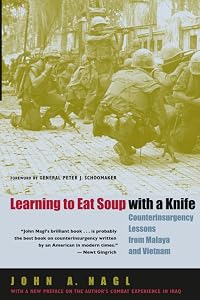
Learning to Eat Soup with a Knife: Counterinsurgency Lessons from Malaya and Vietnam
by John A. Nagl
On This Page
Description
Invariably, armies are accused of preparing to fight the previous war. In Learning to Eat Soup with a Knife, Lieutenant Colonel John A. Nagl-a veteran of both Operation Desert Storm and the conflict in Iraq-considers the now crucial question of how armies adapt to changing circumstances during the course of conflicts for which they are initially unprepared. Through the use of archival sources and interviews with participants in both engagements, Nagl compares the development of show more counterinsurgency doctrine and practice in the Malayan Emergency from 1948 to 1960 with what developed in the Vietnam War from 1950 to 1975. In examining these two events, Nagl argues that organizational culture is key to the ability to learn from unanticipated conditions, a variable which explains why the British army successfully conducted counterinsurgency in Malaya and why the American army failed to do so in Vietnam, treating the war instead as a conventional conflict. Nagl concludes that the British army, because of its role as a colonial police force and the organizational characteristics created by its history and national culture, was better able to quickly learn and apply the lessons of counterinsurgency during the course of the Malayan Emergency. With a new preface reflecting on the author's combat experience in Iraq, Learning to Eat Soup with a Knife is a timely examination of the lessons of previous counterinsurgency campaigns that will be hailed by both military leaders and interested civilians. show lessTags
Recommendations

















Member Reviews
This book was recommended to me by a friend who also happens to be ex-SF and who has extensive combat and training experience. I thank him for the suggestion. I think this is the sort of book whose value depends in part on where you’re at going into it. While women like me were barred from the honor of serving, especially in combat arms, when I was young enough for my service to matter, I have had the privilege of studying the lessons of unconventional and guerrilla warfare extensively since the mid 1990s. Back then, while pursuing a doctorate in an unrelated subject, I had academic access to a great deal of excellent but neglected scholarship coming from the Army historical service and other places, much of which taught many of the show more general lessons of this book. And I’ve continued that study over the decades since. The author is certainly not wrong to point up the ongoing arrogance and amnesia one finds so often in Big Green and the highest levels of the United States government. I do think he is a bit off base in praising the “learning culture” of British armed forces as highly as he seems to, under emphasizing important differences between the Malayan Emergency and what became the Vietnam War. More importantly I think the 19 years of American combat involvement since this book was first published demonstrates a more fundamental truth about fighting insurgencies - no matter the level of tactical excellence achieved, you have to offer something the indigenous personnel want and believe will succeed and that they invest in, and do it early before your chances are lost forever (if you even have a chance). Tactical excellence is not a substitute for a viable strategic vision. Furthermore I have come to believe that some insurgencies are fundamentally literally incapable of being defeated by Western powers. We can change regimes, certainly. But the experiences of Afghanistan and Iraq certainly drive the limits of regime change, and the unpleasant sequelae, home with an exclamation point.
One finds in this book an earnest ongoing optimism that maybe next time the United States can study harder and learn more and then it’ll win these kinds of wars. While learning is imperative and this book underscores several methods of doing so, I think the fundamental optimism about winning-with-homework is misplaced in certain conflicts.
So I think this is a good book, very much worth reading as part of inquiries into COIN and military learning theory at the operational level. It might seem like a revolutionary book depending on where you are coming from in your studies. For me it simply is a good book, not a great or revolutionary one. show less
One finds in this book an earnest ongoing optimism that maybe next time the United States can study harder and learn more and then it’ll win these kinds of wars. While learning is imperative and this book underscores several methods of doing so, I think the fundamental optimism about winning-with-homework is misplaced in certain conflicts.
So I think this is a good book, very much worth reading as part of inquiries into COIN and military learning theory at the operational level. It might seem like a revolutionary book depending on where you are coming from in your studies. For me it simply is a good book, not a great or revolutionary one. show less
Really good, just like the new COIN field manual, and probably ultimately just as dangerously misleading.
Really good, just like the new COIN field manual, and probably ultimately just as dangerously misleading.
With apologies to the author, I had to stop reading about half way through this book. Unfortunately, some of impact of Nagl's book was undercut by already having read about the General Petraeus approach to counterinsurgency in Iraq. Much of the Petraeus approach apparently uses the lessons and understanding outlined by Nagl in "Learning to Eat Soup with a Knife, so the book, and its lessons from history, weren't really new enough nor groundbreaking enough to hold my interest. Because of that, it seemed dry and repetitive to me, and my interest faded. I think we all saw how poorly prepared we were to handle political and civil unrest in Iraq, and we subsequently came to understand the benefits of the counterinsurgency as generally show more credited to General Petraeus. So the value in Nagl's writing seems validated. However, my interest in the subject just wasn't strong enough to sustain me, and I put the book down, never to pick it up again. show less
Not quite a modern Kitson, Nagl concentrates more on a psychological and sociological analysis of the ability (or, to be frank, the inability) of the British and American armies to learn lessons from the conflicts in Malaya and Vietnam, respectively. He conducts a detailed analysis of the historical phases of each conflict and the particular military and political drivers that contributed to the observed behaviour patterns.
Much of the tactical analysis you see in similar books is missing or weak, as he concentrates on very high level 'business' processes (this may be due to both wars being primarily infantry affairs and Col Nagl being a cavalryman.) His view of Nirvana is the "learning institution", similar the sort of cyclical show more self-review popularised within industrial continuous improvement methodologies and how this can apply within the strongly hierarchical environment of the conventional or mainstream military.
The paperback edition has a short preface reflecting his experiences from a year (2003/04) serving in Iraq. show less
Much of the tactical analysis you see in similar books is missing or weak, as he concentrates on very high level 'business' processes (this may be due to both wars being primarily infantry affairs and Col Nagl being a cavalryman.) His view of Nirvana is the "learning institution", similar the sort of cyclical show more self-review popularised within industrial continuous improvement methodologies and how this can apply within the strongly hierarchical environment of the conventional or mainstream military.
The paperback edition has a short preface reflecting his experiences from a year (2003/04) serving in Iraq. show less
Erudite and academic although with a dry writing style Nagl wrote what is considered to be a classic in counterinsurgency. He tends to repeat the contrast between the British experience and the Americans in Vietnam although he does rightly point out the insights that effective counterinsurgency tactics require.
Good book
I think it was more about organizational culture than counter insurgency, it seemed like it just happened to use a COIN comparison situation to get this point across.
i guess the army has gotten better at being adaptive and allowing innovation, but it's still frustratingly slow
oh well..."be the change you want to see" -Ghandi
I think it was more about organizational culture than counter insurgency, it seemed like it just happened to use a COIN comparison situation to get this point across.
i guess the army has gotten better at being adaptive and allowing innovation, but it's still frustratingly slow
oh well..."be the change you want to see" -Ghandi
Members
- Recently Added By
Lists

Best British Empire History Books
39 works; 8 members

Books About the Vietnam War
15 works; 6 members
Author Information

3 Works 569 Members
John A. Nagl is a U.S. Army Major currently stationed at Fort Riley, Kansas. He holds a M.Phil. and a D.Phil. in international relations from Oxford University.
Common Knowledge
- Original publication date
- 2002
- Important places
- Malaya; Vietnam
- Blurbers
- Rubin, Trudy; Jaffe, Greg; Gingrich, Newt; Ayers, Nick; Reynolds, Paul; Schrage, Michael (show all 11); Metz, Steven; Baldwin, Tom; Aylwin-Foster, Nigel R. F.; Mackinlay, John; Hoffman, Frank G.
Classifications
- Genres
- History, Nonfiction, General Nonfiction
- DDC/MDS
- 959.504 — History & geography History of Asia Southeast Asia: Myanmar, Thailand, Laos, Cambodia, Vietnam Malaysia; Singapore; Brunei
- LCC
- DS597 .N27 — History of Europe, Asia, Africa and Oceania Asia History of Asia Malaysia. Malay Peninsula. Straits Settlements Local history and description Sarawak
- BISAC
Statistics
- Members
- 490
- Popularity
- 61,771
- Reviews
- 9
- Rating
- (3.65)
- Languages
- English
- Media
- Paper, Audiobook, Ebook
- ISBNs
- 9
- ASINs
- 5