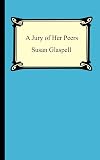
A Jury of Her Peers
by Susan Glaspell
On This Page
Description
An excellent short dramatic story by Susan Glaspell.Tags
Recommendations

















Member Recommendations
Member Reviews
What a marvelous little story! I love it when I get more than I bargained for.
Two women are dragged along with their husbands, a sheriff and a witness, to the scene of a murder. While the men are "investigating", the women, who are subject to a snide, deprecating remark now and then, gather the real clues to what occurred at this house of a neighbor.
There is a lot being said by Ms. Glaspell. She addresses the relationships between men and women and those among women themselves. There is a thread of question: what might I have done? And one of responsibility: what if I had paid attention, what if I had offered help?
It is very hard to discuss in any detail without giving away too much of the plot, and I hope that others will read this show more gem, so I do not want to do that. show less
Two women are dragged along with their husbands, a sheriff and a witness, to the scene of a murder. While the men are "investigating", the women, who are subject to a snide, deprecating remark now and then, gather the real clues to what occurred at this house of a neighbor.
There is a lot being said by Ms. Glaspell. She addresses the relationships between men and women and those among women themselves. There is a thread of question: what might I have done? And one of responsibility: what if I had paid attention, what if I had offered help?
It is very hard to discuss in any detail without giving away too much of the plot, and I hope that others will read this show more gem, so I do not want to do that. show less
I read this short story because Elaine Showalter mentions that it provided the title for her most recent book A Jury of Her Peers: American Women Writers from Anne Bradstreet to Annie Proulx. Glaspell is apparently one of the skilled American women writers Showalter believes time has forgotten. I believe she was a Pulitzer Prize winning writer in the early part of the 20th century. The story, which is based on a true crime, focuses on a woman who is suspected of murdering her husband. However, when the male inspectors talk to her and examine her house, they can find no obvious signs of distress or rationale for her crime. Their wives, however, who have been brought along to the woman's house to collect clothes to bring to her in jail, show more quickly notice "insignificant" details that reveal the accused woman's mental and emotional state and compellingly suggest that she was responsible for the murder. When they discover why, they conspire to hide the evidence and help her go free.
I enjoyed it as well & upon reflection, I think it was rather fantastic. The problem that I had was that I read it soon after reading Showalter's rather comprehensive summary and discussion of it in the introduction to her book - in some places, it actually seemed like a word-for-word retelling - so I kind of felt like I knew what to expect, where it was going, what the style would be. That having been said, it is a powerful story & a remarkable picture of quiet domestic discord. I am a big fan of "quiet" unrest, if that makes any sense - writers to manage to convey potent emotional turmoil with the smallest, most subtle words or images, rather than characters who have a screaming fit and tell the reader exactly what the problem is in long speeches.
I loved the gender dynamics at work in the story - how the two women were treated like idiots for focusing on small, "insignificant" domestic things by their "smarter" husbands, who were formally investigating the crime. Showalter points out in her discussion of the story that this can also be read as a criticism of how the male-dominated world of writing scorned the concerns of women's fiction as small-minded and "domestic". I actually love "domestic fiction" - I think some of the most fascinating books I have read succeed because they recognize that the most interesting drama is often that found in the home, in daily life, in interactions between family members, etc.
I read about other Glaspell works in Marise's thread & I am really interested to read more. She seems like just my kind of author. show less
I enjoyed it as well & upon reflection, I think it was rather fantastic. The problem that I had was that I read it soon after reading Showalter's rather comprehensive summary and discussion of it in the introduction to her book - in some places, it actually seemed like a word-for-word retelling - so I kind of felt like I knew what to expect, where it was going, what the style would be. That having been said, it is a powerful story & a remarkable picture of quiet domestic discord. I am a big fan of "quiet" unrest, if that makes any sense - writers to manage to convey potent emotional turmoil with the smallest, most subtle words or images, rather than characters who have a screaming fit and tell the reader exactly what the problem is in long speeches.
I loved the gender dynamics at work in the story - how the two women were treated like idiots for focusing on small, "insignificant" domestic things by their "smarter" husbands, who were formally investigating the crime. Showalter points out in her discussion of the story that this can also be read as a criticism of how the male-dominated world of writing scorned the concerns of women's fiction as small-minded and "domestic". I actually love "domestic fiction" - I think some of the most fascinating books I have read succeed because they recognize that the most interesting drama is often that found in the home, in daily life, in interactions between family members, etc.
I read about other Glaspell works in Marise's thread & I am really interested to read more. She seems like just my kind of author. show less
Sheriff Peters and his wife, arrive by buggy to transport Mr. Hale and his wife, Martha, to the neighboring Wright Family farm down the road. Mr. Hale was to describe the events that he had witnessed a day earlier when he and his son stopped at their neighbor, to speak with Frank Wright about agreeing to foot half of the bill for running a telephone line out their way. When he arrived at the Wright farm, he found Martha Wright (née Foster), in a somewhat catatonic state and her husband dead in their bedroom with a noose around his neck. Although Hale and Peters agree that Wright was a decent sort (the measure of which - "He didn't drink, and kept his word as well as most, … and paid his debts) the reader would disagree.
Martha, being show more the only person of interest, was arrested for allegedly murdering her husband. Throughout the story, the women and reader are subjected to the condescending wisecracks of the numbnut spouses. In fact, these men are so full of themselves “searching for clues”, that the Accused’s peers have already solved the crime and spirited away the damning evidence right from under their noses. I found this 1917 story by Susan Glaspell to be “meh”. I don’t know that I would describe this as feminist literature – maybe yes for 1917.
I see by my GR Friends' excellent reviews that I missed the mark on this one. I listened to the Audible+ of this story, earlier today, and was completely underwhelmed. The story oozed atmosphere as did the narration, but it was slow slow slow (read dull dull dull). In deference to the high ratings by GRFriends, I decided to try the printed version. This definitely improved the experience. The audible is 55 minutes long but the story is less than twenty pages of text (depending on your chosen font) and takes roughly 20 minutes to read. That’s already a great argument in favor of the printed version, so if you are interested you can find the story at Gutenberg.org in a collection entitled The Best Short Stories of 1917, by Various – if you press on this link it will take you directly to the story. show less
Martha, being show more the only person of interest, was arrested for allegedly murdering her husband. Throughout the story, the women and reader are subjected to the condescending wisecracks of the numbnut spouses. In fact, these men are so full of themselves “searching for clues”, that the Accused’s peers have already solved the crime and spirited away the damning evidence right from under their noses. I found this 1917 story by Susan Glaspell to be “meh”. I don’t know that I would describe this as feminist literature – maybe yes for 1917.
I see by my GR Friends' excellent reviews that I missed the mark on this one. I listened to the Audible+ of this story, earlier today, and was completely underwhelmed. The story oozed atmosphere as did the narration, but it was slow slow slow (read dull dull dull). In deference to the high ratings by GRFriends, I decided to try the printed version. This definitely improved the experience. The audible is 55 minutes long but the story is less than twenty pages of text (depending on your chosen font) and takes roughly 20 minutes to read. That’s already a great argument in favor of the printed version, so if you are interested you can find the story at Gutenberg.org in a collection entitled The Best Short Stories of 1917, by Various – if you press on this link it will take you directly to the story. show less
I did read this for school, so naturally, I came in with low expectations. However, I was pleasantly surprised by the theme of this story. My biggest gripe is that it was difficult to understand what was going on or what the characters were saying because of the writing style, but that is understandable because it was written over a half a century ago.
wow. this was brilliantly written and I'm sort of crying
This is the second time I've read this short story. First time in college, second time just now. My outlook on life has somewhat changed with the greater experience. I believe I was more negative towards the story and the actions of the women in the story the last time I read it. It's not an original thought, but the only thing I can think of at the moment.
Members
- Recently Added By
Lists

First published in 1917
132 works; 3 members
Author Information

42+ Works 879 Members
Some Editions
Awards and Honors
Notable Lists
Queen's Quorum (The First Moderns – 75)
Work Relationships
Is contained in
Women in the Trees: U.S. Women's Short Stories About Battering and Resistance, 1839-1994 by Susan Koppelman
To the Queen's Taste: The First Supplement to 101 Years Entertainment Consisting of the Best Stories Published in the First Four Years of Ellery Queen's Mystery Magazine by Ellery Queen
Inspired
Has as a study
Has as a student's study guide
Common Knowledge
- Canonical title
- A Jury of Her Peers
- Original title
- A Jury of Her Peers
- Original publication date
- 1917
- People/Characters*
- Martha Hale; Signora Peters
- Important places*
- USA
- First words
- When Martha Hale opened the storm-door and got a cut of the north wind, she ran back for her big woolen scarf.
- Last words
- (Click to show. Warning: May contain spoilers.)"We call it--knot it, Mr. Henderson."
- Original language*
- Inglese
*Some information comes from Common Knowledge in other languages. Click "Edit" for more information.
Classifications
- Genres
- Fiction and Literature, General Fiction, Mystery
- DDC/MDS
- 808 — Literature & rhetoric Literature, rhetoric & criticism Rhetoric and collections of literary texts from more than two literatures
- LCC
- PZ7 .G48113 .J — Language and Literature Fiction and juvenile belles lettres Fiction and juvenile belles lettres Juvenile belles lettres
- BISAC
Statistics
- Members
- 94
- Popularity
- 342,282
- Reviews
- 9
- Rating
- (3.88)
- Languages
- English, French, Italian
- Media
- Paper, Audiobook, Ebook
- ISBNs
- 15
- ASINs
- 3