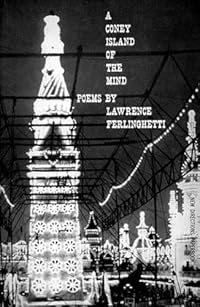
A Coney Island of the Mind
by Lawrence Ferlinghetti
On This Page
Description
Twenty-nine poems from the 1950's.Tags
Recommendations




















Member Reviews
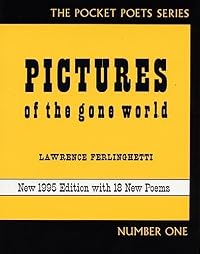
This New Directions paperback from 1958 brings together a selection of poems from Ferlinghetti's first, self-published collection Pictures of the gone world (1955) with two new, longer poems, "A Coney Island of the mind" and "Oral messages".
The title poem, "a kind of circus of the soul," in 29 sections, taking its title from a line of Henry Miller's — is something like the Ferlinghetti version of "Howl", a confrontation between the poet's sensibility and the banality of Eisenhower's America. But it's all a lot more playful and literary, full of mischievous echoes of everyone from Wordsworth, Keats and W B Yeats to T S Eliot and James Joyce. Where Ginsberg's lines thump out at you in a merciless rhythm, Ferlinghetti dances down the show more page in unexpected leaps and pirouettes. And comes to a fabulous conclusion in section 29 where he manages to condense Ulysses, Finnegan's Wake, Anna Karenina, Hemingway, Proust and Lorca (and much else) into about 100 breathlessly unpunctuated lines.
"Oral messages" are jazz poems, meant for live performance but still quite effective on the page, again full of clever puns and literary references that you would probably only pick up on a very subliminal level in performance. "Pictures of the gone world" range a little more widely, with a few nods to the lyrical tradition, but still in the light-footed style of "Coney Island".
The typographic design, with its classic underground "typewriter-style" look, is superb — I loved that they even went as far as using freehand underlining for emphasis instead of italics. Freda Browne is credited as the designer, while the cover is by Rudolphe de Harak. show less
The title poem, "a kind of circus of the soul," in 29 sections, taking its title from a line of Henry Miller's — is something like the Ferlinghetti version of "Howl", a confrontation between the poet's sensibility and the banality of Eisenhower's America. But it's all a lot more playful and literary, full of mischievous echoes of everyone from Wordsworth, Keats and W B Yeats to T S Eliot and James Joyce. Where Ginsberg's lines thump out at you in a merciless rhythm, Ferlinghetti dances down the show more page in unexpected leaps and pirouettes. And comes to a fabulous conclusion in section 29 where he manages to condense Ulysses, Finnegan's Wake, Anna Karenina, Hemingway, Proust and Lorca (and much else) into about 100 breathlessly unpunctuated lines.
"Oral messages" are jazz poems, meant for live performance but still quite effective on the page, again full of clever puns and literary references that you would probably only pick up on a very subliminal level in performance. "Pictures of the gone world" range a little more widely, with a few nods to the lyrical tradition, but still in the light-footed style of "Coney Island".
The typographic design, with its classic underground "typewriter-style" look, is superb — I loved that they even went as far as using freehand underlining for emphasis instead of italics. Freda Browne is credited as the designer, while the cover is by Rudolphe de Harak. show less
This 1950s poetry collection is the most famous writing by Ferlinghetti, who was also lauded as an activist, publisher, bookseller, and painter. It has three principal sections: the title piece, "Oral Messages," and poems from "Pictures of the Gone World."
The title of the book and its first section was taken "out of context" from Henry Miller's Into the Night Life. Ferlinghetti said that it was to describe the carnivalesque aspect of his own subjective experience in composing the poems. But a different and credible reading is to see the US society that the poet engages in his verse as a mental amusement park: corralling minds into circuitous rides that exhilarate, games that impoverish, and technology that dazzles and mystifies. Still, show more the weight of these poems often rests not in social criticism but in aesthetic contemplation, libidinal impulse, epistemic anxiety, and similar dilemmas.
The second section of the book is "Oral Messages," seven longer poems composed for recitation with "jazz accompaniment" (48), and to incorporate experimentation and spontaneity. Although this mode is a paragon of Beat Generation performance, and Ferlinghetti did publish prominent Beat authors, he rejected the "Beat" label for his own work. My favorite of these poems is "Junkman's Obbligato," which urges downward economic mobility in order to champion life and freedom. But a close second is the diffident brag of "Autobiography" ("I am the man. / I was there. / I suffered / somewhat.") succumbing irregularly to atypical end rhyme.
The final thirteen poems are selected from a volume "Pictures of the Gone World" that Ferlinghetti had written just three years previously. These are similar to some of those in the first section (briefer, and like them individually numbered rather than titled), and they tend toward a narrower and more intimate sensibility--even though the eleventh has the great wide scope of the world as the place for life and death.
Ferlinghetti offers some unflinching anti-Christian blasphemy in the fifth "Coney Island" poem (15-6), but the "Oral Messages" seem to exhibit sincere apocalyptic anticipation ("I Am Waiting") and a hope of obscure divine palingenesis ("Christ Climbed Down").
Despite Ferlinghetti's use of popular culture and accessible idiom, his texts are still in dialog with the canons of elite art and literature. The first poem of the book orients to the painting of Goya to reflect on "maimed citizens in painted cars" (10), and the second one alludes to Homer's Odyssey to indict "American demi-Democracy" (12). Later verses cite Hieronymus Bosch, Morris Graves, Franz Kafka, Dante, Chagall, Proust, and others. The poet fulminates against the enclosure of culture by experts and institutions in poem 9 of "Pictures of the Gone World," but he had an M.A. in English literature and a Ph.D. in comparative literature, and the consequences of this training are everywhere visible in his poems.
Twenty-first century readers may occasionally struggle with a dated allusion or two in these pages (nothing too arcane for a 'net search to remedy, though). Ironically, it is the "popular" and contemporary references from the 1950s that are more likely to have passed into obscurity. On the whole, the verses have aged well and still have a sense of immediacy sixty-four years later. show less
The title of the book and its first section was taken "out of context" from Henry Miller's Into the Night Life. Ferlinghetti said that it was to describe the carnivalesque aspect of his own subjective experience in composing the poems. But a different and credible reading is to see the US society that the poet engages in his verse as a mental amusement park: corralling minds into circuitous rides that exhilarate, games that impoverish, and technology that dazzles and mystifies. Still, show more the weight of these poems often rests not in social criticism but in aesthetic contemplation, libidinal impulse, epistemic anxiety, and similar dilemmas.
The second section of the book is "Oral Messages," seven longer poems composed for recitation with "jazz accompaniment" (48), and to incorporate experimentation and spontaneity. Although this mode is a paragon of Beat Generation performance, and Ferlinghetti did publish prominent Beat authors, he rejected the "Beat" label for his own work. My favorite of these poems is "Junkman's Obbligato," which urges downward economic mobility in order to champion life and freedom. But a close second is the diffident brag of "Autobiography" ("I am the man. / I was there. / I suffered / somewhat.") succumbing irregularly to atypical end rhyme.
The final thirteen poems are selected from a volume "Pictures of the Gone World" that Ferlinghetti had written just three years previously. These are similar to some of those in the first section (briefer, and like them individually numbered rather than titled), and they tend toward a narrower and more intimate sensibility--even though the eleventh has the great wide scope of the world as the place for life and death.
Ferlinghetti offers some unflinching anti-Christian blasphemy in the fifth "Coney Island" poem (15-6), but the "Oral Messages" seem to exhibit sincere apocalyptic anticipation ("I Am Waiting") and a hope of obscure divine palingenesis ("Christ Climbed Down").
Despite Ferlinghetti's use of popular culture and accessible idiom, his texts are still in dialog with the canons of elite art and literature. The first poem of the book orients to the painting of Goya to reflect on "maimed citizens in painted cars" (10), and the second one alludes to Homer's Odyssey to indict "American demi-Democracy" (12). Later verses cite Hieronymus Bosch, Morris Graves, Franz Kafka, Dante, Chagall, Proust, and others. The poet fulminates against the enclosure of culture by experts and institutions in poem 9 of "Pictures of the Gone World," but he had an M.A. in English literature and a Ph.D. in comparative literature, and the consequences of this training are everywhere visible in his poems.
Twenty-first century readers may occasionally struggle with a dated allusion or two in these pages (nothing too arcane for a 'net search to remedy, though). Ironically, it is the "popular" and contemporary references from the 1950s that are more likely to have passed into obscurity. On the whole, the verses have aged well and still have a sense of immediacy sixty-four years later. show less
Lawrence Ferlinghetti is one the more unknown figures of the Beat Generation. However, 'A Coney Island of the Mind' presents itself as one the most accessible and enjoyable introductions both to the writing of the Beat Poets as to poetry in general.
What makes this tiny book of poetry so special? It's hard to define, really. Ferlinghetti's biggest success lies within his ability to capture precise moments, thoughts and emotions. His style isn't unique but it doesn't have the rambling presentation of, for example, [a:Allen Ginsberg|4261|Allen Ginsberg|http://d.gr-assets.com/authors/1206649831p2/4261.jpg]'s writings. For most readers, this will be a relief, as 'A Coney Island of the Mind' profits from a much higher degree of show more clarity.
Ferlinghetti says he's 'walked down alleys too narrow for Chryslers'. One could say this small quote summarizes the main aspects of his work; very down-to-earth, everyday thematics and most of all, very honest and direct poetry. In short, Ferlinghetti does everything a collection of poetry should do - it provides some great imagery, interesting ideas and holds plenty of secrets and mystery after a first read. Recommended. show less
What makes this tiny book of poetry so special? It's hard to define, really. Ferlinghetti's biggest success lies within his ability to capture precise moments, thoughts and emotions. His style isn't unique but it doesn't have the rambling presentation of, for example, [a:Allen Ginsberg|4261|Allen Ginsberg|http://d.gr-assets.com/authors/1206649831p2/4261.jpg]'s writings. For most readers, this will be a relief, as 'A Coney Island of the Mind' profits from a much higher degree of show more clarity.
Ferlinghetti says he's 'walked down alleys too narrow for Chryslers'. One could say this small quote summarizes the main aspects of his work; very down-to-earth, everyday thematics and most of all, very honest and direct poetry. In short, Ferlinghetti does everything a collection of poetry should do - it provides some great imagery, interesting ideas and holds plenty of secrets and mystery after a first read. Recommended. show less
review of
Lawrence Ferlinghetti's A Coney Island of the Mind
by tENTATIVELY, a cONVENIENCE - November 12, 2011
Rereading A Coney Island of the Mind for what might be the 1st time in 41 yrs felt like going home again - by wch I mean that it feels like something that I'm very familiar w/ - even though I'm not. There's always the possibility that when one reads something in one's 'formative yrs' that it becomes deeply instantiated. Rereading this felt strangely comfortable - like being w/ an old friend that I can trust.
Ferlinghetti was probably the 1st 'rebel poet' I ever read. When I did so, in the early 1970s, his literateness & anti-war attitudes jived w/ my own. These days. I often feel like I live in an all-too-illiterate society show more (hence my enthusiasm for Goodreads' counterbalance) & reading a bk at all, esp 1 that references many other writers & artists, is ultimately what probably makes me feel like I'm in the company of friends - even though I only 'know' most or all of these people thru their works.
Goya (p9) & Morris Graves (25) & Dante (28) & Chagall (29) & Kafka (31) & Hemingway & Proust & T.S.Eliot (44) & Djuna Barnes (45), etc, etc, grace these pages as characters. What a cast! Ferlinghetti is, of course, the cofounder of City Lights bks & a publisher - as well as a writer in many forms. I can relate: I'm the cofounder of Normal's Books & a publisher & a writer in many forms. I reckon that if I ever have the opportunity to meet him (he's still alive at 92 as I write this) he wdn't have any problem recognizing many of the creative people that I frequently mention & wd probably stump me from time-to-time w/ his own extensive knowledge. If only this were the case more often!
A Coney Island of the Mind was originally published in 1958 & some of the poetry in it dates back to his 1st bk from 1955: Pictures of the Gone World. It astounds me somewhat how much I can relate to the attitude of this bk. He refers to "anarchy" in a completely friendly positive way w/o bothering to even acknowledge the substantial suppression of it in the USA of the time. Take this sentence from "Autobiography":
"I have seen Egyptian pilots in purple clouds
shopkeepers rolling up their blinds
at midday
potato salad and dandelions
at anarchist picnics."
It amused me, & seemed precocious, to read the phrase "drugged store cowboys" on p13 - knowing that a movie wd be similarly named decades later.
On p48 he mentions that the poems "Junkman's Obbligato" & "Autobiography" had been read by him w/ The Cellar Jazz Quintet & released on record. This recording is also on 2 different CDs - one w/ Kenneth Rexroth & one w/ Kenneth Patchen. There're probably people who wd find poetry read along w/ jazz to be a sad cliché of a bygone age - for me, these recordings are utterly wonderful. & reading these poems again I hear Ferlinghetti's readings in memory.
I rarely, or never, hear my poet friends mention Ferlinghetti. Is it b/c he's so much a part of the culture that there's no 'need'? After all, A Coney Island of the Mind is sd to've sold over a million copies - &, given that it's an easy read, most of those copies have probably been read. I wonder if it's more b/c he doesn't self-identify w/ the Beats - the literary superstars of the 20th century? According to his Wikipedia entry:
"Although in style and theme Ferlinghetti’s own writing is very unlike that of the original NY Beat circle, he had important associations with the Beat writers, who made City Lights Bookstore their headquarters when they were in San Francisco. He has often claimed that he was not a Beat, but a bohemian of an earlier generation."
I don't really find his writing to be "very unlike that of the original NY Beat circle" at all & find that to be a somewhat surprising statement. The poetry, at least, seems akin to Ginsberg's. Then again, it's often unclear to me who the Beats were - aside from the core circle of friends most often referenced: Burroughs, Ginsberg, Corso, McClure, Kerouac.. Many people seem to be sometimes associated w/ the Beats & sometimes not.
If Ferlinghetti's not a Beat is he a progenitor (well, no, he's a few yrs too late for that)? His "I am Waiting" (from no later than 1958) is a list poem of sorts that predates Anne Waldman's more famous "Fast Talking Woman" by 16 yrs or so. City Lights published that too. Now Waldman's one of those folks ambiguously associated w/ the Beats (she's the coeditor of the Beats at Naropa bk) although I'm told she associates herself more w/ a New York school that's not Beat. Here's a small section from "I am Waiting" that seems like a good place to end this review:
"and I am waiting
for the war to be fought
which will make the world safe
for anarchy" show less
Lawrence Ferlinghetti's A Coney Island of the Mind
by tENTATIVELY, a cONVENIENCE - November 12, 2011
Rereading A Coney Island of the Mind for what might be the 1st time in 41 yrs felt like going home again - by wch I mean that it feels like something that I'm very familiar w/ - even though I'm not. There's always the possibility that when one reads something in one's 'formative yrs' that it becomes deeply instantiated. Rereading this felt strangely comfortable - like being w/ an old friend that I can trust.
Ferlinghetti was probably the 1st 'rebel poet' I ever read. When I did so, in the early 1970s, his literateness & anti-war attitudes jived w/ my own. These days. I often feel like I live in an all-too-illiterate society show more (hence my enthusiasm for Goodreads' counterbalance) & reading a bk at all, esp 1 that references many other writers & artists, is ultimately what probably makes me feel like I'm in the company of friends - even though I only 'know' most or all of these people thru their works.
Goya (p9) & Morris Graves (25) & Dante (28) & Chagall (29) & Kafka (31) & Hemingway & Proust & T.S.Eliot (44) & Djuna Barnes (45), etc, etc, grace these pages as characters. What a cast! Ferlinghetti is, of course, the cofounder of City Lights bks & a publisher - as well as a writer in many forms. I can relate: I'm the cofounder of Normal's Books & a publisher & a writer in many forms. I reckon that if I ever have the opportunity to meet him (he's still alive at 92 as I write this) he wdn't have any problem recognizing many of the creative people that I frequently mention & wd probably stump me from time-to-time w/ his own extensive knowledge. If only this were the case more often!
A Coney Island of the Mind was originally published in 1958 & some of the poetry in it dates back to his 1st bk from 1955: Pictures of the Gone World. It astounds me somewhat how much I can relate to the attitude of this bk. He refers to "anarchy" in a completely friendly positive way w/o bothering to even acknowledge the substantial suppression of it in the USA of the time. Take this sentence from "Autobiography":
"I have seen Egyptian pilots in purple clouds
shopkeepers rolling up their blinds
at midday
potato salad and dandelions
at anarchist picnics."
It amused me, & seemed precocious, to read the phrase "drugged store cowboys" on p13 - knowing that a movie wd be similarly named decades later.
On p48 he mentions that the poems "Junkman's Obbligato" & "Autobiography" had been read by him w/ The Cellar Jazz Quintet & released on record. This recording is also on 2 different CDs - one w/ Kenneth Rexroth & one w/ Kenneth Patchen. There're probably people who wd find poetry read along w/ jazz to be a sad cliché of a bygone age - for me, these recordings are utterly wonderful. & reading these poems again I hear Ferlinghetti's readings in memory.
I rarely, or never, hear my poet friends mention Ferlinghetti. Is it b/c he's so much a part of the culture that there's no 'need'? After all, A Coney Island of the Mind is sd to've sold over a million copies - &, given that it's an easy read, most of those copies have probably been read. I wonder if it's more b/c he doesn't self-identify w/ the Beats - the literary superstars of the 20th century? According to his Wikipedia entry:
"Although in style and theme Ferlinghetti’s own writing is very unlike that of the original NY Beat circle, he had important associations with the Beat writers, who made City Lights Bookstore their headquarters when they were in San Francisco. He has often claimed that he was not a Beat, but a bohemian of an earlier generation."
I don't really find his writing to be "very unlike that of the original NY Beat circle" at all & find that to be a somewhat surprising statement. The poetry, at least, seems akin to Ginsberg's. Then again, it's often unclear to me who the Beats were - aside from the core circle of friends most often referenced: Burroughs, Ginsberg, Corso, McClure, Kerouac.. Many people seem to be sometimes associated w/ the Beats & sometimes not.
If Ferlinghetti's not a Beat is he a progenitor (well, no, he's a few yrs too late for that)? His "I am Waiting" (from no later than 1958) is a list poem of sorts that predates Anne Waldman's more famous "Fast Talking Woman" by 16 yrs or so. City Lights published that too. Now Waldman's one of those folks ambiguously associated w/ the Beats (she's the coeditor of the Beats at Naropa bk) although I'm told she associates herself more w/ a New York school that's not Beat. Here's a small section from "I am Waiting" that seems like a good place to end this review:
"and I am waiting
for the war to be fought
which will make the world safe
for anarchy" show less
I was sitting in the Memorial Union at the State University of Iowa sometime in the mid-sixties. I was hearing Lawrence Ferlinghetti, in person, reading from his Coney Island of the Mind (New Directions, 1958). Probably he had read a number of my favorites. I’m not going to quote them, for you couldn’t hear his voice (and that made all the difference) and in LibraryThing formatting you can’t see them spread out on the page as Ferlinghetti does it, silently instructing you on how to see and how to say his words. I’m sure he had finished “I Am Waiting,” and “Dog,” perhaps passages from “Autobiography” and maybe “Christ Climbed Down.” I had already introduced most of those to some of my students. He probably started show more with passages from the poem, “A Coney Island of the Mind,” almost certainly “The pennycandystore beyond the El / is where I first / fell in love / with unreality . . . .” I specifically remember #15, his poem about the poet: “Constantly risking absurdity / and death / whenever he performs / above the heads / of his audience / the poet like an acrobat / climbs on rime / to a high wire of his own making . . . .” I remember that he became for us the “little charleychaplin man” of his poem. Then quietly and tenderly he was reciting a poem that I had overlooked, that I did not recognize as one of his (you have to imagine this one centered on the page, nicely spaced out; you have to hear his soft, firm, Italianate voice):
Dove sta amore
Where lies love
Dove sta amore
Here lies love
The ring dove love
In lyrical delight
Hear love’s hillsong
Love’s true willsong
Love’s low plainsong
Too sweet plainsong
In passages of night
Dove sta amore
Here lies love
The ring dove love
Dove sta amore
Here lies love
I was enchanted. Chills, quite literally, crept up my spine. Poetry is not on the page, I remember thinking to myself. It isn’t even a matter of words, not words alone. It’s in the voice of the poet. It’s in the accents and timbre and mellifluous fluidity.
I have shared Ferlinghetti’s poetry with many classes. I have read his poems aloud many times. But never this one. Never “Dove sta amore.” For it requires the poet’s voice.
As I left the Union and stepped out into the brisk night air, probably going back to dissertation notes in my third-floor office looking out upon the Iowa River, I remember thinking to myself. This was no Allen Ginsburg howling in the night. This was no Jack Kerouac or Neal Cassady or William S. Boroughs celebrating one of his highs or lows. This was no Gergor Corso, sensual and sensuous, daring and indiscreet. What I heard tonight was the voice of poetry in the twentieth century. This is our Walt Whitman. This is the poetry of my generation.
I have imitated many contemporary poets in my own personal writing. I have adapted my voice and my language to the rhythms and images of James Dickey and (occasionally) Howard Nemerov, Thom Gunn and Donald Justice and even the erudite Richard Wilbur. But I have never dared imitate Ferlinghetti. And yet his voice is my voice, his language is my language, his viewpoint is my viewpoint, more surely, more often, more confidently than the others.
If I were to put together an anthology of poetry written in my lifetime—poems that I wish I could have written—I would not be able to limit Ferlinghetti to just one or two. But near the first of the book, or at the top of my list, would be his “Dog.” If you haven’t already, you must read it—and see it on the page.
His “Autobiography” is my generation’s Everyman, our Song of Myself. He makes the streets of San Francisco everyone’s home, and wherever we live, he lives right down the block or just across town. In this poem, he reviews his own poetry (in a way), and very sensitively I think:
I am a word
in a tree.
I am a hill of poetry.
I am a raid
on the inarticulate.
I have dreamt
that all my teeth fell out
but my tongue lived
to tell the tale.
For I am a still
of poetry.
I am a bank of song.
I am a playerpiano
in an abandoned casino
on a seaside esplanade
in a dense fog
still playing.
Maybe he is “a still / of poetry”; but in my book he’s the Jack Daniels of modern poets. His is, indeed, “a raid / on the inarticulate.” If Wordsworth and Whitman taught us to hear poetry in the language of “the common man,” Ferlinghetti shaped the language to the ear of “the common reader.”
Dove sta amore
Here lies love
So here we are, fifty years after Coney Island of the Mind. Like Lawrence Ferlinghetti, we are waiting, still waiting.
I am waiting for Tom Swift to grow up
and I am waiting
for the American Boy
to take off Beauty’s clothes
and get on top of her
and I am waiting
for Alice in Wonderland
to retransmit to me
her total dream of innocence
and I am waiting
for Childe Roland to come
to the final darkest tower
and I am waiting
for Aphrodite
to grow live arms
at a final disarmament conference
in a new rebirth of wonder.
OK, maybe there’s still an echo of the sixties there. After all Ferlinghetti and his friends got to the sixties a little before the rest of us did. But some folks still haven’t seen Tom Swift and the All-American Boy for what they really are. And the Ferlinghetti of the last section of “I Am Waiting,” here in the twenty-first century still speaks to and for us all:
I am waiting
to get some intimations
of immortality
by recollecting my early childhood
. . . . . . . . . .
and I am awaiting
perpetually and forever
a renaissance of wonder. show less
Dove sta amore
Where lies love
Dove sta amore
Here lies love
The ring dove love
In lyrical delight
Hear love’s hillsong
Love’s true willsong
Love’s low plainsong
Too sweet plainsong
In passages of night
Dove sta amore
Here lies love
The ring dove love
Dove sta amore
Here lies love
I was enchanted. Chills, quite literally, crept up my spine. Poetry is not on the page, I remember thinking to myself. It isn’t even a matter of words, not words alone. It’s in the voice of the poet. It’s in the accents and timbre and mellifluous fluidity.
I have shared Ferlinghetti’s poetry with many classes. I have read his poems aloud many times. But never this one. Never “Dove sta amore.” For it requires the poet’s voice.
As I left the Union and stepped out into the brisk night air, probably going back to dissertation notes in my third-floor office looking out upon the Iowa River, I remember thinking to myself. This was no Allen Ginsburg howling in the night. This was no Jack Kerouac or Neal Cassady or William S. Boroughs celebrating one of his highs or lows. This was no Gergor Corso, sensual and sensuous, daring and indiscreet. What I heard tonight was the voice of poetry in the twentieth century. This is our Walt Whitman. This is the poetry of my generation.
I have imitated many contemporary poets in my own personal writing. I have adapted my voice and my language to the rhythms and images of James Dickey and (occasionally) Howard Nemerov, Thom Gunn and Donald Justice and even the erudite Richard Wilbur. But I have never dared imitate Ferlinghetti. And yet his voice is my voice, his language is my language, his viewpoint is my viewpoint, more surely, more often, more confidently than the others.
If I were to put together an anthology of poetry written in my lifetime—poems that I wish I could have written—I would not be able to limit Ferlinghetti to just one or two. But near the first of the book, or at the top of my list, would be his “Dog.” If you haven’t already, you must read it—and see it on the page.
His “Autobiography” is my generation’s Everyman, our Song of Myself. He makes the streets of San Francisco everyone’s home, and wherever we live, he lives right down the block or just across town. In this poem, he reviews his own poetry (in a way), and very sensitively I think:
I am a word
in a tree.
I am a hill of poetry.
I am a raid
on the inarticulate.
I have dreamt
that all my teeth fell out
but my tongue lived
to tell the tale.
For I am a still
of poetry.
I am a bank of song.
I am a playerpiano
in an abandoned casino
on a seaside esplanade
in a dense fog
still playing.
Maybe he is “a still / of poetry”; but in my book he’s the Jack Daniels of modern poets. His is, indeed, “a raid / on the inarticulate.” If Wordsworth and Whitman taught us to hear poetry in the language of “the common man,” Ferlinghetti shaped the language to the ear of “the common reader.”
Dove sta amore
Here lies love
So here we are, fifty years after Coney Island of the Mind. Like Lawrence Ferlinghetti, we are waiting, still waiting.
I am waiting for Tom Swift to grow up
and I am waiting
for the American Boy
to take off Beauty’s clothes
and get on top of her
and I am waiting
for Alice in Wonderland
to retransmit to me
her total dream of innocence
and I am waiting
for Childe Roland to come
to the final darkest tower
and I am waiting
for Aphrodite
to grow live arms
at a final disarmament conference
in a new rebirth of wonder.
OK, maybe there’s still an echo of the sixties there. After all Ferlinghetti and his friends got to the sixties a little before the rest of us did. But some folks still haven’t seen Tom Swift and the All-American Boy for what they really are. And the Ferlinghetti of the last section of “I Am Waiting,” here in the twenty-first century still speaks to and for us all:
I am waiting
to get some intimations
of immortality
by recollecting my early childhood
. . . . . . . . . .
and I am awaiting
perpetually and forever
a renaissance of wonder. show less
Huzzah for Lawrence Ferlinghetti for this fine collection of poetry! Not only does he improve upon the work of his first collection in every conceivable way during the titular first section, he augments it with a second section of longer titled poems meant to be read to jazz accompaniment. Bob Dylan lifted the style of "Autobiography" completely for his hit song "A Hard Rain's A-Gonna Fall." If this book doesn't justify its millions in sales I don't know what collection of poetry doesn't. The only chink in the armor is the third section which is a selection of what is likely the best of the best of his Pictures Of The Gone World.
I wasn't familiar with the work of Lawrence Ferlinghetti until I read this title -- The Beat writers whose work I know the best are: Jack Kerouac and William S. Burroughs. Although, according to Wikipedia, Ferlinghetti did not consider himself to be a Beat poet -- The poems in this collection remind me of Kerouac's style (the poetic aspect of Kerouac's writing, that is). The poem, in this work, which blew my mind more than any other -- Was written when Ferlinghetti was circa 35-36 years old (Poem #2 on p. 78 of this edition, from "Pictures of the Gone World", 1955). It could be that Poem #2 came into being as a result of either intuition, instinct -- Or both (according to the "Encyclopedia of World Biography", Ferlinghetti's father, show more Carlo, died six months before L. Ferlinghetti's birth; L. Ferlinghetti's mother, Clemence, was then thrown into a downward spiral and eventually institutionalized). In any case, I was amazed by what I perceived to be Ferlinghetti's visceral understanding of mortality, in the way that he juxtaposed an image of the young, lighthearted and oblivious -- With that of the old and decrepit, in Poem #2. Despite my being a person who's not usually interested in poetry -- I was impressed with this collection. And so I'll end with the text of Poem #2 from p. 78 of this edition -- As it had such a profound effect on me (the text is left-justified below i.e. not formatted in the way that Ferlinghetti did in this book).
just as I used to say
love comes harder to the aged
because they've been running
on the same old rails too long
and then when the sly switch comes along
they miss the turn
and burn up the wrong rail while
the gay caboose goes flying
and the steam engine driver don't recognize
them new electric horns
and the aged run out on the rusty spur
which ends up in
the dead grass where
the rusty tin cans and bedsprings and old razor
blades and moldy mattresses
lie
and the rail breaks off dead
right there
though the ties go on a while
and the aged
say to themselves
well
this must be the place
we were supposed to lie down
and they do
while the bright saloon careens along away
on a high
hilltop
its windows full of bluesky and lovers
with flowers
their long hair streaming
and all of them laughing
and waving and
whispering to each other
and looking out and
wondering what that graveyard
where the rails end
is show less
just as I used to say
love comes harder to the aged
because they've been running
on the same old rails too long
and then when the sly switch comes along
they miss the turn
and burn up the wrong rail while
the gay caboose goes flying
and the steam engine driver don't recognize
them new electric horns
and the aged run out on the rusty spur
which ends up in
the dead grass where
the rusty tin cans and bedsprings and old razor
blades and moldy mattresses
lie
and the rail breaks off dead
right there
though the ties go on a while
and the aged
say to themselves
well
this must be the place
we were supposed to lie down
and they do
while the bright saloon careens along away
on a high
hilltop
its windows full of bluesky and lovers
with flowers
their long hair streaming
and all of them laughing
and waving and
whispering to each other
and looking out and
wondering what that graveyard
where the rails end
is show less
Members
- Recently Added By
Lists

Nifty Fifties
129 works; 14 members

1950s
340 works; 22 members

Poetry Corner
187 works; 13 members

Beat
64 works; 1 member

Poetry volumes by single author
121 works; 8 members
Author Information

147+ Works 6,645 Members
Lawrence Ferlinghetti was born Lawrence Monsanto Ferling in Yonkers, New York on March 24, 1919. He received a B. A. from the University of North Carolina, a M. A. from Columbia University, and a Ph.D from the Sorbonne. During World War II, he served in the U. S. Naval Reserve and was sent to Nagasaki shortly after it was bombed. In 1953, he and show more Peter Martin began to publish City Lights magazine. They also opened the City Lights Books Shop in San Francisco to help support the magazine. In 1955, they launched City Light Publishing, which became known as the heart of the "Beat" movement. Ferlinghetti is the author of more than thirty books of poetry including Time of Useful Consciousness, Poetry as Insurgent Art, How to Paint Sunlight, A Far Rockaway of the Heart, Over All the Obscene Boundaries: European Poems and Transitions, Who Are We Now?, The Secret Meaning of Things, and A Coney Island of the Mind. He is also the author of more than eight plays and of the novels Love in the Days of Rage and Her. He has translated the work of a number of poets including Nicanor Parra, Jacques Prevert, and Pier Paolo Pasolini. He received the lifetime achievement award from the National Book Critics Circle in 2000, the Frost Medal in 2003, and the Literarian Award in 2005, presented for "outstanding service to the American literary community." He was named the first poet laureate of San Francisco in 1998. He writes a weekly column for the San Francisco Chronicle. (Bowker Author Biography) show less
Awards and Honors
Distinctions
Series
Belongs to Publisher Series
Arion Press (74)
Common Knowledge
- Canonical title
- A Coney Island of the Mind
- Original title
- A Coney Island of the Mind
- Original publication date
- 1958
- People/Characters
- Lawrence Ferlinghetti
- Important places
- San Francisco, California, USA; New York, New York, USA
- Epigraph
- [p. 8, opposite poem 1]
The title of this book is taken from Henry Miller's INTO THE NIGHT LIFE. It is used out of context but expresses the way I felt about these poems when I wrote them -- as if they were, taken toge... (show all)ther, a kind of Coney Island of the mind, a kind of circus of the soul. - Dedication
- To K.
- First words
- In Goya's greatest scene we seem to see...
- Last words
- (Click to show. Warning: May contain spoilers.)I too have drunk and seen the spider.
- Blurbers
- Coppola, Francis Ford; Creeley, Robert; Baraka, Amiri; Tilson Thomas, Michael; Waits, Tom
Classifications
Statistics
- Members
- 2,051
- Popularity
- 10,096
- Reviews
- 32
- Rating
- (4.09)
- Languages
- 7 — English, French, German, Italian, Norwegian (Bokmål), Portuguese, Spanish
- Media
- Paper, Ebook
- ISBNs
- 12
- UPCs
- 1
- ASINs
- 17