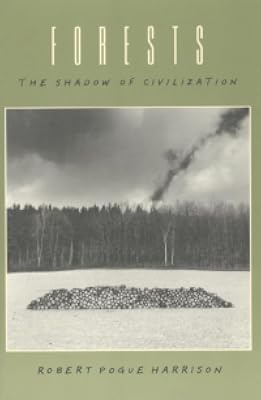
Forests: The Shadow of Civilization
by Robert Pogue Harrison
On This Page
Description
In this wide-ranging exploration of the role of forests in Western thought, Robert Pogue Harrison enriches our understanding not only of the forest's place in the cultural imagination of the West, but also of the ecological dilemmas that now confront us so urgently. Consistently insightful and beautifully written, this work is especially compelling at a time when the forest, as a source of wonder, respect, and meaning, disappears daily from the earth. "Forests is one of the most remarkable show more essays on the human place in nature I have ever read, and belongs on the small shelf that includes Raymond Williams' masterpiece, The Country and the City. Elegantly conceived, beautifully written, and powerfully argued, [Forests] is a model of scholarship at its passionate best. No one who cares about cultural history, about the human place in nature, or about the future of our earthly home, should miss it.-William Cronon, Yale Review "Forests is, among other things, a work of scholarship, and one of immense value . . . one that we have needed. It can be read and reread, added to and commented on for some time to come."-John Haines, The New York Times Book Review show lessTags
Recommendations









Member Reviews
Human civilization grew up and out of the shadows of the immense forests that came to cover all of the Northern Hemisphere at the conclusion of the most recent glacial event and are thus therefore, utterly, completely dependent on the forest at every level, from the most pragmatic to the most profound. That, in a nutshell, is Harrison's thesis. His purpose is to show (and he does not travel outside of western civilization to make his point, but it holds globally, I have no doubt at all) how this great truth informs every human creative and cultural impulse at the deepest level. From Gilgamesh to MacBeth, from Descartes to Conrad, from Rousseau to Thoreau, it seems that almost no change in the understanding of the human condition comes show more without, in some form or another, a "return" to the forest for inspiration, exploitation, or transformation. It was a brilliant exposition too of the the contradictions and limitations of the "enlightenment" view that through rational means man can be perfected. To do this requires denying "the shadow", that is, requires taming the wild and forested, which is nothing less than the massive destruction of nature, and ultimately, yes, ourselves. In the first three-quarters of the book, Harrison traces this evolution, in the final chapter he brings forth his final thesis, that having "left" the forest (nature) to live in dwellings we are forever separated from our "roots" (see how pervasive it is!); the closest we can get to nature is through the poetic mediation or "logos" or "bringing together" of the visionaries. He links our fear and denial of death (which nature "going into the forest" can teach us not to fear) with our wanton destructiveness of nature. In the final part of the book, making his point about the poetic "mediation" without which the little connection we have with "nature" is feeble at best, he discusses the work of Constable, Thoreau, an English poet named John Clare and an Italian poet named Andrea Zanzotto. The exegesis of a couple Constable's paintings was fascinating and illuminating, and his view on Thoreau added something new to the mix, his enthusiasm over Clare an Zanzotto--both poets so rooted to their home ground that the one went mad when he lost his home and the other never leaves home. Interesting to learn about and perhaps now I will see them everywhere. I'm not sure what I think of it all, but I am convinced it is very much worth meditating on in a serious way. One major take-away was a new understanding of how the medieval hunting forest preserve of the aristocrats and the "rational" forestry methods of the enlightenment period (in which it is assumed that everything on earth must be useful and exists for the benefit of mankind) are in a way, at the root of the warring factions between wildlife preservationists and the forestry industry today. ****1/2 show less
Ratings
Members
- Recently Added By
Lists

Mustich's 1000 Books to Read Before You Die: A Life Changing List
1,001 works; 19 members
Author Information
8 Works 611 Members
Robert Pogue Harrison is the Rosina Pierotti Professor of Italian literature and chair of graduate studies in Italian at Stanford University. He is the author of Forests: The Shadow of Civilization, The Dominion of the Dead, and Gardens: An Essay on the Human Condition, all published by the University of Chicago Press.
Awards and Honors
Notable Lists
Common Knowledge
- Original publication date
- 1992
- People/Characters
- Giambattista Vico; Gilgamesh; Artemis; Dionysus; Dante Alighieri; Rousseau, Jean-Jacques, 1712-1778 (show all 11); Joseph Conrad; William Wordsworth; Henry David Thoreau; Grimm brothers; William Shakespeare
- Epigraph
- De la Judée à Tunis, au Maroc, et d'autre part d'Athènes à Gênes, toutes ces cimes chauves qui regardent d'en haut la Méditerranée ont perdue leur couronne de culture, de forêts. Et reviendra-t-elle? Jamais. Si les an... (show all)tiques dieux, les races actives et fortes, sous qui fleurissaient ces rivages, sortaient aujourd'hui du tombeau, ils diraient: "Tristes peuples du Livre, de grammaire et de mots, de subtilités vaines, qu'avez-vous fait de la Nature?"
- Dedication
- For Michel Serres
Classifications
- Genres
- Science & Nature, Literature Studies and Criticism, Nonfiction, Fiction and Literature, Philosophy
- DDC/MDS
- 809.9336 — Literature & rhetoric Literature, rhetoric & criticism History, description, critical appraisal of more than two literatures Literature displaying specific features, miscellaneous writings Literature displaying other aspects Literature dealing with specific themes and subjects Physical and natural phenomena
- LCC
- PN56 .F64 .H37 — Language and Literature Literature (General) Literature (General) Theory. Philosophy. Esthetics
- BISAC
Statistics
- Members
- 231
- Popularity
- 140,874
- Reviews
- 1
- Rating
- (4.42)
- Languages
- English, French, Italian
- Media
- Paper, Audiobook, Ebook
- ISBNs
- 8
- ASINs
- 2