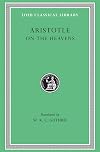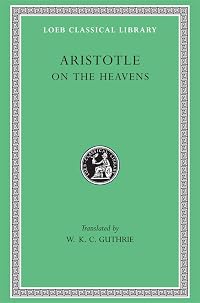
On the Heavens
by Aristotle
On This Page
Description
The science which has to do with nature clearly concerns itself for the most part with bodies and magnitudes and their properties and movements, but also with the principles of this sort of substance, as many as they may be. For of things constituted by nature some are bodies and magnitudes, some possess body and magnitude, and some are principles of things which possess these. Now a continuum is that which is divisible into parts always capable of subdivision, and a body is that which is show more every way divisible. show lessTags
Recommendations







Member Reviews
Even if I didn't think this was great reading (and I do) it would be an essential book for the powerful influence (some would say stranglehold, and say it justly) it had on culture and science for two millenia. I doubt Aristotle would have agreed to becoming dogma.
A fairly straightforward Aristotelian text. I felt it wasn't as great as some of his others.
Bought in high school
Ratings
Members
- Recently Added By
Lists

Books Referenced by Izetbegovic's Islam Between East and West
233 works; 2 members
Author Information

2,089+ Works 57,671 Members
Some Editions
Series
Belongs to Publisher Series
Work Relationships
Is contained in
Common Knowledge
- Canonical title
- On the Heavens
- Original title
- Περί ουρανού
- Alternate titles
- De Caelo; De Caelo et Mundo
- People/Characters
- Aristotle
- Important places
- Ancient Greece; Greece
- Important events
- Classical Antiquity; 4th century BCE
Classifications
- Genres
- Philosophy, Nonfiction, General Nonfiction, Science & Nature
- DDC/MDS
- 113 — Philosophy & psychology Metaphysics (existence, purpose, and the nature of reality) Cosmology (Philosophy of nature)
- LCC
- PA3612 .A8 .D4 — Language and Literature Greek language and literature. Latin language and literature Greek literature Translations
- BISAC
Statistics
- Members
- 169
- Popularity
- 194,559
- Reviews
- 3
- Rating
- (3.70)
- Languages
- 8 — English, Finnish, French, German, Greek (Ancient), Greek, Italian, Multiple languages
- Media
- Paper, Ebook
- ISBNs
- 23
- ASINs
- 6