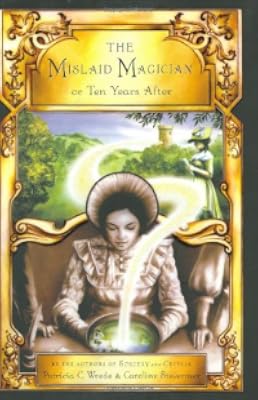
The Mislaid Magician, or, Ten Years After
by Patricia C. Wrede, Caroline Stevermer (Author)
Cecelia and Kate (3)
On This Page
Description
Family affairs don't stop cousins Cecelia and Kate from their magical duties in Regency England—"A thoroughly enchanting confection" (Kirkus Reviews).It's been a decade since Kate and Cecelia foiled Napoleon's plot to reclaim the French crown. The cousins now have estates, children, and a place at the height of wizarding society. It is 1828, and though magic remains at the heart of the British Empire, a new power has begun to make itself felt across England: the steam engine. As iron show more tracks crisscross the countryside, the shaking of the locomotives begins to disrupt the workings of English magic, threatening the very foundations of the Empire. A foreign wizard on a diplomatic mission to England vanishes, and the Prime Minister sends Cecelia's husband to investigate. In order to accompany her husband to the north of England, Cecelia leaves her children in Kate's care. As Cecelia and James fight for the future of magic, Kate is left with a no less daunting problem: how to care for a gaggle of disobedient, spell-casting tots. This ebook features illustrated biographies of Patricia C. Wrede and Caroline Stevermer including rare photos and never-before-seen documents from the authors' personal collections. Young Adult Fiction. Historical Fiction. Fantasy. show less
Tags
Recommendations






Member Reviews
Try saying that title three times fast. You'll turn blue in the face.
This is the third in the Sorcery and Cecilia series, which started with the truly delightful The Enchanted Chocolate Pot, and continued with the clunkier The Grand Tour. Given its predecessors, there was an even chance of another spiffing adventure, or a slightly disappointing romp.
Luckily, this one lands on the side of spiffingness. (Spifficosity? Spiffliness? Spifficity?) It is ten years later, our heroines - Cecy and Kate - are happily ensconced with their families, still merrily in love with their husbands, but now also with children and nannies underfoot. It has returned to the charming epistolary nature of the first book, with the friends separated once more by show more distance as Cecy and her husband go off to help out the Duke of Wellington find out what's happened to a missing magician who was doing some surveying work for a new train line. Meanwhile, Kate stays at home, minding all the children (with nannies, so it's not as much of a handful as you might expect!). This time we also get letters back and forth from the husbands. That was rather amusing, given that they tend to summarise the previous ten pages of flustered correspondance with a succinct comment.
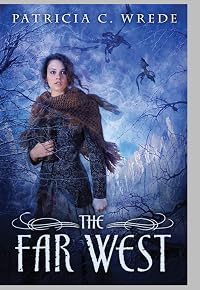
One flaw of this book is that I can never quite tell Cecy and Kate apart, they don't have very distinguishing voices in the narrative. (They even look nearly identical on the cover!) It's not really important (I couldn't tell them apart in any of the books, to be frank), but it is a flaw regardless. And that the plot gets ridiculously confusing in the final chapters. But, I don't read these for the plot so much as for the lovely interaction between Cecy and Kate. Or is that between Kate and Cecy?
Anyhow, this is recommended (although do read the first book!) to anyone who enjoys a silly romp through Regency England with a couple of delightful young women. show less
This is the third in the Sorcery and Cecilia series, which started with the truly delightful The Enchanted Chocolate Pot, and continued with the clunkier The Grand Tour. Given its predecessors, there was an even chance of another spiffing adventure, or a slightly disappointing romp.
Luckily, this one lands on the side of spiffingness. (Spifficosity? Spiffliness? Spifficity?) It is ten years later, our heroines - Cecy and Kate - are happily ensconced with their families, still merrily in love with their husbands, but now also with children and nannies underfoot. It has returned to the charming epistolary nature of the first book, with the friends separated once more by show more distance as Cecy and her husband go off to help out the Duke of Wellington find out what's happened to a missing magician who was doing some surveying work for a new train line. Meanwhile, Kate stays at home, minding all the children (with nannies, so it's not as much of a handful as you might expect!). This time we also get letters back and forth from the husbands. That was rather amusing, given that they tend to summarise the previous ten pages of flustered correspondance with a succinct comment.
One flaw of this book is that I can never quite tell Cecy and Kate apart, they don't have very distinguishing voices in the narrative. (They even look nearly identical on the cover!) It's not really important (I couldn't tell them apart in any of the books, to be frank), but it is a flaw regardless. And that the plot gets ridiculously confusing in the final chapters. But, I don't read these for the plot so much as for the lovely interaction between Cecy and Kate. Or is that between Kate and Cecy?
Anyhow, this is recommended (although do read the first book!) to anyone who enjoys a silly romp through Regency England with a couple of delightful young women. show less
Cecilia and her cousin Kate are back, now matrons with growing families. While Kate supervises all six of their children, plus one superfluous urchin, Cecy and her sadly non-magical husband James go looking for a missing wizard and get more than they bargained for. This is the second sequel, and I liked it much better than The Grand Tour. TGT was written in diary rather than letter format, which I think left something missing. Thomas and James exchange letters as well as the ladies, and on all sides the personal interaction is witty and entertaining.
Started on audio; finished on kindle
I’m delighted that the return to the epistolary format brought the series back to the quality of the first novel in the series! That was my hope, after feeling lukewarm with the 2nd in the trilogy. Seeing Thomas, Kate, James, and Cecilia as parents and enjoying further adventures was great fun. I was happy that Thomas and James joined in the letter-writing, and the pacing was much better in this third book. I was especially glad to see Kate get her magical groove on a couple of times. I was worried at first that thread from book 2 was being dropped.
Recommended for folks who like historical fantasy with humor and romance. If you’re looking for tame, light romance in a fantasy setting, this is for you.
I’m delighted that the return to the epistolary format brought the series back to the quality of the first novel in the series! That was my hope, after feeling lukewarm with the 2nd in the trilogy. Seeing Thomas, Kate, James, and Cecilia as parents and enjoying further adventures was great fun. I was happy that Thomas and James joined in the letter-writing, and the pacing was much better in this third book. I was especially glad to see Kate get her magical groove on a couple of times. I was worried at first that thread from book 2 was being dropped.
Recommended for folks who like historical fantasy with humor and romance. If you’re looking for tame, light romance in a fantasy setting, this is for you.
Better than The Grand Tour but still not up to the standard set by Sorcery and Cecelia. This book goes back to the original epistolary format, which helps it recover some of its charm, although I did find that initially I missed some of the interpersonal scenes that made it into the diaries of the second book but are not things that get included in letters - as if we'd been allowed to get closer to the characters by sharing more of their thoughts, and then pushed away again. I guess I'm trying to have it both ways, though. The magical peril in this book was more complicated and more interesting this time around, although what was happening to Cecy and James didn't seem to connect nearly as much as it could have to what was happening to show more Kate and Thomas... it was clear that the two authors had very different ideas going in, and they didn't manage to tie them together as well as they did the first (or even second) time through. Still, a lot of light, witty fun, and very charming. show less
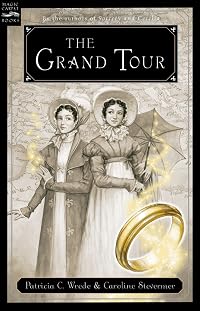
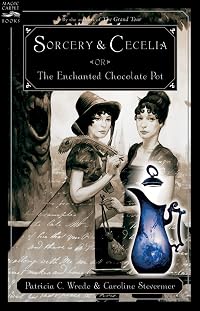
[The Grand Tour] and [The Mislaid Magician] by Patricia C. Wrede and Caroline Stevermer are the follow-ups to [Sorcery and Cecilia]. I have been searching diligently for these ever since I discovered they existed (H/T to ronincats). Finally, while browsing a local bookstore, I checked out the young adult section, which I rarely visit, and there they were. Apparently, I was looking in all the wrong places.
Anyway, [Sorcery and Cecilia] is an epistolary novel of letters exchanged between the two protagonists, Cecy and Kate, with the authors writing alternate chapters/letters. This format doesn't work for [The Grand Tour] because the two cousins are traveling together, so the conceit is modified: Cecy's subsequent deposition "to the Joint show more Representative of the British Ministry of Magic, the War Office, and the Foreign Office" alternate with Kate's journal entriers during their travels. The letters resume in [The Mislaid Magician] as Cecy travels and Kate stays home in parallel and ultimately converging plotlines. If you like the epistolary format, great; otherwise, avoid these books.
While [The Grand Tour] takes place immediately after the events in [Sorcery and Cecilia], [The Mislaid Magician] begins ten years later. Both couple now have children who play key roles in the story. Cecy and James are sent on a mission to investigate a Prussian magician/engineer who disappeared while conducting a survey of a rail line in northern England. Meanwhile, the plot at home is precipitated by the sudden visit of Kate's sister Georgiana, apparently in some sort of trouble. The plot thickens with the discovery of a kidnapped girl nearby. Neither of these arrivals will talk about their troubles, thus leaving Kate and Thomas and the children to muddle along trying to figure things out. Cecy and James quickly run into Georgy's husband Daniel and become embroiled in a house party hosted by the Webbs, a sister and brother of dubious background and intentions. Cecy and James discreetly inquire about the missing Herr Schellen while navigating the social shoals and magical mysteries at Haliwar Tower, the home of the Webbs.
All three books share a similar lighthearted and fun style. They are an entertaining fusion of Regency romance, mystery, and fantasy. The characters are amusing and the dialogue well done, and the plot keeps rolling along. The comedy and tone are reminiscent of [[Connie Willis]], most notably, her time traveling novel [To Say Nothing of the Dog], itself modeled on the Victorian classic [Three Men in a Boat]. The stories and characters are not deep, and the plots are predictable. These books are neither art nor literature, but a very pleasant way to spend several hours. I won't touch on issues of diversity, stereotypes, tropes, etc., since these books follow the generally narrow genre formulas and conventions associated with the Regency-period setting. show less
Anyway, [Sorcery and Cecilia] is an epistolary novel of letters exchanged between the two protagonists, Cecy and Kate, with the authors writing alternate chapters/letters. This format doesn't work for [The Grand Tour] because the two cousins are traveling together, so the conceit is modified: Cecy's subsequent deposition "to the Joint show more Representative of the British Ministry of Magic, the War Office, and the Foreign Office" alternate with Kate's journal entriers during their travels. The letters resume in [The Mislaid Magician] as Cecy travels and Kate stays home in parallel and ultimately converging plotlines. If you like the epistolary format, great; otherwise, avoid these books.
While [The Grand Tour] takes place immediately after the events in [Sorcery and Cecilia], [The Mislaid Magician] begins ten years later. Both couple now have children who play key roles in the story. Cecy and James are sent on a mission to investigate a Prussian magician/engineer who disappeared while conducting a survey of a rail line in northern England. Meanwhile, the plot at home is precipitated by the sudden visit of Kate's sister Georgiana, apparently in some sort of trouble. The plot thickens with the discovery of a kidnapped girl nearby. Neither of these arrivals will talk about their troubles, thus leaving Kate and Thomas and the children to muddle along trying to figure things out. Cecy and James quickly run into Georgy's husband Daniel and become embroiled in a house party hosted by the Webbs, a sister and brother of dubious background and intentions. Cecy and James discreetly inquire about the missing Herr Schellen while navigating the social shoals and magical mysteries at Haliwar Tower, the home of the Webbs.
All three books share a similar lighthearted and fun style. They are an entertaining fusion of Regency romance, mystery, and fantasy. The characters are amusing and the dialogue well done, and the plot keeps rolling along. The comedy and tone are reminiscent of [[Connie Willis]], most notably, her time traveling novel [To Say Nothing of the Dog], itself modeled on the Victorian classic [Three Men in a Boat]. The stories and characters are not deep, and the plots are predictable. These books are neither art nor literature, but a very pleasant way to spend several hours. I won't touch on issues of diversity, stereotypes, tropes, etc., since these books follow the generally narrow genre formulas and conventions associated with the Regency-period setting. show less
Another very enjoyable book in this series. Wrede and Stevermer maintain their tone well despite co-writing, and weave a story which is mysterious but not Byzantine. As usual, it's a fun and easy read.
At the same time, two minor qualifications. The division between male and female characters is very clear from their writing, but despite reading this in a single session, I sometimes found myself unsure of which man or woman was writing. Their voices are rather similar, and I found I mostly used the content of the letters, or even the signatures, to confirm identities. This was particularly an issue once family members started shuffling around between the two! I suspect this is down to the books' origins, since on my reading, the women show more are essentially both Georgette Heyer Heroine and the men Georgette Heyer Hero, both of them a little generic as a result. They have their own distinguishing traits and interests, but don't feel especially different in personality or voice.
The second is that, as I understand it, they write these plots by adding to each others' letters, as in some parlour games, and then edit it afterwards. As a result, the plot is generally creative, but does have a certain organic handwaviness to it, rather than the tight plot and internal consistency a single writer usually achieves. Disparate elements are woven together, and though mostly good, there's a lingering flavour of the parlour game left on it. I don't particularly feel this detracts, but more demanding readers may. show less
At the same time, two minor qualifications. The division between male and female characters is very clear from their writing, but despite reading this in a single session, I sometimes found myself unsure of which man or woman was writing. Their voices are rather similar, and I found I mostly used the content of the letters, or even the signatures, to confirm identities. This was particularly an issue once family members started shuffling around between the two! I suspect this is down to the books' origins, since on my reading, the women show more are essentially both Georgette Heyer Heroine and the men Georgette Heyer Hero, both of them a little generic as a result. They have their own distinguishing traits and interests, but don't feel especially different in personality or voice.
The second is that, as I understand it, they write these plots by adding to each others' letters, as in some parlour games, and then edit it afterwards. As a result, the plot is generally creative, but does have a certain organic handwaviness to it, rather than the tight plot and internal consistency a single writer usually achieves. Disparate elements are woven together, and though mostly good, there's a lingering flavour of the parlour game left on it. I don't particularly feel this detracts, but more demanding readers may. show less
It is the early nineteenth century and the age of steam is just getting underway. However, in this version of history magic exists and is recognized. There is a Royal Society of Magicians and Lord Wellington, now Prime Minister, employs wizards as well as generals to guard the realm. A German magician dispatched to investigate accidents on a railway line has gone missing. Ley lines appear to be involved, as well as a kidnapped child, a hysterical Dutchess and some very inventive children. Quite fun.
Members
- Recently Added By
Lists

Female Protagonist
1,056 works; 57 members

Books Read in 2023
5,547 works; 145 members

Readers Guide to Steampunk
65 works; 1 member

Books Read in 2018
4,360 works; 110 members

Favorite Epistolary Fiction
143 works; 144 members

Best Cozy Fantasy
46 works; 8 members
Author Information

42+ Works 41,581 Members
Patricia Collins Wrede is an American fantasy writer, born 1953 in Chicago, Illinois; she is the eldest of five children. She graduated from Carleton College in 1974 with a BA in Biology. She earned an MBA from University of Minnesota in 1977. She finished her first book in 1978. She is a full-time writer. She is a vegetarian and lives in show more Minneapolis, Minnesota with her three cats. (Bowker Author Biography) show less

Some Editions
Series

Work Relationships
Is contained in
Common Knowledge
- Canonical title
- The Mislaid Magician, or, Ten Years After
- Original publication date
- 2006
- People/Characters
- Elizabeth Rushton; Katherine Talgarth "Kate" Schofield; Thomas Schofield; Cecelia Rushton Tarleton; James Tarleton; Alexandrina Victoria, Queen of the United Kingdom
- Important places
- England, UK
- First words
- Dearest Kate, It was splendid to see you and Thomas and your boys again this fortnight past.
- Quotations
- She who laughs last may not invariably laugh best, but she does laugh.
- Last words
- (Click to show. Warning: May contain spoilers.)Even a new and interesting magical tutor is unlikely to completely deter my twins, after all.
Your contented,
Cecy.
Classifications
- Genres
- Fiction and Literature, Teen, Fantasy, Young Adult
- DDC/MDS
- 813.54 — Literature & rhetoric American literature in English American fiction in English 1900-1999 1945-1999
- LCC
- PZ7 .W915 .M — Language and Literature Fiction and juvenile belles lettres Fiction and juvenile belles lettres Juvenile belles lettres
- BISAC
Statistics
- Members
- 1,147
- Popularity
- 21,952
- Reviews
- 41
- Rating
- (3.72)
- Languages
- English
- Media
- Paper, Audiobook, Ebook
- ISBNs
- 10
- ASINs
- 6