Aran Knitting
by Alice Starmore
On This Page
Description
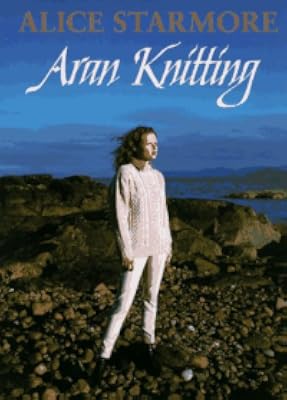
The definitive guide to the ever-popular Irish Aran sweater, Starmore's highly sought after book returns in a revised and expanded version. It encompasses a history of Aran knitting; a complete workshop in technique, pattern, and design; 60 charted patterns include the original edition's 14 designs, plus a new garment. Color photographs depict finished caps, sweaters, and shawls.Tags
Recommendations







Member Recommendations

Member Reviews
Although I've had this book for at least five years, have gone through the patterns many times, and have even knitted some, until yesterday I had never read Alice Starmore's chapter on the historical background of Aran knitting, nor had I read her preface to this edition. It was a whole new take on the subject, something I had thought I knew something about -- why I've even designed some sweaters that would fall into this classification.
[Aran Knitting] was originally published in 1997. My edition is a newer and expanded one published by Dover in 2010. In it, Starmore reflects on her initial 1997 discussion of Aran knitting and the continued insistence by so many on ignoring the evidence that it is neither a centuries old tradition of show more stitch combinations, not a traditional fisher's garment. Wait a minute, where did all those stories come from? was my immediate thought.
Starmore thoughtfully and methodically lays out her arguments. She does it so well that the reader is left with little choice but to agree. Her idea that ignoring the evidence she provides is rooted in commercial interest has the ring of truth to it. She discusses some of the standard texts such as Richard Rutt's "A History of Knitting", explaining where her theories differ. Then, based on her own experience with the 1992 publication of her book "The Celtic Connection", she shows how that technique, "acknowledged as a completely new direction in colourwork, texture and cable knitting", has over the years become part of the lore of the "history" of knitting, comparing that development with the development of the romantic ideas around Aran knitting.
Here then are Starmore's conclusions, in her own words:
on construction and style
- The Aran sweater was developed from the traditional Scottish gansey.
- Aran women learned gansey knitting skills from a Scottish source or sources.
- The Aran sweater was not made as a fisherman's garment.
- The impetus behind the development of the Aran sweater was commercial.
- Aran "tradition" involving the Aran sweater is of recent origin, beginning only after 1946.
- Contrary to belief, the Aran sweater was not made from heavy, unscoured, naturally oily wool, spun straight from the sheep's back.
more controversially, on pattern
- Aran sweaters have no connection with ancient Celtic sources, unless it is on a purely superficial level.
- Most of the Aran patterns were born in the mind of an excellent gansey knitter.
- Commercial forces shaped the development of Aran sweater patterns, just as they shaped the method of construction
Now I have a whole new way of looking at and thinking about these designs. show less
[Aran Knitting] was originally published in 1997. My edition is a newer and expanded one published by Dover in 2010. In it, Starmore reflects on her initial 1997 discussion of Aran knitting and the continued insistence by so many on ignoring the evidence that it is neither a centuries old tradition of show more stitch combinations, not a traditional fisher's garment. Wait a minute, where did all those stories come from? was my immediate thought.
Starmore thoughtfully and methodically lays out her arguments. She does it so well that the reader is left with little choice but to agree. Her idea that ignoring the evidence she provides is rooted in commercial interest has the ring of truth to it. She discusses some of the standard texts such as Richard Rutt's "A History of Knitting", explaining where her theories differ. Then, based on her own experience with the 1992 publication of her book "The Celtic Connection", she shows how that technique, "acknowledged as a completely new direction in colourwork, texture and cable knitting", has over the years become part of the lore of the "history" of knitting, comparing that development with the development of the romantic ideas around Aran knitting.
Here then are Starmore's conclusions, in her own words:
on construction and style
- The Aran sweater was developed from the traditional Scottish gansey.
- Aran women learned gansey knitting skills from a Scottish source or sources.
- The Aran sweater was not made as a fisherman's garment.
- The impetus behind the development of the Aran sweater was commercial.
- Aran "tradition" involving the Aran sweater is of recent origin, beginning only after 1946.
- Contrary to belief, the Aran sweater was not made from heavy, unscoured, naturally oily wool, spun straight from the sheep's back.
more controversially, on pattern
- Aran sweaters have no connection with ancient Celtic sources, unless it is on a purely superficial level.
- Most of the Aran patterns were born in the mind of an excellent gansey knitter.
- Commercial forces shaped the development of Aran sweater patterns, just as they shaped the method of construction
Now I have a whole new way of looking at and thinking about these designs. show less
Since its original publication in 1997, Alice Starmore's Aran Knitting has been considered a classic. The book begins with a history of Aran knitting, based on analysis of eleven historical Aran knitted garments in the collection of the National Museum of Ireland. This section is followed by 48 pages of charted cable patterns, in which Starmore explains the construction techniques and illustrates the ways in which new variations can be developed from existing patterns.
The pattern section in the 2010 reprint includes the same 14 garments as the first edition, with additional sizes for most, plus one new pattern, a shaped cardigan in sport weight yarn. With only one exception, these patterns are gorgeous; I immediately added half of them show more to my queue on Ravelry. This book is an excellent resource for anyone interested in cable knitting. show less
The pattern section in the 2010 reprint includes the same 14 garments as the first edition, with additional sizes for most, plus one new pattern, a shaped cardigan in sport weight yarn. With only one exception, these patterns are gorgeous; I immediately added half of them show more to my queue on Ravelry. This book is an excellent resource for anyone interested in cable knitting. show less
Excellent researched history of Aran Islands knitting including museum pieces and patterns inspired by them.
paperback
Ratings
Members
- Recently Added By
Lists

Best Books of Knitting Patterns
60 works; 6 members
Author Information

20 Works 6,176 Members
Series
Belongs to Publisher Series
Common Knowledge
- Original publication date
- 1997
Classifications
- Genres
- Home & Garden, Nonfiction, Art & Design, General Nonfiction
- DDC/MDS
- 746.4320432 — Arts & recreation Drawing & decorative arts Fashion Design / Weaving, Knitting, Embroidery Needlework and handwork Knitting, crocheting, tatting Knitting Standard subdivisions
- LCC
- TT819 .I73 .S7 — Technology Handicrafts. Arts and crafts Handicrafts. Arts and crafts Home arts. Homecrafts
Statistics
- Members
- 752
- Popularity
- 37,358
- Reviews
- 6
- Rating
- (4.60)
- Languages
- English
- Media
- Paper
- ISBNs
- 2
- UPCs
- 1