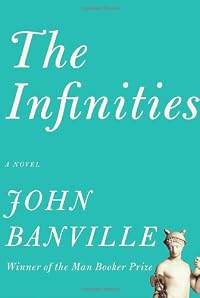
The Infinities
by John Banville
On This Page
Description
On a languid midsummer's day in the countryside, old Adam Godley, a renowned theoretical mathematician lies dying. Gathered around him are his family: Adam, his son; Adam's wife; Petra, his daughter; his wife Ursula, stepmother to his children; and his daughter's young man. But the Godley family is not alone in their vigil. Around them hovers a family of mischievious immortals who begin to stir up trouble to sometimes wildly unintended effect.Tags
Recommendations















Member Reviews
Ostensibly, this is book about a dying man, whose family assembles around him and waits for him to draw his final breath - a conventional enough device, second only to the old standbys of a family assembling for the holidays, a marriage or a funeral. Ostensibly. In actuality, that's just a jump-off point for what I can only describe as a romp through nearly every theme touched on by classic literature, from existential ruminations on the meaning of life to the bawdy realities of what that life actually involves for the people that live it.
On the surface, it's the story of the dying Adam Godley (take heed of the name...), his wife, Ursula, son Adam and daughter Petra (think of the meaning of her name - stone); and Adam junior's wife, show more Helen (whose name also will prove meaningful.) But it's also narrated by the gods of Olympus, who, as is their wont, have decided to alleviate their boredom or pursue their lusts by descending to involve themselves in the concerns of the Godley family. The narrator is Hermes - or is it? As his voice seems to blur and meld with that of the dying Adam in the final pages. Zeus covets Helen and commands Hermes to hold back the dawn so that he can have his way with her. And then Pan, in the form of Benny Grace, shows up on the doorstep...
There's no way to summarize what happens in this novel, and indeed what happens, event-wise, seems less important for Banville than finding a way to make us think about the world we inhabit. It's a world where the immortals are as present as the `infinities' of the title, which the dying Adam, a mathematician, discovered. Why would the gods come back? Well, Hermes points out in a matter-of-fact manner, they never left. "We merely made it seem that we had withdrawn, for a decent interval, as if to say we know when we are not wanted," he explains. "At the same time, we cannot resist revealing ourselves to you once in a while, out of our incurable boredom, our love of mischief, or that lingering nostalgia we harbour for this rough world of our making."
Adam and the family dog appear to be the only members of the household to suspect the presence of the immortals amongst them. Adam recognizes it intellectually - after all, if there are infinities, shouldn't there be immortal beings that inhabit them? - while the dog recognizes it on a more visceral level, along with the innate human fear of death. Meanwhile, the others will have their lives reshaped by the gods in ways they may not understand, or attribute to chance.
This is a fascinating book, but one that - despite the constant references to every possible bodily function and fluid imaginable - is all about ideas, likely to appeal to those who can pick up on all of Banville's allusions to classic drama or alternative history. as I was reading, there were often moments where I felt he was present at my shoulder, whispering "get it?" and giving me a sly wink or a nudge in the manner of the Olympians in his novel. I don't usually have a taste for surreal elements creeping into a book, or self-conscious wit, but ultimately Banville won me over with his combination of luscious writing and comic insights into human frailty.
Highly recommended to anyone with a taste for literary fiction, but not for anyone who finds themselves disliking novels that are more about people thinking than doing stuff. (If you haven't enjoyed anything else by Banville, the odds are high that you won't like this one.) I've rated it 4.5 stars, rounded up to 5. show less
On the surface, it's the story of the dying Adam Godley (take heed of the name...), his wife, Ursula, son Adam and daughter Petra (think of the meaning of her name - stone); and Adam junior's wife, show more Helen (whose name also will prove meaningful.) But it's also narrated by the gods of Olympus, who, as is their wont, have decided to alleviate their boredom or pursue their lusts by descending to involve themselves in the concerns of the Godley family. The narrator is Hermes - or is it? As his voice seems to blur and meld with that of the dying Adam in the final pages. Zeus covets Helen and commands Hermes to hold back the dawn so that he can have his way with her. And then Pan, in the form of Benny Grace, shows up on the doorstep...
There's no way to summarize what happens in this novel, and indeed what happens, event-wise, seems less important for Banville than finding a way to make us think about the world we inhabit. It's a world where the immortals are as present as the `infinities' of the title, which the dying Adam, a mathematician, discovered. Why would the gods come back? Well, Hermes points out in a matter-of-fact manner, they never left. "We merely made it seem that we had withdrawn, for a decent interval, as if to say we know when we are not wanted," he explains. "At the same time, we cannot resist revealing ourselves to you once in a while, out of our incurable boredom, our love of mischief, or that lingering nostalgia we harbour for this rough world of our making."
Adam and the family dog appear to be the only members of the household to suspect the presence of the immortals amongst them. Adam recognizes it intellectually - after all, if there are infinities, shouldn't there be immortal beings that inhabit them? - while the dog recognizes it on a more visceral level, along with the innate human fear of death. Meanwhile, the others will have their lives reshaped by the gods in ways they may not understand, or attribute to chance.
This is a fascinating book, but one that - despite the constant references to every possible bodily function and fluid imaginable - is all about ideas, likely to appeal to those who can pick up on all of Banville's allusions to classic drama or alternative history. as I was reading, there were often moments where I felt he was present at my shoulder, whispering "get it?" and giving me a sly wink or a nudge in the manner of the Olympians in his novel. I don't usually have a taste for surreal elements creeping into a book, or self-conscious wit, but ultimately Banville won me over with his combination of luscious writing and comic insights into human frailty.
Highly recommended to anyone with a taste for literary fiction, but not for anyone who finds themselves disliking novels that are more about people thinking than doing stuff. (If you haven't enjoyed anything else by Banville, the odds are high that you won't like this one.) I've rated it 4.5 stars, rounded up to 5. show less
I should have bought my own copy of The Infinities; it’s a book to linger over, not read in haste because it’s due back at the library. It is a beautiful book.
I like Banville’s playful characterisation. This is a story about a household reunion because the patriarch old Adam Godley is dying, but the household is watched over by the ancient Greek gods. They watch the vigil with cynical amusement and mild jealousy; they interfere out of malice and selfishness. They are petty and vindictive; they are sensual and spiteful. Humans are their playthings, an amusing diversion, yet Hermes thinks of himself as benign too:
I hover in the air above them, my chlamys spread as wide as it will go, in the attitude of Piero’s Madonna della show more Misericordia, protecting my little band of mortal sinners. I am not all sneers and scathings, you see, I have my gentler side. (p194)
Only a master like Banville could pull this off without it seeming ridiculous!
This playful tale also has a serious side. It deals with death, in an age when some of us in wealthy western societies can live well into middle age before the loss of someone we care about. Young Adam is surprised by the unexpected emotions that beset him when he sits by his dying father’s bedside, and he also has to confront all the issues that family reunion brings when relationships are strained and individuals are not really compatible. One should behave well at family gatherings of this type, but oh dear! it’s not easy!
Read the rest at http://anzlitlovers.wordpress.com/2010/07/02/the-infinities-by-john-banville/ show less
I like Banville’s playful characterisation. This is a story about a household reunion because the patriarch old Adam Godley is dying, but the household is watched over by the ancient Greek gods. They watch the vigil with cynical amusement and mild jealousy; they interfere out of malice and selfishness. They are petty and vindictive; they are sensual and spiteful. Humans are their playthings, an amusing diversion, yet Hermes thinks of himself as benign too:
I hover in the air above them, my chlamys spread as wide as it will go, in the attitude of Piero’s Madonna della show more Misericordia, protecting my little band of mortal sinners. I am not all sneers and scathings, you see, I have my gentler side. (p194)
Only a master like Banville could pull this off without it seeming ridiculous!
This playful tale also has a serious side. It deals with death, in an age when some of us in wealthy western societies can live well into middle age before the loss of someone we care about. Young Adam is surprised by the unexpected emotions that beset him when he sits by his dying father’s bedside, and he also has to confront all the issues that family reunion brings when relationships are strained and individuals are not really compatible. One should behave well at family gatherings of this type, but oh dear! it’s not easy!
Read the rest at http://anzlitlovers.wordpress.com/2010/07/02/the-infinities-by-john-banville/ show less
I wanted to like this book! The story is beautifully narrated by Hermes and revolves around the deathbed of the Godley family patriarch. While the family all waits together they are attended by the eternal family of the Greek gods. Zeus and Hermes are transfixed by the daily drama of these darling mortals they have come to know.
I'll be honest, I drifted in and out with this book. The prose is lovely but dense. It felt like a story I was being read as I tried to sleep. I remember bits and pieces but large spots are blank so I know I must have nodded off for awhile.
I'll be honest, I drifted in and out with this book. The prose is lovely but dense. It felt like a story I was being read as I tried to sleep. I remember bits and pieces but large spots are blank so I know I must have nodded off for awhile.
John Banville is one of the great stylists of contemporary English-language fiction, and his abundant talents are on exuberant, rollicking display in The Infinities. The action of the novel takes place over a single day, as Adam Godley, the famous theoretical mathematician, lies dying in a top floor room of his huge country home (called Arden House). Surrounding him are his much younger wife Ursula (a closet alcoholic), his neurotic and profoundly insecure daughter Petra, his ungainly and impressionable son Adam, and young Adam's beautiful wife Helen. These and others drift through the day and the grounds that surround the house, waiting for old Adam to breathe his last, haunted by buried desires and secret torments. Present as well are show more a clutch of pagan deities: randy and conniving Zeus, and the voluble Hermes, who provides ironic commentary in the genial voice of a host showing off his most prized possessions. The novel has the dewy, sun-dappled radiance of a Merchant Ivory film. Nothing escapes the author's keen eye, including the dust motes slowly settling in the angled sunlight. No one can surpass Banville when it comes to creating full-blooded characters and exposing their true motives. But in this novel, there is a chance that he allows playfulness and ironic distance too much dominion. While certainly enjoyable and filled with examples of the author's astonishing verbal fluency, the novel comes across as lightweight, insubstantial, a bit of fluff. The Infinities will please Banville's admirers, but it is probably not the book to start with if you are approaching this author for the first time. show less
As old Adam Godley lies in a coma in the top room of the house, presumed to be dying, his family gathers. His alcoholic wife, Ursula’ son Adam and daughter-in-law Helen; somewhat mad daughter Petra; erstwhile biographer Roddy; housekeeper (and former owner of the house, fallen on hard times) Ivy; and the cowman, Duffy, mingle in the house along with some Greek gods, both seen and unseen (and in one case, felt)- Zeus, temporarily in love/lust with Helen, Pan in his guise of a long time friend of old Adam, and Hermes, the main narrator. The gods toy with the humans, as they always do, playing with their relationships, messing about with time and deciding on future events. We slowly realize that the story takes place in an alternative show more universe, one where cars run on salt water, yet steam trains ride the rails. Old Adam is a mathematician who proved, years ago, that the theory of relativity was dead wrong and overturned everything that was known about physics.
Taking place over the course of one day, there is not a plot so much as there is a group of people (including gods) reacting to events and thinking about and seeking love of different sorts. Banville’s prose is lovely; he plays with language and Classic allusions like they are pretty toys. The narrative voice is mostly Hermes, but sometimes old Adam takes up the reins and muses over his past and his regrets. While it might seem that this wouldn’t make much of a book, it’s oddly compelling- I couldn’t put it down- because, after all, what’s more important to humans than love and death? show less
Taking place over the course of one day, there is not a plot so much as there is a group of people (including gods) reacting to events and thinking about and seeking love of different sorts. Banville’s prose is lovely; he plays with language and Classic allusions like they are pretty toys. The narrative voice is mostly Hermes, but sometimes old Adam takes up the reins and muses over his past and his regrets. While it might seem that this wouldn’t make much of a book, it’s oddly compelling- I couldn’t put it down- because, after all, what’s more important to humans than love and death? show less
I loved this book. The characters are amazing, and each one charming in his or her own way, and their interactions with one another, also a source of endless delight. To be introduced to such an interesting group of people at such a critical watershed event in their lives, is almost all one could possibly want. The story -- or I should say, interleaved and interpenetrating stories -- well, I found those compelling too, but once you care about the characters, perhaps that's not surprising. I entered this book with no expectations -- the way to read most books, I think -- and immediately saw it as a book to be savored. So leave your expectations at the door, prepare to savor the prose and the portraits of the people involved, and perhaps show more you'll get swept up into the maelstrom just as I did. show less
Old Adam Godley, a theoretical mathematician whose theories about the infinite universes that surround and intersect our own have revolutionized the way physicists and mathematicians conceive of the world, lies dying. Paralyzed and comatose, he lies in state in the upper room of his English country manor while around him, his disfunctional family goes about the business of living in the presence of death. Godley’s son, also named Adam, is a giant in stature but has always been overshadowed by his famous father’s metaphorical height. Adam’s supermodel-lovely wife, Helen, is an actress by profession and walking the stage in her daily life as well. Shrill daughter Petra is damaged inside and out by a turbulent, morbid, and obsessive show more mind; and wife Ursula is fragile and secretly (or not so secretly) alchoholic. But the family is not alone on this momentous day, when old Adam may or may not die. Flitting amongst them are the inhabitants of one of old Adam’s “infinities,” known to us as the gods of the Greek pantheon. The narrator is Hermes (unless perhaps he is old Adam himself), and he is joined in his observation of the Godley family by his lascivious father Zeus (who’s only there because of the gorgeous Helen) and the mischievous Pan in the guise of Benny Grace, an old business associate of Adam’s.
Bewitching and, at times, bewildering, “The Infinities” is a luminous meditation on desire, fragility, and identity. Light on plot and heavy on a sort of wry philosophy, the book is worth the ride for the sheer beauty of the language itself. show less
Bewitching and, at times, bewildering, “The Infinities” is a luminous meditation on desire, fragility, and identity. Light on plot and heavy on a sort of wry philosophy, the book is worth the ride for the sheer beauty of the language itself. show less
Members
- Recently Added By
Published Reviews
ThingScore 88
If “The Infinities” has the bones of a novel of ideas, it’s fleshed out and robed as a novel of sensibility and style. Its drapery is velvet and brocade — sumptuous and at times over-heavy.
added by Shortride
Banville brings us the gods in as many forms as the ancients saw them. They behave badly, as they do in Homer, and as Plato so regretted; but then, they are familiar with perfect ideas that humans can grope for while they live, but can only know either before they are born, or as they die, as Plato explained. ... In Banville’s hands, ancient civilisation has become another realm in which all show more permutations are possible. show less
added by paradoxosalpha
Lists

Best 21st Century Books (So Far)
670 works; 86 members

Top 50 Favourite Books
50 works; 2 members
Author Information

90+ Works 28,013 Members
Some Editions
Awards and Honors
Series
Belongs to Publisher Series
L'eclèctica (187)
Common Knowledge
- Canonical title
- The Infinities
- Original title
- The Infinities
- Original publication date
- 2009
- First words
- Of the things we fashioned for them that they might be comforted, dawn is the one that works.
- Last words
- (Click to show. Warning: May contain spoilers.)Helen looks back, and sees his look. She presses a hand to her womb.
'Oh!' - Original language
- English
Classifications
Statistics
- Members
- 1,046
- Popularity
- 24,537
- Reviews
- 44
- Rating
- (3.52)
- Languages
- 11 — Catalan, Dutch, English, French, German, Hebrew, Italian, Japanese, Portuguese, Spanish, Turkish
- Media
- Paper, Audiobook, Ebook
- ISBNs
- 32
- ASINs
- 10
