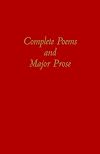
Complete Poems and Major Prose
by John Milton
On This Page
Description
TEXTBOOK CONTAINING THE COMPLETE POEMS AND MAJOR PROSE OF JOHN MILTON.Tags
Recommendations











Member Reviews
Finally, I made it to Milton! Reading this as an adult was a real treat. There are three larger sections and this is a long review, but this work as a whole seems to be under-reviewed and deserves comment. Additionally, there may be some spoilers, though basic familiarity with Biblical stories will have already provided them as well.
The first section is short poetry. Milton's poems use pastoral life, the Greek and Roman Gods, and Christian beliefs to comment on the deaths of acquaintances and friends, corruption in the clergy, virtue, divorce, and what for him would be some modern political events. Much of it is written in Latin and translated and some of it is Milton's translation from Greek or Hebrew (the Psalms). For a modern reader show more the explanatory notes are essential because he used so much of the stories of the gods. I was not interested in deep understanding of most of these poems, but it was worth reading once to get a feel for the style of the younger vs. the older Milton and to add to a basic understanding of what was important to him.
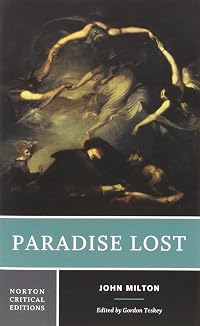
The second section includes Milton's three longer poetic works, Paradise Lost, Paradise Regained, and Samson Agonistes.
Paradise Lost includes a great deal of time spent on the world of Satan and explaining the physical processes whereby Lucifer and his crew were kicked out of heaven, hell was constructed, the earth was created, and Satan got out of heaven to go and tempt Eve and Adam to be corrupted. Free will is discussed- inadequately. Although there is an effort made to show that there is truly free will without coercion, this is not the case because of the superior understandings of the heavenly and formerly heavenly folk. The whole situation felt fatalistic, despite Milton's intent and explanation. It is interesting that although Eve is blamed, she is never as fully informed as Adam about what exactly might occur because of Satan's attempt. Eve is presented as less intelligent than Adam and Adam from a modern perspective is presented as a jerk, blaming Eve rather than sticking by her. The characterization of Adam and Eve was effective even though limited by Milton's understanding of the role of women and men. I was surprised by Jesus' presence with God the father during the time of Adam and Eve, before having been born to Mary. There were several instances of unexpected humor presented throughout this work.
Paradise Regained was less interesting. It is the story of Satan tempting Jesus. This temptation is ineffective, which means that humans now have the possibility to regain paradise. Satan is kind of obnoxious here- we know that he will not be successful, he just kind of buzzes around being annoying. The interesting part was Satan describing the knowledge of the Greeks and Jesus commenting that he is familiar with it. Milton is very familiar with classical references and uses them throughout all of his work.
Samson Agonistes is a drama about Samson, modeled after a Greek tragedy. It was effective but unremarkable, especially when compared with Milton's other work.
The third section is prose. It includes a variety of topics. Some of it was speeches made at college, and it was interesting to view his earlier work. He appeared very interested in education and in explaining the problems within the Anglican church, but the two most interesting pieces addressed divorce and censorship. It cannot have been a popular thing among the clergy for him to explain that the Bible allows divorce and to plead for pity on people who, due to lack of experience, innocently marry someone with whom they are not compatible. Aeropagitica is a plea for partial freedom of the press. Milton explained that bad material can be read productively by thoughtful readers and that good material may be worthless to those who are not of discerning judgment. He explained that such censorship, to be effective, must cover more than just written work (music, theater, conversation), and that it is impossible to manage every idea. He explained the problem of finding appropriate censors- the skilled, discerning readers do not want the job, and the willing are not capable of it. After Aeropagitica, other political writings are included, such as a defense of the execution of Charles I, a defense of his defense, explanation of the limited rights of monarchs, and the importance of reading the Bible and forming conclusions without interference from church officials. Much of Milton's prose was moving, some of it was repetitive, and parts of it required the use of the textual notes to understand.
I leave this book with a great deal of respect for Milton. Even with this respect, it must be acknowledged that his writing was definitely representative of the values of his times and context, including a discounting of all that was not Christian. For him this meant atheists, agnostics, "papists," and even Presbyterians (though this was more political). If I were to recommend parts of this work, the two most essential would be Paradise Lost and Aeropagitica, though there is value in all of it. show less
The first section is short poetry. Milton's poems use pastoral life, the Greek and Roman Gods, and Christian beliefs to comment on the deaths of acquaintances and friends, corruption in the clergy, virtue, divorce, and what for him would be some modern political events. Much of it is written in Latin and translated and some of it is Milton's translation from Greek or Hebrew (the Psalms). For a modern reader show more the explanatory notes are essential because he used so much of the stories of the gods. I was not interested in deep understanding of most of these poems, but it was worth reading once to get a feel for the style of the younger vs. the older Milton and to add to a basic understanding of what was important to him.
The second section includes Milton's three longer poetic works, Paradise Lost, Paradise Regained, and Samson Agonistes.
Paradise Lost includes a great deal of time spent on the world of Satan and explaining the physical processes whereby Lucifer and his crew were kicked out of heaven, hell was constructed, the earth was created, and Satan got out of heaven to go and tempt Eve and Adam to be corrupted. Free will is discussed- inadequately. Although there is an effort made to show that there is truly free will without coercion, this is not the case because of the superior understandings of the heavenly and formerly heavenly folk. The whole situation felt fatalistic, despite Milton's intent and explanation. It is interesting that although Eve is blamed, she is never as fully informed as Adam about what exactly might occur because of Satan's attempt. Eve is presented as less intelligent than Adam and Adam from a modern perspective is presented as a jerk, blaming Eve rather than sticking by her. The characterization of Adam and Eve was effective even though limited by Milton's understanding of the role of women and men. I was surprised by Jesus' presence with God the father during the time of Adam and Eve, before having been born to Mary. There were several instances of unexpected humor presented throughout this work.
Paradise Regained was less interesting. It is the story of Satan tempting Jesus. This temptation is ineffective, which means that humans now have the possibility to regain paradise. Satan is kind of obnoxious here- we know that he will not be successful, he just kind of buzzes around being annoying. The interesting part was Satan describing the knowledge of the Greeks and Jesus commenting that he is familiar with it. Milton is very familiar with classical references and uses them throughout all of his work.
Samson Agonistes is a drama about Samson, modeled after a Greek tragedy. It was effective but unremarkable, especially when compared with Milton's other work.
The third section is prose. It includes a variety of topics. Some of it was speeches made at college, and it was interesting to view his earlier work. He appeared very interested in education and in explaining the problems within the Anglican church, but the two most interesting pieces addressed divorce and censorship. It cannot have been a popular thing among the clergy for him to explain that the Bible allows divorce and to plead for pity on people who, due to lack of experience, innocently marry someone with whom they are not compatible. Aeropagitica is a plea for partial freedom of the press. Milton explained that bad material can be read productively by thoughtful readers and that good material may be worthless to those who are not of discerning judgment. He explained that such censorship, to be effective, must cover more than just written work (music, theater, conversation), and that it is impossible to manage every idea. He explained the problem of finding appropriate censors- the skilled, discerning readers do not want the job, and the willing are not capable of it. After Aeropagitica, other political writings are included, such as a defense of the execution of Charles I, a defense of his defense, explanation of the limited rights of monarchs, and the importance of reading the Bible and forming conclusions without interference from church officials. Much of Milton's prose was moving, some of it was repetitive, and parts of it required the use of the textual notes to understand.
I leave this book with a great deal of respect for Milton. Even with this respect, it must be acknowledged that his writing was definitely representative of the values of his times and context, including a discounting of all that was not Christian. For him this meant atheists, agnostics, "papists," and even Presbyterians (though this was more political). If I were to recommend parts of this work, the two most essential would be Paradise Lost and Aeropagitica, though there is value in all of it. show less
Ok, so I didn't read this whole thing, obviously. But I did read "Paradise Lost" and that's the important thing, right? And I actually ended up enjoying it a lot more than I expected to. The language is really beautiful and compelling, even though it's pretty misogynistic (and yeh I know, it gets that from the source material).
I've read and enjoyed mostly the parts about Adam and Eve in 'Paradise Lost.'
Some day maybe I'll read more Milton, but now, in 2024, have released ownership of this volume from my library.
Some day maybe I'll read more Milton, but now, in 2024, have released ownership of this volume from my library.
This is pretty well the standard edition of Milton, with a critically established text, a reasonable level of apparatus for non-expert readers, and a critical mass of Milton's work extending beyond his major works to everything that anyone who is not a specialist is likely to need.
See Milton and Tomatos at From Word to Word
Ratings
Members
- Recently Added By
Lists

The Road to Freedom (Will Durant's 100 Best Books for an Education)
100 works; 8 members
Author Information

764+ Works 35,355 Members
John Milton, English scholar and classical poet, is one of the major figures of Western literature. He was born in 1608 into a prosperous London family. By the age of 17, he was proficient in Latin, Greek, and Hebrew. Milton attended Cambridge University, earning a B.A. and an M.A. before secluding himself for five years to read, write and study show more on his own. It is believed that Milton read evertything that had been published in Latin, Greek, and English. He was considered one of the most educated men of his time. Milton also had a reputation as a radical. After his own wife left him early in their marriage, Milton published an unpopular treatise supporting divorce in the case of incompatibility. Milton was also a vocal supporter of Oliver Cromwell and worked for him. Milton's first work, Lycidas, an elegy on the death of a classmate, was published in 1632, and he had numerous works published in the ensuing years, including Pastoral and Areopagitica. His Christian epic poem, Paradise Lost, which traced humanity's fall from divine grace, appeared in 1667, assuring his place as one of the finest non-dramatic poet of the Renaissance Age. Milton went blind at the age of 43 from the incredible strain he placed on his eyes. Amazingly, Paradise Lost and his other major works, Paradise Regained and Samson Agonistes, were composed after the lost of his sight. These major works were painstakingly and slowly dictated to secretaries. John Milton died in 1674. (Bowker Author Biography) show less
All Editions
Work Relationships
Contains
Classifications
Statistics
- Members
- 867
- Popularity
- 31,494
- Reviews
- 6
- Rating
- (4.43)
- Languages
- English
- Media
- Paper, Ebook
- ISBNs
- 4
- ASINs
- 11