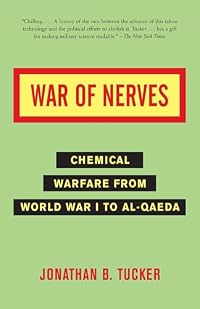
War of Nerves: Chemical Warfare from World War I to Al-Qaeda
by Jonathan Tucker
97 Members (3.83)
On This Page
Description
Statesmen, generals, and diplomats have long debated the military utility and morality of chemical warfare. In 1925, the use of chemical weapons in war was prohibited by international treaty; in 1997 the ban on the use of chemical weapons was extended to cover their development, production, and stockpiling. Nevertheless, Iraq employed chemical weapons on a large scale as recently as the 1980s, first during its eight-year war with Iran and then against its rebellious Kurdish minority. InWar show more of Nerves, Jonathan Tucker, a leading expert on chemical and biological weapons, writes about chemical warfare from World War I to the present. The author makes clear how, at the turn of the twentieth century, the large-scale use of toxic chemicals on the battlefield became feasible and cheap; how Germany first developed and employed toxic weapons during World War I, burying some 6,000 cylinders (containing 168 tons of chlorine) opposite the Allied trenches defending the town of Ypres, in Belgium. German troops simultaneously opened the chlorine cylinders, panicking two French divisions and tearing a gap four miles wide in the Ypres front. Chemical warfare had begun: five months later, the Allies retaliated with their own use of chlorine gas. By the end of the war, chemical warfare had inflicted roughly one million casualties, 90,000 of them fatal. Tucker writes about the synthesis of the first nerve agent—Tabun—in 1936 by a German industrial chemist developing new pesticides how its high toxicity made it unusable as a pesticide but viable as a weapon for the Nazi regime. A few years later, two even more toxic nerve agents—Sarin and Soman—were developed for military use. Hitler never employed this secret weapon; German intelligence concluded—incorrectly—that the Allies had developed a similar capability. Following World War II, we see the rise of a Cold War chemical competition between the United States and the Soviet Union that paralleled the nuclear arms race, as each pursued the secrets of the German nerve agents; how the United States and Britain planned to mass-produce Sarin (only the United States did); how the superpowers developed and mass-produced V-agents, a new generation of nerve agents of extraordinary potency; and how nerve agents spread to the Third World, including their suspected use by Egypt during the Yemen Civil War (1963—1967), as well as Iraq’s use of nerve agents in its war against Iran and on its own people. Iraq’s use of nerve agents hastened the negotiation of an international treaty banning the use of chemical weapons, which went into effect in 1997. Although the treaty now has more than 175 member-states, al-Qaeda and related terrorist groups are seeking to acquire nerve agents. In this important and revelatory book, Jonathan Tucker makes clear that we are at a crossroads that could lead either to the further spread of these weapons or to their ultimate abolition. show lessTags
Recommendations
























Member Reviews
Members
- Recently Added By
Author Information

2 Works 101 Members
Common Knowledge
- Original publication date
- 2006
- First words
- The U.S. Army Chemical School at Fort Leonard Wood, near the edge of the Ozark Mountains in south-central Missouri, trains thousands of soldiers, sailors, and marines each year in the art and science of chemical warfare defen... (show all)se.
- Last words
- (Click to show. Warning: May contain spoilers.)In view of the continuing threat of chemical weapons proliferation and use, strengthening the legal and moral barriers against the use of chemistry for hostile purposes will be vital for human well-being and survival in the twenty-first century.
Classifications
- Genres
- Nonfiction, History, General Nonfiction, Science & Nature
- DDC/MDS
- 358.34 — Society, Government, and Culture Public administration & military science Air and other specialized forces and warfare; engineering and related services Other technical services
- LCC
- UG447 .T83 — Military Science Military engineering. Air forces Military engineering Attack and defense. Siege warfare
- BISAC
Statistics
- Members
- 97
- Popularity
- 327,985
- Rating
- (3.83)
- Languages
- English
- Media
- Paper, Ebook
- ISBNs
- 3
- ASINs
- 1