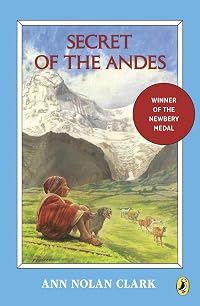
Secret of the Andes
by Ann Nolan Clark
On This Page
Description
An Indian boy who tends llamas in a hidden valley in Peru learns the traditions and secrets of his Inca ancestors.Tags
Recommendations










Member Reviews
I liked it a lot. I think Cusi is a neat kid, and his upbringing only makes him just a little different from any other child; he's not 'exotic'. He's brave enough to attempt to figure things out on his own, but still with natural motivations of impulses and hesitations. I felt that I was right with him the whole time.
The explanation at the end makes so much sense that it seems, to me, odd I wasn't able to figure it out earlier.
I only had two drawings, both of which hearkened to traditional Incan art... are there more in some editions?
I liked the writing style. I thought it intentional, as meant to echo the speaking style of people who spend a lot of time in thought, and much of their time speaking doing so in song & other oral show more traditions. It's deliberate, thoughtful, careful... not casual. Note that the people in town are more vocal, more likely to throw words about heedlessly.
I enjoyed learning about Peru's geography and popular culture, as well as about some of its history. In a way I wish the book were longer... but I appreciate the tight focus, too.
I probably would not have liked this when I was a child. It's subtle, a bit *L*iterary, not lively. Otoh, there is a bit of a quest... I bet a truly talented team could make a good short movie of it. show less
The explanation at the end makes so much sense that it seems, to me, odd I wasn't able to figure it out earlier.
I only had two drawings, both of which hearkened to traditional Incan art... are there more in some editions?
I liked the writing style. I thought it intentional, as meant to echo the speaking style of people who spend a lot of time in thought, and much of their time speaking doing so in song & other oral show more traditions. It's deliberate, thoughtful, careful... not casual. Note that the people in town are more vocal, more likely to throw words about heedlessly.
I enjoyed learning about Peru's geography and popular culture, as well as about some of its history. In a way I wish the book were longer... but I appreciate the tight focus, too.
I probably would not have liked this when I was a child. It's subtle, a bit *L*iterary, not lively. Otoh, there is a bit of a quest... I bet a truly talented team could make a good short movie of it. show less
I remember greatly enjoying this book when I first read it aloud, many years ago, so I was happy to find a chance to read it again. I was surprised, though, when I realized how sun worship is a major theme throughout the entire book. Throughout the story, Cusi both observes and participates in rituals to welcome the sun every morning. That gave us something to discuss as we read it!
One major theme throughout the story is Cusi’s search for a family. He was raised by an old man in a lonely valley high in the Andes Mountains—but why was he kept apart from all other people? As the mysteries of his past and that of his people are slowly revealed, we learn a lot about Peru and the ancient Inca.
Despite the heavy emphasis on pagan beliefs, show more I believe that this book is valuable as a glimpse into Peruvian culture and a child’s need for love and family. However, it definitely needs parental guidance. show less
One major theme throughout the story is Cusi’s search for a family. He was raised by an old man in a lonely valley high in the Andes Mountains—but why was he kept apart from all other people? As the mysteries of his past and that of his people are slowly revealed, we learn a lot about Peru and the ancient Inca.
Despite the heavy emphasis on pagan beliefs, show more I believe that this book is valuable as a glimpse into Peruvian culture and a child’s need for love and family. However, it definitely needs parental guidance. show less
This Newbery winner was a drier read than some of my earlier choices, a story more focused on its theme and setting than on thrills. Which means that I wasn't very excited to get back to it, but could still recognize the quality of the story telling. Cusi is a young Incan, living in the upper reaches of the Andes and working on a llama farm. His unassuming present hides a complex past, one that he is on the threshold of discovering. We witness his growth and evolution as he learns the mysteries of his people's past, and see from the inside what it is like to live as the conquered in a conquered land, but never conquered in spirit. It is a quiet story that I appreciated, as much for its revelation of a people and place that are show more unfamiliar to me, as for the gradual maturation of Cusi and his sweet relationships with those in his life. A well written and informative story, a slice of life in a place that I don't usually visit. I recommend it, keeping in mind that it is a quiet and slow story about growing up. show less
This book is what gives Newbery Winners a bad name. It is well written, with beautiful descriptions, has a historical setting not well represented in literature, and is a natural choice for teachers looking to fill the void. The trouble is, it's not a great book. Yes, there's the conflict of a boy wanting to belong, to find a family. But conflict alone doesn't make a compelling story, and if I found it dry, as an adult reader, I suspect most children will find it dry as well. Moreover, the book actually has little educational content, not enough to justify leading an unwilling child to drink herein. My recommendation is to skip this one. If you must use it... read it aloud, bring out many pictures of the geography, learn the history show more first, and hope for the best. show less
Secret of the Andes is the story of an Incan boy, Cusi, and his caregiver and mentor, Chuto, who live in the mountains of Peru and herd llamas. They live a very isolated life, and as Cusi grows older he begins to realize there is more to the world than his limited experience. Chuto also hints, quite enigmatically, that Cusi is destined for greater things. They are visited by strange travelers who teach Cusi many things, and eventually Cusi sets out on a solo journey to "seek his heart's desire."
The author of this book taught on a Native American reservation in New Mexico from 1920-1955, and also travelled extensively through Latin America. She wrote many children's books about Native Americans, both North and South. I think the author show more was trying to do something valuable with this book, expose children to a culture that was on this continent before Europeans arrived, and that still tries to persist. In my present day adult world view, the book seemed to gloss over the surface of the evils of colonization and also romanticize Incan culture. However, I guess in 1952, just admitting that Incan culture existed and was in many ways good is what needed to happen. Who knows. Many of the early Newbery winners take place in foreign countries, which I find fascinating.
Also, the kid chews a lot of coca leaves in this book.
The book itself was quite boring, and I found the language too flowery. At times Chuto was frustratingly aloof with Cusi, refusing to explain things to him or answer his questions because it wasn't time. It reminded me a little bit of how Dumbledore ignores Harry in book 5, except that Chuto is no Dumbledore, and in the end it remains frustrating that Chuto won't explain anything to Cusi.
Apparently this book is most famous for beating out Charlotte's Web and winning the 1953 Newbery. show less
The author of this book taught on a Native American reservation in New Mexico from 1920-1955, and also travelled extensively through Latin America. She wrote many children's books about Native Americans, both North and South. I think the author show more was trying to do something valuable with this book, expose children to a culture that was on this continent before Europeans arrived, and that still tries to persist. In my present day adult world view, the book seemed to gloss over the surface of the evils of colonization and also romanticize Incan culture. However, I guess in 1952, just admitting that Incan culture existed and was in many ways good is what needed to happen. Who knows. Many of the early Newbery winners take place in foreign countries, which I find fascinating.
Also, the kid chews a lot of coca leaves in this book.
The book itself was quite boring, and I found the language too flowery. At times Chuto was frustratingly aloof with Cusi, refusing to explain things to him or answer his questions because it wasn't time. It reminded me a little bit of how Dumbledore ignores Harry in book 5, except that Chuto is no Dumbledore, and in the end it remains frustrating that Chuto won't explain anything to Cusi.
Apparently this book is most famous for beating out Charlotte's Web and winning the 1953 Newbery. show less
I'm a bit of an Inca-phile...having consumed many books on Incan history, their lives, and their ultimate demise following the Spanish Conquest in the early 16th Century.
And so I bought Secret of the Andes for my daughter...thinking that the Newberry Award winner would be a terrific way for me to share my interests with my avid reader. The book sat on her shelf for about a year. I moved it to my shelf for about another 6 months. And finally picked it up a couple of days ago.
If you have any interest in the Incas, the Conquest Era, or Indigenous peoples, then you'll respect this book's tale of a young Inca boy named Cusi. Cusi's story is one of awareness, discovery and maturation.
Cusi lives in a Hidden Valley in the Peruvian Andes. While show more tending to his small herd of Llama's (with his most favorite, Misti), he discovers a family living on the other side of a mountain. This sparks Cusi's internal and external adventure to discover his own history, his own past, and his real family.
Along the way, Cusi learns, in broad strokes, Incan origin and religious myths, and the impact on their cultural heritage of Spanish conquest.
The book is deep and spiritual. There's not a lot of action...no fighting Conquistadors, no bloody battles on the pampas or in the mountains, and only a small bit of lost incan gold. Ann Nolan's writing is crisp, the dialogue is short, and should be very readable for ages 12+. show less
And so I bought Secret of the Andes for my daughter...thinking that the Newberry Award winner would be a terrific way for me to share my interests with my avid reader. The book sat on her shelf for about a year. I moved it to my shelf for about another 6 months. And finally picked it up a couple of days ago.
If you have any interest in the Incas, the Conquest Era, or Indigenous peoples, then you'll respect this book's tale of a young Inca boy named Cusi. Cusi's story is one of awareness, discovery and maturation.
Cusi lives in a Hidden Valley in the Peruvian Andes. While show more tending to his small herd of Llama's (with his most favorite, Misti), he discovers a family living on the other side of a mountain. This sparks Cusi's internal and external adventure to discover his own history, his own past, and his real family.
Along the way, Cusi learns, in broad strokes, Incan origin and religious myths, and the impact on their cultural heritage of Spanish conquest.
The book is deep and spiritual. There's not a lot of action...no fighting Conquistadors, no bloody battles on the pampas or in the mountains, and only a small bit of lost incan gold. Ann Nolan's writing is crisp, the dialogue is short, and should be very readable for ages 12+. show less
I read this in a single day, over long plane rides. This is a quiet story, not super exciting but with small events of coming of age. I enjoyed the writing and the story.
I read it on the way to Peru. The novel helped get me in the mood and gave me some background of an Andean culture. The depiction of the places, especially the Salt Terraces of Maras gave what I learned on my travels a little imagination of what could have been. The novel takes place in "Modern Peru" but still more than 50 years ago, though I suppose it could take place today.
I drank a lot of coca leaf tea, partially for altitude while in Peru, especially before going to the highlands.
~~~Some spoilers ~~~
I was disappointed that Cusi, the lead character, was show more essentially turned away from what he wanted most, a family. The end to me was bittersweet of him creating happiness for himself but it came because he was turned away by those who he would have wanted to be with. However, while in Peru, I learned that it was customary for families with many children to have late children brought up away from the family, essentially given to the community for military or spiritual purposes and that gave me better understanding of what perhaps may have gone on in this novel. show less
I read it on the way to Peru. The novel helped get me in the mood and gave me some background of an Andean culture. The depiction of the places, especially the Salt Terraces of Maras gave what I learned on my travels a little imagination of what could have been. The novel takes place in "Modern Peru" but still more than 50 years ago, though I suppose it could take place today.
I drank a lot of coca leaf tea, partially for altitude while in Peru, especially before going to the highlands.
~~~Some spoilers ~~~
I was disappointed that Cusi, the lead character, was show more essentially turned away from what he wanted most, a family. The end to me was bittersweet of him creating happiness for himself but it came because he was turned away by those who he would have wanted to be with. However, while in Peru, I learned that it was customary for families with many children to have late children brought up away from the family, essentially given to the community for military or spiritual purposes and that gave me better understanding of what perhaps may have gone on in this novel. show less
Members
- Recently Added By
Lists

A Child's Book Tour of the Andes ::: Argentina, Chile, Colombia, Ecuador
24 works; 3 members

Newbery Medal Winners - By Year
105 works; 7 members

Honey For a Child's Heart
1,152 works; 25 members

Sonlight Books
1,487 works; 25 members

Before Austen Comes Aesop
318 works; 9 members

Books Read in 2021
5,361 works; 114 members

The Story of the World: Activity Book Three: Early Modern Times
191 works; 3 members

The Story of the World: Activity Book Four: The Modern Age
333 works; 2 members
Author Information

All Editions
Awards and Honors
Common Knowledge
- Canonical title
- Secret of the Andes
- Original title
- Secret of the Andes
- Original publication date
- 1952
- People/Characters
- Cusi; Chuto
- Important places
- Andes Mountains, Peru; Cuzco, Peru; Peru
- Important events*
- indigene Identität der Nachfahren der Inkas
- Related movies
- Secret of the Andes (1999 | IMDb)
- First words
- "What are you doing, Cusi?" An old Indian stood looking down at a boy who lay on an overhanging rock, gazing into the valley below.
"What are you doing Cusi?" - Last words
- (Click to show. Warning: May contain spoilers.)Cusi and Chuto rose to face the east and to salute the Sun for a new beginning.
- Original language
- English
- Disambiguation notice
- book
*Some information comes from Common Knowledge in other languages. Click "Edit" for more information.
Classifications
Statistics
- Members
- 2,330
- Popularity
- 8,475
- Reviews
- 20
- Rating
- (3.43)
- Languages
- English
- Media
- Paper, Audiobook, Ebook
- ISBNs
- 16
- ASINs
- 23