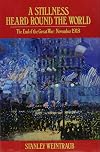
A Stillness Heard Round the World: The End of the Great War, November 1918
by Stanley Weintraub
On This Page
Description
The eleventh hour of the eleventh day of the eleventh month in 1918 will live in history as a great moment--the hour the Armistice went into effect, bringing an end to the First World War. Guns were silenced, and worldwide the great and small alike celebrated the end of 51 months of fighting. In this magnificent book, Stanley Weintraub recreates the days leading up to the armistice and documents the reactions of survivors on both sides of the front. Thirty-year-old Major Omar Bradley show more lamented that his rank would be reduced to that of captain and that he was "professionally ruined." King George V celebrated with a bottle of brandy laid aside for the Battle of Waterloo. In America, for 16-year-old Charles Lindbergh the end of the war meant the purchase of a war-surplus "Flying Jenny." In a German hospital, Corporal Adolf Hitler, temporarily blinded by teargas, wept. Weintraub has delved into the archives, sifted through a large collection of letters and diaries sent to him by survivors and heirs to survivors, and interviewed many eyewitnesses to produce this vivid rendering of the end not just of a war but of an era. Here are notable literary, military, and political figures of the 20th century as young men and women--their careers to come still at the mercy of a last bullet or burst of shrapnel. Here also are the reflections of such figures as Albert Einstein, Thomas Mann and Joseph Conrad on the effects of the war, and eerie premonitions of the Second World War, whose seeds were sown in both the harshness and the paradoxical laxity of the peace agreement. A major evocation of the last days of the Great War, A Stillness Heard Round the World offers both historical vignettes and heartfelt visions of the horror of war and the ecstacy of peace. show lessTags
Recommendations
















Member Reviews
1959. A Stillness Heard Round the World The End of the Great War: November 1918, by Stanley Weintraub (read 24 Nov 1985) This book is not too well organized, but it contains much absorbing information on the last days of the First World War. It starts by telling of the False Armistice, then on to the meeting in the Forest, the 72 hours before the signing, the events in Germany, the Kaiser's going to Holland, the signing, the last shots, and the celebrations. Much poignancy, and little things overwhelmed me emotionally. The material is gathered from accounts of people who were there and from numerous memoirs and secondary sources. The book often tells of fiction treating the events as well--for instance, Parade's End , by Ford Madox Ford show more (which I read 7 Sept 1984 and did not care for). This is an enjoyable book to read about a fantastic time: November 1918. It also reminds me of a family story which has always amazed me; my oldest sister was born June 8, 1916 and when my mother in our farm home learned of the event on Nov 11, 1918, she told my sister to go to the field where my father was working and tell him. So she did and he told her he had heard the church bell ringing and would be coming home with the team he was working with. It certainly says something for the maturity of my sister, just two and a half, that she was commissioned to carry out and did carry out the task my mother, no doubt aware of my sister's capability, had assigned her. show less
Ratings
Members
- Recently Added By
Author Information

62+ Works 3,782 Members
Stanley Weintraub is Evan Pugh Professor Emeritus of Arts & Humanities at Pennsylvania State University. He has written acclaimed works of military history on World Wars I & II. He lives in Boalsburg, Pennsylvania. (Publisher Provided) Stanley Weintraub was born in Philadelphia, Pennsylvania on April 17, 1929. He received a B.S. in education from show more West Chester State Teachers College in 1949 and a M. A. in English from Temple University. He served in the Army during the Korean Conflict where he was awarded the Bronze Star and the Korean Ribbon with five battle stars. Upon his return, he received a Ph.D. from Pennsylvania State University where he went on to teach until his retirement. He wrote over 40 books during his lifetime including Private and Public Shaw: A Dual Portrait of Lawrence of Arabia and George Bernard Shaw, Beardsley: A Biography, 11 Days in December, Silent Night: The Story of the World War I Christmas Truce, MacArthur's War, Long Day's Journey into War, and A Stillness Heard Round the World: The End of the Great War. He received the George Freedley Award in 1971 for Journey to Heartbreak: The Crucible Years of Bernard Shaw, 1914-1918 and the Freedom Foundation Award in 1980 for The London Yankees: Portraits of American Writers and Artists in London, 1894-1914. (Bowker Author Biography) show less
Series
Belongs to Publisher Series
Common Knowledge
- Important events
- World War I
- Epigraph
- "Bliss it was on that dawn to be alive." - Wordsworth
- Dedication
- In memory of Ewart Garland, who flew over Flanders on the final day, and for the thousand others who shared their memories with me.
- First words
- From Ypres in Flanders to St. Mihiel in Lorraine, German machine gunners and artillerymen were staving off the end by little more than a stubborn refusal to concede defeat.
Classifications
Statistics
- Members
- 55
- Popularity
- 546,657
- Reviews
- 1
- Rating
- (3.75)
- Languages
- English
- Media
- Paper
- ISBNs
- 4
- ASINs
- 3