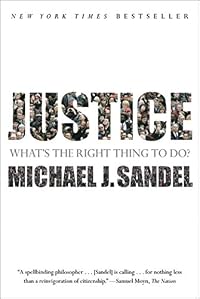
Justice: What's the Right Thing to Do?
by Michael J. Sandel
On This Page
Description
Popular Harvard professor Michael Sandel offers a searching, lyrical exploration of the meaning of justice that considers familiar controversies such as affirmative action, same-sex marriage, physician-assisted suicide, abortion, national service, patriotism and dissent, and the moral limits of markets in fresh and illuminating ways.Tags
Recommendations













Member Recommendations
Member Reviews
Michael Sandel, em sua profunda exploração da justiça, nos convida a refletir sobre os fundamentos morais que sustentam uma sociedade justa. Mais do que apresentar soluções técnicas, sua abordagem provoca uma investigação sobre os valores que devem guiar nossas escolhas públicas — como a dignidade humana, a solidariedade e o bem comum.
A busca por igualdade, integração social e uma distribuição mais justa da riqueza continua sendo um ideal inspirador. Sandel reconhece essas aspirações e argumenta que a justiça não pode ser neutra em relação ao bem, tampouco se limitar à maximização da liberdade individual. Para ele, precisamos envolver os valores compartilhados e as virtudes cívicas que unem uma show more comunidade.
Contudo, Sandel também nos desafia a ir além da crença de que a justiça decorre simplesmente de mais intervenção estatal. Ele questiona tanto o liberalismo individualista quanto o utilitarismo que negligenciam o papel da moralidade na política. Não se trata de rejeitar o Estado, mas de refletir qual papel ele deve ocupar em uma sociedade que valoriza não apenas resultados, mas também princípios.
O paradoxo contemporâneo, onde grandes estruturas estatais coexistem com desigualdades persistentes, reforça a necessidade de repensarmos os caminhos habituais. Sandel nos inspira a considerar não apenas políticas públicas eficientes, mas também comunidades engajadas e cidadãos ativos, capazes de participar na definição do que é justo.
Assim, talvez a verdadeira revolução esteja em reconectar a justiça à prática da cidadania, em um esforço coletivo para construir uma sociedade que não apenas distribua bens, mas também cultive o senso de propósito e pertencimento. show less
A busca por igualdade, integração social e uma distribuição mais justa da riqueza continua sendo um ideal inspirador. Sandel reconhece essas aspirações e argumenta que a justiça não pode ser neutra em relação ao bem, tampouco se limitar à maximização da liberdade individual. Para ele, precisamos envolver os valores compartilhados e as virtudes cívicas que unem uma show more comunidade.
Contudo, Sandel também nos desafia a ir além da crença de que a justiça decorre simplesmente de mais intervenção estatal. Ele questiona tanto o liberalismo individualista quanto o utilitarismo que negligenciam o papel da moralidade na política. Não se trata de rejeitar o Estado, mas de refletir qual papel ele deve ocupar em uma sociedade que valoriza não apenas resultados, mas também princípios.
O paradoxo contemporâneo, onde grandes estruturas estatais coexistem com desigualdades persistentes, reforça a necessidade de repensarmos os caminhos habituais. Sandel nos inspira a considerar não apenas políticas públicas eficientes, mas também comunidades engajadas e cidadãos ativos, capazes de participar na definição do que é justo.
Assim, talvez a verdadeira revolução esteja em reconectar a justiça à prática da cidadania, em um esforço coletivo para construir uma sociedade que não apenas distribua bens, mas também cultive o senso de propósito e pertencimento. show less
Four stars because it was an engaging read that reintroduced me to philosophers I had all but forgotten (mostly Kant, who is wrong in such interesting and productive ways). Sandel helped me to clarify my own muddled and contradictory political / ethical beliefs - he's a great storyteller who brings very dense works of philosophy to life with engaging thought experiments and clear discussions.
However, I was ambivalent about Sandel's arguments at the end of the book and wish he had contextualized his argument by questioning his own methods. Is it intellectually honest or efficacious to apply philosophical methods to politics? (Read: rationalist though I am, shouldn't I be suspicious of the opinions of a bunch of old white guys who, for show more the most part, thought they lived in an orderly clockwork universe?) Some of my lingering questions:
(a) What gives modern nation-states the right or duty to enact justice? Is the political system of the United States designed to enact justice? How much does the duty of government to create a just society converge with the duties of government as formally enshrined in the U.S. Constitution?
(b) Are political debates about justice best understood as rational dialogues, or can they be better understood as expressions of power, emotion, and/or ideology?
(c) To what extent do the rational methods of Western philosophy actually help us enact justice? Could it be that those methods actually obscure the role of emotion and culture in our ethical lives?
(d) What is the relationship between biology, culture, and justice? If something is almost universally valued by human beings (like caring for children) or universally valued by a culture (like monogamous marriage), is enshrining it in law an ethical decision or a pragmatic one?
So, yeah, I thought about this book a lot, and I would like to read more on this subject. But I find it difficult to be satisfied by any philosophical discussion so embedded in a specific political context. show less
However, I was ambivalent about Sandel's arguments at the end of the book and wish he had contextualized his argument by questioning his own methods. Is it intellectually honest or efficacious to apply philosophical methods to politics? (Read: rationalist though I am, shouldn't I be suspicious of the opinions of a bunch of old white guys who, for show more the most part, thought they lived in an orderly clockwork universe?) Some of my lingering questions:
(a) What gives modern nation-states the right or duty to enact justice? Is the political system of the United States designed to enact justice? How much does the duty of government to create a just society converge with the duties of government as formally enshrined in the U.S. Constitution?
(b) Are political debates about justice best understood as rational dialogues, or can they be better understood as expressions of power, emotion, and/or ideology?
(c) To what extent do the rational methods of Western philosophy actually help us enact justice? Could it be that those methods actually obscure the role of emotion and culture in our ethical lives?
(d) What is the relationship between biology, culture, and justice? If something is almost universally valued by human beings (like caring for children) or universally valued by a culture (like monogamous marriage), is enshrining it in law an ethical decision or a pragmatic one?
So, yeah, I thought about this book a lot, and I would like to read more on this subject. But I find it difficult to be satisfied by any philosophical discussion so embedded in a specific political context. show less
Moral Philosophy 101, in book form, with motivating examples, and capped off with the author's own carefully corralled-off opinions. I'm not sure whether it's the quality of writing or my maturity or the review or all three, but I got a lot out of this book in terms of understanding the more-complicated-than-utilitarianism-or-libertarianism philosophies and how they interrelate.
New-to-me ideas include the concept of a narrative or contingent-and-situated identity that has moral weight, some interesting arguments against contractual obligations being the sole source of moral work, and most especially the "of course!" connection that the reason philosophers developed moral philosophy was to build out an ethical framework that could show more inform secular law and politics -- that is, the ideas that undergird American society were developed more or less explicitly as an alternative to religious formulations of what it means to be a good person. With that connection, it seems more reasonable to me that the idea of "liberty as the shared American religion" might now diverge from the parallel secular reconstruction of previously shared religious belief and take on a life of its own, and that as a society we would ensure future elites are conversant with these ideas. Sandel does a lot of balancing between specific ideas and general themes, and he does it well.
This is nonfiction that will reward rereads. show less
New-to-me ideas include the concept of a narrative or contingent-and-situated identity that has moral weight, some interesting arguments against contractual obligations being the sole source of moral work, and most especially the "of course!" connection that the reason philosophers developed moral philosophy was to build out an ethical framework that could show more inform secular law and politics -- that is, the ideas that undergird American society were developed more or less explicitly as an alternative to religious formulations of what it means to be a good person. With that connection, it seems more reasonable to me that the idea of "liberty as the shared American religion" might now diverge from the parallel secular reconstruction of previously shared religious belief and take on a life of its own, and that as a society we would ensure future elites are conversant with these ideas. Sandel does a lot of balancing between specific ideas and general themes, and he does it well.
This is nonfiction that will reward rereads. show less
A politics emptied of substantive moral engagement makes for an impoverished civic life. It is also an open invitation to narrow, intolerant moralisms. Fundamentalists rush in where liberals fear to tread.
Sandel builds his argument gradually, almost imperceptibly, across 220 pages before revealing his political philosophy and how it fits into the discussion of Bentham, Kant, Rawls, and Aristotle he delineates across the previous eight chapters. As an overview of major political philosophies, Justice is clear and erudite, sometimes even repetitious in its description of concepts like Rawls's "veil of ignorance" and Kant's "categorical imperative." Sandel illustrates many of the complications of particular political systems by applying show more them to problematic anecdotes and well-known political controversies in American society.
While I have few, if any, problems with the book as an instructive and thoughtful work of political philosophy, I am still somewhat unclear as to the details and specifics of Sandel's communitarian conclusions. I think he recognizes a huge problem with current liberal political philosophy, most especially the error of ceding the moral arena to those who are religiously minded. By essentially rendering moral value to one's private life, liberals avoid engaging moral arguments in the political arena. Instead, they hold a certain indifference to the moral dispositions of the citizenry — Rawl's "veil of ignorance," for example.
I found myself thinking of President Carter's "crisis of confidence" speech. I think Sandel might have appreciated Carter's urgent warning against the malaise afflicting those who've lost the "unity of purpose for our nation." Sandel similarly contends that a just society requires a strong sense of community and "must find a way to cultivate in citizens a concern for the whole, a dedication to the common good." show less
Sandel builds his argument gradually, almost imperceptibly, across 220 pages before revealing his political philosophy and how it fits into the discussion of Bentham, Kant, Rawls, and Aristotle he delineates across the previous eight chapters. As an overview of major political philosophies, Justice is clear and erudite, sometimes even repetitious in its description of concepts like Rawls's "veil of ignorance" and Kant's "categorical imperative." Sandel illustrates many of the complications of particular political systems by applying show more them to problematic anecdotes and well-known political controversies in American society.
While I have few, if any, problems with the book as an instructive and thoughtful work of political philosophy, I am still somewhat unclear as to the details and specifics of Sandel's communitarian conclusions. I think he recognizes a huge problem with current liberal political philosophy, most especially the error of ceding the moral arena to those who are religiously minded. By essentially rendering moral value to one's private life, liberals avoid engaging moral arguments in the political arena. Instead, they hold a certain indifference to the moral dispositions of the citizenry — Rawl's "veil of ignorance," for example.
I found myself thinking of President Carter's "crisis of confidence" speech. I think Sandel might have appreciated Carter's urgent warning against the malaise afflicting those who've lost the "unity of purpose for our nation." Sandel similarly contends that a just society requires a strong sense of community and "must find a way to cultivate in citizens a concern for the whole, a dedication to the common good." show less
I not only recommend this as a book to be read, I recommend it as a book to be read twice.
And while I do not see it as entirely unblemished, its attempt to place serious moral and ethical issues in front of us is not only laudable, it is critical to us addressing transnational challenges such as climate change, immigration, and the concentration of wealth.
I was drawn to read this book from the many accolades Michael Sandel generates from the admirers of his very popular course at Harvard University on morality and good government.
But this book, “Justice: What’s the right thing to do?” is not about justice, per se. It is an intellectual exercise in constructing what a fair society would look like were we in a position to build show more one.
More particularly, the book is a prescription about how the United States of America would operate if it were a fair society.
If I were writing a book about justice, about where to get it and how recognize it, I would probably write a book about the courts, who run them, and which courts you are likely to get better justice than some others.
I don’t think anybody expects to see justice meted out at the corner gas station, or in the playground or, God forbid, on Capitol Hill. But that is exactly what the sound bites on the 6pm news would like us to believe: that somebody really high up is gonna get justice for the ordinary man.
While this book is a few years old its lessons for legislators are clear: good laws and good government does not come from pandering to people who have accumulated wealth by virtue of birth, or merit, or even of citizenship. No.
Good government comes from promoting the common good, by building a sense of community, by using markets to promote economic activity not as an excuse to underinvest in social good, and reversing the trend toward the concentration of wealth.
(I think a young Barack Obama must have sat in on Sandel’s lectures.)
Sandel sees the objects of government in the US as promoting to some degree the welfare of its citizens, but protecting freedoms guaranteed by the founders, and by promoting the good in people and society.
He takes issue with the current Republican consensus that government by definition is bad and big government to be avoided at all costs. And while there is no real social contract in the conduct of government in the US, it is understood that government rule with the consent of the ruled.
America took a huge gamble electing Donald Trump as its semi-sovereign leader for a four year term as President. Trump mocked those who trusted government, he mocked its governors, and he spit on its institutions going right up to the transfer of power to his successor.
Trump exploited people’s rather fuzzy idea of what government does, and certainly what America’s federal government does. According to Trump, only chumps follow the law.
This book is written during the Obama years, not the Trump years. I loook forward to reading Sandel’s interpretation of the Trump years in the cause of good government.
Sandel quite rightly asserts that that an unbiased application of the laws is not only impossible but wholly undesireable, and he relies to some extent on what Aristotle believed was the duty of government: to promote public virtue even when the understanding of what constitutes the good and the right in America is hugely debatable.
But that doesn’t mean debating these values is wholly useless in public life.
For many years I have questioned the efficacy of putting the rights of individuals into laws without an equal and corresponding list of civic duties in those documents. In my opinion, public life is stained by the trumpeting of rights without obligations. Obligations of the rich and the poor, the educated, the advantaged and the disadvantaged to make government more fair, more relevant, and with much less inertia built into the system.
Nobody knows exactly how many Federal laws are on the books in the United States. In Canada, my understanding is that there are more 65,000 federal laws alone even before an elected official gets to make one more.
When people ask why is it so hard to get the laws WE want, they certainly must understand the battle that exists between the laws that are already there, and the good those laws are trying to promote. show less
And while I do not see it as entirely unblemished, its attempt to place serious moral and ethical issues in front of us is not only laudable, it is critical to us addressing transnational challenges such as climate change, immigration, and the concentration of wealth.
I was drawn to read this book from the many accolades Michael Sandel generates from the admirers of his very popular course at Harvard University on morality and good government.
But this book, “Justice: What’s the right thing to do?” is not about justice, per se. It is an intellectual exercise in constructing what a fair society would look like were we in a position to build show more one.
More particularly, the book is a prescription about how the United States of America would operate if it were a fair society.
If I were writing a book about justice, about where to get it and how recognize it, I would probably write a book about the courts, who run them, and which courts you are likely to get better justice than some others.
I don’t think anybody expects to see justice meted out at the corner gas station, or in the playground or, God forbid, on Capitol Hill. But that is exactly what the sound bites on the 6pm news would like us to believe: that somebody really high up is gonna get justice for the ordinary man.
While this book is a few years old its lessons for legislators are clear: good laws and good government does not come from pandering to people who have accumulated wealth by virtue of birth, or merit, or even of citizenship. No.
Good government comes from promoting the common good, by building a sense of community, by using markets to promote economic activity not as an excuse to underinvest in social good, and reversing the trend toward the concentration of wealth.
(I think a young Barack Obama must have sat in on Sandel’s lectures.)
Sandel sees the objects of government in the US as promoting to some degree the welfare of its citizens, but protecting freedoms guaranteed by the founders, and by promoting the good in people and society.
He takes issue with the current Republican consensus that government by definition is bad and big government to be avoided at all costs. And while there is no real social contract in the conduct of government in the US, it is understood that government rule with the consent of the ruled.
America took a huge gamble electing Donald Trump as its semi-sovereign leader for a four year term as President. Trump mocked those who trusted government, he mocked its governors, and he spit on its institutions going right up to the transfer of power to his successor.
Trump exploited people’s rather fuzzy idea of what government does, and certainly what America’s federal government does. According to Trump, only chumps follow the law.
This book is written during the Obama years, not the Trump years. I loook forward to reading Sandel’s interpretation of the Trump years in the cause of good government.
Sandel quite rightly asserts that that an unbiased application of the laws is not only impossible but wholly undesireable, and he relies to some extent on what Aristotle believed was the duty of government: to promote public virtue even when the understanding of what constitutes the good and the right in America is hugely debatable.
But that doesn’t mean debating these values is wholly useless in public life.
For many years I have questioned the efficacy of putting the rights of individuals into laws without an equal and corresponding list of civic duties in those documents. In my opinion, public life is stained by the trumpeting of rights without obligations. Obligations of the rich and the poor, the educated, the advantaged and the disadvantaged to make government more fair, more relevant, and with much less inertia built into the system.
Nobody knows exactly how many Federal laws are on the books in the United States. In Canada, my understanding is that there are more 65,000 federal laws alone even before an elected official gets to make one more.
When people ask why is it so hard to get the laws WE want, they certainly must understand the battle that exists between the laws that are already there, and the good those laws are trying to promote. show less
I wasn't sure I'd get much out of this book, since I've already listened to the series of Dr. Sandel's lectures on which it's based. But I loved that series, and figured the book would be worth a shot. I'm so glad I did. Not only was the refresher worthwhile, but the final chapter (which is almost entirely new from the course) is a really great finish.
Sandel uses more or less the same disquisitive approach to the question of justice here that he used in the aforementioned course, and it's a good technique. It allows him to address a pretty thorny topic from a position of relative neutrality, and to proceed through some of the most significant historical thinking about it in an accessible way.
I also appreciated the boldness of his final show more section, because a more typical means of wrapping up would have been to feign complete neutrality, and resist taking any kind of stand. I suppose it doesn't hurt, either, that I agree generally with the stand he does take. show less
Sandel uses more or less the same disquisitive approach to the question of justice here that he used in the aforementioned course, and it's a good technique. It allows him to address a pretty thorny topic from a position of relative neutrality, and to proceed through some of the most significant historical thinking about it in an accessible way.
I also appreciated the boldness of his final show more section, because a more typical means of wrapping up would have been to feign complete neutrality, and resist taking any kind of stand. I suppose it doesn't hurt, either, that I agree generally with the stand he does take. show less
Trying to suss out how to understand justice and the path to a just society without reference to Marxist analysis strikes me as roughly equivalent to trying to understand the diversity of life on Earth with reference to Darwinian evolution. Aristotle, Mill, Kant, & Rawls are tremendously useful, and I don't mean to argue Marx & Engels have the only useful analysis for how to promote human flourishing, but Sandel has huge gaps and some weird underlying assumptions that spotlight where the holes in his framework are.
Members
- Recently Added By
Lists

The Enlightened Economist
107 works; 1 member

Política - Clásicos
164 works; 2 members

Mind Expanding Books by hackerkid
581 works; 8 members
Author Information

Michael J. Sandel is the Anne T. and Robert M. Bass Professor of Government at Harvard University and the author of the New York Times bestseller Justice: What's the Right Thing to Do? His work has been the subject of television series on PBS and the BBC.
Awards and Honors
Distinctions
Notable Lists
Series
Belongs to Publisher Series
非文學 (14)
Common Knowledge
- Canonical title*
- Giustizia. Il nostro bene comune
- Original title
- Justice; Justice : what's the right thing to do ?
- Original publication date
- 2009
- People/Characters
- Kant, Immanuel, 1724-1804; John Rawls; Jeremy Bentham; Aristotle, 384-322; John Stuart Mill
- Related movies
- Justice (2011 | IMDb)
- Dedication
- For Kiku, with love
- First words
- In the summer of 2004, Hurricane Charley roared out of the Gulf of Mexico and swept across Florida to the Atlantic Ocean.
- Last words
- (Click to show. Warning: May contain spoilers.)It is also a more promising basis for a just society.
- Blurbers
- Dionne, E. J., Jr.; Will, George F.
- Canonical DDC/MDS
- 172.2
- Canonical LCC
- JC578.S25
*Some information comes from Common Knowledge in other languages. Click "Edit" for more information.
Classifications
- Genres
- Philosophy, Politics and Government, General Nonfiction, Nonfiction
- DDC/MDS
- 172.2 — Philosophy and Psychology Ethics Political ethics Duties of public officers
- LCC
- JC578 .S25 — Political Science Political theory Political theory. The state. Theories of the state Purpose, functions, and relations of the state
- BISAC
Statistics
- Members
- 2,521
- Popularity
- 7,572
- Reviews
- 42
- Rating
- (4.18)
- Languages
- 17 — Czech, Dutch, English, Finnish, French, German, Greek, Hungarian, Italian, Japanese, Korean, Polish, Spanish, Turkish, Vietnamese, Portuguese (Portugal), Chinese, traditional
- Media
- Paper, Audiobook, Ebook
- ISBNs
- 59
- ASINs
- 26