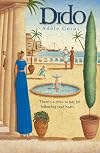
Dido
by Adèle Geras
On This Page
Description
A vivid novel inspired by the classic story of Dido from the author of TROY and ITHAKA. While she was still trembling with the complete unexpectedness of what Aeneas had just said and done, he leaned forward a little and kissed her on the mouth. Just one swift, soft touch of his lips on hers and then he turned and walked away.Love can be deadly. Especially when two girls fall for the same man - one a queen, the other her serving girl.Elissa knows she is playing with fire, but she can't show more resist. Queen Dido suspects nothing, until one fateful night . . . Secrets are revealed, hearts are broken and as dawn breaks, a terrible tragedy unfolds.A passionate tale of love, betrayal and revenge. show lessTags
Recommendations









































Member Reviews
Disappointing. I loved Ithaka (and shed many tears when the dog died) and generally think that Geras' project of retelling the heroic epics is a good thing: ambitious, attractive, elegant. But in choosing Dido as the standout episode of The Aeneid, she risks comparison to Henry Purcell -- and to Ursula Le Guin, whose recent Lavinia takes much sparser material and makes something utterly magical from it.
Maybe Geras is constrained by finding a new angle on one of the most famous love stories in history. Her formal strategy -- the whole book takes place over twenty-four hours, with multiple flashbacks to fill in the story of Aeneas' time in Carthage -- is ingenious, and as in Ithaka and Troy she finds some slanted vantage points on the show more main narrative among the young serving folk of Dido's palace. Elissa, the serving girl, Cubby, a menial labourer, and Iopas, the court poet, have no basis in Virgil's poem, and while this doesn't matter so much in Ithaka (after all, there is the mysterious servant girl who isn't hanged in the Odyssey) here the characters feel like an invention too far.
This is compounded by some shonky, blocky dialogue as Geras tries to render Dido's adult passion for Aeneas and her suicide -- both bound about with concerns about class and propriety that seem terribly Victorian -- comprehensible to a teen audience. Geras also exhibits little sympathy towards either Dido or Aeneas, and the bit players thrust into the centre of the story are not convincing enough to carry it, not least when they are told what to do by the gods who appear so often over the course of the story that the palace seems like an annex of Olympus. From my memory of The Aeneid, the gods appear sparingly and it's always a big event. The effect of these dei ex machina is curiously chilling, rendering the outcome of individuals' actions utterly moot (something that the Greek tragedians wrestled with endlessly).
There are moments that carry the genuine charge, mystery and grandeur of the classic tale: Aphrodite's apparation in the cave and Dido's and Hades' kiss. But overall, this is the weakest entry in what was shaping up to be Geras' canon. show less
Maybe Geras is constrained by finding a new angle on one of the most famous love stories in history. Her formal strategy -- the whole book takes place over twenty-four hours, with multiple flashbacks to fill in the story of Aeneas' time in Carthage -- is ingenious, and as in Ithaka and Troy she finds some slanted vantage points on the show more main narrative among the young serving folk of Dido's palace. Elissa, the serving girl, Cubby, a menial labourer, and Iopas, the court poet, have no basis in Virgil's poem, and while this doesn't matter so much in Ithaka (after all, there is the mysterious servant girl who isn't hanged in the Odyssey) here the characters feel like an invention too far.
This is compounded by some shonky, blocky dialogue as Geras tries to render Dido's adult passion for Aeneas and her suicide -- both bound about with concerns about class and propriety that seem terribly Victorian -- comprehensible to a teen audience. Geras also exhibits little sympathy towards either Dido or Aeneas, and the bit players thrust into the centre of the story are not convincing enough to carry it, not least when they are told what to do by the gods who appear so often over the course of the story that the palace seems like an annex of Olympus. From my memory of The Aeneid, the gods appear sparingly and it's always a big event. The effect of these dei ex machina is curiously chilling, rendering the outcome of individuals' actions utterly moot (something that the Greek tragedians wrestled with endlessly).
There are moments that carry the genuine charge, mystery and grandeur of the classic tale: Aphrodite's apparation in the cave and Dido's and Hades' kiss. But overall, this is the weakest entry in what was shaping up to be Geras' canon. show less
Ratings
Members
- Recently Added By
Lists

Aeneas
15 works; 1 member
Author Information

120+ Works 4,556 Members
Some Editions
Classifications
Statistics
- Members
- 24
- Popularity
- 1,111,054
- Reviews
- 1
- Rating
- (2.00)
- Languages
- English
- Media
- Paper, Ebook
- ISBNs
- 4
- ASINs
- 1