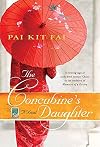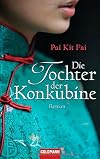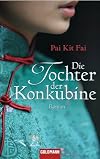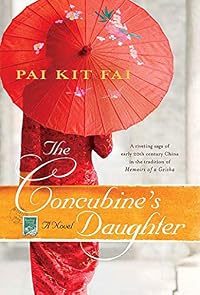
The Concubine's Daughter
by Pai Kit Fai
On This Page
Description
Li-Xia, the daughter of a young concubine to an old silk farmer in rural China, escapes her destiny of becoming a concubine by outwitting her father's orders to bind her feet and running away with an English sea captain, and takes her first steps towards fulfilling her mother's dream of becoming a scholar.Tags
Recommendations

Member Reviews
I give the first part of The Concubine’s Daughter 4 stars. I was riveted by the plight of girls and women in early 20th century China, and learned about Chinese culture. The plot was intriguing, the details fascinating, and the writing lovely.
I give the second half of the book 2.5 stars; it was a repeat of the first half, but with a different character. The story would have been better off ending with the first part, or possibly divided into two books. I like an epic family story, but my reaction to this one was, “Do we have to go through this all over again?”
The plot and antagonists were similar, but less engaging the second time around. The horrors faced by the women started to seem like someone’s sick fantasy rather than show more historical insight – though I don’t know enough about Chinese culture to make that statement with certainty.
I did hang in through the end, and read the final author notes with great interest. I would recommend this book if it came up in conversation, but I won’t go out of my way to tell everyone I know about it. show less
I give the second half of the book 2.5 stars; it was a repeat of the first half, but with a different character. The story would have been better off ending with the first part, or possibly divided into two books. I like an epic family story, but my reaction to this one was, “Do we have to go through this all over again?”
The plot and antagonists were similar, but less engaging the second time around. The horrors faced by the women started to seem like someone’s sick fantasy rather than show more historical insight – though I don’t know enough about Chinese culture to make that statement with certainty.
I did hang in through the end, and read the final author notes with great interest. I would recommend this book if it came up in conversation, but I won’t go out of my way to tell everyone I know about it. show less
 This review was written for LibraryThing Early Reviewers.
What a terrible book. I would summarize the plot as 'women in China attempt to fend off the advances of Chinese men, who are uniformly portrayed as cruel, greedy, and/or rapists, until they can manage to catch the eye of a white (or part-white) man, who is respectful and loving and appalled by Chinese brutality.' Aside from the hideous racial messages of the book, the plot consists of a string of trauma, including multiple attempted rapes, that have little to no emotional resonance with the women who are the victims, and does not affect their feelings towards men, sex (when with an appropriately white partner, of course), or much of anything (with one notable exception, which seemed to have more to do with moving the plot along than show more anything else). I was unsurprised to learn, after reading the author's interview included at the back of the book, that in spite of the Chinese name that appears on the cover, the author is actually a British man who married a Chinese woman (just like all the heroes in the book!), and is publishing the book under the Chinese name that her family gave him (a neat bit of cultural appropriation). I was also unsurprised to learn that his 'research' for a novel set in the early 1900s seemed to consisted of 'living in China for the past 30 years' and 'marrying into a Chinese family that donated a library once.'
The book labels itself as 'in the style of Memoirs of a Geisha.' I really enjoyed Memoirs of a Geisha, and am fully capable of enjoying a good story even when it is somewhat Orientalist. However, Memoirs of a Geisha included interesting characters and an engaging plot (in my opinion), which can cause me to overlook quite a bit, while The Concubine's Daughter came across to me as a piece of self-indulgent wish-fulfillment with little to recommend it. Blatant foreshadowing (for example, a vow to kill a certain character at the age of 3) never comes to anything at all, leaving the reader to wonder why the foreshadowing wasn't edited out, and many characters were one-dimensional. I cannot recommend this book to anyone at all. show less
The book labels itself as 'in the style of Memoirs of a Geisha.' I really enjoyed Memoirs of a Geisha, and am fully capable of enjoying a good story even when it is somewhat Orientalist. However, Memoirs of a Geisha included interesting characters and an engaging plot (in my opinion), which can cause me to overlook quite a bit, while The Concubine's Daughter came across to me as a piece of self-indulgent wish-fulfillment with little to recommend it. Blatant foreshadowing (for example, a vow to kill a certain character at the age of 3) never comes to anything at all, leaving the reader to wonder why the foreshadowing wasn't edited out, and many characters were one-dimensional. I cannot recommend this book to anyone at all. show less
While some sections of this novel were well written and engaging, overall the overwhelming violence of many passages was unnecessary and a huge turn off. I had to force myself to read through several hundred pages of misogyny and violence in order to review the book. I think the editor could have chopped about a hundred pages from this text and the story would have been just as thorough and perhaps more engaging.
This review was written for LibraryThing Early Reviewers.Fai’s novel presents us with three women: the concubine (who barely makes an appearance before dying giving birth), her daughter Li-Xia, and Li-Xia’s daughter Siu-Sing. Set in rural China from the early 20th century to 1940, these women lead the hard lives of the poor and powerless. Horrible people seek to control their lives; fortunately, good people shelter them, teach them, and give them hope. All three women are intent on becoming scholars, not the playthings of men. In this place and time, it’s a hard road they travel. Custom, and bad people who would make a profit off them, are against them all the way.
I must admit I’m torn about this book. One the one had, the details of life in China during the period of 1910 to 1940 show more are incredible. The world of the silk farms, the opium dens and the traders working out of Macao and Hong Kong are richly drawn. The foods, the colors, the smells, the textures are vivid. But the characters leave something to be desired.
There are no shades of gray in this book. The characters are either all good or all bad. No villain has any redeeming qualities; no heroine has any doubts, character flaws or missteps. They stay on their chosen paths without ever wavering. No stopping for fun, no thinking it was all too much to deal with. The heroines are lucky, too, in that they have kind women to look after them, teach them and protect them. Pebble, the Fish, Ruby all devote themselves to the protagonists without regard for themselves. Li-Xia and Sui-Sing are, sadly, Mary Sues.
Did I enjoy the book? Yes, I did. I have a great passion for Chinese history, and this novel brought certain aspects of that history to life. It was worth reading. Did I wish the characters were more rounded and complex? Yes, definitely. show less
I must admit I’m torn about this book. One the one had, the details of life in China during the period of 1910 to 1940 show more are incredible. The world of the silk farms, the opium dens and the traders working out of Macao and Hong Kong are richly drawn. The foods, the colors, the smells, the textures are vivid. But the characters leave something to be desired.
There are no shades of gray in this book. The characters are either all good or all bad. No villain has any redeeming qualities; no heroine has any doubts, character flaws or missteps. They stay on their chosen paths without ever wavering. No stopping for fun, no thinking it was all too much to deal with. The heroines are lucky, too, in that they have kind women to look after them, teach them and protect them. Pebble, the Fish, Ruby all devote themselves to the protagonists without regard for themselves. Li-Xia and Sui-Sing are, sadly, Mary Sues.
Did I enjoy the book? Yes, I did. I have a great passion for Chinese history, and this novel brought certain aspects of that history to life. It was worth reading. Did I wish the characters were more rounded and complex? Yes, definitely. show less
Over all, I enjoyed this book and how it followed three generations of women. I liked how although each woman had similar experiences, they handled them in different ways. Though there were a few times I felt like skipping a chapter because it just seemed to rehash what had happen a couple chapters earlier.
This review was written for LibraryThing Early Reviewers.The writing style of 'The Concubine's Daughter' did not move me but the description of this time of China's history did, especially if you are a woman. Being of the female gender myself I have to feel even more grateful that I live in this country (USA) in today's times. I would not have fared so well if I were living in China back then. Pai- Ling, the Concubine, her daughter, Li-Xia and her grand daughter, Siu- Sing are subjected to cruelty beyond imagination because they are women - or chattel as their father's, husbands and owners property. Tough stuff to get through. Each of these women are of strong spirit and manage to survive - for a time at least, despite severe adversity. The other characters in the book are rather show more stereotypical, the cruel father figure, the evil power hungry housekeeper, the dirty old man/lord of the house, the jealous vengeful wives and the kind old wise woman who cares for the concubine's daughter and granddaughter. The only decent men were either half white or all white - this did not seem fair to me. Were all Chinese men of the times all bloodthirsty brutes? Hopefully not, but we are only introduced to one who happens to be Sings teacher in the story. I enjoyed the history behind the story but not the the repetition of the brutality the three women had to go through. I think if the story had centered mainly on the granddaughter and her struggle it would have been a more desirable read. Despite my criticisms I did enjoy this book. It kept my attention and I learned even more about this time of China's culture and history. All in all I give it a thumbs up. show less
This review was written for LibraryThing Early Reviewers.This tale is told at a leisurely pace so don't expect to be pulled into the story immediately. It takes about twenty pages to be firmly planted into the culture that surrounds Li-Xia's birth.
Li-Xia is willful. Her father decides he will fetch a good price for her sung-tip (a contract giving another person ownership of her) by binding her feet. It doesn't work and instead of being hobbled by the bindings, she learns her freedom is only limited by how far her feet can take her. Eventually she becomes a scholar who can read, write and calculate sums.
It is the story of Su Sing that is the most interesting. Each successive generation has new societal challenges and heartbreak. Su Sing is fortunate to be raised by people who care for her and show more who value education. She is a scholar and an athlete.
I am not sure each woman's story could stand on its own but combined they do provide a powerful portrait of women who want to overcome their circumstances for a better life. show less
Li-Xia is willful. Her father decides he will fetch a good price for her sung-tip (a contract giving another person ownership of her) by binding her feet. It doesn't work and instead of being hobbled by the bindings, she learns her freedom is only limited by how far her feet can take her. Eventually she becomes a scholar who can read, write and calculate sums.
It is the story of Su Sing that is the most interesting. Each successive generation has new societal challenges and heartbreak. Su Sing is fortunate to be raised by people who care for her and show more who value education. She is a scholar and an athlete.
I am not sure each woman's story could stand on its own but combined they do provide a powerful portrait of women who want to overcome their circumstances for a better life. show less
This review was written for LibraryThing Early Reviewers.Members
- Recently Added By
Author Information
18 Works 499 Members
Common Knowledge
- Canonical title
- The Concubine's Daughter
- Original publication date
- 2009-09-29
- People/Characters
- Li Xia; Su Sing; Pebble
- Important places
- Hong Kong, China
- Dedication
- For my wife, Phyllis
Hope Dellon
Al Zuckerman - First words
- Yik-Munn, the farmer, poured another cup of hot rice wine.
- Last words
- (Click to show. Warning: May contain spoilers.)Across the path of the rising sun, she saw the topmasts of a fast-raked schooner under billowing sails, its dragon banners streaming in the flawless golden sky.
Classifications
- Genres
- Fiction and Literature, General Fiction, Historical Fiction
- DDC/MDS
- 823.914 — Literature & rhetoric English & Old English literatures English fiction 1900- 1901-1999 1945-1999
- LCC
- PR9619.3 .P52 .C66 — Language and Literature English English Literature English literature: Provincial, local, etc.
- BISAC
Statistics
- Members
- 306
- Popularity
- 104,201
- Reviews
- 34
- Rating
- (3.43)
- Languages
- English, German
- Media
- Paper, Ebook
- ISBNs
- 5
- ASINs
- 4