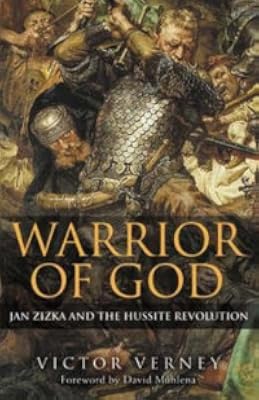
Warrior of God: Jan Zizka and the Hussite Revolution
by Victor Verney
On This Page
Description
Paperback edition of the first modern biography of one of the greatest military strategists of all time. Jan Zizka (1370-1424) was a formidable figure whose life and military career was set amidst the whirlwind of monumental revolutions - military, religious, political and social - that engulfed medieval Europe in the 14th and 15th centuries. The leader of Bohemia's Hussite Revolution - the first of the religious wars during the Protestant Reformation - he was a forward-thinking military show more genius whose record is virtually unmatched. He fielded a peasant militia, initially untrained and unequipped, and faced down the Holy Roman Empire's huge professional army of armored knights known as 'The Men of Iron'. Among his numerous innovations was the armored wagon fitted with small cannons and muskets, presaging the modern tank. All this, despite the fact that for much of his later career he went completely blind. Yet remarkably, beyond central Europe, very little is known about him. In this original and engrossing study, historian Victor Verney combines an authoritative analysis with colorful anecdotes to reveal the incredible exploits of this forgotten military genius and the fascinating cast of characters who surrounded him. show lessTags
Recommendations
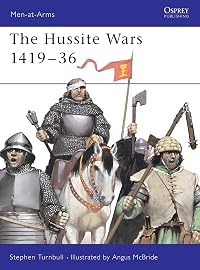


















Member Recommendations
Member Reviews
The Hussite Wars are indeed an exotic topic that deserves more attention and for which the author is to be congratulated. The best part of the book is, however, the precise and erudite foreword by a Czech-American librarian. The text itself suffers from the author's disdain for professional courtesy: Only rarely does the author provide sources for his statements (ten source footnotes in the first fifty pages; 35 total titles in the bibliography, all in English). When he does, these sources usually are (dated) English translations of Czech and German books about Bohemia where one can hint at the source of mistranslations and misunderstandings (not speaking Czech, I obviously cannot spot those). The author also quotes one Osprey title show more about Tannenberg (not included in the bibliography) but does not mention the more pertinent one about the Hussite Wars. A thorough treatment would have required including the mainly non-English literature (such as František Šmahel's recent three-volume history). Thus from a point of craftmanship, the value of this title is debatable.
From a narrative point of view, the book provides a good account of Jan Zizka's life and generalship. As a participant of the battle of Grunwald 1410, Zizka witnessed the declining value of the knight as a weapon system. His combination of war wagons, early mobile artillery and peasant soldiers resulted in a killer package ideally suited for the rolling and populated country of Bohemia. Farther east, he would have run into major supply problems, further south, the Alpine territory would have crushed his mobility. While Zizka proved to be a supreme tactician (never losing a battle), he squandered his chances in fruitless sieges of minor stronghold instead of conquering a territory.
The Hussites suffered from the dominant and unquestioned position of Prague which never allowed for a stable compromise between cities and peasants (as happened in Switzerland where the smaller city states entered into an alliance with the peasants). When the revolutionary fervor of Prague subsided, disunion crushed the Hussites - long after the death of Zizka who, like Robert E. Lee, could not transform battlefield successes into political victory. show less
From a narrative point of view, the book provides a good account of Jan Zizka's life and generalship. As a participant of the battle of Grunwald 1410, Zizka witnessed the declining value of the knight as a weapon system. His combination of war wagons, early mobile artillery and peasant soldiers resulted in a killer package ideally suited for the rolling and populated country of Bohemia. Farther east, he would have run into major supply problems, further south, the Alpine territory would have crushed his mobility. While Zizka proved to be a supreme tactician (never losing a battle), he squandered his chances in fruitless sieges of minor stronghold instead of conquering a territory.
The Hussites suffered from the dominant and unquestioned position of Prague which never allowed for a stable compromise between cities and peasants (as happened in Switzerland where the smaller city states entered into an alliance with the peasants). When the revolutionary fervor of Prague subsided, disunion crushed the Hussites - long after the death of Zizka who, like Robert E. Lee, could not transform battlefield successes into political victory. show less
Ratings
Members
- Recently Added By
Author Information
1 Work 31 Members
Victor Verney, the grandson of Slovak and Greek immigrants, grew up in Buffalo, New York. Formerly a college professor and newspaper editor, he is now a full-time writer residing in Des Moines, Iowa. David Muhlena is the Head Librarian of the National Czech and Slovak Museum.
Common Knowledge
- People/Characters
- Jan Zizka; Jan Hus; John Wycliffe; Sigismund, King of Hungary; Pope Martin V
Classifications
- Genres
- Nonfiction, History, Biography & Memoir, Religion & Spirituality
- DDC/MDS
- 943.71 — History & geography History of Europe Central Europe: Germany, Austria, Switzerland, Czech, Poland, Hungary Czech Republic and Slovakia Czech Republic
- LCC
- DB2111 .Z59 .V47 — History of Europe, Asia, Africa and Oceania Austria – Liechtenstein – Hungary – Czechoslovakia History of Austria. Liechtenstein. Hungary. Czechoslovakia Czechoslovakia History By period Early and medieval to 1526
- BISAC
Statistics
- Members
- 31
- Popularity
- 900,868
- Reviews
- 1
- Rating
- (3.00)
- Languages
- English
- Media
- Paper, Ebook
- ISBNs
- 4
- ASINs
- 1