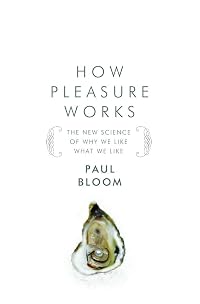
How Pleasure Works: The New Science of Why We Like What We Like
by Paul Bloom
On This Page
Description
In this fascinating and witty account, Yale psychologist Paul Bloom draws on insights from child development, philosophy, neuroscience, and behavioral economics to examine the science behind our curious desires, attractions, and tastes, covering everything from the animal instincts for sex and food to the uniquely human taste for art, music, and stories.Tags
Recommendations







Member Reviews
A fascinating and quick read about the mysterious and at times contradictory ways we get pleasure, and to a large extent feel aversion.
There are a lot of enlightening historical tidbits here I didn't know, like a simple chemical test to identify super-tasters along with a lot studies backing up facts about how we place value on ownership and contact around a basic theory of essentialism.
Back when I was at GM, it was remarked prices changed, but you could always get extra work or effect a thank you with a box of donuts. Similarly, doing studies they find they cannot get affluent MIT students to participate in a study for $2, but a candy bar less than two bucks will work. These are some of the human idiosyncrasies studied.
Coming away show more from the book, I was most impressed with the scientific study of this essentialism: why mothers only want the bronzed booties of their children, why idols' clothing fetches a higher price without dry cleaning and why children that believe you can duplicate a silver cup don't want your duplicator near their wubby. While the authors don't overtly state this, they have found a basis for belief in the supernatural and a tendency for reverence that both develop at an early age in the human mind.
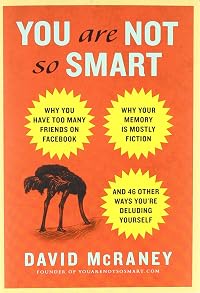
There is a lot of overlap and synchronicity with You Are Not So Smart: Why You Have Too Many Friends on Facebook, Why Your Memory Is Mostly Fiction, and 46 Other Ways You're Deluding Yourself and The Invisible Gorilla: And Other Ways Our Intuitions Deceive Us. show less
There are a lot of enlightening historical tidbits here I didn't know, like a simple chemical test to identify super-tasters along with a lot studies backing up facts about how we place value on ownership and contact around a basic theory of essentialism.
Back when I was at GM, it was remarked prices changed, but you could always get extra work or effect a thank you with a box of donuts. Similarly, doing studies they find they cannot get affluent MIT students to participate in a study for $2, but a candy bar less than two bucks will work. These are some of the human idiosyncrasies studied.
Coming away show more from the book, I was most impressed with the scientific study of this essentialism: why mothers only want the bronzed booties of their children, why idols' clothing fetches a higher price without dry cleaning and why children that believe you can duplicate a silver cup don't want your duplicator near their wubby. While the authors don't overtly state this, they have found a basis for belief in the supernatural and a tendency for reverence that both develop at an early age in the human mind.
There is a lot of overlap and synchronicity with You Are Not So Smart: Why You Have Too Many Friends on Facebook, Why Your Memory Is Mostly Fiction, and 46 Other Ways You're Deluding Yourself and The Invisible Gorilla: And Other Ways Our Intuitions Deceive Us. show less
This a book to stimulate curiosity, not to answer it. Bloom presents several theories on how pleasure works, most of which revolve around the idea that, as humans, we believe that everything has an invisible, immeasurable essence, and that when our perception of that essence matches up with something desirable, we want it. Well, I disagree with several particulars, but it's an interesting idea. Maybe not the end-all, be-all of pleasure, but certainly interesting.
I loved this book it. It starts off
a forgery, by disapointing Hermann Goering on his deathbed, and then goes on to explain how a collector was able to purchase Napoléon’s penis
But really it makes you doubt that objects have any essence aside from what we assign them.
Goering was an obsessive art collector and had already plundered much of Europe. But he was a huge fan of Vermeer, and this was the acquisition that he was most proud of.
a forgery, by disapointing Hermann Goering on his deathbed, and then goes on to explain how a collector was able to purchase Napoléon’s penis
it was (severed by the priest who had administered last rites to him.)before going onto the market.
But really it makes you doubt that objects have any essence aside from what we assign them.
This theory of pleasure is an extension of one of the most interesting ideas in the cognitive sciences, which is that people naturally assume that things in the world—including other people—haveshow more
invisible essences that make them what they are.show less
It was an enjoyable read with lots of interesting anecdotes, but there wasn't much content that didn't seem obvious.
"By distorting experience, beliefs, including essentialist beliefs, garner support for themselves, which is one reason why it is so hard to change our minds about anything."
"By distorting experience, beliefs, including essentialist beliefs, garner support for themselves, which is one reason why it is so hard to change our minds about anything."
"[...] people naturally assume that things in the world - including other people - have invisible essences that make them what they are. Experimental psychologists have argued that this essentialist perspective underlies our understanding of the physical and social worlds, and developmental and cross-cultural psychologists have propposed that it is instinctive and universal. We are natural-born essentialists. (p xii)" Evolution moulded us this way, and our essentialism determines much of how we experience pleasure from food (how old we believe a wine to be), sex, art (the real painting, not a fake); even if many pleasures evolved as by-products. Maybe, but much essentialism still seem quite silly. It was interesting to learn about an show more experiment by McClure et. al (2004) which showed that difference areas in the brain lighted up in fMRI scans when people knew as opposed to did not know whether they drank Coke or Pepsi. show less
Essentialism, biology, natural selection. Could have probably just read the introduction and been done with it. Loaded with references to a lot of obvious-seeming studies.
could have been good book, isn't. Very unclear statement of idea on how pleasure works. the best part is stories abot wierd pleasures.
Members
- Recently Added By
Lists

Books Cited in Blueprint by Nicholas Christakis
261 works; 1 member
Author Information

25+ Works 2,131 Members
Paul Bloom is the Brooks and Suzanne Ragen Professor of Psychology at Yale University and the author or editor of six books, including the acclaimed How Pleasure Works. He lives in New Haven with his wife and two sons.
Awards and Honors
Awards
Series
Belongs to Publisher Series
Work Relationships
Has as a commentary on the text
Common Knowledge
- Canonical title
- How Pleasure Works: The New Science of Why We Like What We Like
- Original title
- How pleasure works
- Original publication date
- 2010
- Dedication
- For my father, Bernie Bloom
- First words
- There is an animal aspect to human pleasure. (Preface)
Hermann Goering, the designated successor to Adolf Hilter, was waiting to be executed for crimes against humanity when he learned about the pleasure that had been stolen from him. - Last words
- (Click to show. Warning: May contain spoilers.)And the girl said, "They will in a minute."
Classifications
- Genres
- Nonfiction, General Nonfiction, Science & Nature
- DDC/MDS
- 152.42 — Philosophy & psychology Psychology Sensory perception, movement, emotions, physiological drives Emotions Pleasure, Enjoyment, Happiness, Joy, Ecstasy
- LCC
- BF515 .B56 — Philosophy, Psychology and Religion Psychology Psychology Affection. Feeling. Emotion
- BISAC
Statistics
- Members
- 434
- Popularity
- 70,443
- Reviews
- 7
- Rating
- (3.43)
- Languages
- 6 — Chinese, English, German, Italian, Portuguese (Portugal), Russian
- Media
- Paper, Audiobook, Ebook
- ISBNs
- 11
- ASINs
- 11