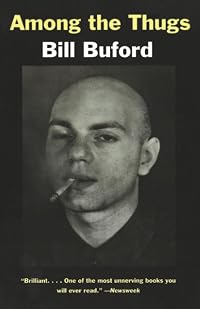
Among the Thugs
by Bill Buford
On This Page
Description
They have names like Barmy Bernie, Daft Donald, and Steamin' Sammy. They like lager (in huge quantities), the Queen, football clubs (especially Manchester United), and themselves. Their dislike encompasses the rest of the known universe, and England's soccer thugs express it in ways that range from mere vandalism to riots that terrorize entire cities. Now Bill Buford, editor of the prestigious journal Granta, enters this alternate society and records both its savageries and its sinister show more allure with the social imagination of a George Orwell and the raw personal engagement of a Hunter Thompson. show lessTags
Recommendations























Member Reviews
Among the Thugs stands next The Hell's Angels as an unflinching look at a violent male subculture, in this case the classic English football hooligan of the 1980s. Buford was an American living in England. What he depicts as an idle curiosity about a strange feature of English culture, much sensationalized by the press, became a multiyear sociological study.
It is an undeniable fact that by all conventional measures, attending a football game in England is a terrible way to spend a Saturday afternoon. Bad weather, hours walking and standing on cement terraces, and being crushed in narrow passageways and too-small cages by a drunk, chanting, mass of the lads. There's also a chance of random violence at the hands of supporters of the other show more team, of the police, or the crowd itself. And then there's the minor problems of no parking, poor transit, and sanitary facilities consisting of 'pee on the people lower than you'. But somehow, thousands if not millions of English headed out to the grounds every Saturday. Football gives the week meaning. In a series of short narrative essays about his experiences across England and the continent, with all sorts of fringe members of "the Firm", Buford explores what that meaning is.
Buford's first topic is the crowd itself, human individuality compressed into the herd, submerged in the crush, the chanting, the mass of movements. The crowd is the the base of everything else in football, an animal energy that is the true draw, not the action on the pitch. Crowds are fickle things, always an outsider to the body politic. The crowd demands a leader, but one cannot just declare themselves the leader of the crowd, you must be chosen.
The second theme is violence. The crowd is a means to an end, and "when it goes off", as signaled by someone throwing a trash bin through a window, the crowd becomes animated in mass violence, from throwing stones at riot police, to mass property destruction and semi-random knifings. If being part of a crowd is transforming, being part of a violent mob is ecstatic: Buford describes feeling like he could fly, the electric thrill of chasing and being chased, and he was a journalist maintaining his distance from the event.
The third theme is racism. The lads are proud to be English, happy to tell you they don't much care for non-white people or foreigners, and delighted to go to another country and be as beastly as possible to the inhabitants. Buford attends a National Front white power disco, a profoundly weird homoerotic punk-rock rave, of shirtless skinheads men jumping up and down in a mass and rubbing each other's heads while their girlfriends look on. While the football firms are gleefully racist, and white power foot soldiers football fanatics, there's not a true alliance between the two, because the mid-80s leadership of the National Front are a bunch of dweebs afraid of the raw physicality of the crowd.
And of course there's the minor stuff, life "on the jib" to get as much stolen beer and illegal rides out of football as possible. After all, who can compel payment from a crowd? There's the ambiguous relationship between hooligans, the press, and law enforcement. There's the Hillsborough disaster, and crowd control reform. There's the international hustling of 'DJ', a counterfeiter and aspiring photographer from a privileged background.
But ultimately, this book is about The Lads and their mythos. Buford observes that in England, it is just not done for members of the literati to talk about the working class, and so no one will admit that the true "English working class" has vanished. I quote in full.
"It is still possible, I suppose, to belong to a phrase-the working class—a piece of language that serves to reinforce certain social customs and a way of talking and that obscures the fact that the only thing hiding behind it is a highly mannered suburban society stripped of culture and sophistication and living only for its affectations: a bloated code of maleness, an exaggerated, embarrassing patriotism, a violent nationalism, an array of bankrupt antisocial habits. This bored, empty, decadent generation consists of nothing more than what it appears to be. It is a lad culture without mystery, so deadened that it uses violence to wake itself up. It pricks itself so that it has feeling, burns its flesh so that it has smell."
Yeah. You feel that?
Go Manchester United! show less
It is an undeniable fact that by all conventional measures, attending a football game in England is a terrible way to spend a Saturday afternoon. Bad weather, hours walking and standing on cement terraces, and being crushed in narrow passageways and too-small cages by a drunk, chanting, mass of the lads. There's also a chance of random violence at the hands of supporters of the other show more team, of the police, or the crowd itself. And then there's the minor problems of no parking, poor transit, and sanitary facilities consisting of 'pee on the people lower than you'. But somehow, thousands if not millions of English headed out to the grounds every Saturday. Football gives the week meaning. In a series of short narrative essays about his experiences across England and the continent, with all sorts of fringe members of "the Firm", Buford explores what that meaning is.
Buford's first topic is the crowd itself, human individuality compressed into the herd, submerged in the crush, the chanting, the mass of movements. The crowd is the the base of everything else in football, an animal energy that is the true draw, not the action on the pitch. Crowds are fickle things, always an outsider to the body politic. The crowd demands a leader, but one cannot just declare themselves the leader of the crowd, you must be chosen.
The second theme is violence. The crowd is a means to an end, and "when it goes off", as signaled by someone throwing a trash bin through a window, the crowd becomes animated in mass violence, from throwing stones at riot police, to mass property destruction and semi-random knifings. If being part of a crowd is transforming, being part of a violent mob is ecstatic: Buford describes feeling like he could fly, the electric thrill of chasing and being chased, and he was a journalist maintaining his distance from the event.
The third theme is racism. The lads are proud to be English, happy to tell you they don't much care for non-white people or foreigners, and delighted to go to another country and be as beastly as possible to the inhabitants. Buford attends a National Front white power disco, a profoundly weird homoerotic punk-rock rave, of shirtless skinheads men jumping up and down in a mass and rubbing each other's heads while their girlfriends look on. While the football firms are gleefully racist, and white power foot soldiers football fanatics, there's not a true alliance between the two, because the mid-80s leadership of the National Front are a bunch of dweebs afraid of the raw physicality of the crowd.
And of course there's the minor stuff, life "on the jib" to get as much stolen beer and illegal rides out of football as possible. After all, who can compel payment from a crowd? There's the ambiguous relationship between hooligans, the press, and law enforcement. There's the Hillsborough disaster, and crowd control reform. There's the international hustling of 'DJ', a counterfeiter and aspiring photographer from a privileged background.
But ultimately, this book is about The Lads and their mythos. Buford observes that in England, it is just not done for members of the literati to talk about the working class, and so no one will admit that the true "English working class" has vanished. I quote in full.
"It is still possible, I suppose, to belong to a phrase-the working class—a piece of language that serves to reinforce certain social customs and a way of talking and that obscures the fact that the only thing hiding behind it is a highly mannered suburban society stripped of culture and sophistication and living only for its affectations: a bloated code of maleness, an exaggerated, embarrassing patriotism, a violent nationalism, an array of bankrupt antisocial habits. This bored, empty, decadent generation consists of nothing more than what it appears to be. It is a lad culture without mystery, so deadened that it uses violence to wake itself up. It pricks itself so that it has feeling, burns its flesh so that it has smell."
Yeah. You feel that?
Go Manchester United! show less
5/5
Stupidly violent and undeniably engaging.
Among the Thugs is a memoir drawn from three to four years of Bill Buford’s life, during which he embedded himself within a community of Manchester United supporters to better understand the epidemic of football-related violence that gripped the UK in the 1980s.
Much of the book zeroes in on a handful of matches and meet-ups Buford attended, often those that turned violent or 'went off' as the lads commonly describe it. This structure sometimes makes Among the Thugs feel more like a collection of long-form articles than a cohesive, unified narrative. That said, Buford’s writing is consistently sharp: sarcastic, dryly humorous, and often entertaining. At times, though, he strays from show more observer to moral commentator, which occasionally left a bad taste in my mouth. Sometimes it’s justified; other times it feels needlessly judgmental. Still, there’s no denying Buford’s talent. His prose is varied, creative, and immersive. Several passages hit especially hard and have lodged themselves into my brain. I often felt hard pressed to put it down.
From a sociological or theoretical standpoint, Buford offers limited commentary. There’s virtually no discussion of class at all. However, he puts forward a few key arguments. First, he pushes back against theorists who treat crowds as alien or “other”—as something twisted and separate from the rest of society. Buford insists that the capacity for crowd behavior and violence lies within all of us. Second, he argues that hooliganism wasn’t necessarily rooted in economic despair or cultural decay. Instead, he sees it as a substitute for the vices other generations embraced: gambling, drugs, partying, etc. Through personal anecdotes, Buford compellingly conveys the adrenaline rush of crowd violence, the focus, the euphoria, the liberation of shedding individual identity. Given that, is it really surprising so many young men were drawn to it?
He also refutes the idea that violence in these crowds was typically incited by charismatic leaders. In his view, the decision to cross the line into chaos requires collective agreement. Accordingly, he rejects the theory that groups like the National Front orchestrated much of the violence. Rather, the NF simply latched onto whatever nationalism, patriotism, or xenophobia was already present among individuals.
Unfortunately, Among the Thugs ends on a bit of a whimper. Buford is transparent about his fatigue—he feels he’s learned all there is to learn—and that weariness bleeds into the final pages. I found myself wishing for a stronger theoretical conclusion. Still, the final act, in which Buford is brutally beaten by Italian police in Sardinia, feels oddly fitting, a mirror to United supporters doing the exact same thing to Italian youths at the beginning of the book. After hundreds of pages of building tension, it was an important release. Buford concludes with a sobering reflection: that it’s all so stupid. The sports culture, the thugs, the violence, the media, the police—it’s all an unfortunate mess.
What makes Buford’s conclusions feel earned, though, is the depth and duration of his immersion. It’s a fine line between a book like this and something like Nickel and Dimed, where it felt like the author play acted for a few months in low-paying service jobs and felt license to complain about a life that was not her own. Buford, on the other hand, spent years inside this culture. Watching, listening, participating, and frequently putting himself in danger. While I can’t fully explain why, I trust him. His reflections might not be exhaustive and I may not necessarily agree with him in every aspect, but they feel honest and grounded in experience rather than performance.
This might be the most Ballardian piece of nonfiction I’ve ever read. Incredibly memorable. Despite some nitpicks, Among the Thugs genuinely sets itself apart from the crowd. show less
Stupidly violent and undeniably engaging.
Among the Thugs is a memoir drawn from three to four years of Bill Buford’s life, during which he embedded himself within a community of Manchester United supporters to better understand the epidemic of football-related violence that gripped the UK in the 1980s.
Much of the book zeroes in on a handful of matches and meet-ups Buford attended, often those that turned violent or 'went off' as the lads commonly describe it. This structure sometimes makes Among the Thugs feel more like a collection of long-form articles than a cohesive, unified narrative. That said, Buford’s writing is consistently sharp: sarcastic, dryly humorous, and often entertaining. At times, though, he strays from show more observer to moral commentator, which occasionally left a bad taste in my mouth. Sometimes it’s justified; other times it feels needlessly judgmental. Still, there’s no denying Buford’s talent. His prose is varied, creative, and immersive. Several passages hit especially hard and have lodged themselves into my brain. I often felt hard pressed to put it down.
From a sociological or theoretical standpoint, Buford offers limited commentary. There’s virtually no discussion of class at all. However, he puts forward a few key arguments. First, he pushes back against theorists who treat crowds as alien or “other”—as something twisted and separate from the rest of society. Buford insists that the capacity for crowd behavior and violence lies within all of us. Second, he argues that hooliganism wasn’t necessarily rooted in economic despair or cultural decay. Instead, he sees it as a substitute for the vices other generations embraced: gambling, drugs, partying, etc. Through personal anecdotes, Buford compellingly conveys the adrenaline rush of crowd violence, the focus, the euphoria, the liberation of shedding individual identity. Given that, is it really surprising so many young men were drawn to it?
He also refutes the idea that violence in these crowds was typically incited by charismatic leaders. In his view, the decision to cross the line into chaos requires collective agreement. Accordingly, he rejects the theory that groups like the National Front orchestrated much of the violence. Rather, the NF simply latched onto whatever nationalism, patriotism, or xenophobia was already present among individuals.
Unfortunately, Among the Thugs ends on a bit of a whimper. Buford is transparent about his fatigue—he feels he’s learned all there is to learn—and that weariness bleeds into the final pages. I found myself wishing for a stronger theoretical conclusion. Still, the final act, in which Buford is brutally beaten by Italian police in Sardinia, feels oddly fitting, a mirror to United supporters doing the exact same thing to Italian youths at the beginning of the book. After hundreds of pages of building tension, it was an important release. Buford concludes with a sobering reflection: that it’s all so stupid. The sports culture, the thugs, the violence, the media, the police—it’s all an unfortunate mess.
What makes Buford’s conclusions feel earned, though, is the depth and duration of his immersion. It’s a fine line between a book like this and something like Nickel and Dimed, where it felt like the author play acted for a few months in low-paying service jobs and felt license to complain about a life that was not her own. Buford, on the other hand, spent years inside this culture. Watching, listening, participating, and frequently putting himself in danger. While I can’t fully explain why, I trust him. His reflections might not be exhaustive and I may not necessarily agree with him in every aspect, but they feel honest and grounded in experience rather than performance.
This might be the most Ballardian piece of nonfiction I’ve ever read. Incredibly memorable. Despite some nitpicks, Among the Thugs genuinely sets itself apart from the crowd. show less
Reading this after seeing it on Asa's list and my Mom's bookshelf. Not for the faint of heart! Be warned! This alternates between high comedy and horrifying violence: a literal "riot"! But what I liked best about this book though was the narrator. Where gonzo journalism usually tends to be excessively self-aware, either in the American tradition (I was driving THIS and fucked up on THAT) or the British tradition (forgive my mincing but oh me, oh my!) this book is written by a BUDDY. You're always right there with him: too drunk to keep up, fists clenched for no reasons, grossed out and slightly terrified by your new "friends", etc. Excellent, excellent book: a hoot, a riot, a real roller coaster!
This is a powerful exposé of the crowd violence that prominently infected English football in the latter part of the 20th century. But as shown by the epigraphs preceding each chapter, the problem traces far back, even to the 19th century.
Author Bill Buford infiltrated the ranks of these groups of thugs to present truly horrifying eyewitness accounts of their savagery and destructiveness, and the intense exhilaration it provides for them. He analyzes the personalities and circumstances that draw people to this behavior; the disaffected, the aimless, the discontented, those with the need to be be part of something exclusive thereby giving a sense of belonging.
Buford's decription of the mob as a coordinated, structured unit is show more fascinating: its movements akin to a single organism, shifting and reashaping, splitting apart as necessary while on the march and then reforming when necessary. The narrative descriptions of the incidents are quite graphic and sometimes difficult to get through.
The final chapter describes the author's experience in the midst of the stampeding violence at the 1990 World Cup in Sardinia. The stark, abrupt ending - spillover vandalism, arson, and murder back in the suburbs of south London - is an effective last jolt. show less
Author Bill Buford infiltrated the ranks of these groups of thugs to present truly horrifying eyewitness accounts of their savagery and destructiveness, and the intense exhilaration it provides for them. He analyzes the personalities and circumstances that draw people to this behavior; the disaffected, the aimless, the discontented, those with the need to be be part of something exclusive thereby giving a sense of belonging.
Buford's decription of the mob as a coordinated, structured unit is show more fascinating: its movements akin to a single organism, shifting and reashaping, splitting apart as necessary while on the march and then reforming when necessary. The narrative descriptions of the incidents are quite graphic and sometimes difficult to get through.
The final chapter describes the author's experience in the midst of the stampeding violence at the 1990 World Cup in Sardinia. The stark, abrupt ending - spillover vandalism, arson, and murder back in the suburbs of south London - is an effective last jolt. show less
This is a horrific and almost unbearably detailed look at British football (soccer) fan violence. The author, the editor of Granta, includes very little football, but rather follows the ``supporters'' on their Saturday jaunts during the 1980s. British football fans and their loosely organized ``firms''- -with their bizarre ties to white-power groups, skinheads, and the National Front--were involved in scores of deaths, countless riots and skirmishes with police and rival supporters, and untold damage to property in England and across the continent. It is the ``precise moment in its complete sensual intensity'' when the crowd goes over the edge and erupts into heedless violence that captures Buford's attention as he attempts to show more understand such ferocious behavior. He finds that ``violence is their antisocial kick, their mind-altering experience,'' and notes that ``this...is the way animals behave....'' Following his own brutal beating at the hands of Sardinian riot police, a despairing Buford concludes that, in a society that offers little to look forward to or to believe in except ``a bloated code of maleness, an exaggerated, embarrassing patriotism, a violent nationalism, an array of bankrupt social habits,'' youth, out of boredom, frustration, and anger, will use violence ``to wake itself up.'' It is a unique book in my experience documenting the fan culture of soccer in England. The mass violence seems to provide evidence to support the conclusions of those who study the psychology of crowds. These are crowds unlike any I have ever experienced. Buford is a very good writer and his account is mesmerizing. show less
Bill Buford, an American export to Britain, began an exploration of sports violence after he had the misfortune to take a train that was being systematically destroyed by hundreds of Liverpool soccer team supporters - the police seemingly unable to control the riot, indeed as afraid as the other passengers. There is a particularly savage image of a drunk "supporter," as Buford calls the hooligans, throwing lighted matches on the shoes of a well-to-do businessman riding in first-class, perhaps hoping to set the man's pants on fire, the man trying to ignore the barbaric gesture. To Buford, this act became symbolic of the revolt of the unemployed and uneducated against class distinctions: sports fans "determined to break or destroy the show more things that were in their way."
Buford's English friends were not surprised; this was normal behavior for the "lads." What did surprise them was that Buford had never been to a soccer match. So they took him. It was quite an event:
spectators urinating on one another, fighting, manhandling the police, wrestling for their seats. Buford decided to investigate "them."
Some of the behavior Buford attributes to the design of English football (soccer). The spectators become crowds. There are not enough seats for all; most stand to watch and are pressed together in a remarkable intimacy during the game. When they leave, the observers must exit through narrow gates and are forced to herd together in a fashion Buford could only describe as a stampede. Indeed, they are fenced in (often with chain linked fences topped with several rows of barbed wire curved ill towards the spectators) during the match in conditions much like a stockyard. Buford recalls one match: "the single toilet facility overflowing, and my feet slapping around in the urine that came pouring down the concrete steps of the terrace, the crush so great that I had to clinch my toes to keep my shoes from being pulled off, horrified by the prospect of my woolen socks soaking up this cascading pungent liquid still warm and steaming in the cold air. The conditions are appalling, but essential: it is understood that anything more civilized would diffuse the experience."
Unfortunately, the type of fan that enjoys this experience is also one that the British National Front, the neo-Nazi party, believes is most responsive to its race-baiting, jingoistic, xenophobic literature and propaganda, and they do their very best to enlist cadres of football fans into groups that revel in violence and class hatred.
The truly scary revelation of this book is Buford's discovery of how easily he became part of the crowd and began to act just like them. Crowds are mindless. Crowds are primitive, barbaric. childish, fickle, unpredictable, capricious, dirty. and vicious. Crowds kill. They killed Jesus and Socrates. They murdered at the Bastille, in Mississippi, and in front of the Wmter Palace. People in crowds are typically those who have "abandoned intelligence. discrimination, judgment. " They are "unable to think for themselves, are vulnerable to agitators, outside influences, infiltrators, communists, fascists, racists, nationalists, phalangists, and spies."
Why have people adopted this manner of behavior? Is it biological, innate to our species, or does it result from environmental conditions, overcrowding and poverty? Buford theorizes that the English working class has essentially disappeared, that most jobs are "service" or white collar. "This bored, empty, decadent generation consists of nothing more than what it ap~s to be. It is a lad culture without mystery, so deadened that it uses violence to wake itself up. It pricks itself so that it has feeling, bums its flesh so that it has smell." show less
Buford's English friends were not surprised; this was normal behavior for the "lads." What did surprise them was that Buford had never been to a soccer match. So they took him. It was quite an event:
spectators urinating on one another, fighting, manhandling the police, wrestling for their seats. Buford decided to investigate "them."
Some of the behavior Buford attributes to the design of English football (soccer). The spectators become crowds. There are not enough seats for all; most stand to watch and are pressed together in a remarkable intimacy during the game. When they leave, the observers must exit through narrow gates and are forced to herd together in a fashion Buford could only describe as a stampede. Indeed, they are fenced in (often with chain linked fences topped with several rows of barbed wire curved ill towards the spectators) during the match in conditions much like a stockyard. Buford recalls one match: "the single toilet facility overflowing, and my feet slapping around in the urine that came pouring down the concrete steps of the terrace, the crush so great that I had to clinch my toes to keep my shoes from being pulled off, horrified by the prospect of my woolen socks soaking up this cascading pungent liquid still warm and steaming in the cold air. The conditions are appalling, but essential: it is understood that anything more civilized would diffuse the experience."
Unfortunately, the type of fan that enjoys this experience is also one that the British National Front, the neo-Nazi party, believes is most responsive to its race-baiting, jingoistic, xenophobic literature and propaganda, and they do their very best to enlist cadres of football fans into groups that revel in violence and class hatred.
The truly scary revelation of this book is Buford's discovery of how easily he became part of the crowd and began to act just like them. Crowds are mindless. Crowds are primitive, barbaric. childish, fickle, unpredictable, capricious, dirty. and vicious. Crowds kill. They killed Jesus and Socrates. They murdered at the Bastille, in Mississippi, and in front of the Wmter Palace. People in crowds are typically those who have "abandoned intelligence. discrimination, judgment. " They are "unable to think for themselves, are vulnerable to agitators, outside influences, infiltrators, communists, fascists, racists, nationalists, phalangists, and spies."
Why have people adopted this manner of behavior? Is it biological, innate to our species, or does it result from environmental conditions, overcrowding and poverty? Buford theorizes that the English working class has essentially disappeared, that most jobs are "service" or white collar. "This bored, empty, decadent generation consists of nothing more than what it ap~s to be. It is a lad culture without mystery, so deadened that it uses violence to wake itself up. It pricks itself so that it has feeling, bums its flesh so that it has smell." show less
Soccer hooliganism was and still is the bane for much of the footballing world. Violent, drunken fans, hell bent on destruction leave nothing but shame and millions of dollars of damage behind. There are many books and articles explaining the socio-economic and general psychology of crowd behavior, but there haven't been many that seek out an insiders view of the violent crowd. In Among the Thugs, Bill Buford embeds himself in the lad culture that prevailed in European soccer in the late '80s and early '90s to provide a unique perspective of what fuels the crowd.
The violence exhibited by supporters of the top flight soccer before, during, and after the matches was in many ways a feature of game for many in the 1980s. It was just what show more was done. By the late '80s the violence had become organized. At the time the police looked to confine the violence, rather then curb it. As long supporters only harmed other supporters then so be it. Buford, an ex-pat, inserts himself into these violent crowds like no other member of the press ever had. He becomes a hooligan.
Bill Buford describes all the horrible drunkeness, and awful violence you'd expect for a book about hooliganism. And what people do in the anonymity of the crowd is truly horrible. But what sets Buford's account out for the others is that he tries to seek out the not just the how but why the violence was so prevalent during those times. Sure alcohol fueled the rage. The changing economy from blue collar work to service industries played a major role and soccer became an outlet for the aggression. For Buford though it was the experience in the terraces that really drove the crowd. Being jammed into such a tiny place, that you had to become apart of the crowd just to survive. Moving and a swaying and pushing and pulling on people to keep from getting crushed created something of living organism. You have to give up your individuality to become apart of the crowd. Once people stop being individuals and their actions are dictated by the crowd then anything and everything is possible. Especially with a select group of troublemakers looking to lead that crowd.
Today, the firms that once controlled the crowds are largely dead in England. The nationalist party fell away, nationalism isn't that big anymore, economy improved, policing of supporters got better, banning the leaders/jail time, the rise of the EPL, all-seater grounds, and destruction of the terraces has lead to a calmer supporter culture. Violence still happens but now its smaller and less organized then in the past. Buford by immersing himself so deeply in the lad culture has done a wonderful job of giving us some insight into violent crowds. And along the way gave me some wonderful passages about the game to remind me why I love it so much. show less
The violence exhibited by supporters of the top flight soccer before, during, and after the matches was in many ways a feature of game for many in the 1980s. It was just what show more was done. By the late '80s the violence had become organized. At the time the police looked to confine the violence, rather then curb it. As long supporters only harmed other supporters then so be it. Buford, an ex-pat, inserts himself into these violent crowds like no other member of the press ever had. He becomes a hooligan.
Bill Buford describes all the horrible drunkeness, and awful violence you'd expect for a book about hooliganism. And what people do in the anonymity of the crowd is truly horrible. But what sets Buford's account out for the others is that he tries to seek out the not just the how but why the violence was so prevalent during those times. Sure alcohol fueled the rage. The changing economy from blue collar work to service industries played a major role and soccer became an outlet for the aggression. For Buford though it was the experience in the terraces that really drove the crowd. Being jammed into such a tiny place, that you had to become apart of the crowd just to survive. Moving and a swaying and pushing and pulling on people to keep from getting crushed created something of living organism. You have to give up your individuality to become apart of the crowd. Once people stop being individuals and their actions are dictated by the crowd then anything and everything is possible. Especially with a select group of troublemakers looking to lead that crowd.
Today, the firms that once controlled the crowds are largely dead in England. The nationalist party fell away, nationalism isn't that big anymore, economy improved, policing of supporters got better, banning the leaders/jail time, the rise of the EPL, all-seater grounds, and destruction of the terraces has lead to a calmer supporter culture. Violence still happens but now its smaller and less organized then in the past. Buford by immersing himself so deeply in the lad culture has done a wonderful job of giving us some insight into violent crowds. And along the way gave me some wonderful passages about the game to remind me why I love it so much. show less
Members
- Recently Added By
Lists

My Year Spent Doing Something Stupid so I Could Write This Book
34 works; 6 members

The Joe Rogan Experience Library
254 works; 3 members

Guilty Pleasures
223 works; 87 members
Author Information

71+ Works 11,082 Members
Awards and Honors
Series
Belongs to Publisher Series
Common Knowledge
- Canonical title*
- Parmi les hooligans
- Original title
- Among the thugs
- Blurbers
- Jonathan Raban; Don DeLillo
*Some information comes from Common Knowledge in other languages. Click "Edit" for more information.
Classifications
- Genres
- Sports and Leisure, Sociology, Nonfiction, General Nonfiction, Biography & Memoir, History
- DDC/MDS
- 363.32 — Society, government, & culture Social problems and social services Public Safety - Police, Crime Investigation Terrorism, Disasters, Civil Defense Social conflict
- LCC
- GV943.9 .F35 .B84 — Geography, Anthropology and Recreation Recreation. Leisure Recreation. Leisure Sports Ball games: Baseball, football, golf, etc.
- BISAC
Statistics
- Members
- 1,093
- Popularity
- 23,459
- Reviews
- 33
- Rating
- (3.95)
- Languages
- 8 — Danish, Dutch, English, French, German, Portuguese, Spanish, Swedish
- Media
- Paper, Ebook
- ISBNs
- 25
- ASINs
- 6