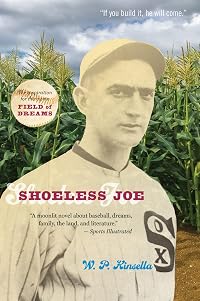
Shoeless Joe
by W. P. Kinsella
On This Page
Description
Shoeless Joe, the soul-stirring novel on which the movie Field of Dreams is based, is more than just another baseball story. Kinsella captures the spiritual dimension that baseball represents for its most determined devotees in this tale of love and the power of dreams to make people come alive. "Shoeless Joe" is the great Joe Jackson, one of the eight members of the 1919 Chicago White Sox who were banned from baseball for throwing the World Series. One day, while out in his corn field, Iowa show more farmer Ray Kinsella hears the voice of a baseball announcer saying, "If you build it, he will come." "He," of course, is Ray's hero, Joe Jackson. "It" is a baseball stadium, which Ray carves out of his corn field. show lessTags
Recommendations














Member Reviews
Most people already know this story through the film version, Field of Dreams. For anyone who isn’t familiar with it, it’s the story of Ray, an Iowa man who builds a baseball diamond in the middle of a cornfield on his farm. A voice tells him, “If you build it, he will come.” His wife Annie supports his wild scheme with no questions and he builds the field. Soon long-dead baseball players like Shoeless Joe Jackson appear on the diamond to play baseball.
On the surface the book is obviously about baseball, but as someone who isn’t a fan of the sport, I can promise it’s really about so much more. It’s about dreaming big, supporting the people you love and finding your true home.
The writing is lyrical and nostalgic. I love show more Kinsella’s reverence for the sport. He treats both the game and the Iowa cornfields like they are something holy and precious. I’m sure that reading it as I drove through Iowa played a big part in the fact that I felt so connected to the story. We are travelers right alongside Ray on his quest to follow the instructions being given to him.
Some people around him can see the magic and some can't. This aspect of the story made me think of reading. Some people pick up a book and are carried away by the beauty of the story, others get nothing from it and the experience is forgettable. I'm so grateful to be one of the ones that can see the magic.
BOTTOM LINE: Pack this book in your suitcase the next time you take a road trip through the beautiful Midwestern states. It’s a reminder to appreciate all the things you love in your life and to always notice the magic.
“My impulse is to turn back, but I know I won't, even though it is so easy not to do something.”
“Growing up is a ritual -- more deadly than religion, more complicated than baseball, for there seem to be no rules. Everything is experienced for the first time.”
“America has been erased like a blackboard, only to be rebuilt and then erased again.”
"Iowa City is a town of grandfathers fighting a losing battle against time. We have a drugstore with a soda fountain," I say. "It's dark and cool and you can smell malt the air like a musty perfume. And they have a cold lemon-Cokes and sweating glasses, a lime drink called Green River, and just the best chocolate malts in America."
**One major change from the book to the film is the character of the reclusive writer. The role is beautifully played by James Earl Jones in the movie, but in the book it’s J.D. Salinger! show less
On the surface the book is obviously about baseball, but as someone who isn’t a fan of the sport, I can promise it’s really about so much more. It’s about dreaming big, supporting the people you love and finding your true home.
The writing is lyrical and nostalgic. I love show more Kinsella’s reverence for the sport. He treats both the game and the Iowa cornfields like they are something holy and precious. I’m sure that reading it as I drove through Iowa played a big part in the fact that I felt so connected to the story. We are travelers right alongside Ray on his quest to follow the instructions being given to him.
Some people around him can see the magic and some can't. This aspect of the story made me think of reading. Some people pick up a book and are carried away by the beauty of the story, others get nothing from it and the experience is forgettable. I'm so grateful to be one of the ones that can see the magic.
BOTTOM LINE: Pack this book in your suitcase the next time you take a road trip through the beautiful Midwestern states. It’s a reminder to appreciate all the things you love in your life and to always notice the magic.
“My impulse is to turn back, but I know I won't, even though it is so easy not to do something.”
“Growing up is a ritual -- more deadly than religion, more complicated than baseball, for there seem to be no rules. Everything is experienced for the first time.”
“America has been erased like a blackboard, only to be rebuilt and then erased again.”
"Iowa City is a town of grandfathers fighting a losing battle against time. We have a drugstore with a soda fountain," I say. "It's dark and cool and you can smell malt the air like a musty perfume. And they have a cold lemon-Cokes and sweating glasses, a lime drink called Green River, and just the best chocolate malts in America."
**One major change from the book to the film is the character of the reclusive writer. The role is beautifully played by James Earl Jones in the movie, but in the book it’s J.D. Salinger! show less
Let's get something straight: Field of Dreams is one of my favourite movies. Maybe... my very favourite movie. I've always known it was based on this book, but for whatever reason it has taken me over 20 years to actually read this book. It is weird, reading a book that you've already seen a movie adaptation of. I usually do it the other way around. So, not much of this story was a surprise to me. However, there is a LOT in this book that never made it to the movie. The thing about movies based on books is that movies get cluttered much faster than books do, so they need to be distilled, to get the essence of the narrative and apply cinematic principles to it. So, some of the key characters in the book (Ray Kinsella's twin brother, and show more Ray's buddy, "the oldest living Cub" for example) never made it to the movie, though they are constants throughout the novel. There is a scene in the movie where Ray's wife, Annie, stands up to a conservative crowd in a town hall meeting, defending a controversial book by Terence Mann, the fictional author who stands in for J. D. Salinger. Never happened in the book (and Salinger appears as himself there also). So, my point is that at times I was tempted to jump ahead or skip things as I was reading this book, because I knew how it was going to go. But, enough was different from the movie version that I actually couldn't be confident it WOULD go how it did in the movie. There is no reason the story should turn out the same in the movie as it does in the book. I won't tell you, dear reader, whether I was right or not -- you'll have to find out for yourself. Kinsella wrote a lot about baseball, and a lot about the Indigenous peoples of Canada (which maybe would be considered a big appropriation no-no nowadays, since he was a white guy). He mostly wrote short stories, which is not my genre of choice, so I doubt I'll dip much further into his bibliography, but I may pick up another of his baseball novels someday. He was a good writer, and I'm sure Field of Dreams is a great film because it had great source material. show less
W.P. Kinsella was one of my favorite authors growin up and this is one of his classic books. Most people will be familiar with this novel as the source for the movie Field of Dreams. The basic gist is that a baseball crazy man named Ray Kinsella marries a woman from Iowa and together they purchase a farm. Ray gets a mystical message "If you build it, he will come" and knows that it refers to disgraced baseball star Shoeless Joe Jackson. He builds a baseball field on his farm, and Shoeless Joe appears, followed by the rest of the 1919 Chicago White Sox players banned from baseball for throwing the World Series.
Ray gets more missions from the mysterious voice: to take reclusive author J.D. Salinger to a game at Fenway Park, find the show more curiously named Moonlight Graham who played in one baseball game and never came to bat, and the Oldest Living Chicago Cub player. Bringing this odd group together, Ray is also able to reunite with his (dead) father who played baseball in his youth, and his (living) identical twin brother who ran away from the circus.
What I forgot about this book is that it is largely a series of conversations focusing on philosophy, dreams, American identity, and fatherhood. It's a great blend of magic and the quotidian. And the fictional version of J.D. Salinger is a hoot, and one can only hope the real Salinger was something like that. The book holds up and perhaps even better than I remembered from an adult perspective. show less
Ray gets more missions from the mysterious voice: to take reclusive author J.D. Salinger to a game at Fenway Park, find the show more curiously named Moonlight Graham who played in one baseball game and never came to bat, and the Oldest Living Chicago Cub player. Bringing this odd group together, Ray is also able to reunite with his (dead) father who played baseball in his youth, and his (living) identical twin brother who ran away from the circus.
What I forgot about this book is that it is largely a series of conversations focusing on philosophy, dreams, American identity, and fatherhood. It's a great blend of magic and the quotidian. And the fictional version of J.D. Salinger is a hoot, and one can only hope the real Salinger was something like that. The book holds up and perhaps even better than I remembered from an adult perspective. show less
Just as there is comfort food, there is comfort reading. And for me, there is no better comfort reading than W.P. Kinsella’s classic baseball fantasy, Shoeless Joe. I re-read this one every few years to remind myself why I fell in love with the game in the first place – and why that romance has lasted for over 50 years now. What is not to like about a novel about baseball, family and second chances? Keep in mind that this is not Field of Dreams, the great Kevin Costner movie based on Kinsella’s novel. Shoeless Joe is better.
Ray Kinsella, an accidental farmer, lives with his wife and little girl on a rented Iowa farm. Ray is still learning on the job, and things are not going well. But despite the family’s financial problems, Ray show more is willing to plow up a substantial portion of his cornfield when he hears what seems to be the voice of a baseball announcer saying to him, “If you build it, he will come.” Weird as that is, Ray instinctively knows that he is Shoeless Joe Jackson, one of the disgraced Chicago White Sox players accused of throwing the 1919 World Series (and his father’s favorite baseball player). So build it, he does.
Building the stadium, though, is just the beginning of Ray’s quest, a quest that will lead him on a cross-country road trip to the hideaway home of reclusive author J.D. Salinger. Ray knows that he needs to bring Salinger back to his little Iowa ballpark, but he does not know why – and Salinger is having none of it, so Ray kidnaps him. On the way back to Iowa, Ray stops in Boston to deliver on the promise he made to Salinger to bring him to a game at Fenway Park if he would just get in the car. Late in the game, Ray’s personal announcer makes another appearance to give Ray and Salinger a hint about what they need to do next.
Shoeless Joe is, especially for hardcore baseball fans, a thing of beauty. It is primarily a novel about the beauty of second chances. Shoeless Joe Jackson and the Black Sox get to play baseball again; Ray reconciles with the twin brother he lost track of years earlier; old men who barely missed out on the opportunity to play major league baseball get a chance to see their younger selves compete with and against ghost players from the past; Ray gets to see his father as a young man. And Ray gets a second chance to save his farm from his scheming brother-in-law.
This is a book about following one’s dreams, taking chances, and joyously living the only shot at life any of us will ever be blessed to have. When I need to remind myself of these principles, I reach for Shoeless Joe. It has done the trick for three decades – and I hope there are still several more re-reads in my future.
Rated at: 5.0 show less
Ray Kinsella, an accidental farmer, lives with his wife and little girl on a rented Iowa farm. Ray is still learning on the job, and things are not going well. But despite the family’s financial problems, Ray show more is willing to plow up a substantial portion of his cornfield when he hears what seems to be the voice of a baseball announcer saying to him, “If you build it, he will come.” Weird as that is, Ray instinctively knows that he is Shoeless Joe Jackson, one of the disgraced Chicago White Sox players accused of throwing the 1919 World Series (and his father’s favorite baseball player). So build it, he does.
Building the stadium, though, is just the beginning of Ray’s quest, a quest that will lead him on a cross-country road trip to the hideaway home of reclusive author J.D. Salinger. Ray knows that he needs to bring Salinger back to his little Iowa ballpark, but he does not know why – and Salinger is having none of it, so Ray kidnaps him. On the way back to Iowa, Ray stops in Boston to deliver on the promise he made to Salinger to bring him to a game at Fenway Park if he would just get in the car. Late in the game, Ray’s personal announcer makes another appearance to give Ray and Salinger a hint about what they need to do next.
Shoeless Joe is, especially for hardcore baseball fans, a thing of beauty. It is primarily a novel about the beauty of second chances. Shoeless Joe Jackson and the Black Sox get to play baseball again; Ray reconciles with the twin brother he lost track of years earlier; old men who barely missed out on the opportunity to play major league baseball get a chance to see their younger selves compete with and against ghost players from the past; Ray gets to see his father as a young man. And Ray gets a second chance to save his farm from his scheming brother-in-law.
This is a book about following one’s dreams, taking chances, and joyously living the only shot at life any of us will ever be blessed to have. When I need to remind myself of these principles, I reach for Shoeless Joe. It has done the trick for three decades – and I hope there are still several more re-reads in my future.
Rated at: 5.0 show less
I REALLY wanted to love this book. I wish I could read it without any knowledge of the film it inspired. I also wish I wouldn’t have read the review that called it disjointed, because it certainly was and that review made me hyper aware of that.
All that being said, if you’re a reader and a baseball fan, this book is a must.
How can you not be romantic about baseball?!
All that being said, if you’re a reader and a baseball fan, this book is a must.
How can you not be romantic about baseball?!
Most of the reviews of this book compare it to the movie (Field of Dreams), which is not quite fair. The film has a different theme than the book, stressing much more the relationship of Ray and his father, a minor part of the book (and the main story-line in the film), though the basic plot is the same. The film is meant to tear at your heartstrings. There are more characters in the book. I will try and avoid comparisons, and talk about the book itself. I originally read the book when it was first published and decided to re-read it again. So, what is the theme of the book? It is a fantasy, of course. But what kind? Most of the characters are long dead (all the so-called "Black Sox", Moonlight Graham, Ray's father), yet Ray, his show more family, and some others see and talk to them. "Shoeless" Joe even swings Ray's young daughter in his hands. Are they there? You only seem to see if you believe. Some characters only see an empty, small baseball field. Ray hears the voice, as does JD Salinger (Terence Mann in the film), and they see the message on the scoreboard. Or do they? Ray sometimes is suddenly in the past, then back to the present. Why is he directed to get Salinger, then find the dead Moonlight Graham (whom he never heard of previously)? Ray's twin brother is himself directed to re-connect with Ray. Is the book is about believing and following your dreams, even though it may seem crazy to others? Is it the love Ray has for "Shoeless" Joe that brings him back to life? Ray fulfills his dream, as does Moonlight Graham, Eddie Scissons (the "oldest Cub"). and Ray's father, even JD Salinger seems to. And what does the public see when they arrive at the field? Many questions that you must answer yourself after you read "Shoeless Joe". But, maybe that is the essence of a good book, it makes you think more. Kinsella creates great characters (I fell in love with Annie) and makes the historical characters seem realistic. It makes you love baseball (well, OK, I already did). By all means read this book, then try some of Kinsella's other books. Then read some JD Salinger, too...and flip through the Baseball Encyclopedia if you get a chance.... show less
As the basis for the Best Picture nominated film Field of Dreams, it’s impossible now to read WP Kinsella’s Shoeless Joe without conjuring images of Kevin Costner, Ray Liotta, and James Earl Jones. And yet, Shoeless Joe is such a timeless book that, no matter whose faces are placed in the roles of Ray Kinsella, Shoeless Joe Jackson, and JD Salinger, the depth and spirit of the story remain unchanged.
Ray Kinsella’s journey, from his cornfield-turned-ballpark to Fenway Park and then to the Iron Range and Moonlight Graham’s Chisholm, Minnesota is the story of man longing for meaning in his life. He never really wanted to be a farmer, but fell in to the profession when he married a young Iowa girl and found himself incapable of show more leaving. When a voice tells him to mow down his corn and build left field so that, “he will come”, Kinsella does not hesitate in the slightest. He follows of the voice’s commands to the point of kidnapping JD Salinger from his secluded New Hampshire home. Kinsella needs purpose in his life beyond the day-to-day business of running his farm. Ultimately, he finds in purpose in the realization that “he” was not Shoeless Joe, but Ray’s own father, and he realizes that his entire journey brought him back to his family. show less
Ray Kinsella’s journey, from his cornfield-turned-ballpark to Fenway Park and then to the Iron Range and Moonlight Graham’s Chisholm, Minnesota is the story of man longing for meaning in his life. He never really wanted to be a farmer, but fell in to the profession when he married a young Iowa girl and found himself incapable of show more leaving. When a voice tells him to mow down his corn and build left field so that, “he will come”, Kinsella does not hesitate in the slightest. He follows of the voice’s commands to the point of kidnapping JD Salinger from his secluded New Hampshire home. Kinsella needs purpose in his life beyond the day-to-day business of running his farm. Ultimately, he finds in purpose in the realization that “he” was not Shoeless Joe, but Ray’s own father, and he realizes that his entire journey brought him back to his family. show less
Members
- Recently Added By
Lists

The Best of Canadian Literature
235 works; 33 members

Magic Realism
371 works; 51 members
CBC Books - Canada's 100 (+ bonus 10): Which have you read?
110 works; 23 members

Books Set in Iowa
34 works; 8 members

Sports Illustrated's The Top 100 Sports Books of All Time
51 works; 7 members

Top Five Books of 2017
757 works; 231 members

Watched the Movie, Probably Won't Read the Book
185 works; 34 members

Five star books
1,755 works; 108 members

in the name of the game ~ sport novels
23 works; 2 members

Literary Travelogue of the United States Challenge
133 works; 6 members

Best books on sport
33 works; 6 members

Fiction with Men's Given Names in the Title
302 works; 11 members

Books Read in 2018
4,360 works; 110 members

Matt
97 works; 1 member

Recreation
93 works; 1 member
Author Information

42+ Works 5,228 Members
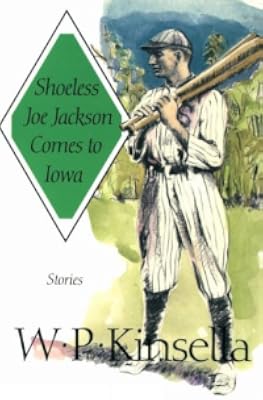
William Patrick Kinsella was born in Edmonton, Alberta, Canada on May 25, 1935. He received a bachelor of arts degree in creative writing at the University of Victoria in 1974 and a master of fine arts degree in English at the University of Iowa in 1978. Before becoming a full-time author, he was a professor of English at the University of show more Calgary. During his lifetime, he wrote approximately 30 books of fiction, nonfiction, and poetry. His first collection of baseball stories, Shoeless Joe Jackson Comes to Iowa, was published in 1980. In 1982, Kinsella expanded the stories into the novel Shoeless Joe, which was adapted into the 1989 movie Field of Dreams starring Kevin Costner and Ray Liotta. Shoeless Joe won the Canadian Authors Association Prize, the Alberta Achievement Award, the Books in Canada First Novel Award, and the Houghton Mifflin Literary Fellowship. His other novels included The Iowa Baseball Confederacy, The Further Adventures of Slugger McBatt, The Alligator Report, The Miss Hobbema Pageant, Magic Time, If Wishes Were Horses, Butterfly Winter, and Russian Dolls. He was made an Officer of the Order of Canada in 1993. He received the Order of British Columbia in 2005 and the George Woodcock Lifetime Achievement Award in 2009. He died of a doctor-assisted death on September 16, 2016 at the age of 81. (Bowker Author Biography) show less
Awards and Honors
Work Relationships
Has the adaptation
Has as a student's study guide
Common Knowledge
- Canonical title
- Shoeless Joe
- Original publication date
- 1982
- People/Characters
- Ray Kinsella; Shoeless Joe Jackson; Annie Kinsella; Karin Kinsella; Moonlight Graham; Eddie "Kid" Scissons (show all 7); J. D. Salinger
- Important places
- Iowa City, Iowa, USA; Iowa, USA; USA
- Related movies
- Field of Dreams (1989 | IMDb)
- Epigraph
- "Some men see things as they are, and say why. I dream of things that never were, and say why not."
--Bobby Kennedy - Dedication
- For Olive Kinsella and Margaret Elliott; for Ethel Anderson. In memory of John Matthew Kinsella (1896-1953)
- First words
- My father said he saw him years later playing in a tenth-rate commercial league in a textile town in Carolina, wearing shoes and an assumed name.
- Last words
- (Click to show. Warning: May contain spoilers.)Above the farm, a moon bright as butter silvers the night as Annie holds the door open for me.
- Canonical DDC/MDS
- 813.54
- Canonical LCC
- PR9199.3.K443
Classifications
Statistics
- Members
- 2,146
- Popularity
- 9,502
- Reviews
- 46
- Rating
- (3.99)
- Languages
- English, French, Italian, Japanese
- Media
- Paper, Audiobook, Ebook
- ISBNs
- 33
- UPCs
- 1
- ASINs
- 15