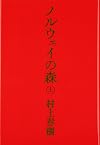
Norwegian Wood, Part 1
by Haruki Murakami
On This Page
Description
"At thirty-seven, Toru Watanabe at last feels ready to come to terms with a love affair that obsessed him in his student days. Almost twenty years before, he and his teenage lover Naoko battled the shadow of death that threatened to overtake them. As Naoko sinks deeper into the abyss of mental despair that will ultimately cost her her life, Toru is inexorably pushed to find new meanings and a new love in order to survive. This haunting love story, told with a relaxed, humorous style, is show more alive with the fumbling tenderness and confusion of youth. Amid the impersonality of today's society, the dilemmas of love and final reaffirmation of life touch deep-rooted chords, which is one reason for the novel's outstanding success in Japan." -- dust cover front flap show lessTags
Recommendations
















































Member Reviews
Norwegian Wood is the novel that turned Haruki Murakami into an internationally recognized force and his status is well deserved! It is the first book of his that I have read and I can’t wait to start another. It’s by far the best book I’ve read so far this year.
Norwegian Wood is a tragic melancholy coming of age novel set in Tokyo during the late 1960′s. There’s nothing overly complex about it. It’s just a love story with characters who grow into adulthood as they try to overcome too much tragedy in their lives. But Murakami is masterful at depicting his characters’ inner turmoils as they grope for emotional solutions to their problems. As I got deeper into the novel I found myself reading slower and slower, wanting to show more stay with the characters for as long as possible. I’m sure that years from now I will still remember Toru, Naoko, Midori, and Reiko–I will remember their struggles–with continuing endearment.
If you want to refresh your memory of this fantastic book or see if it piques your interest, I’ve written a plot summary for you to read: Norwegian Wood chapter summary & synopsis show less
Norwegian Wood is a tragic melancholy coming of age novel set in Tokyo during the late 1960′s. There’s nothing overly complex about it. It’s just a love story with characters who grow into adulthood as they try to overcome too much tragedy in their lives. But Murakami is masterful at depicting his characters’ inner turmoils as they grope for emotional solutions to their problems. As I got deeper into the novel I found myself reading slower and slower, wanting to show more stay with the characters for as long as possible. I’m sure that years from now I will still remember Toru, Naoko, Midori, and Reiko–I will remember their struggles–with continuing endearment.
If you want to refresh your memory of this fantastic book or see if it piques your interest, I’ve written a plot summary for you to read: Norwegian Wood chapter summary & synopsis show less
I had been recommended this book by most as Murakami's best work, so I believe I had over expectations and though the book was a good read, it certainly did not live upto my expectations. The book is definitely not the paradigm of Murakami's writing, it does have troubled characters searching for more meaning in life that is characteristic of Murakami, but the metaphysical and the metaphorical aspect is almost amiss in this novel. Even the usual reference to music is fleeting and limited to Beatles, the stalwarts like Beethoven etc are not discussed in this book. Everyone dies in the book at ages less than 20 and the ending is definitely a disappointment.
Certainly not the best Murakami, but nevertheless I feel the echo of the show more self-destructive spirit and loneliness of the characters ringing through my mind as I hum Norwegian Wood over and over again!! show less
Certainly not the best Murakami, but nevertheless I feel the echo of the show more self-destructive spirit and loneliness of the characters ringing through my mind as I hum Norwegian Wood over and over again!! show less
2008/11/18
文章楽しい。
文章楽しい。
Ratings
Members
- Recently Added By
Author Information

292+ Works 174,492 Members
Haruki Murakami was born on January 12, 1949 in Kyoto, Japan and studied at Tokyo's Waseda University. He opened a coffeehouse/jazz bar in the capital called Peter Cat with his wife. He became a full-time author following the publication of his first novel, Hear the Wind Sing, in 1979. He writes both fiction and non-fiction works. His fiction show more works include Norwegian Wood, Colorless Tsukuru Tazaki and His Years of Pilgrimage, The Strange Library, and Men Without Women. Several of his stories have been adapted for the stage and as films. His nonfiction works include What I Talk About When I Talk About Running. He has received numerous literary awards including the Franz Kafka Prize for Kafka on the Shore, the Yomiuri Prize for The Wind-Up Bird Chronicle, and the Jerusalem Prize. He has translated into Japanese literature written by F. Scott Fitzgerald, Raymond Carver, Truman Capote, John Irving, and Paul Theroux. (Bowker Author Biography) show less
Some Editions
Series
Belongs to Publisher Series
Work Relationships
Is contained in
Common Knowledge
- Canonical title
- Norwegian Wood, Part 1
- Original publication date
- 1987
- Disambiguation notice
- This is book 1 of an edition of Norwegian Wood published in two parts. Do not combine with the regular, single volume edition.
Classifications
- Genres
- Fiction and Literature, General Fiction
- DDC/MDS
- 895.635 — Literature & rhetoric Literatures of other languages Literatures of East and Southeast Asia Japanese Japanese fiction 1945–2000
- LCC
- PL856 .U673 .N67 — Language and Literature Languages and literatures of Eastern Asia, Africa, Oceania Languages of Eastern Asia, Africa, Oceania Japanese language and literature Japanese literature Individual authors and works
Statistics
- Members
- 196
- Popularity
- 166,995
- Reviews
- 3
- Rating
- (3.91)
- Languages
- English, Japanese
- Media
- Paper, Audiobook
- ISBNs
- 6
- ASINs
- 2