Building on Nature: The Life of Antoni Gaudi
by Rachel Victoria Rodriguez
On This Page
Description
Inspired by the natural beauty of his homeland of Catalonia, Antoni Gaudi became a celebrated and innovative architect through the unique structures he designed in Barcelona, having a significant impact on architecture as it was known.Tags
Recommendations






Member Reviews
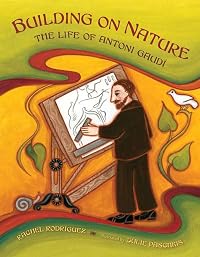
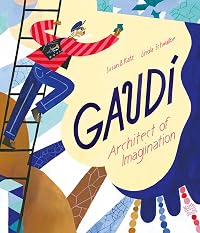
The illustrations in this book are vivid and very detailed. Antoni Gaudi's style of architecture was unlike anything people had seen before. His ability to incorporate elements of nature into the structures of buildings was very imaginative. "His daring creations speak for him. They tell his stories. They are Gaudi's poem to the world." If the structures of his buildings wasn't impressive enough the way he decorated his creations was, having mosaicked the majority of surfaces. I believe this book could spark a child's interest in not only architecture but also the beauty of nature. Using Gaudi as an example, children can learn to value their imagination and become willing to think outside of the box.
After reading the very first page, one sees vivid color and beauty from words alone. It is made as plain as day that Antoni Gaudi found his passion in nature early in life while other children used their energies to run and play. Through this zeal, Gaudi became an architect like no other. Following his imagination, he constructs works of art, seemingly from a child's dream. Following along with each page, the script of what is appears to be an illusion. Despite occasional mockery, Gauti pushes on with his dreams and creates architectural masterpieces that should be seen rather than read about.
This beautifully illustrated book tells the story of Spanish artist and architect Antoni Gaudi's unconventional life in a simple, narrative fashion. The colorful, whimsical illustrations recall Gaudi's own creations, but they are not so close that they are seen as imitations. An author's note in the back gives more detail about Gaudi, and a short bibliography appears below it. Interestingly, the author also lists a series of websites with photographs of Gaudi's buildings-- an excellent idea. This is a great book to expose younger readers (PK-2) to nonfiction and basic research while still entertaining them with an illustrated story. This competes well with other well-written, excellently illustrated biographies for children, such as show more those by Jeanette Winter, for example. show less
This book details the life of Antonio Gaudi from Catalonia, Spain who later went on to become and architect. The book is appealing to children as they are learning about another culture and seeing how a little boy's disabilities do not keep him down. That is, Gaudi as a child could not run and play like the others. While sitting he takes time to develop his awareness of everyday life and the colors and forms of the Mediterranean Sea area around him. His early influences include his parents who are metal smiths. He sees how you are able to bend metal into shapes. Later we see through his architecture that he is seemingly able to bend curves into buildings that are usually straight. We also see that he gets stronger as he ages and loves show more to explore old buildings. Guadi travels to the town of Barcelona to become an architect and he studies on his own. He becomes a part of society and designs things for himself and others before moving onto houses. We see that he pays attention to detail that maybe others would miss. Gaudi is able to problem solve through using models.I think the book is interesting. The illustrations at times take on a life of their own. That is, scales seem off and this combined with the curves can be a bit confusing as the baseline from one side to the other seems off or askew. However I do like how there is a line which seems to connect the left side of the page to the right so there is a sense of movement which may very well mirror the movement of his life. At first Gaudi's work is shunned as it is different from what others are used to. Then, in the section on Park Guell where his work is more accepted, the two pictures flow into each other in his vision of Catalonia. We also see the use of what looks like Venetian tile on the illustration of the mosaic lizard. I love mosaic and I think that this is a good way to introduce another art form to children. He can be seen as a model of persistence as he spent years working on his Holy Family Church. show less
This book is the story of Antoni Gaudi, an architect from Spain. It tells how Gaudi came to create buildings that imitated things he saw in nature.I had never heard of Gaudi or any of his buildings, so the whole book was new information for me. I liked the simplicity of the text and way the author shows how Gaudi’s work evolves and grows, how he tries ideas no one has ever tried before. An author’s note, a list of photos available online, and a bibliography in the back adds more information about Gaudi for those who are interested in learning more.A bit:“He designs a gate for his friend Guell’s country home.A dragon perches atop diamonds and squares, baring his fangs and slithery tongue. Gaudi’s creations get show more braver.”Children’s comments:Children always surprise me. The group of first graders who looked through this book loved it. They liked the buildings Gaudi made. They rated this book mostly 5’s and 3’s, with a couple of 1’s. show less
For some reason I could not really get into this book. The story of Antoni Gaudi did not appear to be a boring one. His life was exciting and he was a brilliant architect and artist. However, the writing did not draw me in--what did was the amazing and stunning paintings of Gaudi and his work.
This book teaches us about Antoni Gaudi, a famous architect from Catalonia. When Gaudi was a little boy he fell ill a lot, and his bones were weak which did not allow him to play as much as his two siblings. But Gaudi observed all the nature around him, and when he got older he went to Barcelona to become an architect. Gaudi would make beautiful structures and everyone was so interested in his work. His architecture was not like normal architects, they included curving ramps and animal like structures. We learn that as Gaudi got older, he worked last on his church in Barcelona. The church is one of the main sites to see in Barcelona even today. We learn that Gaudi’s work is very much appreciated even after his death. I think this book show more did a great job at describing his work and the illustrations really grabbed my attention. Over all I think this book did a good job in showing how good and well known Antoni Gaudi’s work was and still is. show less
Members
- Recently Added By
Lists

A Child's Book Tour of Spain
26 works; 2 members

One Picture Book Per Country
206 works; 1 member
Author Information
3 Works 330 Members
Awards and Honors
Classifications
Statistics
- Members
- 122
- Popularity
- 267,913
- Reviews
- 11
- Rating
- (3.62)
- Languages
- English
- Media
- Paper
- ISBNs
- 1
- ASINs
- 1