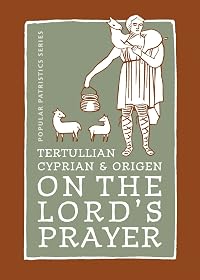
Tertullian, Cyprian, and Origen on the Lord's Prayer
by Alistair Stewart-Sykes, Saint Cyprian, Bishop of Carthage, Origen, Tertullian
Popular Patristics (29)
203 Members (4.33)
On This Page
Description
"These are the only three existing ante-Nicene treatises on the Lord's Prayer, and they became the starting point for many other commentaries. Of the three, however, only the discourse of Cyprian is an address to catechumens. Tertullian's treatise contains additional material on the conduct of worship and on prayer in the assembly, and Origen's commentary is a vast work on the whole subject of prayer, as much suited to advanced learners in the school of Christ as to those preparing for show more baptism."--Jacket. show lessTags
Recommendations








Member Reviews
Members
- Recently Added By
Author Information
13+ Works 404 Members
Alistair Stewart-Sykes is well-known in the field having produced, the first critical text for over a century of the Apostolic church order and the first full-length commentary on the Apostolic tradition.

118+ Works 1,390 Members
Cyprian was born and educated in traditional Roman religion. Two years after his conversion in 246, he became bishop of Carthage, the provincial capital. Beginning in 250, his diocese was faced with the Decian persecutions (250--251). Cyprian fled the city, subjecting himself to intense criticism and ruled his diocese from exile. During his show more absence many Christians lapsed from their faith, and many more obtained libelli pacis libelli pacis, government-issued certificates stating that they had sacrificed to the Roman divinities to avoid punishment. Much of Cyprian's extant correspondence deals with the reconciliation between the church and these lapsi (apostates). Critical issues included the necessity for re-baptism and the status of reconciled clergy. The most important principle was that a cleric who had apostatized was regarded as not in communion with the larger church and could not baptize or ordain. This issue was to haunt Christianity in North Africa and in Egypt (a separate Roman province) and lead to the Donatist and Melitian schisms, in their respective provinces, in the fourth and fifth centuries. Cyprian's intransigence regarding unity with the church led to his dictum: "Outside the Church there is no salvation." During the Valerianic persecutions in 258, he was martyred at Carthage. His writings are known for their attention to martyrs, ministry, and the sacraments. (Bowker Author Biography) show less

128+ Works 2,986 Members
Origen is the foremost member of the School of Alexandria, the first school of genuinely philosophical Christian theology. His Platonism is of an older form, uninfluenced by the Neoplatonism of Plotinus, so his philosophy is quite distinct from that of Augustine of Hippo on a number of issues, but especially on the issue of original sin and show more freedom of will and on the justification of God's permitting evil in the world. Origen became a center of controversy because of his contention that even the Devil would in the end return to God, and he seems to have held that a person enjoys as many successive lives on earth as are needed to return to God after the Fall. However, all matters concerning the interpretation of his thought are controversial. The other members of the school are Clement of Alexandria (c.150-c.213) and Irenaeus of Lyons (died c.202). (Bowker Author Biography) show less

175+ Works 1,849 Members
Tertullian, a convert to Christianity, lived and wrote in the North African city of Carthage. Although he never held a clerical post, his influence on Christianity, especially in the West, was enormous. His writings include apologetic, theological, controversial, and ascetic works. He never shied away from discoursing against those he believed to show more be expounding against the "rule of faith." He is the first major Christian author to write in Latin and to provide Latin terminology for trinitarian theology. Tertullian's theological interests centered around his concern for the purity and holiness of the church. The importance of these issues eventually led Tertullian to join the Montanist sect, which emphasized the immediacy of the spirit, ecstatic prophecy, and a moral strictness. (Bowker Author Biography) show less
Series

Common Knowledge
- Canonical title
- Tertullian, Cyprian, and Origen on the Lord's Prayer
Classifications
Statistics
- Members
- 203
- Popularity
- 161,777
- Rating
- (4.33)
- Languages
- English
- Media
- Paper
- ISBNs
- 1
- ASINs
- 1