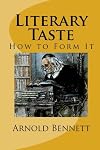
Literary Taste: How to Form It With Detailed Instructions for Collecting a Complete Library of English Literature
by Arnold Bennett
On This Page
Description
Many people would like to be well-read, but without formal instruction, it can be difficult to know where to start. In this volume, Arnold Bennett provides a comprehensive how-to guide to help non-experts become insightful, skilled readers of literary texts. In addition, Bennett offers a number of suggestions about where to begin when tackling the classics and other works of canonical literature..
Tags
Recommendations


























Member Reviews
A short and sweet commentary on how to develop yourself as a literary reader, Arnold Bennett's 1909 book Literary Taste manages quite a feat: it makes the case for high-brow attainment and literary standards without being condescending or snobby, and remains thoroughly amiable and approachable throughout.
It is, of course, outdated – not only in some of its selections (Bennett advocates heavily for the writings of the long-eclipsed Charles Lamb) but in its determination to provide a practical guide for contemporary readers, including a catalogue of various titles and editions and their retail price (in shillings and d, no less). But alongside this, Bennett outlines his persuasive impressions and perspectives on how to approach show more literature, and the only point I could dispute with him is his argument that "if you differ with a classic, it is you who are wrong" (pg. 50), because there are some classics which survive through mere complacency. It is, nevertheless, a good rule of thumb, and the book as a whole is astute in its observations. It also provides as good a description of what constitutes 'taste' in a reading man as can be asked for:
"They find a keen and lasting pleasure in literature. They enjoy literature as some men enjoy beer. The recurrence of this pleasure naturally keeps their interest in literature very much alive. They are for ever making new researches, for ever practising on themselves. They learn to understand themselves. They learn to know what they want. Their taste becomes surer and surer as their experience lengthens. They do not enjoy to-day what will seem tedious to them to-morrow. When they find a book tedious, no amount of popular clatter will persuade them that it is pleasurable; and when they find it pleasurable no chill silence of the street-crowds will affect their conviction that the book is good and permanent. They have faith in themselves." (pp37-8)
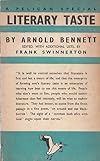
Developing individual taste in literature is not to merely divert yourself for an hour or two in a book, Bennett explains; "it is not to affect one hour, but twenty-four" (pg. 20) and it is something that, once developed, has far greater benefits for your perspective beyond which books you choose to read. "In short, look at literature as you would look at life" (pg. 77), and with application you find you have not only improved your literary taste but your perspective on your life. Bennett's book is a quietly impactful commentary with some good turns of phrase and a pleasant worldview, and despite its age remains a decent primer for those who might wish to begin thinking seriously about literature. For a catalogue price of 6 d in its 1938 edition, you can't go wrong. show less
It is, of course, outdated – not only in some of its selections (Bennett advocates heavily for the writings of the long-eclipsed Charles Lamb) but in its determination to provide a practical guide for contemporary readers, including a catalogue of various titles and editions and their retail price (in shillings and d, no less). But alongside this, Bennett outlines his persuasive impressions and perspectives on how to approach show more literature, and the only point I could dispute with him is his argument that "if you differ with a classic, it is you who are wrong" (pg. 50), because there are some classics which survive through mere complacency. It is, nevertheless, a good rule of thumb, and the book as a whole is astute in its observations. It also provides as good a description of what constitutes 'taste' in a reading man as can be asked for:
"They find a keen and lasting pleasure in literature. They enjoy literature as some men enjoy beer. The recurrence of this pleasure naturally keeps their interest in literature very much alive. They are for ever making new researches, for ever practising on themselves. They learn to understand themselves. They learn to know what they want. Their taste becomes surer and surer as their experience lengthens. They do not enjoy to-day what will seem tedious to them to-morrow. When they find a book tedious, no amount of popular clatter will persuade them that it is pleasurable; and when they find it pleasurable no chill silence of the street-crowds will affect their conviction that the book is good and permanent. They have faith in themselves." (pp37-8)
Developing individual taste in literature is not to merely divert yourself for an hour or two in a book, Bennett explains; "it is not to affect one hour, but twenty-four" (pg. 20) and it is something that, once developed, has far greater benefits for your perspective beyond which books you choose to read. "In short, look at literature as you would look at life" (pg. 77), and with application you find you have not only improved your literary taste but your perspective on your life. Bennett's book is a quietly impactful commentary with some good turns of phrase and a pleasant worldview, and despite its age remains a decent primer for those who might wish to begin thinking seriously about literature. For a catalogue price of 6 d in its 1938 edition, you can't go wrong. show less
Literary taste is no small thing for Arnold Bennett. It is, in brief, the capacity to experience the miraculous: the capacity to do no less than live. For those who look upon literature as a duty or as an attainment attendant upon being a cultured person, he has some little pity, but also much contempt. And yet, as he acknowledges in his first chapter, such people likely comprise the majority of the readership of this volume. How he is able to express these sentiments while retaining the interest and sympathy of his reader is a feat not unworthy of Chaucer's Pardoner.
Beautifully written, although sometimes the author holds somewhat arrogant notions regarding literature and the people who enjoy reading it. This is a good read if you want to feel a cultivated, erudite person. Also very suitable for people who want to impress their high school teachers. Made me laugh out loud a few times as well; read the first part of the chapter on poetry if you want to know what I mean.
I spotted this short little book on the shelves at our library and thought it would be an interesting read. There is no copyright date, but the type of paper used and the typeface hint that it was probably published between 1900 and 1920. I did find a 1909 bibliographic record for this work, so it's probably in the earlier part of the period. It was an interesting perspective to say the least. I loved some of the author's advice. He's given me the perfect excuse to go on a book-buying spree. On page 20, he advises his readers to "buy." He says, "Buy without any immediate reference to what you will read. Buy! Surround yourself with volumes, as handsome as you can afford." Later in the book he tells them (on page 88) to "Buy a library. It show more is obvious that you cannot read unless you have books . . . The moment has now come to inform you plainly that a bookman is, amongst other things, a man who possesses many books. A man who does not possess many books is not a bookman." The author does caution the reader against reading too much of the same kind of stuff. He encourages the reader to read short stories, essays, and poetry in addition to longer fictional works. He encourages the reader to read materials from all periods of literature, beginning with Chaucer and extending to the recently deceased. He does not have time to read contemporary literature, preferring to read what is tried and true. He gives a bibliography of 226 authors and 335 volumes which everyone should own. All of these can be had for the low price of $131.40 (12 cents per day for 3 years)! (If that were only true for us today!) I wonder what the author would think of Kindles and Nooks? While this book is extremely dated, it was an entertaining read. show less
Bennett's writing is excellant, but the book is dated inasmuch as today's education, excuse me, "education" attempts are concerned. He uses Charles Lamb as a beginner or primer author to read. Today it would probably be J R. Rowling and Harry Potter. The sanguine tedium that constitutes the 18th and early 19th century just isn't read anymore. I keep it in my library as a treasure of book-making more than the content.
Ratings
Members
- Recently Added By
Author Information

193+ Works 6,838 Members
Arnold Bennett was born on May 27, 1867 in Hanley, Staffordshire, England. He began his working career as a law clerk and later he left the legal field and became an editor for the magazine Woman. His first novel was "A Man from the North." He wrote several novels set in Hanley, the town where he was born. These are known as the Five Town novels. show more Other titles include "The Babylon Hotel," "The Truth about an Author," and "How to Live on 24 Hours a Day." Bennett won the 1923 James Tait Black Memorial Prize for his novel "Riceyman Steps." "The Journal of Arnold Bennett" was published posthumously in three volumes. Bennett was also the author of "Hugo" which was made into a major motion picture in 2011 starring Jude law and Ben Kingsley, directed by Martin Scorsese. During WWI, Bennett was Director of Propaganda for France at the Ministry of Information. (At that time "propaganda" did not have the negative connotations it would have later in the twentieth century.) This appointment was based on the recommendation of Lord Beaverbrook, who also recommended him as Deputy Minister of that department at the end of the war. Bennett refused a knighthood in 1918. He died in London of typhoid fever on March 27, 1931. (Bowker Author Biography) show less
All Editions
Series
Belongs to Publisher Series
Penguin Special (S11)
Common Knowledge
- Original publication date
- 1909
- First words
- At the beginning a misconception must be removed from the path.
- Last words
- (Click to show. Warning: May contain spoilers.)But it does not shake my conviction that the absence of meditation is the main origin of disappointing stocktakings.
Classifications
Statistics
- Members
- 153
- Popularity
- 213,992
- Reviews
- 5
- Rating
- (3.42)
- Languages
- English, Russian
- Media
- Paper, Audiobook, Ebook
- ISBNs
- 36
- ASINs
- 22