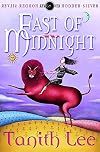
East of Midnight
by Tanith Lee
On This Page
Description
Having exchanged identities, a ruler's consort and a slave discover they seem doomed to die in their new roles.Tags
Recommendations




















Member Reviews
Dekteon is a red-haired slave who is beaten and told he will be sold to the mines, which is a death sentence, for the 'crime' of riding his master's horse in a bit of rebellion possibly egged on by an old slave who appears from time to time. But then the old slave arranges for Dekteon to escape and tells him where to run, a route that takes him through a portal into a strange in-between place, in a scene a little bit reminiscent of the first Witch World novel by Andre Norton.
Once there, a pale and expressionless being advises that his master awaits, and takes Dekteon in a cart drawn by a strange horse with bear-like feet to a ruined mansion where he meets the master - Zaister, who looks remarkably like himself but is an obvious show more sorcerer. He is given the job of night watchman, despite his initial resistance, and has a number of strange and disturbing encounters. And then he finds out what Zaister has in mind for him ....
This very short book was published in the Puffin imprint in the UK, which is for older children - I suppose what would be termed teen now. It sticks to that brief - although at one point a sexual relationship between married people is portrayed, it is done very subliminally and decorously. To begin with, it is very intriguing and I especially liked the carnivorous sheep which have a great depiction, by Bridie Page, on the back cover of the UK edition. One sequence where Dekteon is driven by malevolent bunnies (!) which prevent him from running by constantly tripping him up, and is pursued by the sheep is nicely creepy.
Unfortunately, when Dekteon is sent to the world where Zaister wants him to fulfil his role as a substitute sacrifice , the story rapidly goes downhill. The female-dominated world he finds himself in is unconvincing. The men there work as artisans or even guardsmen, but are shown as not "real men" compared to the manly Dekteon who sets about single-handedly overturning the basis of the local religion by being smarter than the women. He is aided by the absorption of Zaister's abilities since he is actually in Zaister's body through a sort of soul-transfer, just as Zaister begins to lose his abilities due to suffering Dekteon's illiterate and uneducated state .
Not only is it all a bit of a simplistic tale of gender stereotypes, but unless the reader is to believe that Zaister undergoes complete reprogramming during the few days he later spends with Dekteon, his character is completely inconsistent. Despite being shown to be in such awe and fear of womenthat he caves in when he falls into the clutches of an unscrupulous woman and her two male helpers when trying to escape in Dekteon's body , by the end Zaister is questioning why Dekteon would not want to continue to, among other things, "have my woman". The whole basis of his character is that, for Zaister, this is literally unthinkable - for a start, the woman in question is his King. As well as being raised as one of the subservient gender, he is his wife's social inferior, so this jarred greatly. But it is all in keeping with a sort of male solidarity which takes over once Dekteon shows his big-heartedness towards the other man; not that convincing in view of the circumstances. It was rather a shame that a female-led society is shown as bound by superstition and the kind of stiff upper lip behaviour exhibited by men during the Victorian/Edwardian era in Britain, but here shown by women who are 'crying inside'.
To summarise then, this book had great early promise - more of the carnivorous sheep and spiteful rabbits would have been very welcome - but was derailed by a cliched and gender-stereotyped storyline. For that reason, I can only give it two stars, one of them being for the sheep, rabbits and great cover. show less
Once there, a pale and expressionless being advises that his master awaits, and takes Dekteon in a cart drawn by a strange horse with bear-like feet to a ruined mansion where he meets the master - Zaister, who looks remarkably like himself but is an obvious show more sorcerer. He is given the job of night watchman, despite his initial resistance, and has a number of strange and disturbing encounters. And then he finds out what Zaister has in mind for him ....
This very short book was published in the Puffin imprint in the UK, which is for older children - I suppose what would be termed teen now. It sticks to that brief - although at one point a sexual relationship between married people is portrayed, it is done very subliminally and decorously. To begin with, it is very intriguing and I especially liked the carnivorous sheep which have a great depiction, by Bridie Page, on the back cover of the UK edition. One sequence where Dekteon is driven by malevolent bunnies (!) which prevent him from running by constantly tripping him up, and is pursued by the sheep is nicely creepy.
Unfortunately, when Dekteon is sent to the world where Zaister wants him to fulfil his role
Not only is it all a bit of a simplistic tale of gender stereotypes, but unless the reader is to believe that Zaister undergoes complete reprogramming during the few days he later spends with Dekteon, his character is completely inconsistent. Despite being shown to be in such awe and fear of women
To summarise then, this book had great early promise - more of the carnivorous sheep and spiteful rabbits would have been very welcome - but was derailed by a cliched and gender-stereotyped storyline. For that reason, I can only give it two stars, one of them being for the sheep, rabbits and great cover. show less
Barbarian rebellious slave, fleeing for his life, swapped with a magic-worker from another reality, fleeing his pre-ordained death as consort to the female ruler of a female warrior society. About like you'd expect. Why this ever ended up in the MagicQuest series? This is old-school hard fantasy. (Obviously, this isn't to my taste.) The mechs are pretty cool though.
This novella was lacking for me. There was very little world building and it was fairly sexist. Basically a typical ye-olde-y time that Dekteon lived in and a ye-olde-y time with magic and hybrid animals and woman kings that Zaister lived in.
D and Z switch lives and D is puzzled and somewhat disgusted that women hold power (cuz, you know, they're supposed to be submissive property) so he decides to just be manly and powerful and do the opposite of what the women tell him to do.
So basically the women only hold power because the men never thought to argue that point???
In the end, I didn't get the message Tanith was trying to send. I didn't care about any of the characters (except the horned lions the women rode like horses), though I do show more think Izvire is a sweet name.
I read this in about 3 hours, and Tanith is bae and I want to read all her work, so I'm not mad. But I wouldn't recommend this to the casual fan. show less
D and Z switch lives and D is puzzled and somewhat disgusted that women hold power (cuz, you know, they're supposed to be submissive property) so he decides to just be manly and powerful and do the opposite of what the women tell him to do.
So basically the women only hold power because the men never thought to argue that point???
In the end, I didn't get the message Tanith was trying to send. I didn't care about any of the characters (except the horned lions the women rode like horses), though I do show more think Izvire is a sweet name.
I read this in about 3 hours, and Tanith is bae and I want to read all her work, so I'm not mad. But I wouldn't recommend this to the casual fan. show less
Ratings
Members
- Recently Added By
Talk Discussions
Past Discussions
magic+2 parallel worlds+women in power in Name that Book (August 2013)
Author Information

322+ Works 29,803 Members
Tanith Lee, September 19, 1947 - May 24, 2015 Tanith Lee was born on September 19, 1947 in London, England, the daughter of ballroom dancers. She attended various primary schools and had a variety of jobs, from file clerk and assistant librarian to shop assistant and waitress. Lee attended an art college for one year, but felt she would be better show more writing her ideas than painting them. Her first professional sale was "Eustace," a 90 page vignette which appeared in The Ninth Pan Book of Horror Stories in 1968. While Lee was working as an assistant librarian, she wrote a children's story that was accepted for publication. Others of her stories were also bought but never published. In 1971, Macmillan published "The Dragon Hoard," another children's book, which was followed by "Animal Castle" and "Princess Hynchatti and Other Stories" in 1972. Lee was looking for a British publisher for her book "The Birthgrave," but was denied at every House she went. She then wrote to American publisher DAW, known for it's fantasy and horror selections, who immediately accepted her manuscript and published the book in 1975. Thus began a partnership between the two that lasted till 1989 and resulted in 28 books. After the publication of her third book by DAW, Lee quit her job and became a full-time freelance writer. Lee has been nominated for the World Fantasy Award, the August Derleth Award and the Nebula. She has had more than 40 novels published, along with over 200 short stories. Lee died peacefully in her sleep after a long illness on May 24, 2015. (Bowker Author Biography) show less
Some Editions
Series
Belongs to Publisher Series
Heyne Phantasia Märchenwelt der Fantasy (06/4119)
Magic Quest (15)
Heyne Science Fiction & Fantasy (06/4119)
Common Knowledge
- Canonical title*
- Östlich von Mitternacht
- Original title
- East of Midnight
- Original publication date
- 1977
- Original language*
- Englisch
*Some information comes from Common Knowledge in other languages. Click "Edit" for more information.
Classifications
- Genres
- Fiction and Literature, Fantasy, Young Adult
- DDC/MDS
- 823.914 — Literature & rhetoric English & Old English literatures English fiction 1900- 1901-1999 1945-1999
- LCC
- PZ7 .L5149 .E — Language and Literature Fiction and juvenile belles lettres Fiction and juvenile belles lettres Juvenile belles lettres
- BISAC
Statistics
- Members
- 207
- Popularity
- 157,356
- Reviews
- 3
- Rating
- (3.57)
- Languages
- Dutch, English, German
- Media
- Paper, Ebook
- ISBNs
- 9
- ASINs
- 2